
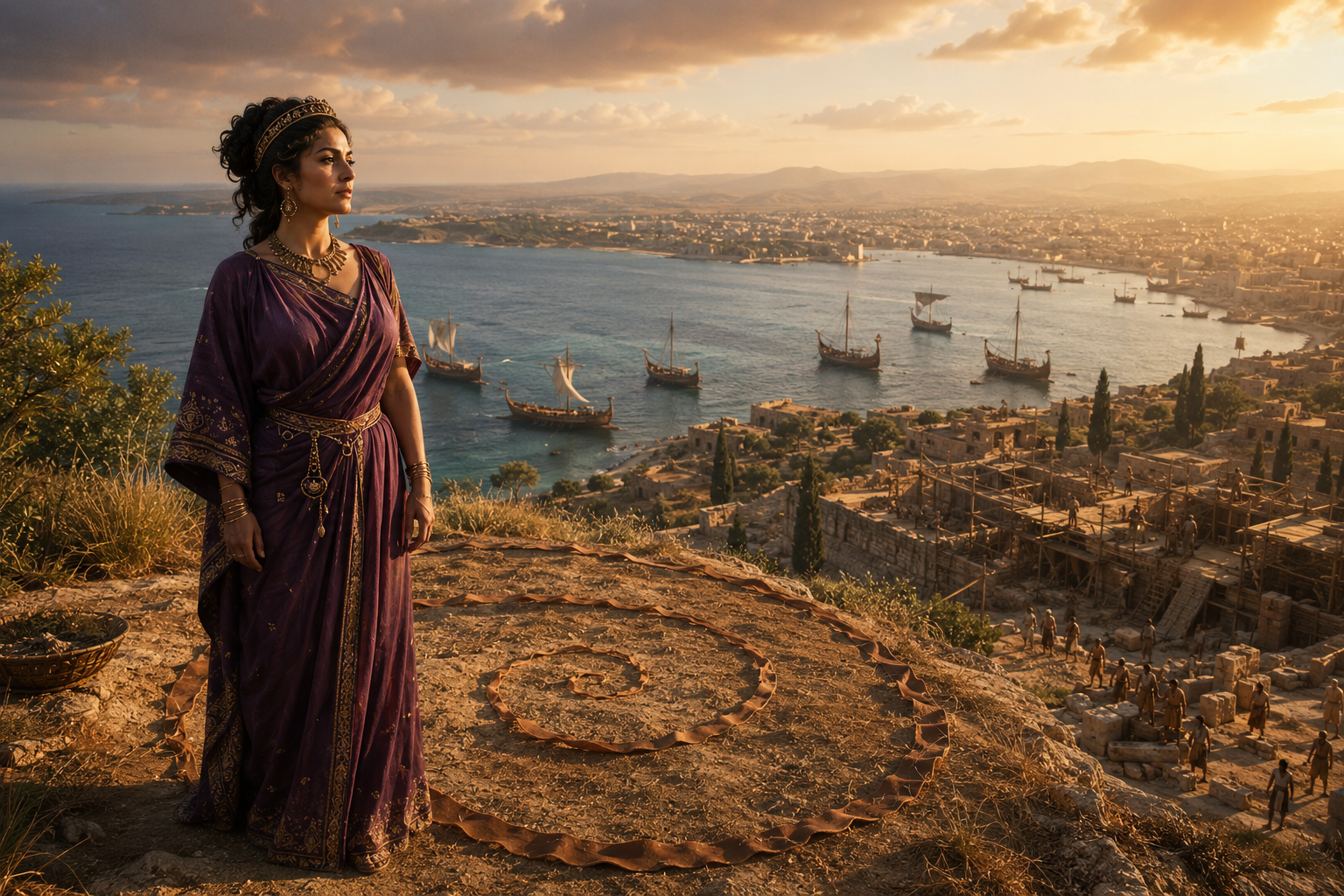
Climb to the top of Byrsa Hill on a clear afternoon and the whole story is laid out below you. The bay curves away to the north, blue and patient. Cargo ships sit at anchor where Phoenician galleys once unloaded purple dye and Spanish silver. The ruins of the city run downhill toward the water in broken terraces, and somewhere under the foundations of a French cathedral and a Roman forum and a Punic citadel is the spot where, the story goes, a woman once spread an oxhide on the ground and changed the map of the Mediterranean.
Her name was Elissa. History would come to call her Dido — “the wanderer” — and the city she founded on this hill would grow into a power that frightened Rome for six hundred years. We have a museum named for her general and a goddess whose sign is still drawn across the country, but the woman who started all of it has somehow slipped out of the popular telling. She deserves better. This is the story of the queen who built Carthage, the legend that grew up around her, and the strange, stubborn ways the truth still pokes through.
The Princess of Tyre
She was born a princess of Tyre, the greatest of the Phoenician city-states, on the coast of what is now Lebanon. Her father was the king — most sources call him Belus — and when he died, the throne was meant to pass jointly to Elissa and her younger brother, Pygmalion.
It did not. Pygmalion took the crown for himself, and the city, weary or frightened, let him keep it. Elissa, by then, had married a man named Sychaeus — also called Acerbas — a priest of the god Melqart and one of the wealthiest men in Tyre. That wealth was his death sentence. Pygmalion, the ancient writers agree, murdered his brother-in-law for his gold, killing him at the altar and then concealing the crime from his sister for as long as he could.
The Phoenicians were the great traders of the ancient world, a people who turned the whole Mediterranean into a network of ports and colonies and trade routes long before Rome was anything more than a cluster of huts on a hill. Elissa came from that seafaring, calculating, mercantile culture. When the time came to save herself, she would act like it.
The Flight
The truth came to her, the legend says, in a dream. The ghost of Sychaeus appeared to her with a face of unnatural pallor, showed her the wound in his chest, named his murderer — and told her where his gold was hidden. Then he told her to run.
She ran. But she ran the way a queen runs. Elissa gathered the nobles of Tyre who had no love for her brother, and she devised a trick to get her husband’s treasure past Pygmalion’s men: she loaded the chests onto the ships, then, in front of the king’s agents, threw sacks overboard while declaring she was casting the cursed gold into the sea to be rid of it. The sacks held sand. The gold stayed aboard. By the time anyone understood, the ships were gone.
Her route west reads like a map of the Phoenician world. She stopped in Cyprus, where she took on a priest of the goddess Astarte and, in one telling, eighty young women to become brides for her followers — a founder thinking, already, about the next generation. Then she pointed the fleet at North Africa, toward a coast the Phoenicians already knew well, near the established colony of Utica. There she went ashore and asked the local Berber people for a small thing: just enough land to rest on.
The Oxhide Bargain
The local chieftain — later writers name him Iarbas — made what he thought was a clever, stingy offer. Elissa and her people could have as much land as a single oxhide would cover.
It was meant to be an insult dressed as generosity. A hide covers a patch of ground a person could lie down on. He had reckoned without a Tyrian merchant’s instinct for the fine print.
Elissa had the oxhide cut into strips so thin they were almost thread, knotted end to end into one impossibly long cord, and with it she encircled the entire hilltop. The chieftain, bound by his own word, had to honor the bargain. The hill became hers, and it kept the memory of the trick in its name: the Greeks called it Byrsa, from their word for oxhide, and Byrsa Hill is what the citadel of Carthage was called for the rest of its existence.
It is the kind of story that sounds too neat to be true, and parts of it almost certainly are folklore. But it has survived for twenty-eight centuries because it captures something real about the people who told it — a civilization that prized cleverness, negotiation, and the well-turned deal over brute force. The Carthaginians would spend their whole history preferring to buy, bargain, and outwit rather than conquer. Their founder, in the legend, did it first.
The City Called “New”
What rose on that hill was named, with the plainness of people who expected it to last, Qart-hadasht — “New City.” Time and Latin and a hundred retellings wore the name down into the one we use now: Carthage.
It did not stay small. From that single hilltop, Elissa’s Punic civilization grew into a commercial empire that ringed the western Mediterranean — Sicily, Sardinia, the Spanish coast, the Atlantic edge of Morocco. Its harbors were engineering marvels. Its navy was the finest afloat. Its merchants reached places Greek and Roman sailors only told stories about. The city the wanderer founded became, within a few centuries, the city that rivaled Rome — and it produced, in Hannibal Barca, the general who would come closer than anyone in antiquity to bringing Rome to its knees.
Elissa would not live to see any of it. Her own story ends almost as soon as the city begins.
The Death on the Pyre
Carthage thrived, and a thriving city with an unmarried queen drew attention. Iarbas — the same Berber king who had been outwitted over the oxhide — sent word that he wished to marry Elissa, and made it clear that refusal would mean war for her young city.
In the oldest version of the legend, the one told long before the Romans got involved, Elissa is trapped between two loyalties: her duty to protect Carthage, and a vow she had made never to remarry after Sychaeus. She asked Iarbas for time. She told her people she would perform a ritual to release herself from her old marriage so she could enter a new one. She had a great pyre built, as if for a sacrifice.
Then she climbed it, drew a sword, and chose death over a marriage that would have cost her either her city or her word. She died to keep both. In the earliest tradition, this is an act of supreme political loyalty — a founder who would not let her city be bargained away, not even to save her own life.
It is worth holding onto that version, because the more famous one buried it.
Then Virgil Got Hold of Her
Eight centuries after Carthage was founded, a Roman poet named Virgil sat down to write an epic glorifying the origins of Rome — and he needed a villain’s origin, too. He reached for Dido.
In the Aeneid, the queen of Carthage falls catastrophically in love with Aeneas, the Trojan prince fleeing the ruins of Troy, who washes up on her shore. She gives him her bed and very nearly her kingdom. Then the gods order him onward to found the Roman race, and he sails away in the night. Dido, abandoned, builds her pyre, climbs it, and falls on his sword — but not before cursing his descendants and calling for “an avenger” to rise from her bones. The curse, Virgil’s Roman readers understood at once, was Hannibal, and the wars her grief set in motion were the Punic Wars.
It is a magnificent piece of writing and a complete fabrication. Aeneas, if he existed at all, would have lived some four hundred years before Elissa; the two could never have met. Virgil took a founder-queen who died defending her independence and rewrote her as a woman destroyed by love for the ancestor of her enemies — turning Carthage’s strength into a story about Carthage’s weakness, conveniently authored by Rome. It is one of history’s great character assassinations, and it is the version most of the world still knows.
The older Elissa — the one who tricked her brother, outwitted a king, and died for her city rather than her heart — is the one worth remembering.
What History Actually Knows
So how much of this is real?
More than you might expect. The Greek historian Timaeus, writing in the third century BCE, dated the founding of Carthage to 814 or 813 BCE and named Elissa, sister of Pygmalion, as its founder. The first-century historian Josephus independently cites a Tyrian king-list — preserved by an earlier writer, Menandros of Ephesus — that includes a King Pygmalion and a sister who founded a city overseas in the seventh year of his reign. Two separate traditions, drawing on Phoenician records now lost, point to the same brother, the same sister, the same flight.
The archaeology fits, roughly. Excavations at Carthage have so far turned up no clear evidence of settlement before the last quarter of the eighth century BCE — which lines up neatly with the legendary date. Whether a single charismatic queen really led the founding party, or whether “Elissa” is a folk-memory of a more gradual colonization, no one can say for certain. But a historical woman named Elissa, sister of a real Tyrian king, leading settlers west to found a real city at very nearly the traditional date, is entirely plausible. The oxhide and the ghost and the pyre are the embroidery. The thread underneath may well be true.
Dido’s Theorem: The Queen Who Solved a Maths Problem
There is a final, unexpected place where Elissa lives on — not in a museum or a poem, but in mathematics.
The oxhide trick poses a genuine geometric question: given a fixed length of cord, what shape encloses the largest possible area? Elissa, in the legend, intuited the answer and ran her strip of hide in a great arc against the sea, using the coastline as one edge to enclose even more ground. Mathematicians today call this the isoperimetric problem, and its classical formulation is known, in her honor, as Dido’s Problem or Dido’s Theorem. The answer she reached by instinct — that the circle encloses the most area for a given perimeter — turns out to be provably, beautifully correct. A Bronze Age queen’s real-estate hustle became a named problem in the calculus of variations. Few founders can claim that.
Where to Stand Where She Stood
You cannot visit Elissa’s Carthage — the city she built was burned to bedrock by Rome in 146 BCE, and what stands today is mostly the Roman city that rose on its grave. But you can stand on her hill.
Byrsa Hill is the heart of any visit to Carthage. The summit holds the Carthage National Museum, and just below it archaeologists have uncovered a rare stretch of actual Punic housing — narrow streets and the stubs of walls from the city in its final century, the closest you can get to the streets Elissa’s descendants walked. From the terrace, the view over the bay is essentially the one she chose this spot for.
In Tunis, the Bardo National Museum holds the Punic collection that gives the legend its texture — the stelae, the masks, the votive offerings, and the carved sign of Tanit, the great goddess Elissa would have prayed to and whose protection her new city was placed under. Stand in those rooms and the abstraction of “the founder of Carthage” becomes a real woman with real gods and a real reason to be afraid of her brother.
She is, in the end, the first of a long line. Carthage rose and fell, Rome came and went, and the country kept producing women who shaped it with hands, hearts, and sheer refusal to be owned — a line that runs, unbroken, from a Phoenician queen on a hilltop straight through three thousand years of Tunisian history. It started here, with an oxhide and a woman who refused to take a small offer.
From the Carthage Magazine Bookshelf
Dido’s city is a ruin now — but the country that grew up around it is the most alive thing in the Mediterranean, and three Carthage Magazine ebooks were built for the traveler who wants to stand on Byrsa Hill themselves and then do the rest of the trip justice:
- All About Tunisia — the definitive English-language traveler’s guide. 572 pages, 27 chapters, all nine regions, every UNESCO inscription, five thematic trails — and the practical answers (visa, currency, transport, etiquette) most travelers wish they’d had on the plane. $24.99 · PDF & EPUB
- Speak Like a Local — 200+ Tunisian Arabic phrases with native audio recorded in Tunis. The phrases for the taxi, the souk, the café, and the dinner table. $14.99 · PDF, EPUB, MP3
- The Authentic Tunisian Cookbook — sixty traditional recipes from the heart of North Africa. For when you get home and find yourself missing the food. $9.99 · PDF & EPUB
All three available as a bundle for $39.99 — guide, language, and food, delivered together.
