
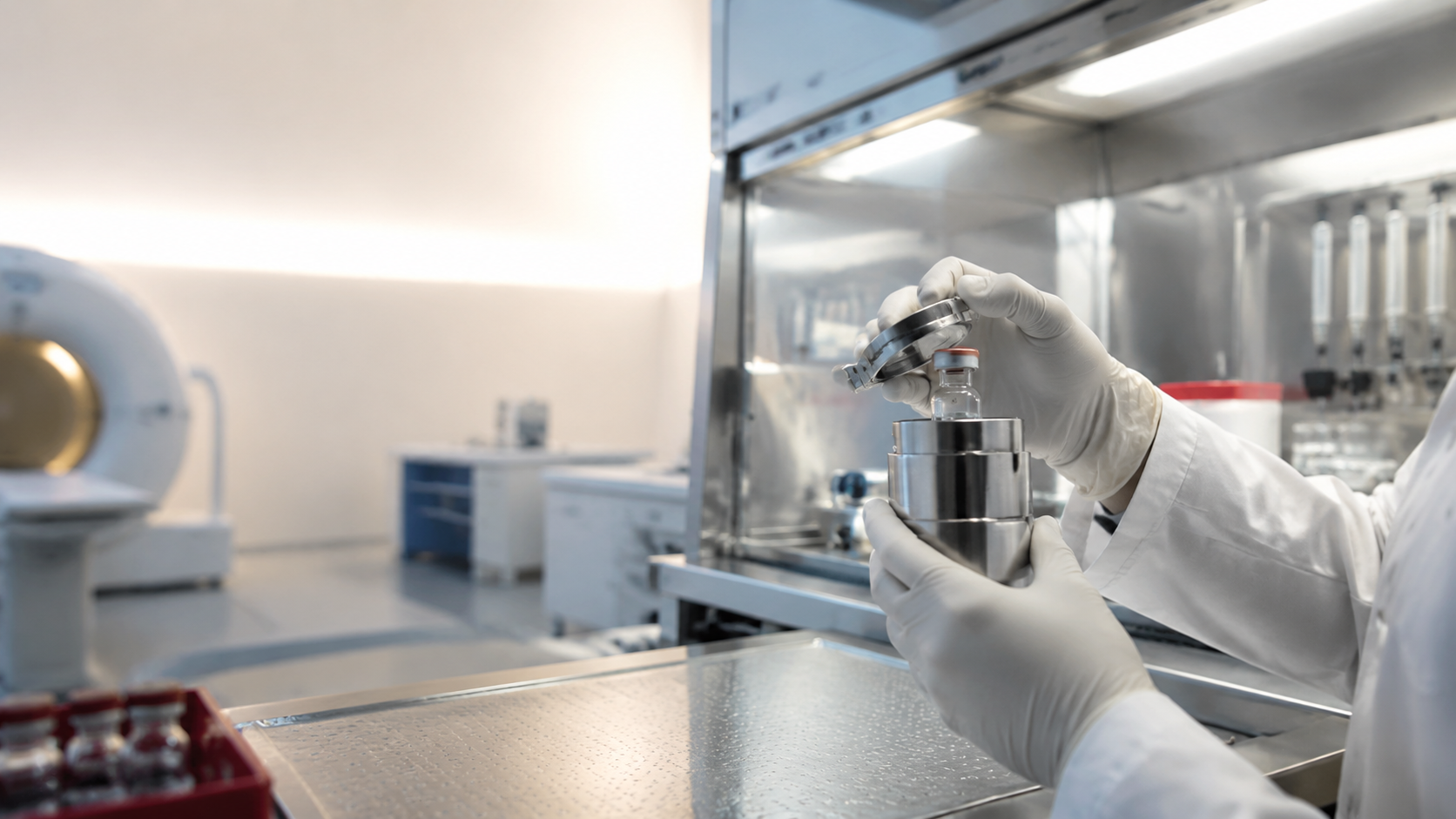
For most of the modern era, a Tunisian man facing prostate cancer has depended, at the most decisive moment of his diagnosis, on a vial flown in from somewhere else. The substance at the centre of his scan is not an ordinary medicine. It is faintly radioactive, it decays by the hour, and it cannot be stockpiled, warehoused, or asked to wait out a delayed flight or a customs hold. For a country that has spent decades building one of North Africa’s most respected medical sectors, that single imported vial has been a quiet, stubborn vulnerability — a piece of world-class care that arrived, when it arrived at all, on someone else’s schedule.
This year, that changed. With support from the International Atomic Energy Agency (IAEA), which announced the milestone on 3 June 2026, Tunisia has begun producing the prostate-cancer imaging drug 18F-PSMA on its own soil. The radiopharmaceutical cleared the national medicines regulator earlier in 2026, and the first patients were scanned with the home-made version in March. Officials expect it to reach hundreds of patients across the country in its first year alone.
A milestone measured in half-lives
To understand why this counts as a genuine milestone and not merely a procurement footnote, it helps to know what kind of drug 18F-PSMA is. The “18F” is fluorine-18, a radioactive isotope with a half-life of under two hours. From the moment it is made, the clock is running — within a single working day, most of it is gone. A medicine like that cannot be ordered from a European supplier and shipped south; by the time it lands, it has largely ceased to be useful. Local availability is not a convenience. It is the entire point.
That is why the achievement was a chain rather than a single step. The drug was produced through a collaboration between two national bodies — the Radioactive Isotope Company, known by its acronym SISORA, and the National Centre for Nuclear Sciences and Technology, or CNSTN — with the IAEA supporting capacity across the full production value chain, from the reactor science down to the quality controls that make a batch safe to inject into a patient.
What 18F-PSMA actually does
Prostate cancer is one of the most prevalent cancers in the world, and the second leading cause of cancer death among Tunisian men. As with most cancers, survival turns heavily on timing: caught early and mapped accurately, it is often manageable; found late, or imprecisely staged, it is far less forgiving.
This is the gap 18F-PSMA fills. PSMA stands for prostate-specific membrane antigen, a protein that sits in unusually high quantities on the surface of most prostate-cancer cells. The drug is engineered to seek out that protein and bind to it. Once it has, a PET/CT scanner can see exactly where it has gathered — which means it can see, with striking clarity, where the cancer is and how far it has travelled. For doctors, that picture is the difference between guessing and knowing: it informs the stage of the disease and helps determine the right course of treatment, up to and including targeted radionuclide therapy.
Why making it at home changes the math
For Tunisian hospitals, domestic production rewrites a logistical equation that used to constrain care. No more rationing scans around the next available shipment; no more watching an expensive import lose its potency in transit. As Mouldi Saidi, who heads biotechnology and nuclear techniques at CNSTN, put it, the shift lets Tunisian hospitals deliver “world-class diagnostic services” without depending on supply lines they do not control.
It also reshapes the economics of advanced care in a country where affordability is part of the national story — the same combination of competence and competitive cost that has made Tunisia a destination for patients across the region. (For a sense of how far the dinar stretches in everyday terms, our guide to the cost of living in Tunisia lays out the numbers, and our expat guide to living, working, and getting care in Tunisia covers the healthcare landscape for residents.)
A network, not a one-off
The most telling detail of the announcement is not the drug itself but the scaffolding built around it. Under a four-year national project, the IAEA helped Tunisia establish formal production protocols and quality-assurance systems, and supported the training of more than twenty specialists — physicists, radiochemists, radiopharmacists, and nuclear-medicine physicians — the kinds of people without whom a radiopharmacy is just a room full of equipment.
Crucially, the effort knitted these people into a single national radiopharmacy network, linking research institutes, hospital nuclear-medicine departments, universities, and the regulators at the Directorate of Pharmacy and Medicines. According to Tzanka Kokalova-Wheldon, who directs the IAEA’s division of physical and chemical sciences, that foundation matters as much as the first product: it is what lets Tunisia develop other radiopharmaceuticals from here, rather than treating 18F-PSMA as a lucky one-off.
Tunis teaches the region
If proof were needed that this is a long game, it arrived in December 2025, when Tunisia launched its first Certificate of Complementary Education in Radiopharmaceutical Sciences — built with the IAEA and France’s National Institute for Nuclear Science and Technology. The six-month programme, taught in French, runs the full length of the discipline: nuclear physics and instrumentation, dosimetry and radioprotection, production and quality control, clinical radiopharmacy, and the research frontier beyond.
The first cohort tells you where Tunisia now sits on the map. Alongside twenty-three Tunisian trainees were ten more from Algeria, Burkina Faso, Congo, Morocco, Mauritania, and Senegal — students who came to Tunis to learn a strategic science their own countries are still building. Tunisia, in other words, is no longer only catching up; it is teaching. As Gashaw Wolde of the IAEA’s Africa division framed it, the accomplishment shows how international cooperation and local innovation together can reshape a healthcare system.
The kind of news that rarely trends
A breakthrough like this will never draw the traffic of a derby result or a currency rumour. It is slow, technical, and undramatic in the way that real institutional progress usually is. But it is precisely the sort of development that quietly redraws what a country can do for its own people — a Tunisian patient now scanned with a Tunisian-made drug, by Tunisian specialists, in a Tunisian hospital. It belongs to the same steady run of national stories worth following on our News desk: less spectacle, more substance, and a country that keeps surprising the people who underestimate it.
Source: International Atomic Energy Agency, “Tunisia Produces Key Radiopharmaceutical for Prostate Cancer Care”, 3 June 2026. Reporting by Dongmei Han and Aruna Korde.
From the Carthage Magazine Bookshelf
Tunisia is far more than its headlines — and for the reader who wants the fuller country standing behind a story like this one, three Carthage Magazine ebooks open the door:
- All About Tunisia — the definitive English-language traveler’s guide. 572 pages, 27 chapters, all nine regions, every UNESCO inscription, five thematic trails — and the practical answers (visa, currency, transport, etiquette) most travelers wish they’d had on the plane. $24.99 · PDF & EPUB
- Speak Like a Local — 200+ Tunisian Arabic phrases with native audio recorded in Tunis. The phrases for the taxi, the souk, the café, and the dinner table. $14.99 · PDF, EPUB, MP3
- The Authentic Tunisian Cookbook — sixty traditional recipes from the heart of North Africa. For when you get home and find yourself missing the food. $9.99 · PDF & EPUB
All three available as a bundle for $39.99 — guide, language, and food, delivered together.
