
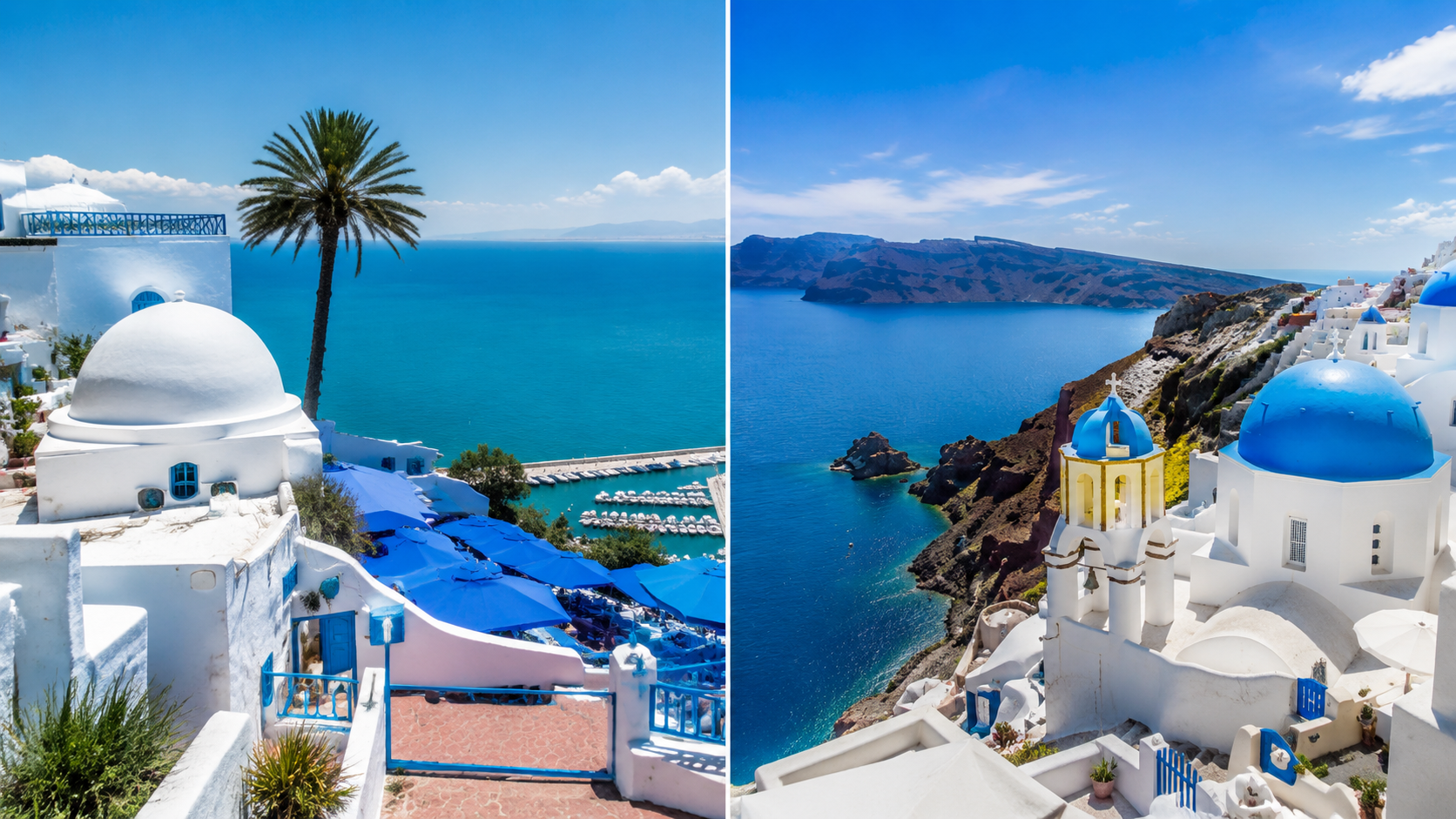
Quick Answer Greece is one of the most beloved travel countries on earth, and for the things it does best — island-hopping, the single most famous skyline in the ancient world, that particular blue — it has no real rival, Tunisia included. Greece wins on the islands, the Acropolis-grade brand of antiquity, the romance of the Aegean, and the ease of travelling inside the EU. Tunisia wins on value (it isn’t close), on having its great sites nearly to itself, on the Punic story and the world’s largest collection of Roman mosaics, on a genuine Sahara, and on warmth that lasts long past the Greek season. If you want the iconic Greek-island summer, go to Greece. If you want an affordable, uncrowded Mediterranean-and-desert trip with serious history, go to Tunisia. Both face the same sea; they offer very different days beside it.
Two admissions before I make the case, because they set the terms.
The first: I’m writing from Tunis, so apply whatever home-team discount you think fair. The second: Greece is wonderful, and in the categories most travellers daydream about — white villages tumbling to a turquoise sea, a ferry between islands, the Parthenon at dusk — it simply delivers what it promises. I’m not going to pretend the small country south of Sicily out-romances the Cyclades. What I can tell you is that these are different trips, and that Tunisia is quietly excellent at several things Greece, for all its beauty, can no longer easily give: empty ruins, true desert, and a Mediterranean holiday that doesn’t drain the account.
The Honest Short Answer
If you want the postcard Greek summer — Santorini’s caldera at sunset, island-hopping through the Cyclades, the Acropolis crowning Athens, tavernas over a darkening sea — and the EU’s seamless ease, go to Greece. It is the right answer for an enormous number of travellers, and it earns its fame.
If you want a quieter, far cheaper Mediterranean trip with as much ancient depth and a fraction of the crowds — Carthage and the Roman cities, the world’s greatest mosaic collection, warm beaches you don’t have to fight for, and a real stretch of Sahara — go to Tunisia. It is the right answer for a different traveller, and an underrated one in 2026. Still unsure it’s worth it at all? We answered that here.
How They Compare — Geography, Scale, Climate
Greece is a country of around ten million people built on the sea: a mainland of mountains and classical sites, and some six thousand islands and islets scattered across the Aegean and Ionian, of which a couple of hundred are inhabited. The trip is the sea — ferries, flights between islands, the slow geography of an archipelago. Summers are hot and dazzling, the season concentrated and intense; the famous islands run hard from June to September and quieten sharply after.
Tunisia is a country of twelve million on the eastern edge of the Maghreb, just south of Sicily, with one long Mediterranean coast and the Sahara beginning about five hours below the capital. It is compact — drivable end to end in a day — and most trips orbit a single base with easy day trips out. There are no domestic flights to schedule and no ferries to time; the logistics are light.
Both are Mediterranean to the core. Greece offers the drama of the archipelago and the romance of getting between islands; Tunisia offers a single, low-friction coast plus something Greece has nothing of — a desert. If island-hopping is the dream, Greece wins before we start. If a simple, warm, all-in-one-country trip suits you, Tunisia does.
Where Greece Wins
Let me lead with where Greece is the better choice, because in its strongest categories it’s decisive.
The islands. There is no Tunisian answer to the Greek islands. The Cyclades — Santorini, Mykonos, Naxos, Milos — the Dodecanese, the Ionian greens of Corfu: white-and-blue villages, volcanic calderas, coves of impossible clarity, the whole grammar of the Aegean summer. Tunisia has Djerba and the Kerkennah islands, both worth your time, but they are gentle, low, and few. On islands, Greece is in a different league.
The single greatest classical brand. The Acropolis and the Parthenon are the most recognisable images of the ancient world, full stop. Delphi, Olympia, Knossos, Epidaurus — Greece is the cradle, and it carries that weight effortlessly. Tunisia’s antiquity is magnificent (more on that below) but it is Punic and Roman, not Greek; if it’s the Parthenon and the birthplace of Western antiquity you’re after, only Greece has it.
The romance of the sea. The ferry at dawn, the harbour tavernas, the specific blue of the Aegean — Greece has turned its sea into one of travel’s great experiences. Tunisia’s coast is lovely and warm, but it doesn’t trade in that particular, world-famous romance.
EU ease. Greece is in the European Union and the Schengen and euro zones, with dense flight and ferry networks and tourism infrastructure honed over decades. For many travellers it is simply frictionless.
If any of these is your reason to travel, book Greece with confidence.
Where Tunisia Wins
Now the other side — and the case is stronger than Greece’s headline glamour suggests.
Value. This is Tunisia’s clearest win, and the gap is wide. Greece — and the popular islands above all — has become genuinely expensive in peak season: ferries, island hotels, waterfront dinners add up fast. Tunisia is inexpensive across the board: hotels, meals, taxis, guides, entrance fees, and some of the most underrated wine in the Mediterranean. Your budget goes dramatically further; the cost-of-living guide has the breakdown. On value, it isn’t close.
Crowds — or their absence. The famous Greek islands in August are a crowd scene, and the Acropolis moves in slow queues. Tunisia’s great sites are nearly empty. You can walk the third-largest Roman amphitheatre ever built at El Jem with a handful of others; Dougga, one of the best-preserved Roman towns anywhere, on a weekday is almost yours alone. The experience of standing alone in a great ancient place — which Greece can rarely offer now — Tunisia gives you routinely.
A different, rarer antiquity. Greece gives you the Greek world supremely. Tunisia gives you the one that opposed it and Rome both: Carthage, the city of Hannibal and Dido, a whole Punic civilization with no Greek equivalent — and then the Roman cities layered on top, plus the largest collection of Roman mosaics on earth at the Bardo. It’s a different chapter of the ancient story, and a less-trodden one.
A real Sahara. Greece has glorious landscapes but no desert. Tunisia’s south — the dunes around Douz and Tozeur, the oases, the original Star Wars sets — is a genuine, accessible Sahara. A night under the desert sky is a Tunisia-only line on this list.
A longer season. The Greek island machine runs hard in summer and powers down after; shoulder and winter visits can mean shuttered tavernas and skeleton ferry schedules. Tunisia stays warm and open far longer — its best months stretch well into autumn, and the south is at its finest in winter. For an off-peak Mediterranean trip, Tunisia is the safer bet.
Where It’s Genuinely Close
A few categories come down to taste.
Beaches. Both deliver. Greece has those jewel-box island coves; Tunisia has long warm sweeps of sand at Hammamet, Djerba, and the Cap Bon, with far more room to spread out (our beach roundup has the pick). Greece edges the drama; Tunisia edges the space and the price.
Food. Two proud Mediterranean kitchens. Greek cuisine is world-famous and superb — the olive oil, the grilled fish, the meze, the yoghurt and honey. Tunisian food is spicier and less known, built on harissa, couscous, brik, and the sea. Different palates; both excellent. Call it a draw and pick by appetite.
Hospitality. Both countries are warm to visitors in that unforced Mediterranean way. Neither wins this; you’ll be looked after in either.
Practicalities — Visas, Money, Getting There
Entry. Greece sits in the Schengen area; depending on your nationality you’ll travel visa-free for short stays or need a Schengen visa. Tunisia is visa-free for stays of up to 90 days for most European, North American, and many other travellers — our visa guide has the details.
Money. Greece is on the euro; Tunisia uses the dinar, a closed currency you obtain on arrival — and, as above, your money stretches far further once you have it.
Getting there and around. Both are well-connected to Europe by air; flights to Tunisia are plentiful and often cheap. Inside Greece you’ll lean on ferries and domestic flights; inside Tunisia, getting around means short drives and louages, with no island logistics to manage.
The Verdict — Who Should Pick Which
Choose Greece if the islands are the point, if you want the Acropolis and the cradle of Western antiquity, if the romance of the Aegean is what you’re buying, and if EU seamlessness matters to you. It is one of the world’s great trips, and nothing here is meant to dim it.
Choose Tunisia if you want the same warm sea and as much ancient weight for a fraction of the cost, if crowds are the thing you’re fleeing, if Carthage and a roomful of mosaics and a night in the Sahara appeal more than another ferry, and if you’d rather travel in the shoulder season without the shutters coming down.
And if you’re still torn, read the rest of the series — our honest comparisons with Italy, Spain, Malta, Egypt, Turkey, and Morocco — then map a week in Tunisia and see if it fits the trip you actually want.
From the Carthage Magazine Bookshelf
If Tunisia is winning you over, three Carthage Magazine ebooks were built for the days between landing and leaving:
- All About Tunisia — the definitive English-language traveler’s guide. 572 pages, 27 chapters, all nine regions, every UNESCO inscription, five thematic trails, and the practical answers most travelers wish they’d had on the plane. $24.99 · PDF & EPUB
- Speak Like a Local — 200+ Tunisian Arabic phrases with native audio recorded in Tunis. $14.99 · PDF, EPUB, MP3
- The Authentic Tunisian Cookbook — sixty traditional recipes from the heart of North Africa. $9.99 · PDF & EPUB
All three available as a bundle for $39.99 — guide, language, and food, delivered together.
