
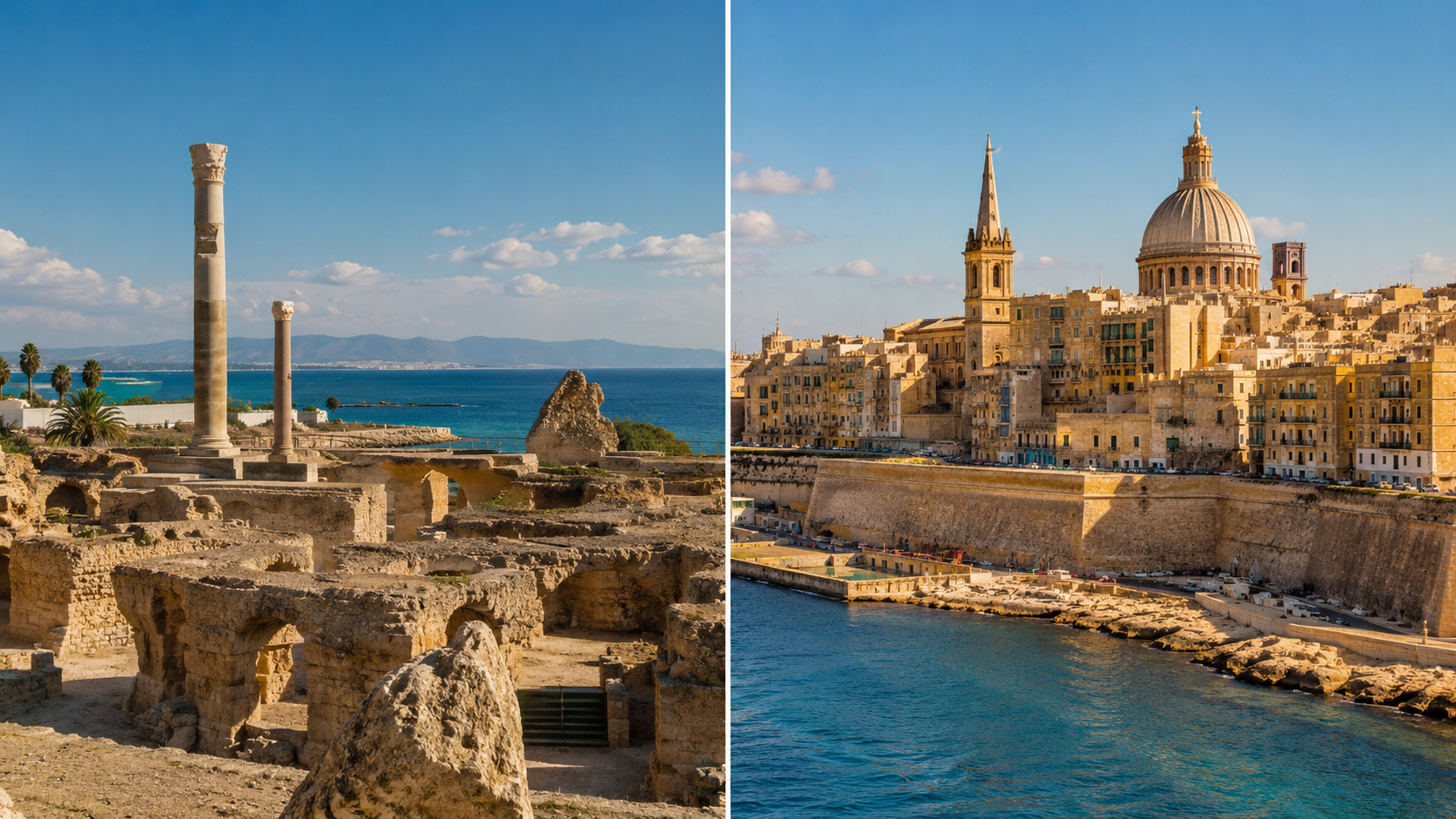
Quick Answer Malta and Tunisia are near neighbours — a short flight apart across the same sea — and they share a deep Phoenician past, which makes this the most sibling-like comparison in the series. Malta wins on effortlessness: it’s English-speaking, in the EU, tiny and easy, with the baroque jewel of Valletta, megalithic temples older than the pyramids, and some of the best diving in the Mediterranean. Tunisia wins on scale and value: it’s far cheaper, far larger and more varied, with a real Sahara, vast Roman cities you can have to yourself, the world’s greatest mosaic collection, and Carthage — the mother-city of the very Phoenician world Malta belonged to. If you want the easy, English, compact island break, go to Malta. If you want the bigger, cheaper, wilder trip with the Phoenician homeland at its centre, go to Tunisia.
Two quick admissions.
The first, as ever: I’m writing from Tunis, so apply your discount. The second: Malta is genuinely lovely and ferociously easy to travel — and for some trips, that ease is the whole point. But these two countries are closer than most travellers realise, in geography and in history, and seeing them side by side tells you a lot about what kind of Mediterranean trip you actually want.
The Honest Short Answer
If you want an easy, compact, English-speaking island break — Valletta’s golden streets, prehistoric temples, world-class diving, everything within a short drive, and the comfort of the EU — go to Malta. For a relaxed week with minimal friction, it’s hard to beat.
If you want a bigger, much cheaper, more varied trip — Carthage and the Roman cities, the world’s largest mosaic collection, warm uncrowded beaches, and a real Sahara — built around the Phoenician homeland Malta was once a far-flung part of — go to Tunisia. Worth it? We’d say very.
How They Compare — Geography, Scale, Climate
Malta is a tiny archipelago of around half a million people south of Sicily — three inhabited islands (Malta, Gozo, Comino) totalling just over 300 square kilometres, which makes the whole country smaller than many single cities. English and Maltese are both official, it’s in the EU, Schengen, and euro zones, and you can cross the main island in under an hour. It is, in the literal sense, a pocket destination.
Tunisia is a country of twelve million on the edge of the Maghreb, just southwest of Malta across open water. One long Mediterranean coast, a compact Roman interior, and the Sahara about five hours south of the capital — small enough to grasp in a week, but vastly larger and more varied than Malta, with a desert, mountains, and a string of distinct regions Malta has no room for.
Both are warm, sea-defined, and steeped in layered history. Malta is the effortless miniature; Tunisia is the larger, wilder, cheaper canvas. And — the detail that frames everything below — both were once part of the same Phoenician world, with Carthage at its head.
Where Malta Wins
The categories where Malta is the better choice, plainly.
Effortlessness and English. Malta is about as easy as international travel gets: English is everywhere, the EU framework is familiar, distances are tiny, and the tourism infrastructure is slick. For a stress-free week, especially a first trip abroad or a short one, Malta is wonderfully simple. Tunisia is easier than its reputation, but it isn’t this easy.
Valletta and the Knights. Malta’s capital is a compact baroque masterpiece — built by the Knights of St John, packed with St John’s Co-Cathedral and its Caravaggios, and a UNESCO World Heritage Site in its own right. Tunis has a beautiful medina, but Valletta’s concentrated grandeur is a particular, and very high, pleasure.
The megalithic temples. Malta’s Ġgantija, Ħaġar Qim, and Mnajdra are among the oldest free-standing stone structures on earth — older than Stonehenge and the pyramids. It is a genuinely world-class prehistoric inheritance with no Tunisian equivalent.
Diving. Malta is one of the Mediterranean’s premier dive destinations — clear water, wrecks, caves, the Blue Hole off Gozo. Tunisia has diving at Tabarka on the coral coast, but Malta wins this category outright.
If any of these is your reason to go, book Malta with confidence.
Where Tunisia Wins
Now the other side — and against a country this small, several of Tunisia’s wins are simply about more.
Value. Malta is not cheap — accommodation and dining have climbed steeply, and summer is dear. Tunisia is inexpensive across the board: hotels, meals, taxis, guides, entrance fees, wine. The cost-of-living guide shows the gap; your money goes dramatically further in Tunisia.
Scale and variety. This is the heart of it. Malta is tiny — you can see most of it in a few days, and there’s no escaping that it’s small and, in summer, crowded. Tunisia offers a whole spectrum Malta has no space for: Mediterranean coast and a real Sahara, big Roman cities and Berber villages, beach resorts and desert oases. If you want range in one trip, it’s no contest.
The Phoenician homeland — and Carthage. Here’s the historical twist. Malta was a Phoenician and Carthaginian island; its very name may descend from a Phoenician root. Tunisia is where the mother-city stood: Carthage itself, capital of that whole Mediterranean world, the city of Hannibal and Dido. To visit Malta’s Punic layer and then Tunisia’s is to travel from a province to the capital. For anyone drawn to that ancient thread, Tunisia holds its source.
Roman cities, nearly alone. Beyond Carthage, Tunisia has El Jem — the third-largest Roman amphitheatre ever built — and Dougga, and the largest Roman mosaic collection on earth, all walkable in near-solitude. Malta’s antiquity is remarkable but small in footprint; Tunisia’s is vast.
A real Sahara. Malta has no desert. Tunisia’s south — dunes, oases, Star Wars sets, a night under the stars — is a Tunisia-only experience in this matchup, and one of the great reasons to come.
Room on the beach. Malta’s swimming spots are gorgeous but limited and, in season, packed onto a small island. Tunisia has long, warm, open sand at Hammamet, Djerba, and the Cap Bon — space to spread out, at a fraction of the price.
Where It’s Genuinely Close
A few honest draws.
The Phoenician inheritance. Both countries carry it — Malta as an island of that world, Tunisia as its centre. Which you find more moving is a matter of perspective, but the shared root makes them natural companions rather than rivals.
The sea. Both have spectacular, clear Mediterranean water. Malta wins on diving infrastructure and fame; Tunisia wins on space and price. Swimmers will be happy in either.
Food. Maltese cuisine is hearty and distinctive (and shares the region’s love of rabbit, bread, and the sea); Tunisian food is spicier and more varied. Different, both satisfying.
Practicalities — Visas, Money, Getting There
Entry. Malta is in the Schengen area (visa-free short stays for many nationalities; a Schengen visa for others). Tunisia is visa-free for up to 90 days for most European, North American, and many other travellers — see the visa guide.
Money. Malta is on the euro; Tunisia uses the dinar, obtained on arrival and worth far more in practice.
Getting there and around. Both are easy to reach from Europe, and they’re close to each other; flights to Tunisia are cheap and frequent. Malta is small enough to cross in an hour; in Tunisia, getting around means short drives and louages between regions.
The Verdict — Who Should Pick Which
Choose Malta if you want the easiest possible Mediterranean week — English-speaking, compact, EU-simple — with Valletta, prehistoric temples, and superb diving in a tidy package. For a short, low-effort, hassle-free trip, it’s excellent.
Choose Tunisia if you want more for less: a far cheaper holiday with a Sahara, vast empty Roman ruins, room on the beach, and the Phoenician capital itself at the centre of it. If Malta is the Mediterranean in miniature, Tunisia is the Mediterranean at full size — and at a discount.
Given how close they sit, the greedy answer is both: a few easy days on Malta and a short hop south to where Carthage stood. While you weigh it, the rest of the series — Greece, Italy, Spain, Egypt, Turkey, Morocco — and a 7-day Tunisia itinerary are right here.
From the Carthage Magazine Bookshelf
If the bigger, wilder neighbour is winning you over, three Carthage Magazine ebooks were built for the trip:
- All About Tunisia — the definitive English-language traveler’s guide. 572 pages, 27 chapters, all nine regions, every UNESCO inscription, five thematic trails, and the practical answers most travelers wish they’d had on the plane. $24.99 · PDF & EPUB
- Speak Like a Local — 200+ Tunisian Arabic phrases with native audio recorded in Tunis. $14.99 · PDF, EPUB, MP3
- The Authentic Tunisian Cookbook — sixty traditional recipes from the heart of North Africa. $9.99 · PDF & EPUB
All three available as a bundle for $39.99 — guide, language, and food, delivered together.
