
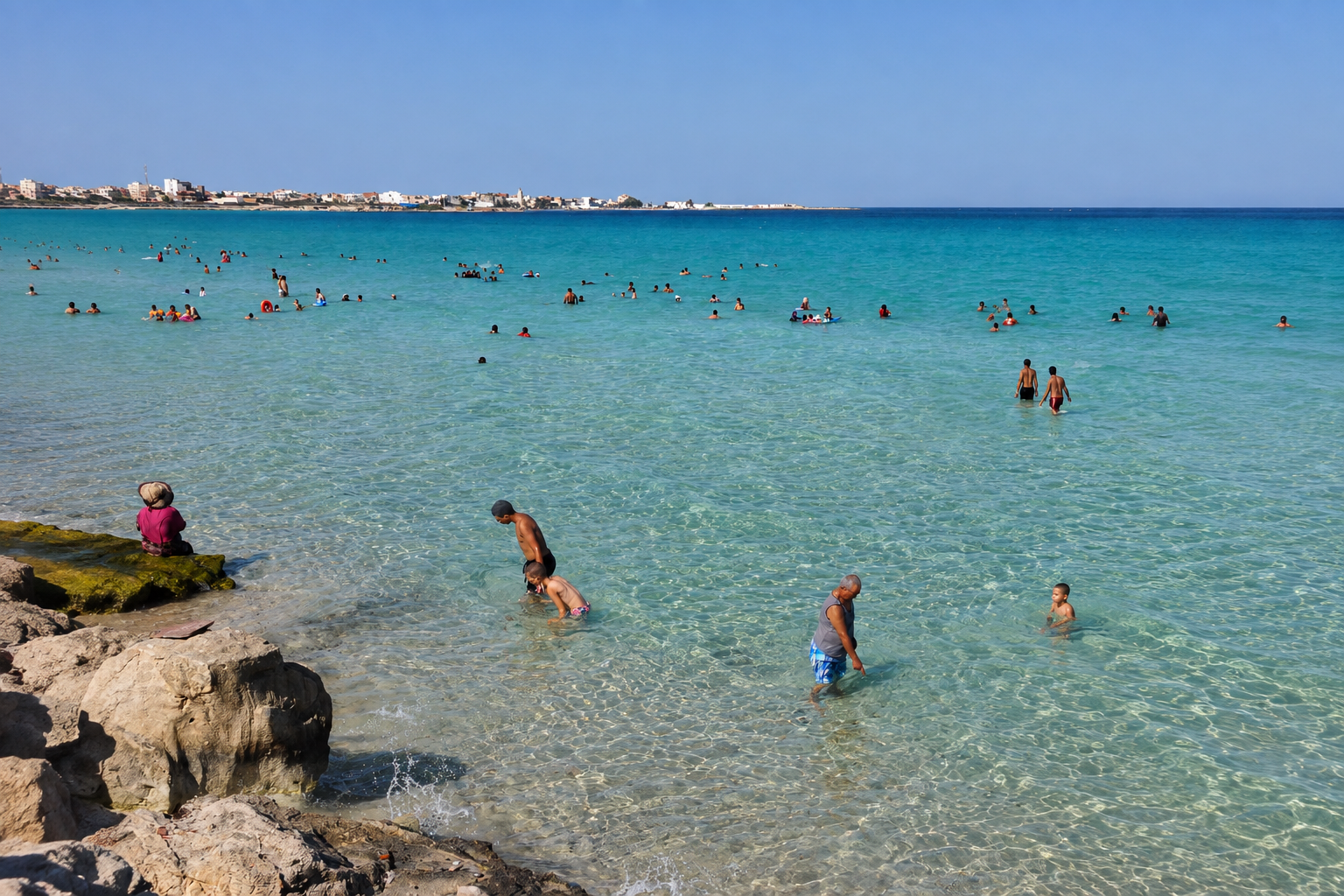
It begins at the airports, in the last days of July. The flights from Paris and Lyon and Rome empty out into arrivals halls at Tunis–Carthage and Enfidha, and the trolleys tell the story before anyone speaks: suitcases wrapped in cling film and stacked three high, boxes taped and retaped, the freight of a year abroad. At the rail, grandmothers scan the doors. Somewhere behind the glass, a child raised in a Lyon suburb is about to be kissed by relatives whose names he half-remembers, in a language he understands better than he speaks.
Within a week, the coast has changed registration. French and Italian plates take the parking spots from La Marsa to Djerba. Café conversations slide between Derja and French mid-sentence. The queues lengthen, the music gets louder, and the prices — everyone notices the prices.
There is a country called Tunisia that exists for ten months of the year, and another that exists in July and August. The second one is louder, fuller, better dressed and worse parked. Its wedding halls are booked in blocks; its apartments rent by the fortnight at rates no local salary explains. And then, in the first week of September, it vanishes — folded back into the suitcases, driven back to the airport — leaving the first country to tally what happened.
What happens is one of the great unwritten rituals of the Mediterranean: the annual return of the diaspora. Well over a million Tunisians live abroad — the largest communities in France, then Italy, Germany, the Gulf and, increasingly, Canada — and each summer a great share of them comes home at once, transforming the coast into a mirror in which the country examines itself.
What the month visibly changes
The economics arrive first, and they are impossible to miss.
Prices climb as the returnees land — fish, fruit, taxis, hairdressers, party dresses — and locals grumble about it as reliably as they complain about the heat. A family living on a Tunisian salary shares a market for six weeks with visitors spending euros, and for those six weeks the euro sets the price. It is the same gap that shapes so much of what daily life in Tunisia costs and feels like, compressed into a single season and put on display in every souk on the coast.
The wedding calendar bends around the same gravity. Tunisian weddings are not spread across the year; they are crushed into the weeks when the family abroad can attend, and whole service economies — halls, orchestras, photographers, pastry-makers, dresses, gold, henna, sound systems — do the bulk of a year’s business in two months. Drive any coastal road on an August night and you will pass three of them, distinguishable by the volume and the fireworks.
And the housing does something strange. Apartments that sit dark all winter open for six weeks, and landlords hold units empty through the spring rather than take a year-long local tenant at a fraction of the summer rate. It is one of the quiet ways the diaspora economy shapes what a home costs the people who stayed — a seasonal distortion that outlasts the season.
The economics underneath
Behind the ritual stands one of the pillars of the national economy. Transfers from Tunisians abroad amount to roughly six percent of GDP — of the same order as the entire tourism sector — and have been growing at double-digit rates. Together, tourism receipts and diaspora transfers had brought in more than 9.6 billion dinars by the end of this July, a flow of hard currency that props up the dinar and fills gaps that neither exports nor investment can.
And the official statistics undercount the season, because much of what the diaspora delivers never passes through a bank. It arrives as cash in envelopes, as suitcases of clothes and medicine and phone parts, as a summer of restaurant bills picked up without discussion, as a parent’s roof renovated and paid for in person. The August economy is partly invisible by design.
Which brings us to the paradox worth stating plainly: emigration — the thing every government treats as a failure and every family treats as a loss — is simultaneously one of the state’s most reliable sources of foreign currency. The country’s most successful export is its people, and August is when the dividends come home to be counted.
The performance, and the quiet part
The money is the easy half to describe. The harder half is what the month does inside families.
There is a performance to the return, and everyone knows the script. The returnee arrives visibly successful — the car, the gifts, the round of coffees paid for the whole table — because that is what the years away must be shown to have purchased. The family receives the success and displays it; the neighbours calibrate. For the children raised in Lyon or Palermo, whose French or Italian outruns their Derja, the month is a language bath and an identity question at once: they are the Arabs of their European schools and the Europeans of their Tunisian summers, fluent everywhere and native nowhere, at least until the third week, when the sea and the grandmother’s cooking do their work.
And there is the quiet part, spoken of in every family and printed almost nowhere: the returnee who is not doing well abroad and cannot say so. The one whose job is precarious, whose papers are uncertain, whose savings were emptied by the very trip that proves the emigration succeeded. The performance of success has a price, and some pay it in silence — borrowing in Europe, sociologists of the diaspora have long observed, in order to be generous in Tunisia. The August performance is not vanity. It is an obligation, and like most obligations it falls heaviest on those least able to carry it.
For those who stayed, the month is its own mirror. The cousin’s car is an argument. The visitor’s casual spending is a measurement of one’s own salary. Some of the young people crowding the summer beaches are quietly taking notes for their own departure — a decision this magazine has written about before, and one the season itself renews: every August, the shop window of emigration is dressed again, and the queue outside it grows.
The number to watch
In the first days of September, the ritual runs in reverse. The departure halls fill with the same families, the embraces longer this time, the grandmothers pressing tupperware into hand luggage as if food could shorten a year. Then the towns exhale. The parking spaces return, the café chairs go free, the prices drift back down toward what the first Tunisia can pay.
If you want a single figure to follow through all of it, follow the remittances: they are the season’s shadow in the national accounts, and they have been growing faster than almost anything else in the economy — which is another way of saying that the second Tunisia keeps getting bigger. The two countries need each other and slightly resent each other, like any family. And like any family, they will do it all again next summer.
From the Carthage Magazine Bookshelf
Whether you’re coming home this summer or bringing someone who’s never seen it, these travel well.
- All About Tunisia — the definitive English-language traveler’s guide. 572 pages, 27 chapters, all nine regions, every UNESCO inscription, five thematic trails — and the practical answers (visa, currency, transport, etiquette) most travelers wish they’d had on the plane. $24.99 · PDF & EPUB.
- Speak Like a Local — 200+ Tunisian Arabic phrases with native audio recorded in Tunis. The phrases for the taxi, the souk, the café, and the dinner table. $14.99 · PDF, EPUB, MP3.
- The Authentic Tunisian Cookbook — sixty traditional recipes from the heart of North Africa. For when you get home and find yourself missing the food. $9.99 · PDF & EPUB.
All three available as a bundle for $39.99 — guide, language, and food, delivered together.
