
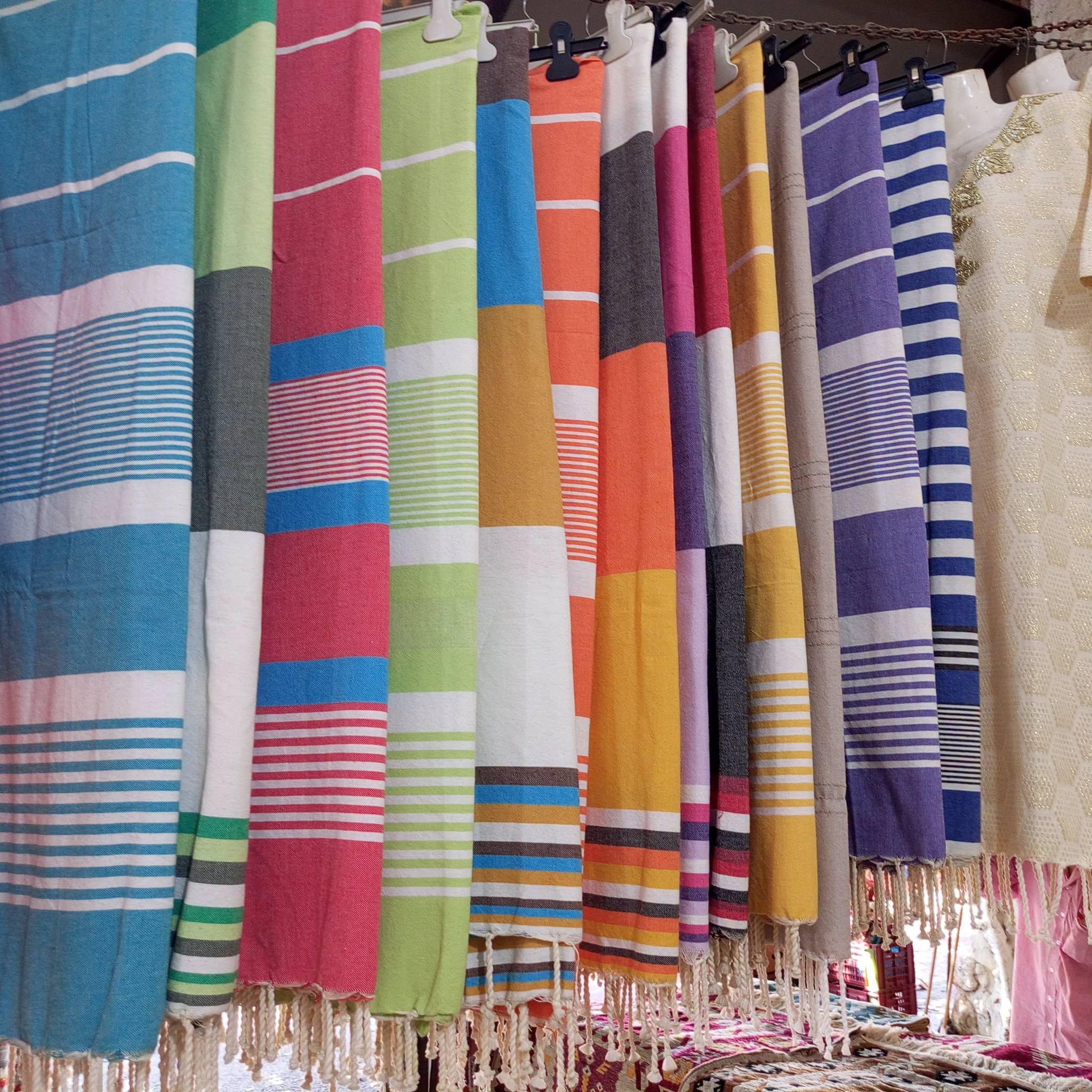
Quick Answer — The fouta (foo-ta) is Tunisia’s traditional hammam towel: a flat-woven, striped cotton cloth, roughly a metre by two, light enough to fold into a jacket pocket and absorbent enough to dry a body in one pass. It was designed for the steam room — tied at the waist, sat on, slept under — and somewhere in the last twenty years it walked out of the hammam and onto every beach in the Mediterranean. Tunisia weaves most of the real ones, in the textile belt of the Sahel. The two weaves you’ll meet are flat (plate) and honeycomb (nid d’abeille); the fringes are still knotted by hand; and a good one bought in a souk costs about what a lunch does. How to tell a loom-woven fouta from a tourist-shop one — and how to buy it — is below.
It is August on the beach at La Marsa, and a family has arrived with no furniture. No umbrella, no chairs, no cooler. What they have is a stack of striped cloth. One fouta goes down on the sand. Two more are knotted between the lifeguard’s chair and a driftwood pole to make shade. A fourth is wrapped around a grandmother’s head against the glare, a fifth around a toddler fresh out of the water, and a sixth — this one honeycombed, soft from a hundred washes — is folded into a pillow for a man who intends to sleep until the heat breaks. The whole encampment, dismantled at six, shakes free of sand and goes into one bag.
Nobody in that family would describe the fouta as a design object. It is a towel. But it is a towel that has quietly become one of Tunisia’s most recognisable exports, draped over sofa arms in Lisbon and Montreal, sold as a “Turkish towel” in shops that have never heard of Ksar Hellal — and the story of how a bathhouse wrap became a global beach staple is a very Tunisian one.
What a fouta is, and what it isn’t
The word fouta is simply Arabic for a cloth or wrap, and versions of it exist from Syria to Yemen. The Tunisian fouta is a specific thing: a rectangle of cotton, sometimes with a little linen, woven flat rather than looped, with coloured stripes running across the width and a knotted fringe at either end. The standard size is about 100 by 200 centimetres and the standard weight is light — a few hundred grams, a third of what a terry towel weighs — which is the entire point. It absorbs fast, dries faster, and takes up almost no room.
What it isn’t is terry. The looped pile of a conventional towel traps water and sand and heat; the flat weave of a fouta lets go of all three, which is why a fouta shaken out at the end of a beach day is dry and clean while the terry towel beside it is a damp sack of grit. The closest cousin is the Turkish peshtemal, born of the same bathhouse tradition in a different corner of the Ottoman world. They are siblings, not twins: the Tunisian piece tends to be lighter and more tightly woven, with stripes rather than checks as its signature. Shops abroad sell both under whichever name is trending that season, which is how a Mahdia-woven cloth ends up labelled “Turkish.”
Born in the steam room
The fouta’s home is the hammam, and you cannot understand the cloth without the room. Tunisian public baths descend from the Roman ones — the country is scattered with the ruins of the originals — and the ritual has barely changed: a hot room, a steam room, a scrub with a coarse kessa glove and black olive-oil soap, a cold rinse, a long rest with tea. A fouta is tied at the waist on the way in. A second is sat on. A third dries you at the end, and a fourth, if you are a regular, is wrapped around your head for the walk home through the cool of the medina. (The full liturgy is in our guide to Tunisian hammams, including what to bring and the men’s and women’s hours.)
A towel that spends its life in wet heat has to dry quickly or it rots, which is why the fouta is flat-woven; and it has to be modest enough to wear in a crowded room, which is why it is long enough to wrap twice. The stripes were practical before they were pretty. A family’s foutas were woven with its own colours and bands so that, in the steam, you could find yours.
The cloth had a life outside the bath too. Across the Maghreb, foutas were worn as head-and-shoulder wraps and tied at the belt as aprons; the striped silk fouta wa blouza of Hammamet is still one of the seven costumes a Tunisian bride wears — it appears at the henna night, the most photographed evening of the seven-day Tunisian wedding. In Djerba, island women’s foutas were woven with wool and worn under a straw hat, and you can still spot older women in them at the Houmt Souk market on a Monday morning.
Where the real ones are woven
Ask a Tunisian where foutas come from and the answer is the Sahel — the coastal strip between Sousse and Mahdia, where cotton and silk weaving has been the family trade for generations. Ksar Hellal calls itself the textile capital of Tunisia and has an eleven-metre monument in the town centre to prove it. Moknine and the villages around Monastir run on looms. And Mahdia, the old Fatimid port, still has silk weavers in its medina producing the shimmering striped cloth that goes into wedding dress, with foutas in pastel stripes as the everyday sideline. Kairouan, inland, weaves too — carpets first, but foutas as well.
The method, in the workshops that still do it by hand, is a chain. A warp of natural off-white cotton is wound and dressed on a wooden pedal loom. The weaver throws the weft, building the coloured bands by changing bobbins, and a single fouta takes anywhere from one to five hours depending on the pattern. The cloth comes off the loom in a long run, is cut, and then travels again — to women who knot the fringes at home, by hand, a few hundred ends per towel. This last step has survived even where the weaving has been mechanised, which is most places: the majority of foutas sold today come off semi-automatic looms, often from cotton yarn recycled and respun from the garment industry, with only the fringe still done by fingers.
That is not a scandal. Tunisia is one of Europe’s largest clothing suppliers and a loom-woven fouta is still a Tunisian fouta. But it is the difference between a twelve-dinar towel and a forty-dinar one, and it helps to know which you are holding.
Flat or honeycomb: the two weaves
Every fouta you meet is one of two things.
The flat weave — fouta plate in the shops, arbi (“traditional”) when it’s the old striped pattern — is the thinner, smoother, lighter one. It packs flattest, dries fastest, and makes the better sarong, tablecloth, and shade-cloth. It is also slightly less absorbent, and on the first few uses feels more like a sheet than a towel. It softens with every wash.
The honeycomb — nid d’abeille, a waffle weave with a raised texture — is thicker, more absorbent, and closer to what a northern European expects a towel to feel like. It is the one to choose as an actual bath towel at home, and the one Tunisian families bring to the hammam for the final dry-off. It is a little heavier and dries a little slower, though still faster than terry.
Beyond those two, you’ll see chevron and diamond weaves, jacquards, and the thicker wool-blend foutas of Djerba. Colour is the Sahel’s signature: a plain body with a cluster of thin stripes at each end is the classic; wide bands of two or three colours is the beach version; the pastel-and-pinstripe style is Mahdia.
How to buy one — and how to tell what you’re buying
Foutas are everywhere in Tunisia, from the souvenir gauntlet of Rue Jamaa Zitouna to the supermarket. The honest advice, by tier:
- Price. A standard machine-woven cotton fouta in a souk or a Sahel market runs roughly 15 to 30 dinars; the honeycomb a little more; a genuinely handloomed piece from a Mahdia or Ksar Hellal workshop 40 dinars and up. Anything much below ten is probably polyester-blend. Haggle gently in the souks — the first price in Tunis assumes you will — and not at all at a weaver’s door, where the price is the price. (Our dinar guide covers the cash you’ll need; cards are rare at a loom.)
- The fringe test. Pick up the end. Hand-knotted fringes are slightly uneven, the knots fat and firm; a machine-hemmed or sewn-off edge means a factory piece. Neither is wrong, but only one is what the sign claims.
- The weave test. Hold a flat fouta to the light. Handloom cloth has small, honest irregularities in the stripe edges and a visible, slightly thickened selvedge; mechanical cloth is perfectly even. Then pinch: pure cotton has a dry, matte hand and warms slowly in the fingers; polyester feels slick and faintly cool.
- The nose test. Cotton smells of nothing. A fouta that smells of chemicals has been dyed in a hurry, and the dye will tell you so in the first wash.
- Where. For the full range at honest prices, any Sahel town market beats the capital; Mahdia’s medina lets you watch the loom you’re buying from. In Tunis, the shops around Souk El Trouk and the cooperatives inside the medina carry Sahel stock. The artisanat state shops are fixed-price and reliable, if a little dearer.
Pack it in the hand luggage. A fouta weighs less than a paperback and will be the first thing you reach for on the next beach, the next long flight, and the next picnic, which is the fouta’s real genius: it is one of the few souvenirs that does not retire to a drawer. (What else to pack, season by season, is its own guide.)
Looking after it
A new fouta is stiff. This is normal and temporary. Soak it overnight in cold water before the first wash — it tightens the weave and sets the dye — then wash warm, no softener, and let the sun do the drying; a fouta on a line in a Tunisian courtyard is one of the quiet sights of the country. It gets softer and more absorbent for years. If a fringe knot loosens, retie it; if a stripe fades, that is the fouta telling you it is cotton.
The small things worth knowing
Foutas are one of several objects Tunisia makes well and talks about little — the chechia, the Sejnane pot, the Nabeul tile — and like them, the fouta carries a regional economy with it. The looms of the Sahel are family businesses, most of the hand-finishing is done by women working from home, and the fouta you buy at a weaver’s workshop rather than an airport shop keeps that chain alive. It is worth the extra ten dinars and the detour.
And one gentle correction, for the next time you see a stack of striped cotton labelled “Turkish towel” in a shop abroad: turn over the tag. More often than you’d think, the loom that made it was an hour south of Sousse.
Saha — to your health — as they say on the way out of the hammam.
From the Carthage Magazine Bookshelf
If a striped cloth has you curious about the hammam, the souk, and the looms of the Sahel, these three are the next step:
- All About Tunisia — the definitive English-language traveler’s guide. 572 pages, 27 chapters, all nine regions, every UNESCO inscription, five thematic trails — and the practical answers (visa, currency, transport, etiquette) most travelers wish they’d had on the plane. $24.99 · PDF & EPUB.
- Speak Like a Local — 200+ Tunisian Arabic phrases with native audio recorded in Tunis. The phrases for the taxi, the souk, the café, and the dinner table. $14.99 · PDF, EPUB, MP3.
- The Authentic Tunisian Cookbook — sixty traditional recipes from the heart of North Africa. For when you get home and find yourself missing the food. $9.99 · PDF & EPUB.
All three available as a bundle for $39.99 — guide, language, and food, delivered together.
