
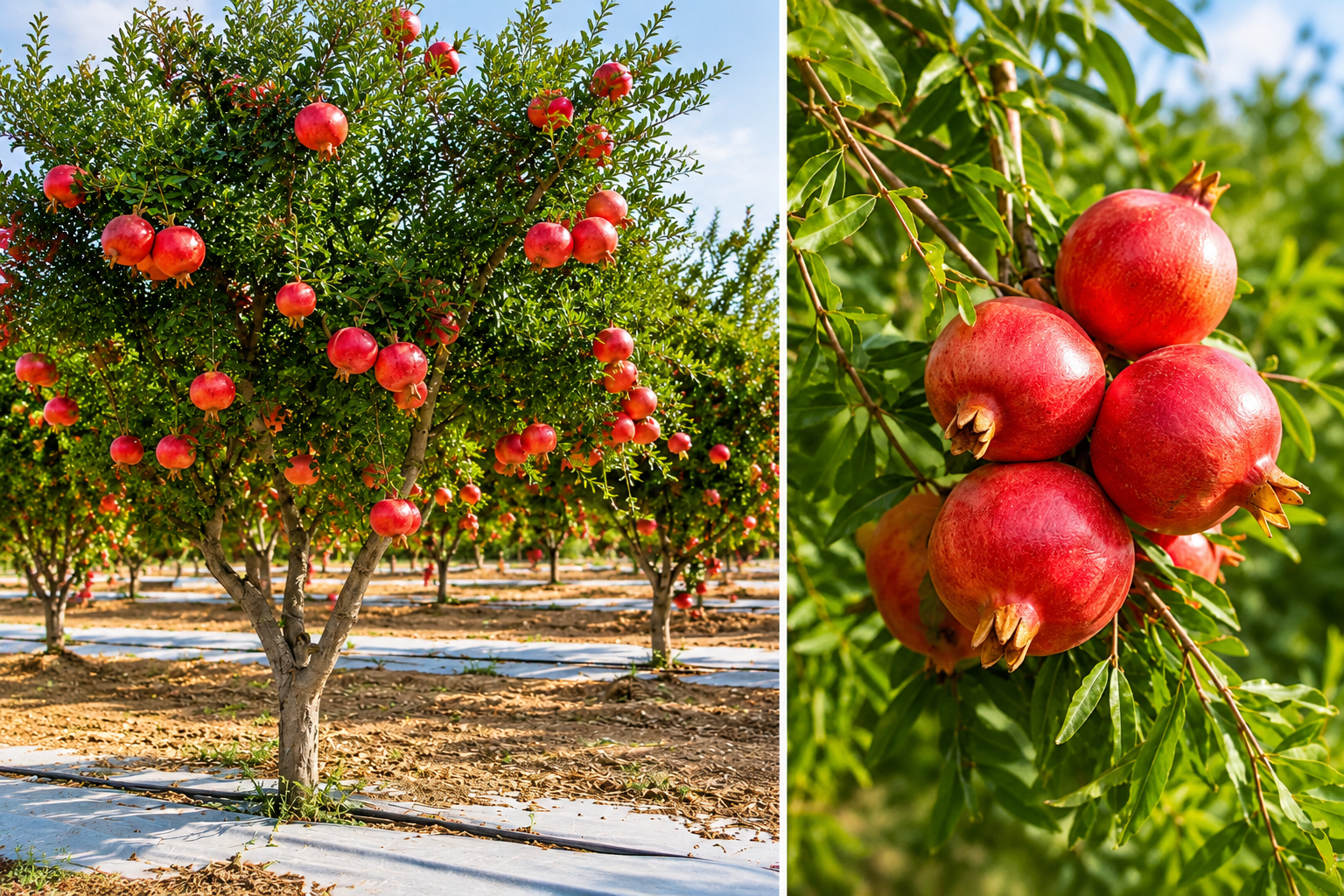
Quick Answer — The pomegranate is Tunisia’s autumn fruit: the Romans named it the Punic apple after Carthage, and it still grows in two great terroirs — the maritime oasis of Gabès, where it ripens in the shade of date palms from mid-September, and Testour, the Andalusian town in the north whose dark-red fruit comes in from mid-October and gets its own festival at the turn of November. Tunisia expects around 98,000 tonnes in 2026, and the local Gabsi variety is the one to look for. Buy them heavy for their size, eat them with a splash of orange-blossom water, and if you can, time your trip for the harvest. Here’s the whole story.
There is a moment in late September when the fruit stalls of Tunis change colour. The last of the summer melons and grapes are still there, but behind them, stacked in pyramids that catch the low light, are the pomegranates — leathery, lopsided, blushing from gold to a red so deep it looks bruised.
A vendor will split one for you with a knife and a flick of the wrist, and the inside is a mosaic: hundreds of glassy garnet seeds packed as tightly as tiles in a Kairouan mosque. In a country that measures its year in harvests — the olives in the winter, the dates in late autumn — the pomegranate is the fruit that opens the season, and the one Tunisians eat with their hands, on the balcony, before the cold comes.
Most travelers never think of it as Tunisian at all. That’s a mistake worth correcting, because few fruits are as bound up with this particular stretch of coast.
The Punic Apple
Start with the name. The Romans called the fruit malum punicum — the Punic apple, the apple of Carthage — and the botanists kept the memory: the tree’s genus is still Punica, and the fruit is Punica granatum, the “seeded apple” that gave the English word its shape.
It was almost certainly the Phoenicians who carried the tree west from the Levant, and it appears among the goods that flowed through Carthage’s ports alongside olives, wine, garlic, and the garum the Romans became addicted to — the whole inventory is in our guide to Carthaginian trade. By the first century CE, Pliny the Elder was already noting the pomegranate trees of Gabès, which means the orchards you can walk today have been on the same ground, more or less, for two thousand years.
The fruit carried meaning as well as trade value. Pomegranates turn up in Punic tombs and on Punic stelae, offerings for the dead and emblems of fertility, and that symbolic charge never quite left. Across the Mediterranean it became the fruit of Persephone and of the Song of Songs; in the Qur’an it is one of the fruits of paradise; and in Tunisia today it sits in the same folk register as the hand of Fatima and the evil-eye bead — a shape you find embroidered on trousseaux, painted on ceramics, and, in Testour, worn as a symbol of the town itself. It is one of those Carthaginian habits Tunisians keep without noticing.
Gabès: Pomegranates in the Shade of Palms
If the pomegranate has a capital, it is Gabès, the southern city that is the only place in the country to be both a port and an oasis. The oasis is layered the way all Saharan gardens are — date palms above, fruit trees in their shade, vegetables at their feet — and in Gabès the fruit tree under the palms is, overwhelmingly, the pomegranate.
The sea air and the brackish springs give the fruit a character growers swear by: a Gabès pomegranate ripens on the tree without help, colours slowly, and has a sweetness cut with just enough acid to make you reach for another. The local variety is called simply Gabsi, and it is the one Tunisians mean when they say romman with any affection. The Tozeur palmeraie grows the same layered way, but there the date is king and the pomegranate a courtier; in Gabès the roles are reversed.
The numbers bear it out. Gabès is consistently the country’s largest producing governorate — around a fifth of national output in 2025, and forecast at just over 17,000 tonnes for 2026. The region’s fruit also carries Tunisia’s only recognised pomegranate geographical indication, the “Grenade de Gabès,” though the label has so far gone unused in the trade.
The season opens here first: harvesting begins around the middle of September, which is why the Gabsi is the first pomegranate to reach the northern markets each year. AMAN – TAP – Testour : la 9e édition du Festival de la Grenade du 29 octobre au 2 novembre 2025 en quête du label AOC +2
Testour: The Andalusian Harvest
The other pomegranate town could not be more different. Testour sits in the wheat country of the northwest, above the Mejerda river, a town rebuilt from scratch in 1609 by Muslims and Jews expelled from Spain — the Great Mosque with its backwards clock and its Stars of David is the most photographed façade in the region, and the whole story of exile and coexistence is in our Testour article.
What the Moriscos brought with them, beyond architecture and malouf, was agriculture: irrigation know-how and cuttings, and among the cuttings, the pomegranate. Locals say the refugees favoured it precisely because its thick peel protects the fruit on a long journey — a plausible reason a fruit became a town’s emblem. The National
Four centuries on, Testour’s pomegranates are famous for their dark, almost black-red colour and their late ripening; the harvest here starts around mid-October, a month behind Gabès, and runs into December. Around 90% of the Beja governorate’s crop comes out of Testour, which puts a town of 14,000 people at the centre of one of the country’s biggest fruit economies — roughly 17,000 tonnes expected in 2026, neck and neck with Gabès. A protected appellation d’origine contrôlée for the “Grenade de Testour” has been in the works for several years, and the town’s answer to the waiting has been to celebrate instead. allAfrica.comLeconomiste Maghrebin
The Testour Pomegranate Festival runs every year across the last days of October and the first of November. The ninth edition, in 2025, ran from 29 October to 2 November with a produce fair, conferences on Andalusian farming and Moorish water heritage, a “cuisine du terroir” day of pomegranate dishes by Tunisian chefs, and folk performances to close. The tenth edition should follow the same calendar this year; check the municipality’s announcements in mid-October.
What you actually experience is simpler than the programme suggests: stalls of fruit lining the narrow streets, malouf ensembles in the square, and pomegranates selling at a dinar and a half or two per kilo — a price that makes you buy more than you can carry. A small cooperative of local women, with a Romena Tour circuit that strings together juice-makers, restaurants, and an embroiderer who stitches nothing but pomegranates, has begun offering workshops for visitors. Pair the festival with Dougga, forty minutes up the road, and you have the classic day trip from Tunis with a harvest at its centre — the full Roman circuit is in our Dougga guide. African ManagerLa Presse
The Varieties, and a Record Season
Tunisia grows at least a dozen named pomegranates, most of them known only inside the country.
Gabsi is the benchmark: medium-sized, pink-to-red skin, juicy, sweet-tart, with seeds soft enough to eat without thinking.
Zehri is paler and sweeter, the one for children and for juicing. Tounsi is the everyday market fruit of the north.
Chelfi is the sour one, kept for cooking and for the tart syrup Tunisians drizzle over salads. Then there is a scattering of local names — Djebali, Kalaai, Baldi, Zaghouani, Andalsi — that tell you where a cutting came from more than what it tastes like.
The curious footnote: a variety known abroad as the “Tunisian soft-seed” has become a prized commercial pomegranate in China, where growers advertise its near-seedless arils and where it fetches prices its ancestors in Gabès would find unbelievable.
The industry behind all this is modest by world standards but growing. Tunisia’s orchards cover about 12,300 hectares, and after a dip to 91,000 tonnes in 2025 from 102,900 the year before, the 2026 crop is forecast at 98,000 tonnes, an 8% recovery. Beyond the two big terroirs, Nabeul and Kairouan each contribute around 14,000 to 15,000 tonnes.
Tunisia exported to around ten countries in 2025, with Libya the traditional buyer just across the Ras Jedir crossing, and a new domestic promotion campaign — in Arabic and French with English subtitles — is being rolled out this autumn to get Tunisians eating more of their own fruit. The honest caveat, the same one that hangs over the olive and the date: the 2023 harvest in Beja fell 40% on drought and heat, and water is the pomegranate’s future as much as it is its past. Testour : la 9e édition du Festival de la Grenade du 29 octobre au 2 novembre 2025 en quête du label AOC | African Manager +3
How Tunisians Eat Them
The first way is the only way that matters: broken open, seeds tipped into a bowl, eaten with a spoon. A Tunisian grandmother will add a spoon of sugar and a splash of orange-blossom water — mazhar — and that combination, garnet seeds glistening under a floral perfume, is the taste of a Tunisian October. It is also the base of the breakfast that has been eaten in the countryside for centuries: zamit with pomegranate, roasted barley flour folded through the seeds with olive oil and honey, a dish so old it predates bread in some households. Our guide to what Tunisians eat for breakfast puts it in context.
From there the uses spread out. Juice pressed on the street corner in Gabès and Sfax, sold in a plastic cup and gone in three swallows. Seeds scattered over a winter salad of oranges and fennel. The pomegranate molasses that Tunisian kitchens have borrowed from the Levant for lamb and for slow-cooked aubergine. And a use nobody exports: the peel, dried and ground, was a dye for wool and a tanning agent for leather, which is one reason Gabès — also the country’s henna capital — has always smelled faintly of colour. Wear gloves when you deseed one, as the zamit recipe warns; the juice stains fingernails for a day.
Buying, and Timing Your Trip
Read the fruit. Weight is everything: a good pomegranate feels heavier than it looks, because weight is juice. The skin should be taut and slightly leathery, not glossy, with flattened, angular shoulders rather than a perfect sphere — the sides square off as the arils swell inside. Colour is a poor guide; a Gabsi can be pink-gold and perfect, a Testouri nearly black and just as good. Avoid soft spots and cracks unless you’re eating it that day.
Know the calendar. Gabsi fruit from mid-September; northern fruit from mid-October; the whole country in peak supply through November, tapering into December when the last Testour fruit is sold from cold stores. By spring you are eating imports or nothing. This makes the pomegranate one of the best arguments for visiting in the golden months, when the olives are also coming in and the ruins are empty.
Store them whole. A pomegranate keeps for weeks in a cool room and a couple of months in the fridge; the seeds, once out, last a few days chilled and freeze well. If you want to take some home, a tin of Testour pomegranate molasses or a bottle of the local grenadine travels better than the fruit — see what else to buy in Tunisia for the rest of the edible souvenirs.
The Romans looked at this fruit and saw Carthage; Testour looks at it and sees Granada; a Tunisian looks at it and sees October. All three are right, and the easiest way to understand a country that has absorbed so many others is to sit down in its harvest season with a bowl of garnet seeds and a spoon.
From the Carthage Magazine Bookshelf
If the pomegranate has you plotting an autumn trip — Gabès, Testour, and the tables in between — these three go with you.
- All About Tunisia — the definitive English-language traveler’s guide. 572 pages, 27 chapters, all nine regions, every UNESCO inscription, five thematic trails — and the practical answers (visa, currency, transport, etiquette) most travelers wish they’d had on the plane. $24.99 · PDF & EPUB.
- Speak Like a Local — 200+ Tunisian Arabic phrases with native audio recorded in Tunis. The phrases for the taxi, the souk, the café, and the dinner table. $14.99 · PDF, EPUB, MP3.
- The Authentic Tunisian Cookbook — sixty traditional recipes from the heart of North Africa. For when you get home and find yourself missing the food. $9.99 · PDF & EPUB.
All three available as a bundle for $39.99 — guide, language, and food, delivered together.
