
Quick Answer — Every autumn, Tunis hosts three “Days of Carthage” festivals, one after another. In 2026 the Carthage Music Days (JMC) run October 3–10, the Carthage Theatre Days (JTC) November 21–28, and the Carthage Film Days (JCC) — Africa’s oldest film festival, celebrating its 60th anniversary — December 12–19. Despite the name, almost everything happens in central Tunis, around Avenue Habib Bourguiba and the Cité de la Culture, not among the ruins. Tickets are cheap, audiences are local and loud, and together the three make the best argument there is for spending autumn in the capital instead of on the coast.
There is a saying in Tunis that summer belongs to the tourists and autumn belongs to the city. By late September the beach crowds have gone, the heat has broken, and the capital’s cultural life walks back onto Avenue Bourguiba as if it had only stepped out for a coffee. Summer’s International Festival of Carthage plays to the Roman theatre on the hill. The Carthage Days play to downtown — to the old cinemas, the small theatres, the Cité de la Culture’s great concrete halls, and the café terraces where every performance is argued over afterwards.
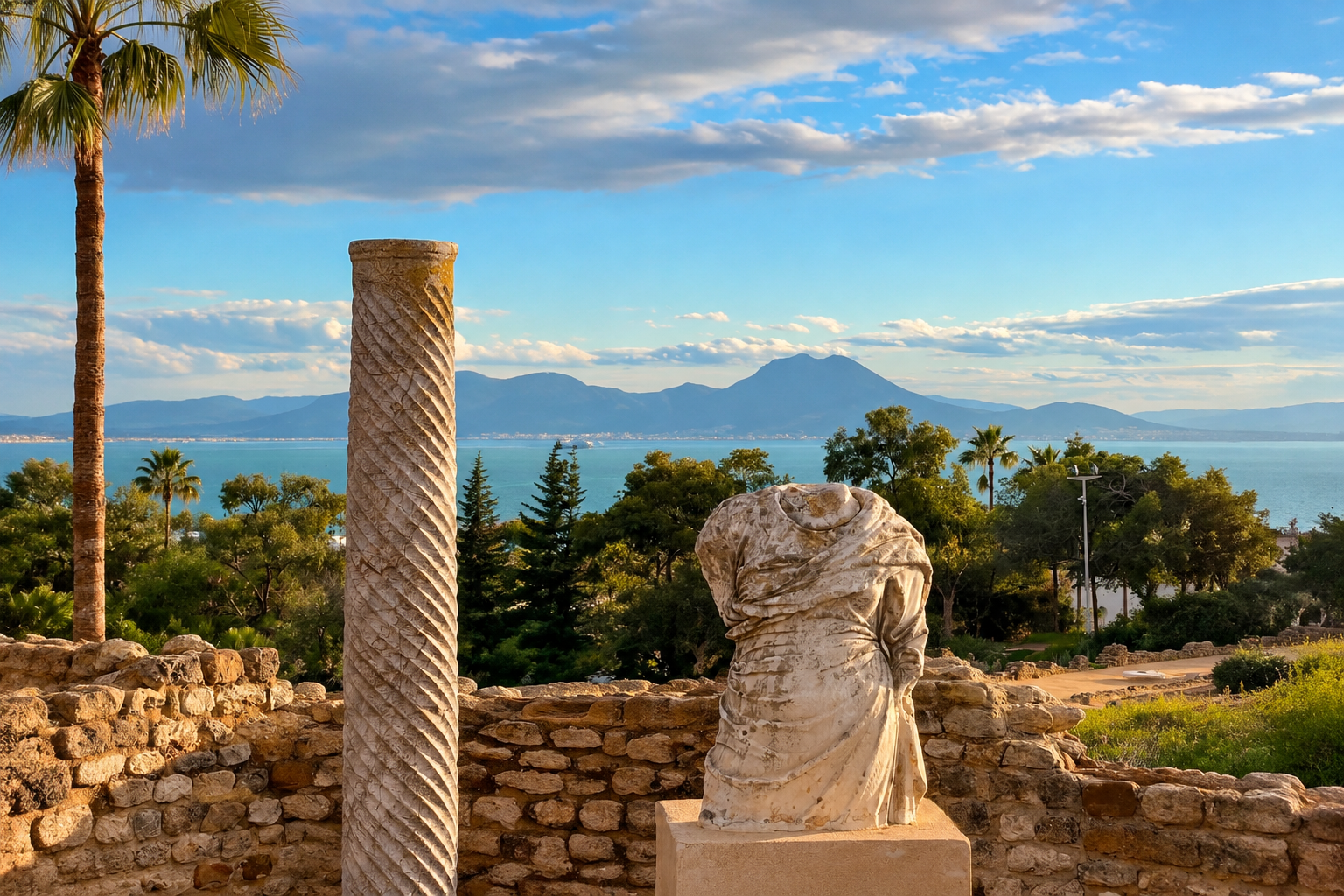
The name confuses almost everyone. None of these festivals takes place in the ruins of Carthage; “Carthage” is the brand, the word Tunisians attach to anything they are proud of, from the airport to the national football team. For visitors this is good news. Everything is walkable from a hotel downtown or at the edge of the medina, and you can see a concert, a play and a film in the same week without ever getting in a car.
The Music Days (JMC): October 3–10
The youngest of the three, and the most outward-looking. The 11th edition is directed by the musician and producer Mondher Falleh, who has built this year’s programme around the Mediterranean — a festival conceived as a bridge between the Maghrebi, African, Arab and European shores. From 378 applications received from every continent, the selection committee chose 26 projects. That tells you what the JMC is: a showcase for new work rather than a parade of stars, with a competition, emerging acts, and the occasional late-night set that turns out to be the best thing you hear all year.
The dates are news in themselves. The last edition ran in January; this year the festival returns to its traditional autumn slot, a move its organisers hope will give it a steadier place in the calendar. Past editions have spread across the capital — the Cité de la Culture, the Opera theatre, open-air sets on the Avenue, and the Ennejma Ezzahra palace in Sidi Bou Said — so check each concert’s venue before you set out. For a sense of the music the JMC champions, read our profile of Imed Alibi, who directed the 2019 edition, and our guide to Tunisian music.
The Theatre Days (JTC): November 21–28
The Journées Théâtrales de Carthage are the region’s great theatre gathering, bringing companies from across the Arab world and Africa to Tunis for a week. The 27th edition is directed by the actor Slim Sanhaji.
Now the honest note. Most productions are performed in Arabic — often Tunisian Derja — or French, and surtitles are the exception rather than the rule. If language is a barrier, choose physical theatre, dance or music-led productions. Or go anyway, for the audience: Tunisian theatregoers treat a premiere the way other countries treat a cup final. And if you only see one show, see it at the Municipal Theatre on Avenue Bourguiba — the white Art Nouveau “Bonbonnière” is worth the ticket on its own.
The Film Days (JCC): December 12–19
The oldest and most famous of the three — and this year a milestone. The 37th edition marks the festival’s 60th anniversary, under the direction of the filmmaker Mokhtar Laâjimi, with four competitions: fiction features, documentary features, short films, and Carthage Ciné-Promesse, a section for emerging talent. Screenings take over the old cinemas along the Avenue from morning to midnight, queues wrap around the colonial arcades for Arab and African premieres, and the Golden Tanit remains one of the most meaningful prizes either cinema can win.
The JCC is also the most accessible of the three for visitors: much of the programme screens with French and often English subtitles. Everything you need is in our full JCC guide; for a warm-up, start with ten Tunisian films that are works of art.
Making It Work
Tickets. Expect to pay a few dinars at the box office, with day-of queues part of the experience. Full programmes are often published only a week or two before each festival opens, and the first place they appear is each festival’s official social media pages — follow them as the dates approach.
Where to stay. Downtown or the medina edge, so you can walk home after late screenings and concerts. For once, the touristic suburbs are the wrong address. Our guide to where to stay in Tunis covers the options.
Weather. October is still warm, November mild and green, and December evenings call for a proper jacket. The numbers are in our month-by-month weather guide.
Combine. A single autumn week can hold a JMC concert, a morning at the ruins, an afternoon in Sidi Bou Said and a night at the theatre. Our autumn guide and Tunis travel guide will help you fill the gaps.
One last honest note. Tunisian festivals are organised by public institutions, and programmes, venues and even dates can shift late. That is not a reason to stay away; it is a reason to check the week before you go — and to leave room for the concert nobody told you about.
FAQ
When are the Carthage festivals in 2026? The Music Days run October 3–10, the Theatre Days November 21–28, and the Film Days (JCC) December 12–19.
Are the Carthage Days held in Carthage? Mostly not. The main venues are in central Tunis — especially along Avenue Habib Bourguiba and at the Cité de la Culture.
Do I need to speak Arabic or French? For the music, no. For the theatre, it helps a great deal. For the films, much of the JCC programme is subtitled in French and often English — check each screening.
How much do tickets cost? Very little by European standards — typically a few dinars, bought at the venue.
What is the difference between the International Festival of Carthage and the Carthage Days? The International Festival of Carthage is a summer concert series held in the Roman theatre of Carthage; its 60th edition ran from July 16 to August 19, 2026. The Carthage Days are three separate autumn festivals for music, theatre and film, held mainly in Tunis.
From the Carthage Magazine Bookshelf
If the festivals have you planning an autumn in Tunis, these three will take you further:
- All About Tunisia — the definitive English-language traveler’s guide. 572 pages, 27 chapters, all nine regions, every UNESCO inscription, five thematic trails. $24.99 · PDF & EPUB.
- Speak Like a Local — 200+ Tunisian Arabic phrases with native audio recorded in Tunis. For the box-office queue and the arguments afterwards. $14.99 · PDF, EPUB, MP3.
- The Authentic Tunisian Cookbook — sixty traditional recipes from the heart of North Africa. $9.99 · PDF & EPUB.
All three available as a bundle for $39.99 — guide, language, and food, delivered together.
