
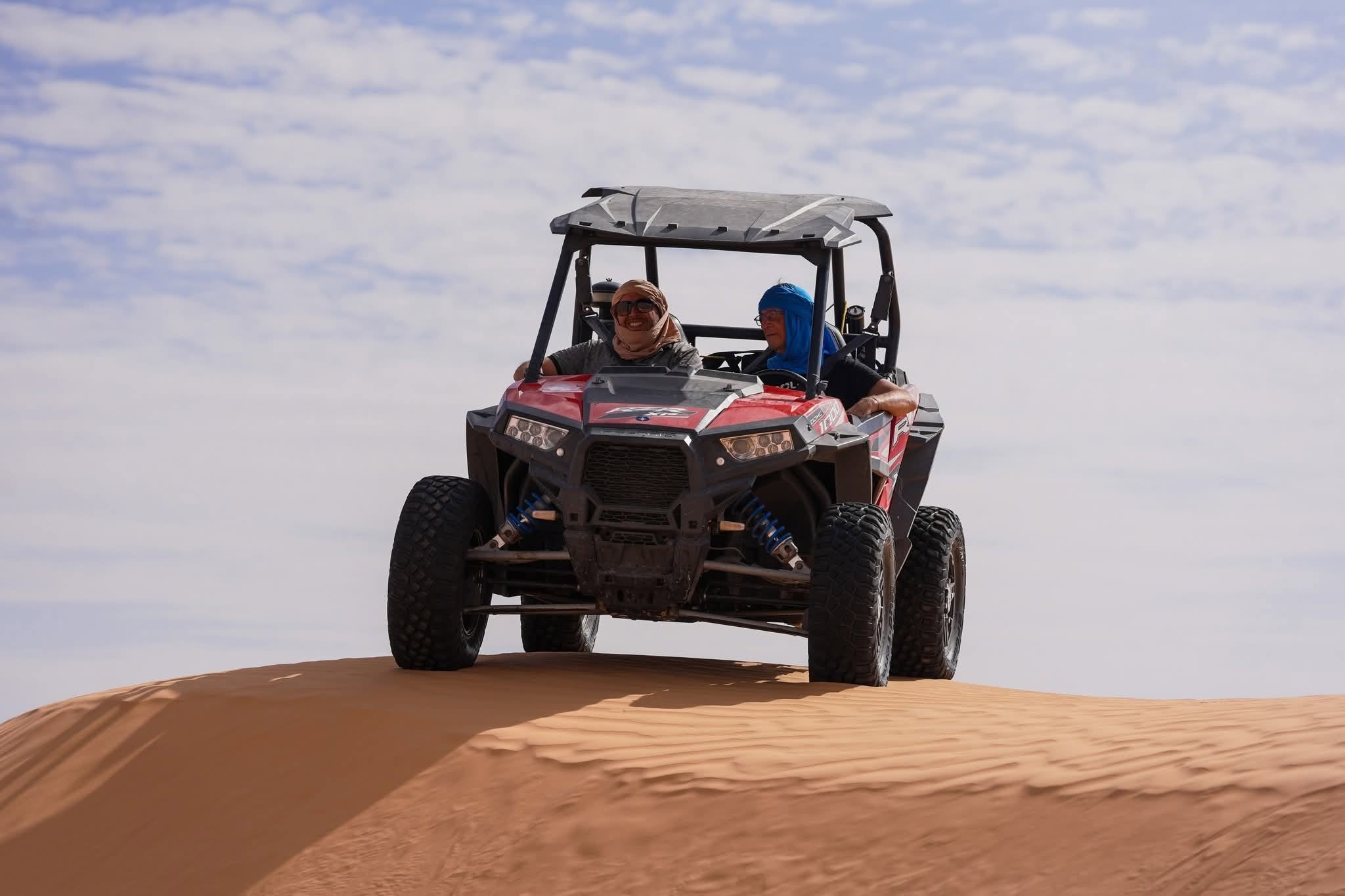
Every country with a desert has a town that calls itself the gateway to it. Douz has the better claim than most, because the claim is literal: walk south from the last café on the last street and within a few hundred metres the palm trees stop, the ground turns to sand, and the dunes start, small ones first, then the long rolling ridges of the Grand Erg Oriental that carry on, unbroken, to Algeria and Libya. There is no transition. Douz is the end of settled Tunisia, and it is where almost every camel that has ever carried a tourist into the Sahara set off from. This is the guide to the town itself: what’s in it, what’s around it, when to come, and how to get there from everywhere else.
The Short Answer
Douz is a market town of about 40,000 people at the southern edge of the Nefzaoua oases, 475 km south of Tunis, 125 km east of Tozeur, and 30 km from Kebili, the governorate capital. It is the classic base for camel treks and desert camps, which leave from the Great Dune at the end of the hotel zone or from the smaller oases of Zaafrane, Sabria and Nouil just beyond town. In town there’s a good Thursday market, a small Sahara museum worth half an hour (5 dinars, closed Mondays), a palm grove of half a million trees, and an arcaded central square. For four days in late December it hosts the International Festival of the Sahara, Tunisia’s oldest festival; the 58th edition runs 19–22 December 2026. Come from October to April, allow two nights, sleep one of them in the dunes, and arrive by louage via Kebili, by car from Tozeur across the Chott el Jerid, or by road from Djerba in about four hours. Douz and everything in this guide are outside the UK Foreign Office’s southern advisory zones, which begin 75 km from the Libyan border, well to the east.
Where Douz Is, and Who Lives There
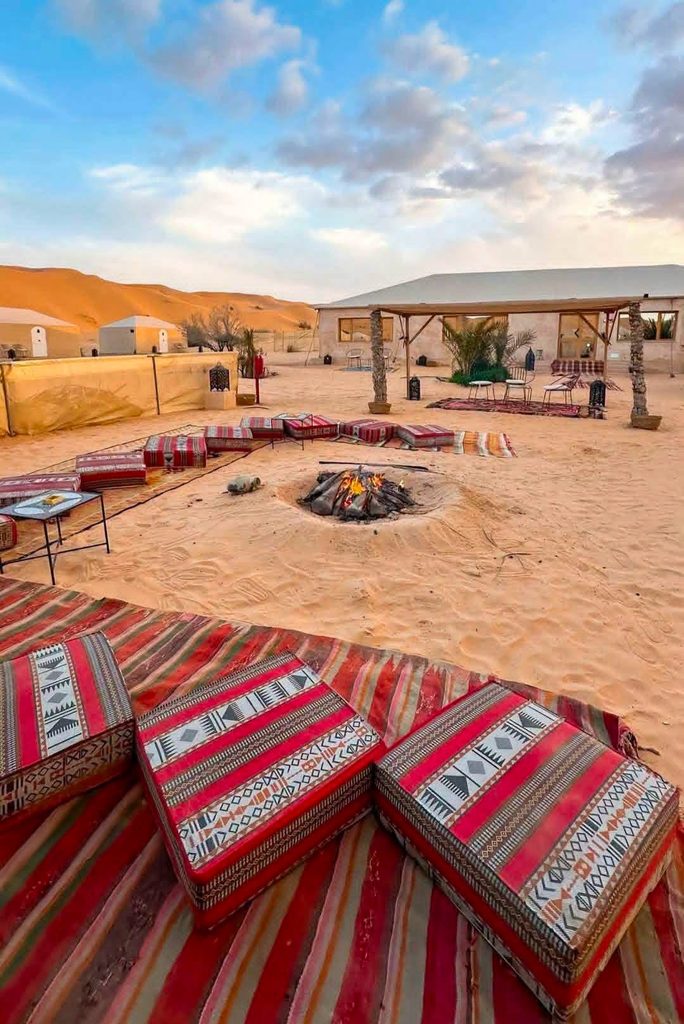
Douz sits on the southern rim of the Nefzaoua, the string of oases that fringes the Chott el Jerid on its eastern side, in the Kebili governorate, which grows more dates than any other in Tunisia. The town is the home of the Mrazig, a tribe of semi-nomadic herders who settled here over the last century and a half without entirely giving up the tent: many families still keep camels and still move stock out into the Erg in winter, which is why the camels you ride here belong to people who actually use them. The oasis is big, half a million palms by the usual count, and the Deglet Nour dates harvested here in October and November are among the best in the country. Beyond the palms, in every direction but north, is sand.
The town itself is low, sand-coloured and unhurried, and it divides into three: the centre around the arcaded square and the market; the palm grove, threaded by irrigation channels and farm tracks; and the zone touristique, a kilometre-long strip of hotels running south-west out of town to the Great Dune, where the asphalt ends.
In Town: The Square, the Market, the Museum
The square. Place des Martyrs, with its whitewashed arcades, is the centre of Douz and the place for a coffee and a look at the town going about its business. The festival’s great parades and camel races happen at H’naïch square on the edge of the palm grove, a short walk south.
Thursday market. Douz’s weekly souk is the best in the south and the one thing worth planning your arrival around. The main market fills the streets off the square with dates, spices, sacks of grain, blankets and the woven goat-hair textiles the Mrazig make; behind it, the livestock market is the real spectacle, with camels, sheep and goats changing hands between men in burnouses who have come in from the desert for the day. Go early, by nine, and expect it to be winding down by noon. Our weekly markets guide has the rest of the region’s market days.
The Sahara Museum. Small, state-run and better than it looks, the museum on the road out towards the hotel zone covers nomad life in the Nefzaoua: the dromedary and everything made from it, the goat-hair tent and its furnishings, saddlery, weaving, men’s and women’s costume, the heavy silver jewellery of the women, and the tattoos they once wore. It is the half-hour that makes the camel trek make sense, and the sensible order is museum first, dunes second. Open 9:30–16:00 in winter, 7:00–14:00 in summer, 8:00–15:00 in Ramadan; closed Mondays; 5 dinars for foreign visitors, 4 for residents.
The palm grove. Walk or cycle the tracks through the oasis in the late afternoon. It is cooler than the town, loud with birds, and you’ll see the three-storey agriculture of a working oasis, palms over fruit trees over vegetables, and the water being shared out along the channels.
The Great Dune and the Zone Touristique
At the end of the hotel strip the road simply stops at the Grande Dune, a big crescent of sand that is the first real dune most visitors ever climb. This is where the hour-long camel rides, the quad bikes and the sand-boarding happen, and at sunset in high season it can feel like a beach. It is not the Sahara; it is the doorstep. Climb it anyway for the view south, which is the view of nothing, all the way to the horizon, and then go further.
The hotels along the strip are the standard three- and four-star desert hotels of the Tunisian south, with pools and large dining rooms built for tour groups; they are comfortable, reasonably priced outside festival week, and have the advantage of being on the sand. Douz also has a handful of simpler hotels in town and a growing number of guesthouses in the palm grove, which are quieter and closer to real life. In festival week, book months ahead or stay in Kebili.
Into the Dunes: Camel Treks and Desert Camps
This is what you came for, and the choice is simple: an hour at the Great Dune, a sunset-to-sunrise night in a camp, or several days of real travel in the Erg. Do the night at minimum. The desert at four in the afternoon with a tour bus idling is not the desert; the desert at dawn, with the wind down and frost on the blanket, is.
The treks leave from Douz and from three small oases beyond it that are, in truth, better starting points: Zaafrane, 12 km south-west, the Mrazig’s second village and the traditional camel-trek base, where the dunes are bigger and emptier; Sabria, further on, at the edge of the tallest dunes in the region; and Nouil, east of town. Between them are a dozen permanent desert camps, from rows of canvas tents around a fire to properly comfortable set-ups with beds, showers and a cook, which is what became of the “glamping” that Douz pioneered in the 2010s. A night in one, with the camel ride out, dinner, breakfast and pickup, costs around $100–150 per person in 2026; a multi-day caravan into the Sabria dunes and the Erg runs from $250 to $600. Our camel trekking and desert tours guide covers operators, what’s included, what to pack and how not to get burned, and our Sahara field guide sets Douz in the wider south. Two rules: book with a Douz or Zaafrane operator rather than a coastal agency if you can, and never go into the Erg beyond the camps without a local guide who knows the wells.
The Sahara Festival
For four days each December, Douz is the centre of the Saharan world. The International Festival of the Sahara began in 1910 as a marriage market and gathering of the tribes and is now the country’s oldest festival: camel racing and camel-wrestling, fantasia horsemen firing muskets at the gallop, sloughi greyhound races, a hare hunt, poetry contests, a staged Bedouin wedding, and music into the night, with tens of thousands of visitors from across North Africa. The 58th edition runs 19–22 December 2026. Our Sahara Festival guide has the programme, an honest note on the crowds, and how to plan around it.
Day Trips and Onward
Douz is a corner, and the roads out of it are part of the point.
- Ksar Ghilane (about 120 km south-east): the hot-spring oasis at the Roman empire’s last outpost, now reachable on a mostly paved road, with its own camps and the best dunes in the country. Our Ksar Ghilane guide has the route; it’s a long day trip or, better, the next night.
- The Chott el Jerid and Tozeur (125 km west): the causeway across the salt lake is one of the great drives in North Africa, and Tozeur with its brick medina, mountain oases and Star Wars sets is the other half of any southern trip.
- Kebili and the old oases (30 km): the abandoned old village of Kebili, the Roman pool at Ksar Ghilane’s cousin El Mansoura, and the quieter oases of Blidet and Jemna, where the date harvest is the whole economy.
- Matmata and the Dahar (about 100 km east): the troglodyte houses of Matmata by the road across the hills, and beyond them the ksour of Tataouine and the coast at Gabès.
Douz is day three or four of our southern Tunisia road trip, and that loop from Djerba is the easiest way to put all of this together.
When to Go
October to April. Autumn brings the date harvest and warm, clear days; December has the festival and the sharpest light, with nights near freezing in the dunes; February and March are the sweet spot for trekking, warm by day, cold enough at night to make the fire matter, and before the spring winds. Avoid June to September, when daytime temperatures pass 45°C and most camps close. Whatever the month, pack for two seasons in one day; our Tunisia packing list and winter guide have the detail, and the short version is a fleece, a hat for the night and a scarf for the sand.
Getting There
- From Tunis: 475 km. The SNTRI night bus runs daily and takes about eight hours; louages go to Kebili (six hours) with a 30-minute hop to Douz. By car, allow seven hours via Kairouan and Gafsa or via Gabès.
- Via Tozeur: the fastest way in. Fly Tunis–Tozeur (an hour) or take the train or bus, then two hours by car or louage across the Chott.
- From Djerba, Gabès and the coast: about four hours from Djerba via the causeway, Gabès and Kebili, or the more scenic route through Matmata; two and a half hours from Gabès. This is the route most coastal tours use.
- From Ksar Ghilane: two to three hours by 4×4 or, these days, a careful saloon car on the paved sections.
Fill the tank in Douz; the next fuel south is a long way off. Cash too: there are banks and ATMs in town, none in the dunes.
A Note on Safety
Douz, Zaafrane, Sabria, Nouil and Ksar Ghilane are all outside the UK Foreign Office’s current southern advisory areas, which cover the zone within 75 km of the Libyan border (Remada, El Borma, Ben Guerdane) and the militarised zone beyond. The deep pistes south and east of Ksar Ghilane towards those areas are a different matter: they need permits, a guide and a reason, and no tourist operator goes there. Within the area in this guide, the risks are the ordinary desert ones, heat, cold, distance and getting lost, and a local guide covers all four. Our is Tunisia safe guide has the broader picture.
Frequently Asked Questions
Yes, if you want the dunes; it is the easiest place in North Africa to step off a paved road into the Sahara. Give it two nights, one of them in a camp.
Being the gateway to the Grand Erg Oriental, the Thursday camel market, the International Festival of the Sahara each December, and Deglet Nour dates.
125 km (two hours), about 250 km (four hours) and 475 km (seven to eight hours).
19–22 December 2026, the 58th edition.
From Tozeur, yes, but you’d miss the point. From the coast, only as part of a two- or three-day desert tour.
No. The nearest is Tozeur-Nefta, 130 km away, with flights from Tunis; Djerba’s airport is about four hours by road.
Not for Douz, the oases or the road to Tozeur. For Ksar Ghilane a 4×4 is still the comfortable choice, and for anything into the Erg you go by camel or with a guide’s vehicle.
From the Carthage Magazine Bookshelf
For the desert south, the words to use around the campfire, and the food to cook when you’re home and missing it, three ebooks from the magazine.
- All About Tunisia — the definitive English-language traveler’s guide. 572 pages, 27 chapters, all nine regions, every UNESCO inscription, five thematic trails — and the practical answers (visa, currency, transport, etiquette) most travelers wish they’d had on the plane. $24.99 · PDF & EPUB.
- Speak Like a Local — 200+ Tunisian Arabic phrases with native audio recorded in Tunis. The phrases for the taxi, the souk, the café, and the dinner table. $14.99 · PDF, EPUB, MP3.
- The Authentic Tunisian Cookbook — sixty traditional recipes from the heart of North Africa. For when you get home and find yourself missing the food. $9.99 · PDF & EPUB.
All three available as a bundle for $39.99 — guide, language, and food, delivered together.
