
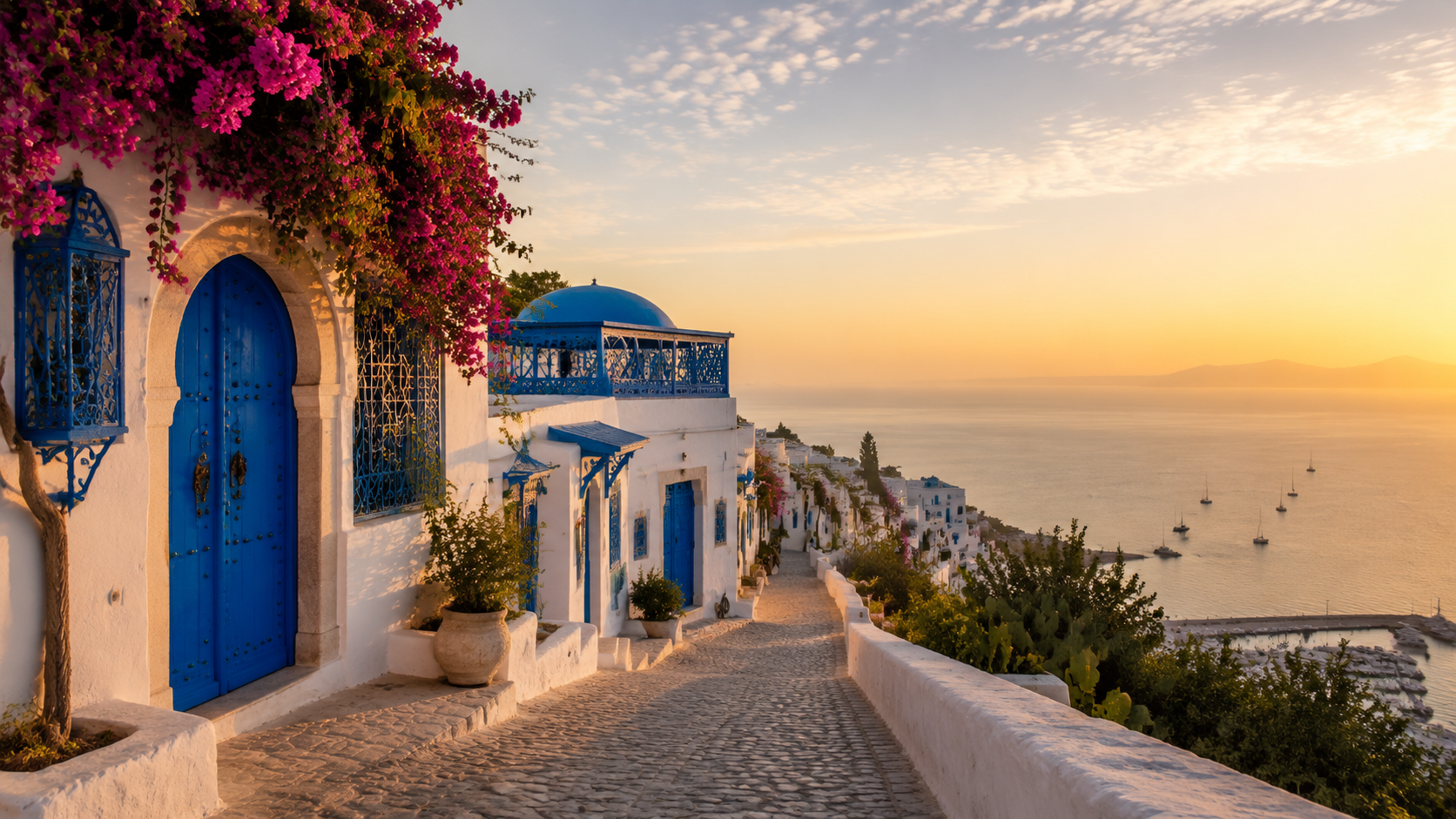
You can stand inside a Roman amphitheatre that once held thirty-five thousand people, eat a fried-tuna sandwich on a harbour wall, and watch the sun fall over the Gulf from a blue-and-white café — all before dinner, all in the same small country. Tunisia packs three thousand years and three distinct landscapes into a space you can cross in a day’s drive: the Mediterranean north, the resort coast, and the Sahara that begins where the olive groves end.
This is the problem with planning a trip here. Not too little to do — too much, scattered across nine regions, with no honest map of what is worth the detour and what is a postcard you can skip. So we built one. What follows is the Carthage Magazine bucket list: the things to do in Tunisia that we, writing from Tunis, would actually send a friend to do. Each entry links to the full guide if you want to go deeper.
The Quick Answer.
If you have one week, the classic loop is Tunis and its medina, the ruins of Carthage, Sidi Bou Said, a day at El Jem, and a southern leg into the Sahara around Tozeur and Douz. If you have a long weekend, stay north: the capital, Carthage, and the blue village are a perfect three-day arc reachable by a single train line. Beach travelers should base on the eastern coast around Hammamet or Sousse; archaeology travelers should head inland, where the greatest concentration of Roman sites in North Africa waits with almost nobody in the frame.
Now, the long version — organised the way the country actually unfolds.
Walk Through the Ruins of Carthage.
Start where the country’s name comes from. Carthage is the city that once rivalled Rome, and the surprise of visiting is how little of it looks like a ruin and how much of it looks like a garden on a hill above the sea. You come for stones and you leave remembering the view. The Antonine Baths — one of the largest bath complexes the Roman world ever built — sit right on the water, their scale legible even in fragments. On Byrsa Hill, the Acropolium, a former cathedral from the French colonial era, crowns the site where the Carthaginian citadel once stood.
Carthage is a twenty-minute train ride from central Tunis on the TGM line, which makes it the easiest world-class archaeological site you will ever reach. Do not rush it, and do not do it as a tiring day trip from the coast when you could simply sleep in the capital.
Get Lost in the Medina of Tunis.
The capital is where most trips begin and the place most rushed travelers undersell. Its medina is a living UNESCO-listed labyrinth, and the right way to enter is through the Bab el Bhar — the Sea Gate — and simply let the souks pull you in. At its heart stands the Great Mosque of Ez-Zitouna, the oldest and most significant mosque in the city, its courtyard built from columns quarried out of Carthage itself.
Beyond the obvious, seek out the restored medieval townhouses now serving as small museums, the tiled mausoleum of the bey-kings, and at least one working hammam. And give an afternoon to the Bardo’s mosaics — Tunisia holds the finest collection of Roman mosaics on earth, and seeing them is one of the genuinely unmissable things to do in the country. For a stranger entry on the capital’s itinerary, the abandoned island fortress of Fort Santiago on Chikly sits marooned in the Lake of Tunis, and the nineteenth-century Municipal Theatre is a white wedding-cake of a building worth a look on any walk through the Ville Nouvelle.
Climb to the Blue Doors of Sidi Bou Said.
Three stops up the TGM line from Carthage is the village that launches a thousand postcards. Sidi Bou Said is all white walls and cobalt-blue doors and bougainvillea spilling over the cliff above the Gulf, and yes, it is touristy, and yes, it is still worth every minute. The classic move is to arrive in the late afternoon, climb to a café at the top, order a mint tea with pine nuts, and stay through sunset. If you want the village hour by hour, our companion piece on the ten best things to do in Sidi Bou Said maps it out.
Stand Inside the Colosseum of the South.
Two and a half hours south of Tunis, rising out of a flat town with no warning, is the Amphitheatre of El Jem — the greatest Roman colosseum in North Africa and one of the best-preserved anywhere. You can walk the corridors beneath the arena floor where gladiators and animals once waited, then climb to the upper tiers for a view across the rooftops. It is reachable by train and bus from Tunis, Hammamet, and Sousse, and it is the single most cinematic stop in the country.
Disappear into the Roman Interior.
Here is the secret most package itineraries miss: the densest, most atmospheric Roman ruins are not on the coast at all — they are inland, and you will often have them nearly to yourself. The underground villas of Bulla Regia, where wealthy Romans built entire floors below ground to escape the heat, are unlike any other site in the Mediterranean — their mosaics are still in place, in situ, on the floors people once walked. Further south, the temple-lined forum of Sbeitla (Sufetula) stands almost complete, three honey-coloured temples in a row. Both reward the traveler willing to rent a car and drive into the country’s quiet interior. The full set of the country’s UNESCO World Heritage Sites is the ambitious archaeologist’s checklist.
Cross into the Sahara.
The desert is the reason many people come, and it does not disappoint. The south is gateway country: oasis towns where palm groves meet the dunes, and where the great sand sea of the Sahara begins. Near Tozeur, the cliffside oasis of Chebika — water spilling out of bare mountain rock into a green ribbon of palms — is the lost-paradise image of Tunisia made real. From the desert towns you can arrange camel treks, 4×4 runs across the chotts, and nights under a sky with no light pollution for hundreds of kilometres.
And then there is the pilgrimage every fan secretly wants to make. Tunisia was Tatooine: George Lucas filmed across the south, and many of the Star Wars sets still stand in the desert near Matmata and Nefta, weathering quietly between sandstorms. Visiting them is one of the most purely fun things to do in Tunisia, and the drive there is half the experience.
Spend a Day on the Island of Djerba.
In the deep south, the island of Djerba mixes long beaches with one of the oldest continuous Jewish communities in the world. Its spiritual centre, the El Ghriba Synagogue, is the oldest synagogue in Africa and the focus of an annual pilgrimage. Djerba has its own airport, which means you can fly straight in from Europe and skip the eight-hour drive from the capital — worth knowing if the south is your priority.
Walk the Ribats of the Coast.
The eastern coast is where Tunisia goes to the beach, but it is also lined with medieval Islamic fortresses called ribats, built to watch the sea for raiders. The Ribat of Sousse, an eighth-century fort with a watchtower you can still climb, anchors a medina that is a UNESCO site in its own right. Down the coast, the Ribat of Monastir is the oldest Islamic fortress in North Africa — and so photogenic it has stood in for Jerusalem in more than one film. Base yourself on this coast if your trip is built around sun, sand, and a short hop to a thousand years of history.
Escape to the Green North.
Most visitors never learn that Tunisia has a forest. The northwest is mountain country — cork oaks, cooler air, and a landscape that looks nothing like the brochures. The mountain town of Aïn Draham, up near the Algerian border, is the heart of it, and a revelation for anyone who thinks North Africa is only desert. Offshore, the Galite Islands — uninhabited, hard to reach, ringed with clear water — are the country’s last true wilderness. And inland, Testour, a town built by Andalusian Muslims and Jews who fled Spain, wears its layered heritage in its architecture and its music. For travelers who want to sleep under the stars, our guide to the best places to camp in Tunisia covers the coast, the mountains, and the desert.
Ride the Red Lizard.
For a single unforgettable half-day, board the Red Lizard Train (Lézard Rouge) — a restored early-twentieth-century beylical train that threads the Selja Gorges in the southwest, hanging over canyon drops and slipping through tunnels cut into the rock. It is the most scenic rail journey in the country and one of those experiences that turns a checklist into a memory.
Eat Your Way Through Tunisia.
You have not visited Tunisia until you have eaten it. Start with our guide to the twenty foods you have to eat, then commit to the essentials: a properly built fricassé — the small, slightly sweet fried roll stuffed with tuna, egg, olives and harissa that is the national street snack — and a plate of true Tunisian couscous, the country’s national dish, which bears almost no resemblance to the boxed version abroad. In summer, work through the fruits of Tunisia, from prickly pears sold off carts to the dates of the southern oases.
Listen, and Watch Things Being Made.
Culture here is not behind glass. A Tunisian wedding will teach you more about Tunisian music — the courtly malouf, the raw mezoued, the trance of stambeli — than any concert hall. In the north, the women of Sejnane still shape and fire pottery by hand using techniques three thousand years old, a craft now recognised by UNESCO. And to understand the country beneath the Arab and Roman layers, read up on its Amazigh (Berber) heritage — the people who were here first, and whose warrior-queen Al-Kahina once defied an empire. You will start seeing the sign of Tanit, the Carthaginian moon goddess, everywhere once you know to look for her.
Before You Go.
A great trip here is built on a few practical decisions made early. Sort out whether you need a visa with our entry guide, get your head around the Tunisian dinar — a closed currency with rules worth knowing before you land — and time your visit using our best-time-to-visit breakdown, where spring and autumn win. Plan how you will get there and how you will move around once you have arrived, decide where to stay, and check the cost of living so nothing surprises you. A handful of Tunisian Arabic phrases will open more doors than you expect — though you will also find that English goes further here than most travelers assume.
Tunisia rewards the traveler who arrives prepared — and then lets the country surprise them anyway. Welcome. Marhba bik.
From the Carthage Magazine Bookshelf
If the flight is booked — or close to it — three Carthage Magazine ebooks were built for exactly the days between arrival and departure:
- All About Tunisia — the definitive English-language traveler’s guide. 572 pages, 27 chapters, all nine regions, every UNESCO inscription, five thematic trails — and the practical answers (visa, currency, transport, etiquette) most travelers wish they’d had on the plane. $24.99 · PDF & EPUB
- Speak Like a Local — 200+ Tunisian Arabic phrases with native audio recorded in Tunis. The phrases for the taxi, the souk, the café, and the dinner table. $14.99 · PDF, EPUB, MP3
- The Authentic Tunisian Cookbook — sixty traditional recipes from the heart of North Africa. For when you get home and find yourself missing the food. $9.99 · PDF & EPUB
All three available as a bundle for $39.99 — guide, language, and food, delivered together.
