
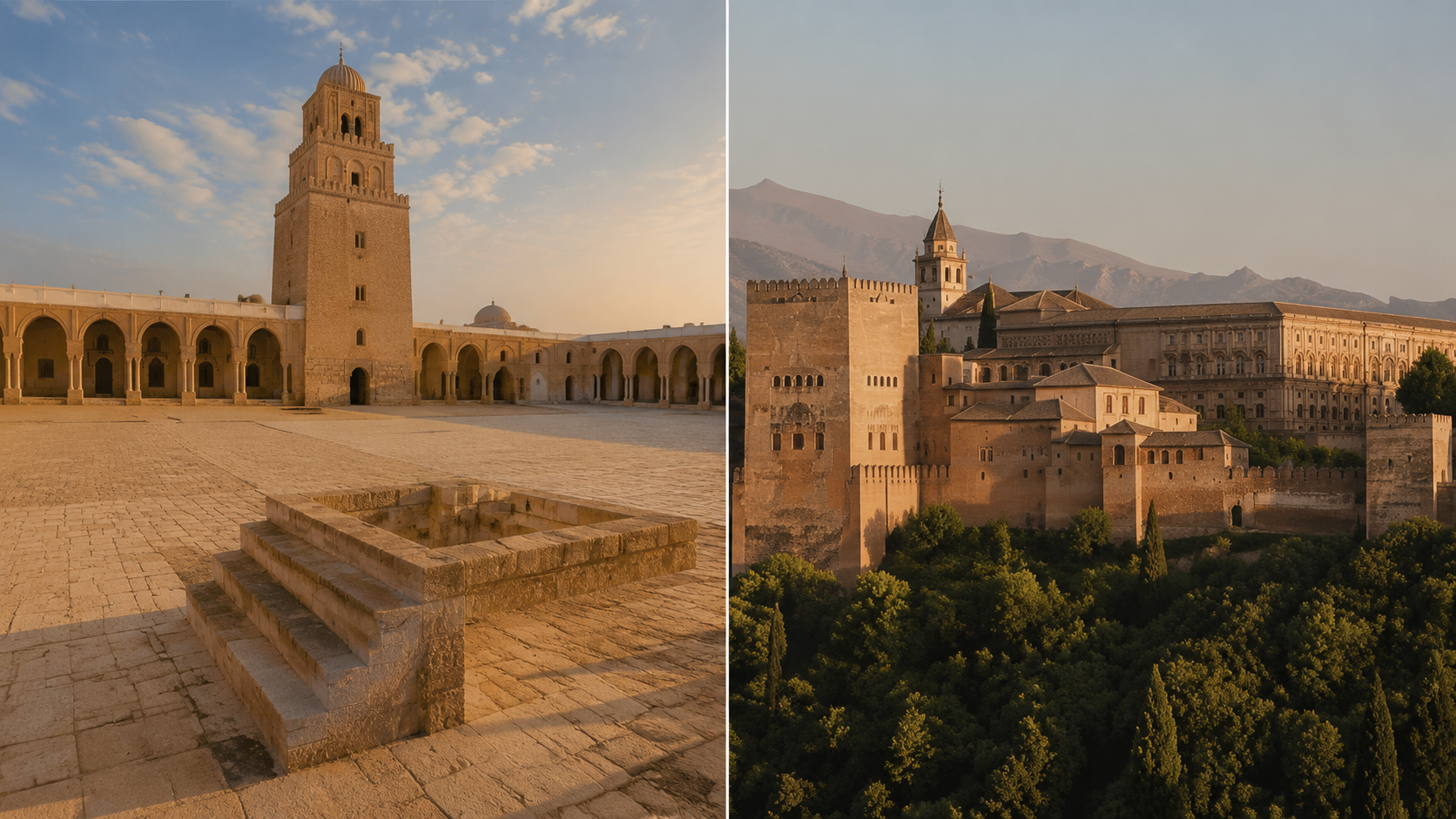
Quick Answer Spain is one of the most complete travel countries on earth — great cities, world-class food, beaches and islands, and a tourism machine that runs like clockwork — and it out-points Tunisia on most of those headline measures. Spain wins on cities (Barcelona, Madrid, Seville), on the Alhambra and Gaudí, on the food and nightlife scene, and on EU ease. Tunisia wins on value, on having its ancient sites nearly empty, on Carthage and the world’s largest mosaic collection, on a real Sahara — and on a quietly beautiful twist: when Muslim Spain fell, much of Andalusia moved to Tunisia, so the culture you admire in Granada partly lived on here. If you want the famous, polished Spanish trip, go to Spain. If you want the affordable, uncrowded version with a surprising thread back to Al-Andalus, go to Tunisia.
Two admissions before the case.
The first: I’m writing from Tunis — apply your discount. The second: Spain is genuinely one of the best all-round travel countries anywhere, and on several of the things travellers most want, it simply wins. I won’t pretend otherwise. But there’s a thread running between these two countries that makes the comparison more interesting than most — a shared Andalusian inheritance — and once you see it, a Tunisia trip reads differently.
The Honest Short Answer
If you want the polished, world-famous Spanish holiday — Gaudí’s Barcelona, the Prado and the Alhambra, tapas crawls and late dinners, Andalusian white towns, the islands — and EU seamlessness, go to Spain. For most travellers it’s the obvious, excellent answer.
If you want a quieter, much cheaper Mediterranean trip with deep history and far fewer people — Carthage and the Roman cities, the planet’s greatest mosaic collection, warm uncrowded beaches, a real Sahara — and a living link to the Andalusia you’d cross Spain to see — go to Tunisia. Is it worth it? We think so.
How They Compare — Geography, Scale, Climate
Spain is a country of around forty-eight million covering most of the Iberian Peninsula, plus the Balearic and Canary Islands — a big, varied country of green north, central plateau, Mediterranean and Atlantic coasts, and a tourism industry that is among the largest and most refined on earth. It rewards a long, ambitious itinerary.
Tunisia is a country of twelve million on the edge of the Maghreb, just south of Sicily — a short flight from the Spanish Mediterranean. One long coast, a compact Roman interior, the Sahara five hours south of the capital. It’s small, warm, and low-friction; most trips work from a single base.
Spain offers scale, polish, and variety; Tunisia offers compactness, calm, value, and a desert. And, unusually for any two countries, they share a chapter of history — which is where the Tunisia case gets its best line.
Where Spain Wins
The categories where Spain is the better choice, plainly stated.
The cities. Barcelona, Madrid, Seville, Granada — there is no Tunisian equivalent, and I won’t invent one. Tunis has a lovely UNESCO medina and a graceful capital I’d recommend to anyone, but Spain’s great cities are in another league of scale and spectacle.
Architecture’s headline acts. Gaudí’s Sagrada Família and Park Güell; the Alhambra in Granada, perhaps the most beautiful building in the Mediterranean world. Tunisia’s Islamic architecture is wonderful — the Great Mosque of Kairouan, the Tunis medina — but the Alhambra and Gaudí are singular.
The food and nightlife scene. Spain’s culinary culture — tapas, jamón, the late-night rhythm, the world-ranked restaurants — is one of the most celebrated anywhere, and its nightlife is legendary. Tunisia’s food is excellent but quieter, and its nights far more low-key.
Infrastructure. High-speed AVE trains, dense flights, polished resorts. Spain moves you around effortlessly.
If any of these is the reason you’re going, book Spain with confidence.
Where Tunisia Wins
Now the other side — including the line only Tunisia can play.
Value. Tunisia’s clearest win. Spain is mid-to-upper-priced by Mediterranean standards and rising in the hotspots; Tunisia is inexpensive across hotels, meals, taxis, guides, entrance fees, and wine. The cost-of-living guide has the detail; your money goes far further.
The Andalusian thread. This is the comparison’s best surprise. When the last Muslims and many Jews were expelled from Spain in the early seventeenth century, great numbers of these Andalusians crossed to Tunisia and settled — founding towns like Testour, with its Spanish-tiled minaret, and shaping Tunisian music (the malouf), crafts, and cooking. Travel in Tunisia and you are, in a real sense, visiting where Al-Andalus continued after Granada fell. For anyone moved by the Alhambra, that’s a profound and little-known counterpart.
Antiquity, nearly alone. Spain has fine Roman remains; Tunisia has spectacular ones you can have to yourself — El Jem, the third-largest Roman amphitheatre ever built, walked with a handful of others; Dougga on a quiet weekday — plus Carthage, Rome’s great rival, and the largest mosaic collection on earth. On ancient depth without crowds, Tunisia wins comfortably.
A real Sahara. Spain has Andalusia’s semi-deserts, but nothing like Tunisia’s south — true dunes, oases, Star Wars sets, nights under the desert sky. A Tunisia-only experience.
Calm and space. Spain’s coasts and headline cities are heavily touristed; Barcelona has spent years pushing back against overtourism. Tunisia’s pressure is gentle and its great sites quiet. If breathing room is the goal, Tunisia has it.
Where It’s Genuinely Close
Taste calls, these.
Beaches. Spain has the Costas and the Balearics; Tunisia has long warm sand at Hammamet, Djerba, and the Cap Bon, emptier and cheaper. Spain wins variety; Tunisia wins space and price.
Food. Spanish cuisine is more celebrated, but Tunisian food shares Spain’s love of seafood, peppers, and the long table — and the two share dishes and ingredients carried across by those same Andalusian migrants. Different, both very good.
Warmth of welcome. Both are warm, sociable cultures. No clear winner; you’ll be looked after either way.
Practicalities — Visas, Money, Getting There
Entry. Spain is in the Schengen area (visa-free short stays for many; Schengen visa for others). Tunisia is visa-free for up to 90 days for most European, North American, and many other travellers — the visa guide has specifics.
Money. Spain is on the euro; Tunisia uses the dinar, obtained on arrival and far stronger in practice.
Getting there and around. Both are easy from Europe; flights to Tunisia are cheap and frequent. Spain’s trains are excellent; in Tunisia, getting around means short drives and louages, with everything close.
The Verdict — Who Should Pick Which
Choose Spain if you want the great cities, the Alhambra and Gaudí, the food-and-nightlife scene, and the polish of one of the world’s top tourism countries. It’s a superb, dependable choice.
Choose Tunisia if you want the same sun and sea for far less, if empty ancient sites and a Sahara appeal more than another city break — and especially if the idea of visiting where Andalusia lived on after 1492 gives you a reason to look across the water. It’s the contrarian’s pick, with an unexpectedly poetic payoff.
Still deciding? Read the rest of the series — Greece, Italy, Malta, Egypt, Turkey, Morocco — and sketch a week in Tunisia.
From the Carthage Magazine Bookshelf
If the Andalusian thread has you curious, three Carthage Magazine ebooks were built for the visit:
- All About Tunisia — the definitive English-language traveler’s guide. 572 pages, 27 chapters, all nine regions, every UNESCO inscription, five thematic trails, and the practical answers most travelers wish they’d had on the plane. $24.99 · PDF & EPUB
- Speak Like a Local — 200+ Tunisian Arabic phrases with native audio recorded in Tunis. $14.99 · PDF, EPUB, MP3
- The Authentic Tunisian Cookbook — sixty traditional recipes from the heart of North Africa. $9.99 · PDF & EPUB
All three available as a bundle for $39.99 — guide, language, and food, delivered together.
