
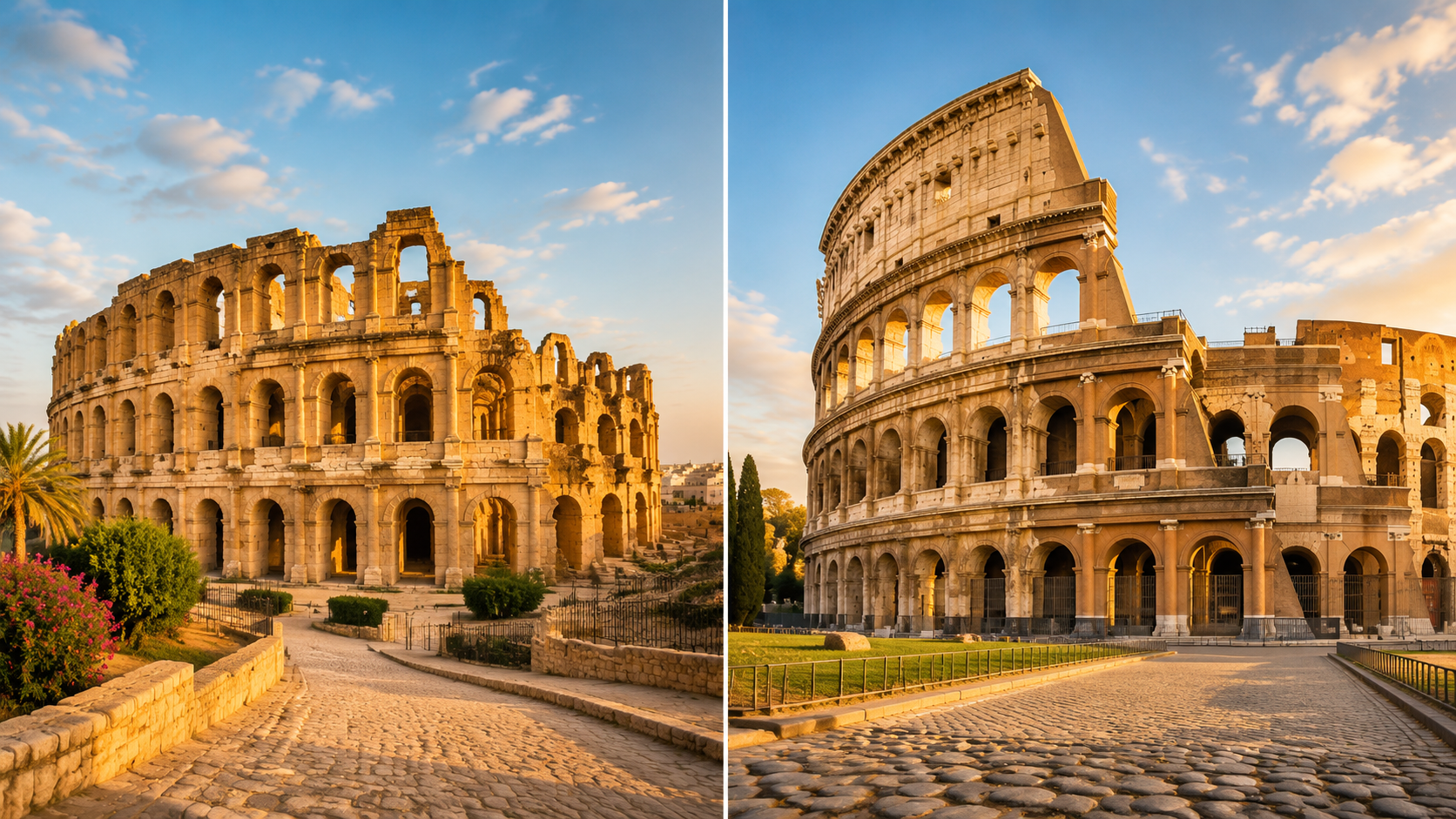
Quick Answer Italy is one of the greatest travel countries that has ever existed, and on art, cities, and the sheer cultural density of the place, nothing in this series — Tunisia included — comes close. Italy wins on Rome, Florence and Venice, on Renaissance art, on the most beloved cuisine on earth, and on infrastructure. Tunisia wins, surprisingly, on Rome’s other half: it has Roman cities you can walk almost alone, the largest collection of Roman mosaics anywhere, and Carthage — the empire Rome spent a century trying to destroy — all for a fraction of Italian prices and with none of the crowds. If you want the canonical European grand tour, go to Italy. If you love the Roman world but not the queues and the bill, Tunisia is the plot twist. The honest move, if you can: pair them. Tunis is a short hop from Sicily.
Two admissions first, because this is the second-hardest comparison to win from Tunis (after Turkey), and you’d stop trusting me if I pretended otherwise.
The first: I’m writing from Tunis, so discount accordingly. The second: Italy is extraordinary, and in the categories most travellers care about most — cities, art, food, romance — it wins, and several of those wins aren’t close. This isn’t a piece that will claim the small country to the south beats Italy on the grand tour. What it will argue is narrower and, I think, genuinely useful: that for one specific kind of traveller — the one who loves Roman ruins and loathes crowds — Tunisia offers something Italy structurally cannot anymore.
The Honest Short Answer
If you want the canonical version of Europe — the Colosseum and the Forum, the Uffizi and the Duomo, the canals of Venice, the Amalfi Coast, Pompeii, the food that needs no introduction — go to Italy. For a vast number of travellers this is simply the right answer, and it earns it several times over.
If you want the Roman world without the crush, at North African prices — the third-largest Roman amphitheatre ever built nearly to yourself, Carthage where it actually stood, the planet’s largest mosaic collection, plus a Sahara Italy can’t offer — go to Tunisia. Different traveller, different trip. Wondering if it’s worth it at all? Here’s the straight answer.
How They Compare — Geography, Scale, Climate
Italy is a country of about sixty million, a long peninsula plus Sicily and Sardinia, reaching from Alpine north to Mediterranean south, packed with world-class cities, art, and coastline, and welcoming tens of millions of visitors a year into one of the most mature tourism economies on earth. It is varied, deep, and — in its famous places — very busy.
Tunisia is a country of twelve million on the edge of the Maghreb, just south of Sicily — closer to Palermo than Palermo is to Milan. One Mediterranean coast, a compact interior of Roman cities, and the Sahara about five hours south of the capital. You can drive it end to end in a day, and most trips work from a single base.
Italy offers staggering range and density; Tunisia offers compactness, calm, and a desert. They are, improbably, near neighbours across a narrow sea — which is exactly why the smart play is often both.
Where Italy Wins
Let me be straight about where Italy is the better choice, because the list is long and several entries are decisive.
The cities. Rome, Florence, Venice, Naples — there is no Tunisian answer, and I won’t insult you by manufacturing one. Tunis has a beautiful UNESCO medina and a graceful capital, and I’d send anyone to it gladly. It is not Rome, and nothing in Tunisia is. If great cities are the spine of your trip, Italy wins before we start.
Art. The Renaissance is Italy’s alone — the Sistine Chapel, the David, the Uffizi, Caravaggio in churches you stumble into by accident. Tunisia’s visual treasure is its mosaics, which are genuinely the best in the world of their kind — but the painted, sculpted, architectural canon of Italy is in a category of one.
Food’s home advantage. Tunisian food is wonderful (I’ll defend it below), but Italian cuisine is the most universally beloved on the planet, and eating it on its own soil is a pilgrimage in itself. On sheer culinary fame and reliability, Italy wins.
Infrastructure. High-speed trains, dense flights, slick logistics. Moving around Italy is effortless in a way Tunisia’s more modest network isn’t quite.
If any of these is your reason to travel, book Italy without a second thought.
Where Tunisia Wins
Now the case — and it’s more pointed than Italy’s grandeur might lead you to expect, because it turns Italy’s own subject against it.
Value. Tunisia’s clearest win. Italy in season — Venice, Rome, the Amalfi Coast, Florence — is expensive and getting more so. Tunisia is inexpensive across hotels, meals, taxis, guides, entrance fees, and wine. The cost-of-living guide has the numbers; the short version is that your budget goes several times further.
Rome’s empire, without Rome’s crowds. Here is the twist that makes this comparison worth writing. Italy has the centre of the Roman world — and the queues to match. Tunisia has the Roman provinces, and you can have them almost alone. El Jem is the third-largest amphitheatre the Romans ever built, and you may share it with a dozen people. Dougga is one of the best-preserved Roman towns anywhere; Bulla Regia has Roman villas you descend into, underground, mosaics still on the floors; Sbeitla has a forum and three temples standing in open country. If you love Roman ruins, Tunisia offers the rare modern luxury of solitude among them.
Carthage — Rome’s great rival, on its own ground. Italy tells the story from the winner’s side. Tunisia gives you the loser’s: Carthage, the city of Hannibal and Dido, the only power that made Rome tremble for a hundred years, standing where it actually stood above the Bay of Tunis. There is no equivalent on the Italian map.
A real Sahara. Italy has Alps, coast, and volcanoes, but no desert. Tunisia’s south — dunes, oases, Star Wars sets — is a genuine Sahara, close and cheap. A desert night is a Tunisia-only line here.
Calm. Italy’s famous places now strain under their own popularity; Venice and Florence are studies in overtourism. Tunisia’s pressure is light and its great sites quiet. If what you want from a holiday is space, Tunisia has it in abundance.
Where It’s Genuinely Close
A couple of categories come down to taste.
Food (yes, really). Italian cuisine wins on fame and consistency — but Tunisian food holds its own as an experience: harissa and couscous, fresh Mediterranean fish, brik, the sweet-and-savoury depth of a cuisine far less known abroad. You will not eat better-known food in Tunisia; you may well eat more surprising food. Italians, incidentally, would recognise Tunisia’s love of pasta — nwasser, makarouna — left behind by a shared sea.
Beaches and coast. Italy has the Amalfi drama; Tunisia has long, warm, uncrowded sand at Hammamet, Djerba, and the Cap Bon. Italy wins the postcard; Tunisia wins the elbow-room and the price.
Coffee culture. Both take coffee seriously and sit over it for hours. A genuine draw.
Practicalities — Visas, Money, Getting There
Entry. Italy is in the Schengen area (visa-free for short stays for many nationalities; a Schengen visa for others). Tunisia is visa-free for up to 90 days for most European, North American, and many other visitors — see the visa guide.
Money. Italy is on the euro; Tunisia uses the dinar, obtained on arrival, and worth far more in practice.
Getting there and around. Both are easy to reach from Europe; flights to Tunisia are cheap and frequent, and Tunis is a short hop from Sicily. Inside Italy, the trains are superb; inside Tunisia, getting around is short drives and louages.
The Verdict — Who Should Pick Which
Choose Italy if you want the cities, the art, the food’s home turf, and the grandest version of the European trip. It is, on most measures, peerless, and this comparison doesn’t pretend otherwise.
Choose Tunisia if you love the Roman world specifically and want it without the crowds and the cost — Carthage, El Jem, Dougga, a roomful of mosaics — with a Sahara thrown in and change left over. It is the connoisseur’s contrarian pick, and a deeply satisfying one.
And the honest best answer, given the geography, is and rather than or: a few days in Sicily and a short flight south. While you weigh it, the rest of the series — Greece, Spain, Malta, Egypt, Turkey, Morocco — and our 7-day Tunisia itinerary will help you decide.
From the Carthage Magazine Bookshelf
If the Roman south is calling, three Carthage Magazine ebooks were built for the trip:
- All About Tunisia — the definitive English-language traveler’s guide. 572 pages, 27 chapters, all nine regions, every UNESCO inscription, five thematic trails, and the practical answers most travelers wish they’d had on the plane. $24.99 · PDF & EPUB
- Speak Like a Local — 200+ Tunisian Arabic phrases with native audio recorded in Tunis. $14.99 · PDF, EPUB, MP3
- The Authentic Tunisian Cookbook — sixty traditional recipes from the heart of North Africa. $9.99 · PDF & EPUB
All three available as a bundle for $39.99 — guide, language, and food, delivered together.
