
This article contains affiliate links. If you book through them, Carthage Magazine earns a small commission at no extra cost to you — it’s part of how we keep our guides free and independent.
Quick Answer — Tunisia is one of the easiest, best-value family destinations in the Mediterranean — a short hop from most of Europe, reliably warm, genuinely affordable, and famously fond of children. The big resort towns of Hammamet, Sousse, and Djerba offer gentle beaches and family hotels; a short drive inland brings Roman ruins and Star Wars film sets that turn a history lesson into an adventure; and the edge of the Sahara delivers camel rides and cave houses that no child forgets. Tunisians adore kids, the food is easy to love, and the whole trip costs a fraction of a European beach holiday. The honest verdict: it’s a brilliant family choice.
There’s a particular kind of holiday that works for everyone in the family — warm enough for the beach, cheap enough not to flinch at, short enough to fly to before nap time, and interesting enough that the adults don’t quietly lose their minds. Tunisia, it turns out, is exactly that holiday, and Europeans have known it for decades.
What follows is an honest guide to Tunisia with kids: where to base yourself, what will actually delight them, what to feed them, and the practical things worth knowing before you go.
Is Tunisia Good for a Family Holiday?
In a word, yes. A handful of things make it stand out.
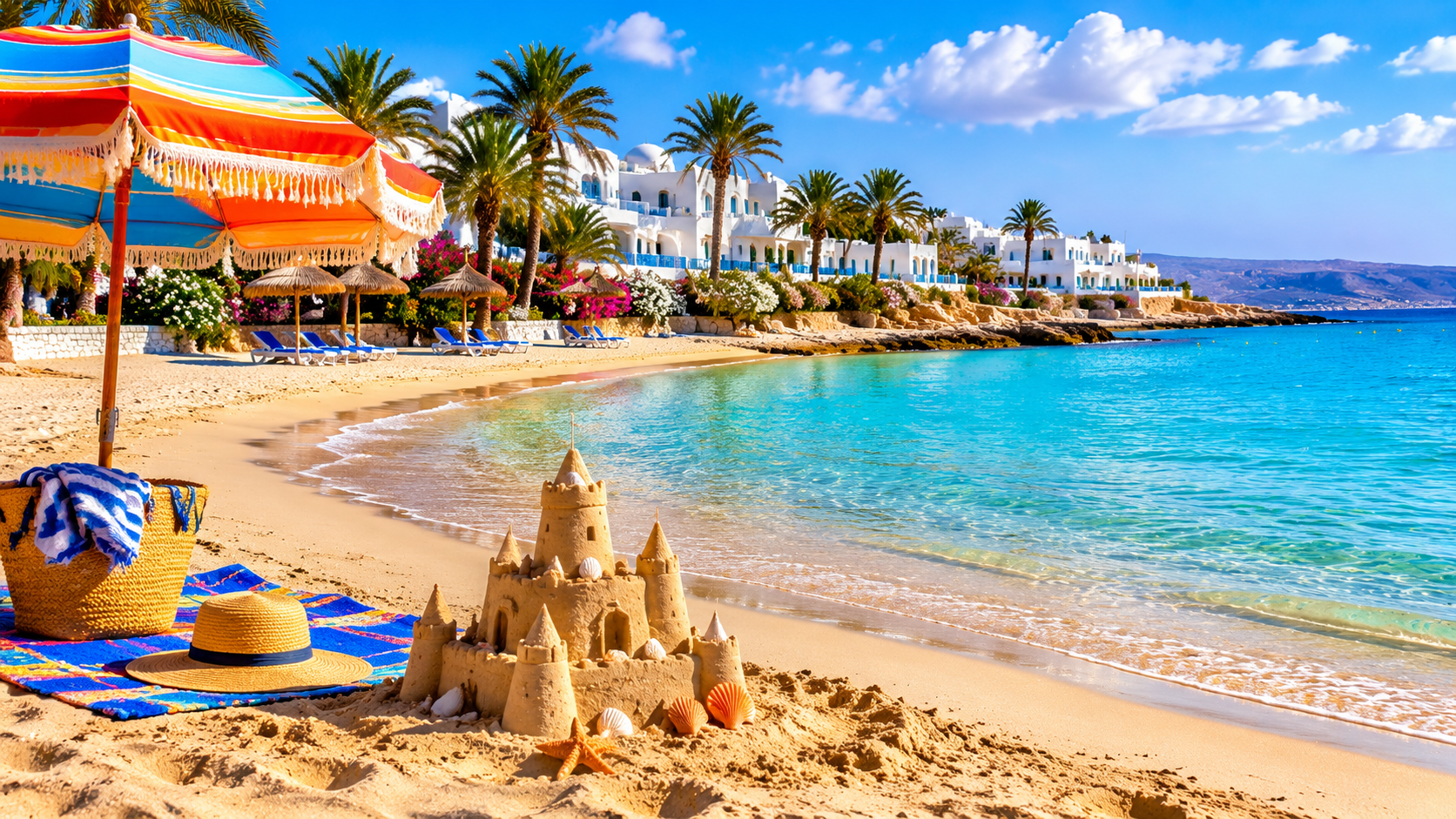
It’s close and cheap: just a two-to-three-hour flight from much of Europe, with a cost of living so low that meals out, ice creams, and excursions barely register against the price of the same trip in Spain or Italy. It’s warm for much of the year, with a long, dependable beach season. And — this matters more than any guidebook lets on — it is a country that genuinely loves children. Tunisians fuss happily over kids, welcome them everywhere, and will make a toddler feel like visiting royalty. Travelling with young children here is met with warmth, not impatience.
It is also, for the avoidance of doubt, a relaxed and welcoming place to visit, a question we’ve tackled honestly in our guide to whether Tunisia is safe.
The Easy Base: Hammamet, Sousse, and Djerba
For most families, the trip is built around a beach resort, and three stand out.
Hammamet is the classic family choice — Tunisia’s original resort town, with soft sandy beaches, calm water, gardens, and a concentration of family-friendly hotels. It’s polished, easy, and close to Tunis, which makes day trips simple.
Sousse offers more of a real-city buzz alongside its beaches and big resort strip (Port El Kantaoui, just north, is especially geared to families), plus a UNESCO-listed medina to wander when everyone’s had enough sun.
And the island of Djerba is the gentlest of the three — flat, sunny, with shallow, warm, child-friendly beaches, a laid-back pace, and enough on-island attractions (a crocodile farm, a heritage museum village, markets) to fill the days you’re not on the sand.
All three give you the same winning formula: a safe, sunny base where small children are happy, with bigger adventures within easy reach — and our hotels in Tunisia guide breaks down where to stay in each, by region and by traveler.
History Kids Actually Like
Tunisia’s great trick is that its history doesn’t feel like history to a child — it feels like a film set, because some of it literally is.
Start with Carthage, just outside Tunis: tell them this was the city of Hannibal, the general who crossed the mountains with war elephants to fight Rome, and suddenly the ruins by the sea have a story worth climbing on. Pair it with the dazzling blue-and-white village of Sidi Bou Said next door for ice cream with a view.
The country’s Roman amphitheatres — above all the colossal one at El Jem — are the kind of place where a child can stand in a real gladiator arena, and that lands far better than any classroom ever could.
The Desert: Camels, Cave Houses, and Star Wars
If your family has it in them to venture south, the edge of the Sahara is where the holiday becomes the stuff of memory. A short camel trek into the dunes is pure delight for most kids, and a night under the stars at a desert camp is unforgettable.
Two southern stops have a special magic for families. Matmata is a village of underground “cave houses” carved into the earth — and one of them is the boyhood home of Luke Skywalker. Which brings us to the real crowd-pleaser: Tunisia is where George Lucas filmed Tatooine, and our field guide to the real Star Wars sets maps the ones you can still visit. For a certain kind of child (and parent), walking onto a genuine Star Wars location is the highlight of the entire trip. The full south is covered in our Tunisian Sahara guide.
Animals, Nature, and Burning Off Energy
Beyond the beach, Tunisia has enough wildlife and open space to wear out even determined small people. The resort areas have the usual water parks and zoos, while Djerba’s crocodile farm is a reliable hit. For families who like the outdoors, the country’s national parks and nature reserves — the wetlands of the north especially — offer flamingos, migratory birds, and easy walks, a gentler counterpoint to the beach days.
Food Kids Will Actually Eat
Parents braced for fussy-eater warfare can relax. Tunisian food is, at its base, very child-friendly: fresh bread, mild couscous, grilled chicken and fish, chips, and an abundance of sweet seasonal fruit. The national snack, brik — a crisp fried pastry, often with egg and potato — is essentially a Tunisian version of something every child already likes. Pastries, dates, and ice cream cover dessert. The famous fiery harissa is served on the side, not stirred through everything, so heat-averse little ones are easily kept happy. As a rule, if your child eats bread, eggs, chicken, pasta, or fruit, they will eat well in Tunisia.
Practical Tips for Travelling with Kids
A few honest, useful things:
When to go. Late spring (May–June) and early autumn (September) are ideal for families — hot enough for the beach, but without the fierce peak of July and August, when the south in particular becomes very hot for small children. Our month-by-month guide has the full picture.
Getting around. Resorts can arrange transfers and excursions, which is the path of least resistance with young kids. If you strike out independently, note that louages and taxis don’t come with child car seats as standard, so bring your own if that matters to you. For many families, the honest middle path is a rental car — your own seats fitted your way, your own schedule, and a boot for the beach kit; DiscoverCars shows deposits and insurance excess before you book, and child seats can be added at booking (confirm availability with the supplier) — read our renting a car in Tunisia guide first. Our guide to getting around Tunisia explains the rest of the options.
Staying connected. With kids in tow, you want maps, the hotel’s WhatsApp, and the photo uploads working from the moment you land — an eSIM installed before you fly handles it in five minutes; the full comparison (including cheap local SIMs if you’d rather) is in our SIM & eSIM guide.
Health and sun. The sun is strong — pack high-factor sunscreen, hats, and water, and ease into the midday heat slowly. Bring any specific medicines you rely on, as brands differ locally. And make sure the whole family is covered: our travel insurance guide explains what actually matters for a Tunisia trip, without the scare tactics.
Pace. The classic mistake is over-programming. One big adventure (a desert trip, a Roman site) bookended by easy beach days makes for a far happier family than a relentless march through the guidebook.
The Honest Verdict
Tunisia gives families an unusually generous deal: the ease and warmth of a Mediterranean beach holiday, the wonder of camels and cave houses and a galaxy far, far away, and a welcome for children that is among the warmest you’ll find anywhere — all for a price that makes the whole thing feel almost too reasonable. Keep the days gentle, say yes to one big adventure, and let the country’s natural fondness for kids do the rest. You’ll come home with a tired, sun-happy family and the photographs to prove it.
From the Carthage Magazine Bookshelf
If a family trip is taking shape, three Carthage Magazine ebooks make the planning — and the days between arrival and departure — a great deal easier:
- All About Tunisia — the definitive English-language traveller’s guide. 572 pages, 27 chapters, all nine regions, every UNESCO inscription, and the practical answers (visa, transport, when to go) every travelling parent wishes they’d had on the plane. $24.99 · PDF & EPUB
- Speak Like a Local — 200+ Tunisian Arabic phrases with native audio recorded in Tunis; the handful your kids will love trying out on delighted locals. $14.99 · PDF, EPUB, MP3
- The Authentic Tunisian Cookbook — sixty traditional recipes, for recreating the holiday’s favourite meals once you’re home. $9.99 · PDF & EPUB
All three are available as a bundle for $39.99 — guide, language, and food, delivered together.
