
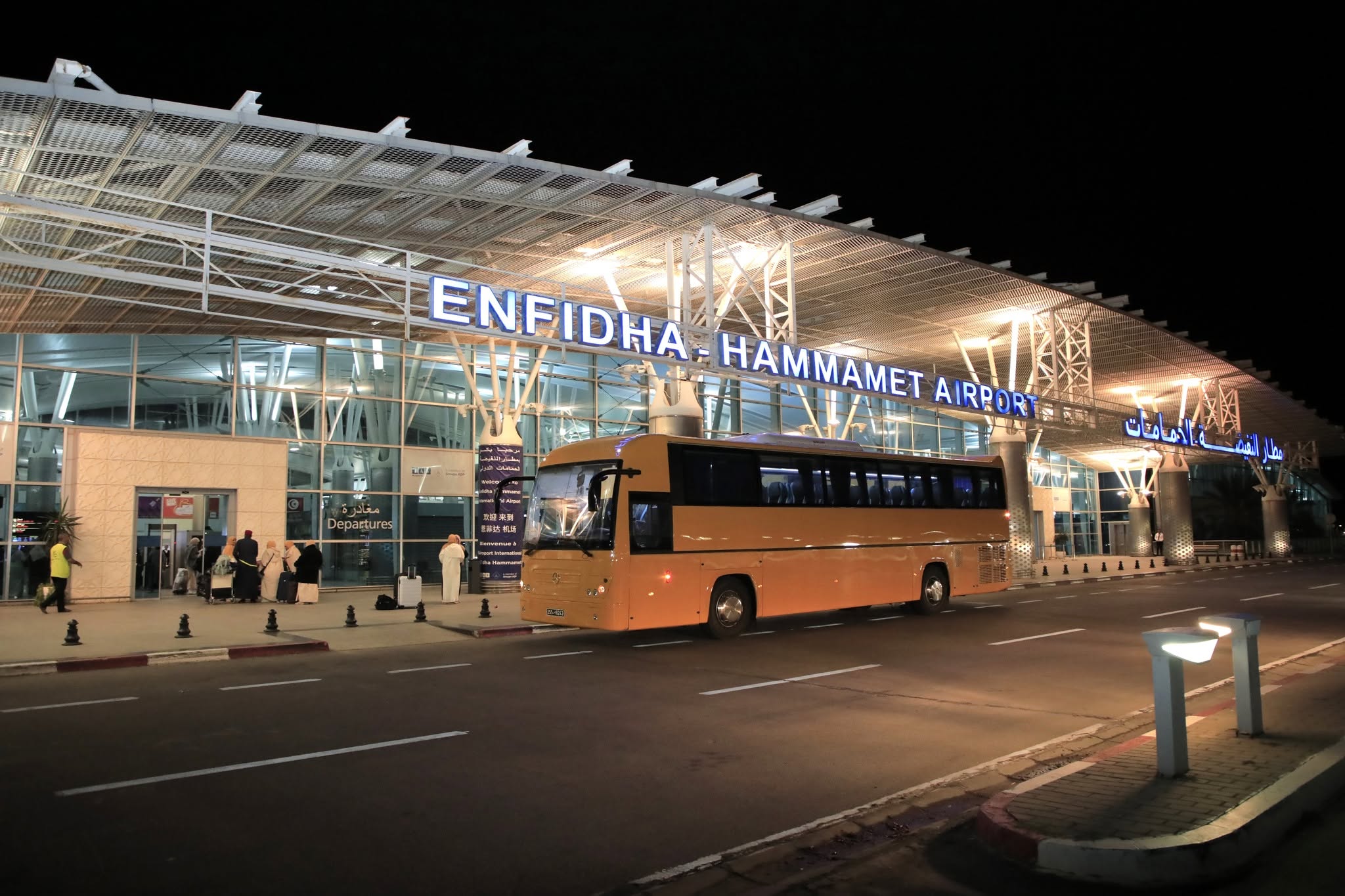
Quick Answer — Enfidha-Hammamet International Airport (NBE) is Tunisia’s resort-coast gateway, sitting on the A1 motorway roughly 40–50 kilometres from Hammamet, 50–60 from Sousse, 85 from Monastir, and 100 south of Tunis. Opened in 2009 and run by TAV Airports, it is a single modern terminal handling mostly charter and leisure flights from Europe, arriving in seasonal waves. Most passengers leave on a package-holiday coach; independent travelers should budget roughly 30–45 dinars for a taxi to Hammamet, 55–70 to Sousse, and 60–80 to Monastir, or pre-book a fixed-price transfer. There is no practical public transport from the terminal. Departing, arrive two and a half to three hours early — when three charters check in at once, the hall fills fast.
Here’s the fuller picture.
Enfidha is the airport with a story in its name. When it opened in 2009 — a gleaming, oversized terminal dropped onto the olive plains between Tunis and Sousse — it was named for the president who commissioned it, Zine El Abidine Ben Ali. Two years later the revolution sent him into exile, his name came off the façade, and the building was quietly rechristened after the small town next door and the resort coast it serves. Almost every visitor who passes through knows none of this; they know only that the arrivals hall is bright, the queues move in bursts, and somewhere outside a coach with their hotel’s name on a card is idling in the heat. But it is a very Tunisian building: ambitious, larger than its present needs, renamed by history, and getting on with the job.
The job is beach tourism. Enfidha was purpose-built, under a concession to the Turkish operator TAV Airports (which also runs Monastir), to relieve the older coastal airports and funnel European holidaymakers to Hammamet, Sousse, Port El Kantaoui, and the Sahel hotels. The single terminal was designed for around seven million passengers a year and rarely comes close, which is why the place can feel eerily spacious one hour and overwhelmed the next: traffic arrives in charter waves — TUI and the other European leisure and low-cost carriers, Nouvelair from a spread of cities, heaviest from the UK, Germany, France, and Central and Eastern Europe, and strongly seasonal. If your trip is a scheduled flight into the capital instead, that story is at Tunis-Carthage and told in our guide to flights to Tunisia.
Arrival: Fast, Then Slow, Then Fast
The rhythm of an Enfidha arrival depends entirely on how many planes landed with yours. Fill in the arrival card the crew hands out before landing; at immigration, most Western passports enter visa-free for up to ninety days on a passport valid six months beyond entry — the country-by-country detail is in our Tunisia visa guide. One charter’s worth of passengers clears in twenty minutes; three at once can take close to an hour. Baggage follows the same wave logic. Customs is a walk-through for holidaymakers.
In the arrivals hall you’ll find exchange desks and ATMs — remember the dinar is a closed currency you cannot buy at home, so this is where your Tunisian cash begins. Change or withdraw only what the first day needs and do the rest in town; the full playbook is in our Tunisian dinar guide.
Data before you land: the smoothest arrival move is having your eSIM installed before boarding — Airalo’s Tunisia packages take five minutes to set up from a QR code and switch on the moment you hit Tunisian airspace, which means maps, taxi apps, and “just landed” messages all work before you’ve cleared passport control. Prefer a local SIM? The operator counters in arrivals sell tourist packages too — bring your passport, and see our full SIM & eSIM guide for the comparison.
The Transfer: How Everyone Actually Leaves
For the large majority of arrivals, the answer is already booked: the package coach. Tour-operator transfers are bundled into most holidays sold on this coast, the reps with clipboards are waiting past customs, and the ride to a Hammamet or Sousse hotel takes forty minutes to an hour with drop-offs. If that’s you, your only task is finding the right coach.
Independent travelers have three real options. Taxis wait outside the terminal around the clock; because the distances are intercity, fares here are commonly quoted as fixed prices rather than metered, and the fair benchmarks in 2026 are roughly 30–45 dinars to Hammamet, 55–70 to Sousse, and 60–80 to Monastir, with modest official night and luggage supplements — agree the figure clearly before the bags go in, and walk to the next car if a quote is double the benchmark. Pre-booked transfers cost a small premium over the rank and remove the negotiation entirely — a driver with a name sign, a fixed price, flight tracking — which after a delayed evening charter is worth every millime. Car-rental desks line the arrivals hall, and the airport’s position directly on the A1 motorway makes it, honestly, one of the easiest places in Tunisia to start driving.
What Enfidha does not have is meaningful public transport. There is no rail link to the terminal — the SNCFT station in Enfidha town is several kilometres away with a thin timetable — no airport bus network worth planning around, and the intercity louages run from Enfidha town on the Tunis–Sousse corridor, not from the terminal, so you’d need a taxi just to reach them (how the louage system works is in our louage guide). Heading to Tunis itself, expect a negotiated taxi north of 100 dinars, or ride to Enfidha town and louage the rest; the full national picture is in getting around Tunisia.
Renting a Car at Enfidha
Most arrivals here roll straight onto a hotel transfer, and for a pure resort week in Hammamet or Sousse that’s the right call. But Enfidha sits usefully between the two — and within striking distance of Kairouan, El Jem, and the Cap Bon loop — so if your plan includes days beyond the beach, a rental collected at the airport turns the transfer into the first leg of the trip. Rental desks operate in the terminal; compare chains and local agencies for your dates on DiscoverCars, with the deposit and insurance excess shown up front, and see our guide to renting a car in Tunisia for the paperwork and the driving culture before you commit.
Is Enfidha Even Your Airport?
Worth settling before you book, because this coast has three. Enfidha (NBE) best serves Hammamet, the Cap Bon side, and the northern Sahel. Monastir (MIR), 85 kilometres south and covered in our Monastir guide, sits closer to the Skanes strip, Monastir itself, and Mahdia — and unlike Enfidha it has a light-rail station at its door. Tunis-Carthage (TUN) carries the scheduled full-service traffic and makes sense if your trip is the capital, the north, or anywhere reached by connecting flight. Package bookings decide this for you; independent travelers comparing fares should weigh the transfer cost and time, not just the ticket. And check your return carefully — it is not unheard of for an operator to fly you into one coastal airport and out of the other.
Departing, and What’s Nearby
Going home, the charter-wave logic runs in reverse: two and a half to three hours before departure is the sensible margin, because check-in for several flights opens at once and the security queue inherits all of them. Spend down your dinars first — you can’t take them with you — and know that the duty-free, while smaller than Tunis-Carthage’s, covers the essentials: dates, olive oil, harissa. If a late departure leaves you a spare day, the airport’s inland position is quietly an asset — Sousse and its medina are under an hour away, and the holy city of Kairouan about the same, which is more of Tunisia than most people expect to see from a beach-holiday gateway. Where you sleep that last night, from resort strip to medina guesthouse, is mapped in our hotels in Tunisia guide.
From the Carthage Magazine Bookshelf
The coach handles the transfer; these three handle everything the resort brochure left out.
- All About Tunisia — the definitive English-language traveler’s guide. 572 pages, 27 chapters, all nine regions, every UNESCO inscription, five thematic trails — and the practical answers (visa, currency, transport, etiquette) most travelers wish they’d had on the plane. $24.99 · PDF & EPUB.
- Speak Like a Local — 200+ Tunisian Arabic phrases with native audio recorded in Tunis. The phrases for the taxi, the souk, the café, and the dinner table. $14.99 · PDF, EPUB, MP3.
- The Authentic Tunisian Cookbook — sixty traditional recipes from the heart of North Africa. For when you get home and find yourself missing the food. $9.99 · PDF & EPUB.
All three available as a bundle for $39.99 — guide, language, and food, delivered together.
