
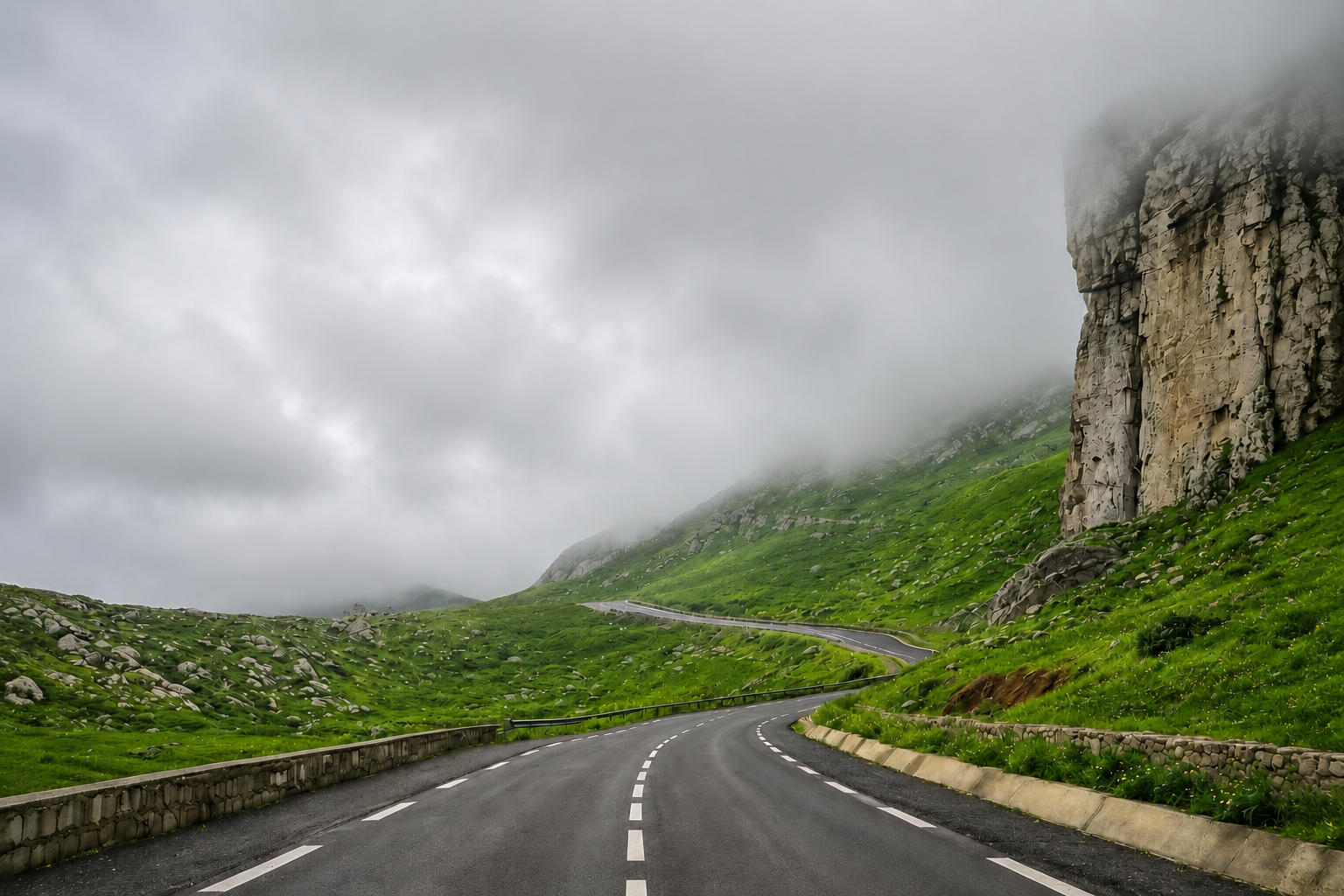
Every country keeps one region for itself, and Tunisia’s is the northwest. While the coast fills with visitors, the high country of the Tell — wheat plains, cork-oak mountains, Roman ruins standing alone in fields — stays almost entirely Tunisian. Its capital is El Kef: a town of white houses stacked against a cliff some 750 metres up, crowned by an Ottoman fortress, facing the mountains of the Algerian frontier across a sea of grain. The name simply means “the rock.” Locals call it El Kef el-Alia — Kef the high — and the air alone, cool and pine-edged when the coast is sweltering, explains the affection.
Founded by Carthage around 500 BC as a western stronghold and known to the Romans as Sicca Veneria — famous, or infamous, for its temple of Venus — El Kef has since been Numidian, Roman, Byzantine, Arab, Ottoman, and briefly, when Tunis fell under Axis occupation in the Second World War, the provisional capital of Tunisia itself. A decade later it served as a rear base for Algeria’s independence fighters. All of that history is still standing, layered into one compact, walkable hillside town that sees so few foreign visitors that schoolchildren may stop to practise their languages on you. Here is the honest guide.
Quick Answer: El Kef sits about 170 kilometres southwest of Tunis, under three hours by car or louage. The essentials — the kasbah, the medina, the basilica, the Sufi shrines, the spring — fill a leisurely day; add a second for Jugurtha’s Table and a third to loop through Dougga or Hammam Mellègue. Spring and autumn are ideal; winter is cold and atmospheric, summer far kinder than the coast. Come precisely because almost nobody else does.
The Kasbah: The Rock’s Crown
Everything in El Kef looks up at the kasbah, and the kasbah looks at everything else. The fortress complex crowning the cliff is really two Ottoman forts — a small one of 1601 and the Grand Fort of 1679, built by Mohamed Pasha on foundations that had carried some form of stronghold since Carthaginian times. It guarded the Algerian frontier for centuries, held the young nationalist Habib Bourguiba as a prisoner in the early 1950s, and stayed in military hands for decades after independence, which is partly why it survives so intact.
Entry is informal — a caretaker, a tip, a potted history in French if you want one — and the reward is the whole northwest arranged at your feet: the white town spilling downhill, the plains running to Jebel Dyr, and on a clear day the blue line of mountains that is Algeria. Come twice if you can, once in the morning for the light on the town and once at sunset for the light on everything else.
The Medina: Five Faiths on One Hillside
El Kef’s old town is small, steep, and quietly extraordinary, because within a few hundred metres of lanes it holds monuments of Carthaginian, Roman, Christian, Jewish, and Muslim devotion — a religious layer-cake few places in North Africa can match. Begin at Ras el-Aïn, the abundant spring that is the reason a town exists on this rock at all, with the great Roman cisterns and bath remains beside it.
Uphill stands the basilica of Dar el-Kous, dedicated to Saint Peter — a substantial early church, roofless but movingly intact, from the centuries when this region was one of Christianity’s heartlands (the fuller story of that era is in our guide to Tunisia’s Roman ruins). Beneath the kasbah walls, the octagonal minaret and white domes of the Zaouia of Sidi Bou Makhlouf, the town’s patron saint, mark El Kef’s deep Sufi tradition; the mausoleum doubled for generations as a conservatory of spiritual music, and the little square below it is the prettiest place in town for a coffee.
And a few lanes away stands the Ghriba synagogue, testimony to the Jewish community that thrived here for centuries and whose Sukkot festivals once drew celebrants — Jewish and Muslim alike — from both sides of the border; it is fragile and largely unrestored, and worth a respectful visit while it stands (our history of the Jews of Tunisia gives the context). Finish at the regional museum of popular arts and traditions, housed in a former zaouia, for the textiles, jewellery, and nomad furnishings of the Tell.
Jugurtha’s Table: The Fortress Nature Built
Sixty-odd kilometres south of town rises the northwest’s most astonishing sight — and one of the least visited great landscapes in the country. The Table de Jugurtha at Kalaat es-Senam is a mesa in the full Arizona sense: an eighty-hectare plateau with sheer cliffs on every side, its highest point at 1,271 metres, standing alone above the wheat like a ship at anchor.
It takes its name from the Numidian king Jugurtha, who is said to have used it as a natural fortress in his long guerrilla war against Rome, and everyone since has had the same idea — the summit, reached by an ancient staircase cut into the rock, carries dolmens, rock-hewn cisterns, prehistoric tombs, a Byzantine arch, and a small mosque. The 360-degree view from the top is the best in northern Tunisia, full stop. Go with your own wheels or a driver arranged in El Kef, take water and real shoes, and give it a half-day; it will repay every minute.
The Wider Northwest: Ruins, Baths, and Green Mountains
El Kef is the natural base for a region that specialises in magnificent things standing alone in countryside. Twelve kilometres from town, at a bend of the Mellègue river, the Roman baths of Hammam Mellègue still function as a working thermal station — you can soak in hot spring water inside structures the Romans built, one of the most cheerfully time-collapsing experiences Tunisia offers.
Within day-trip range lie three of the country’s greatest ancient sites: Dougga, the best-preserved Roman town in North Africa; Makthar, with its Arch of Trajan and great baths; and, further south, the temples of Sbeitla. Toward Jendouba, the underground villas of Bulla Regia mark the road north to the cork-oak mountains of Aïn Draham and the coral coast at Tabarka — meaning El Kef can anchor a northwest loop that ends at the sea. And on the road back to Tunis, the Andalusian town of Testour makes the classic final stop.
The Table of the Tell
The northwest eats differently from the coast, and El Kef is the place to learn it. The regional signature is borzguène — a celebration dish of steamed lamb over sweetened couscous strewn with dates, dried fruit, and nuts, somewhere between a main course and a benediction — alongside dense country breads, hearty chorbas, and the wheat-and-lamb cooking of a grain country with cold winters. The town’s small family-run tables, some of them literally the ground floor of the cook’s house and bookable a day or two ahead, are where the cuisine lives; ask at your guesthouse and follow the recommendation you get.
Making It Work
Louages run from Tunis throughout the day, taking around three hours, and the station is a ten-minute walk downhill from Place de l’Indépendance, the town’s pivot; a car, though, unlocks the region, and the northwest’s roads are quiet and scenic. Stay in the medina if you can — El Kef’s handful of guesthouses trade on views and character rather than luxury, and that is the right trade here. Seasonally, the Tell runs cooler than everywhere else in the country: spring turns the wheat plains green and the verges to wildflowers, autumn is golden, winter brings real cold and occasional snow on the heights, and summer — punishing on the coast and in the south — is merely warm up here, one of the region’s quiet advantages (the national picture is in our best time to visit guide).
However you time it, El Kef asks only one thing of its visitors: slowness. This is a town for climbing to a fortress, sitting in a saint’s square, and watching the light move across a landscape that Carthage, Rome, and every power since thought worth holding — and that tourism, mercifully, has not yet discovered.
From the Carthage Magazine Bookshelf
If the road less travelled — the high Tell, the lone ruins, the fortress towns — is your kind of Tunisia, these three ebooks were built for it:
- All About Tunisia — the definitive English-language traveler’s guide. 572 pages, 27 chapters, all nine regions, every UNESCO inscription, five thematic trails — and the practical answers (visa, currency, transport, etiquette) most travelers wish they’d had on the plane. $24.99 · PDF & EPUB
- Speak Like a Local — 200+ Tunisian Arabic phrases with native audio recorded in Tunis. The phrases for the taxi, the souk, the café, and the dinner table. $14.99 · PDF, EPUB, MP3
- The Authentic Tunisian Cookbook — sixty traditional recipes from the heart of North Africa. For when you get home and find yourself missing the food. $9.99 · PDF & EPUB
All three available as a bundle for $39.99 — guide, language, and food, delivered together.
