
This article contains affiliate links. If you book through them, Carthage Magazine earns a small commission at no extra cost to you — it’s part of how we keep our guides free and independent.
Tunisia has more than a thousand kilometres of Mediterranean coastline, and the strange thing is how little of it most visitors ever see. The package flights land, the transfer buses run to Hammamet or Sousse or Djerba, and the hotel beach — perfectly pleasant, umbrella-striped, jet-ski-adjacent — becomes the whole story.
Meanwhile, an hour or two away in any direction: a crescent of white sand under a Spanish fortress that Tunisians will tell you is the finest beach in the country, a lagoon village where fishing boats moor beside a strip of sand voted among the best in the Mediterranean, a wild northern coast of red cliffs and empty coves that most Europeans could not place on a map.
This is the guide to all of it — the famous strands and the ones locals keep to themselves — organised the way the coast actually runs, from the wild north to the deep south, with honest notes on what each beach is for and how to reach it.
Quick Answer: For sheer beauty, the consensus Tunisian answer is El Mansoura at Kelibia, on the east coast of Cap Bon — white sand and water so clear the boats seem to float on air. For classic resort holidays, Hammamet, Sousse, and Djerba deliver exactly what they promise. For escaping the crowds, head north to Raf Raf, Cap Serrat, and the coast around Bizerte, or east to the Kerkennah islands. Sea temperatures peak from July to September; June and late September offer the best swimming-to-crowds ratio — see our best time to visit guide for the full calendar.
The Wild North: Bizerte to Cap Serrat
The northern coast is Tunisia’s best-kept secret — greener, wilder, and emptier than anywhere else on the shoreline, with a moodier Atlantic-tinged beauty that photographers fall hard for. Around Bizerte, the northernmost city in Africa, the beaches run from the family-friendly Corniche to the long white sweep of Sidi Salem; push west along the coast road and you reach Cap Serrat, a horseshoe of pale sand between forested headlands that on a June weekday you may share with nobody but a herd of cows.
East of Bizerte, the fishing village of Ghar el Melh sits on a lagoon whose sandbar beach — Sidi Ali el Mekki — is a genuine phenomenon: a bare spit of soft sand between still lagoon and open sea, beloved of Tunisians and barely known outside the country. Just beyond it, Raf Raf faces the jagged offshore rock of Pilau island across water that shades from turquoise to ink, and nearby Cape Zbib has earned its local nickname as the Seychelles of Tunisia.
None of this coast is resort territory. Come by car — no bus or louage serves these coves properly, so this is exactly the trip a rental earns its keep on (DiscoverCars shows deposits and insurance excess before you book; our rental guide covers the rest) — bring a picnic, and get the Mediterranean as it looked before the brochure was invented.
The Coral Coast: Tabarka
In the far northwest, near the Algerian border, Tabarka does its own thing entirely: a Genoese fort on an island, a marina, red rock needles rising from the sea, and mountains of cork oak crowding down to the shore. The town beach is good; the diving is the real story, as this is Tunisia’s coral coast and its underwater capital. Pair the beach with the forest — Tabarka is the rare place where you can swim in the morning and walk in green mountains in the afternoon.
Cap Bon: The Country’s Finest Sand
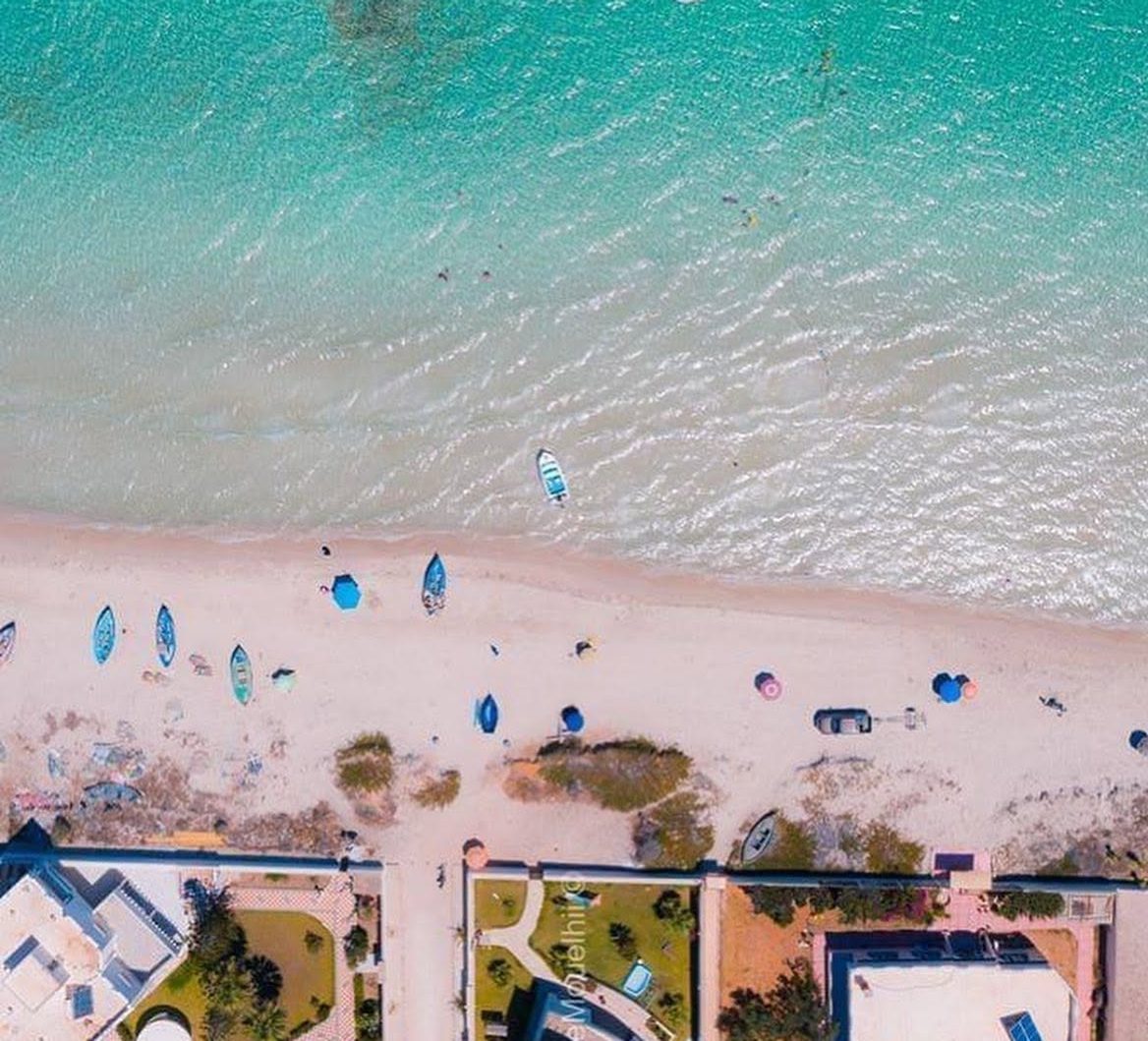
The east coast of the Cap Bon peninsula is where Tunisians themselves go for the beach, and the reason is simple: it has the best sand and the clearest water in the country. The jewel is El Mansoura at Kelibia — a curve of powder-white sand beneath the ramparts of the country’s mightiest fortress, with water so transparent that anchored boats appear suspended above their own shadows.
It is regularly, and in our view correctly, called the most beautiful beach in Tunisia. Around it spread the quieter strands of Kelibia and Hammam Ghezaz, and at the peninsula’s dramatic tip, below El Haouaria’s cliffs, the small bay of Ras el Drek looks across the strait toward Sicily. Facilities are low-key everywhere — this is guesthouse and beach-café country, not resort country — which is precisely its charm, and one more reason a rental car turns the peninsula from one beach into a week of them.
The Classic Resorts: Hammamet to Monastir
The gulf coast south of Cap Bon is Tunisia’s holiday heartland, and it earns the status honestly. Hammamet built its reputation on a long arc of fine golden sand backed by the whitewashed medina — the town beach by the old walls remains one of the loveliest urban beaches on the Mediterranean, while Yasmine Hammamet to the south handles the full-scale resort experience.
Sousse pairs a UNESCO-listed medina with kilometres of beach running north to the purpose-built marina of Port El Kantaoui, and Monastir offers the Skanes hotel strip plus the unbeatable novelty of swimming within sight of an eighth-century ribat. These are the beaches for travellers who want infrastructure — loungers, watersports, restaurants at the sand’s edge — and our hotels in Tunisia guide breaks down where to stay along this whole strip, by region and by traveler. In high summer they are lively in every sense. Go in June or September for the same sea with half the company.
Mahdia: The Mainland’s Softest Sand
Keep going south and the coast saves a surprise. Mahdia, the old Fatimid capital on its narrow peninsula, has what many connoisseurs quietly rank as the mainland’s best beach: a long ribbon of sand so pale and fine it squeaks underfoot, shelving gently into shallow, bath-warm water.
The hotel zone is modest by Sousse standards and the town — fishing port, silk-weaving tradition, sea-swept cemetery at the peninsula’s tip — has kept its soul. For families especially, Mahdia may be the single best beach base in Tunisia; our Tunisia with kids guide makes the wider case.
Djerba and the Deep South
Then there is the island. Djerba’s beach reputation rests on its northeastern shore — Sidi Mahres and Seguia, long stretches of white sand and shallow turquoise water lined with low-rise hotels and lagoons that flamingos visit in winter. Seguia, toward the island’s southeastern corner, is the local pick for the prettiest water; our dedicated guide to the best beaches in Djerba walks the whole shoreline, and the best time to visit Djerba piece covers the island’s famously long season.
Across the water on the mainland, Zarzis offers Djerba-quality sand with a fraction of the visitors — an out-of-the-ordinary resort town in the best sense. And off Sfax, the flat, palm-scattered Kerkennah islands trade dramatic beaches for something rarer: shallow, warm, utterly tranquil water and a fishing culture that has not changed its rhythm for centuries. Kerkennah is not for beach connoisseurs; it is for people who want the twenty-first century to leave them alone for a few days.
The Capital’s Coast
Finally, do not overlook the beaches on Tunis’s doorstep. La Marsa, at the end of the TGM line, is the capital’s favourite — a proper city beach with a corniche that fills on summer evenings with the whole town out walking. Next door, Gammarth adds the comfort of resort hotels twenty minutes from the medina. Neither will win the national beauty contest, but for combining a culture-heavy Tunis itinerary with a daily swim, they are exactly right.
Choosing Yours
The honest summary: for beauty, Cap Bon’s east coast and the wild north; for resorts and facilities, Hammamet, Sousse, and Djerba; for families, Mahdia; for solitude, Cap Serrat, Kerkennah, and Zarzis; for city-plus-sea, La Marsa. The water is warmest from July through September and swimmable from June into October; the northern beaches catch more wind and surf, the eastern and southern ones lie calmer and shallower. Wherever you land, one rule holds along the entire thousand kilometres: walk ten minutes past the last umbrella, and Tunisia will find you a stretch of the Mediterranean to yourself.
From the Carthage Magazine Bookshelf
If a stretch of Tunisian sand has made it onto your shortlist, these three ebooks cover everything between the airport and the water:
- All About Tunisia — the definitive English-language traveler’s guide. 572 pages, 27 chapters, all nine regions, every UNESCO inscription, five thematic trails — and the practical answers (visa, currency, transport, etiquette) most travelers wish they’d had on the plane. $24.99 · PDF & EPUB
- Speak Like a Local — 200+ Tunisian Arabic phrases with native audio recorded in Tunis. The phrases for the taxi, the souk, the café, and the dinner table. $14.99 · PDF, EPUB, MP3
- The Authentic Tunisian Cookbook — sixty traditional recipes from the heart of North Africa. For when you get home and find yourself missing the food. $9.99 · PDF & EPUB
All three available as a bundle for $39.99 — guide, language, and food, delivered together.
