
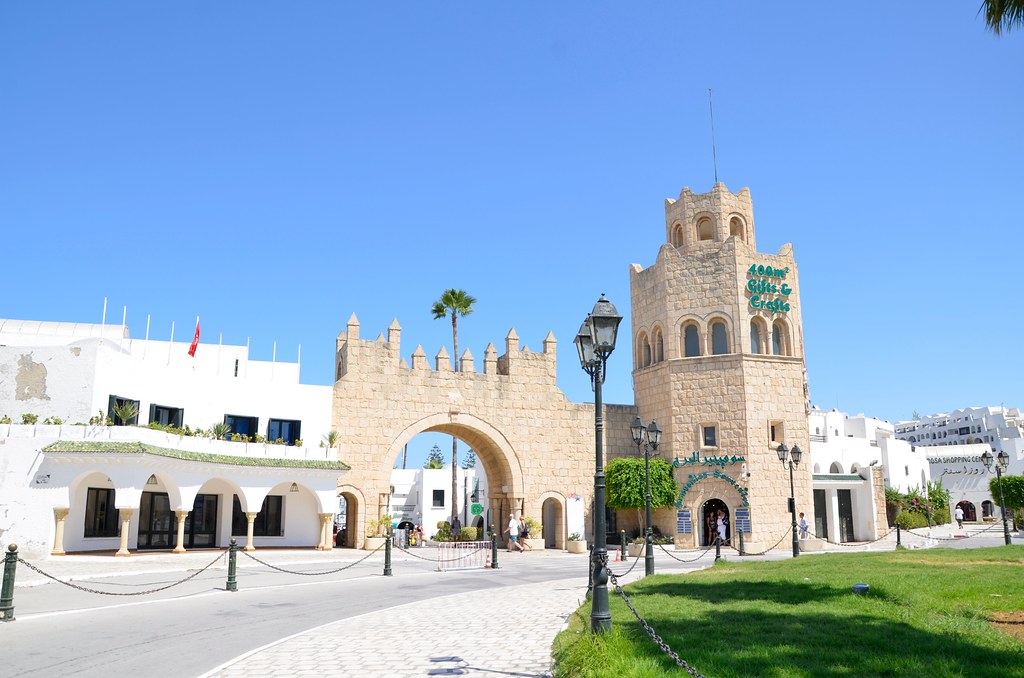
Quick Answer Sousse is Tunisia’s third-largest city, the capital of the Sahel region on the central Mediterranean coast, and home to a UNESCO-listed medina inscribed in 1988. It sits 140 kilometres south of Tunis, reachable in 90 minutes by car, two hours by SNCFT train, or via direct charter flights into Monastir airport 25 kilometres away. Sousse is in practice two cities stacked back-to-back: a 9th-century fortress-town built by the Aghlabids around the Ribat and the Great Mosque, and a 30-kilometre resort strip that runs north through Boujaafar, Hammam Sousse, and Port El Kantaoui. Most travellers come for one of the two. The trick is to see both.
The first thing you notice, coming into Sousse from the north on the A1 motorway, is that the city has a skyline and Tunisia mostly does not. Hammamet stays low. Mahdia stays low. Even Tunis flattens out beyond Lac 1. Sousse climbs. Hotels stack up along the corniche, the medina walls hold a tan rectangle of old city against the sea, and somewhere behind it all rises the cream-coloured tower of a 9th-century fortress that has been watching the harbour since the Aghlabids built it for a reason.
This is Tunisia’s beach capital and its third city and its most-photographed medina after Tunis. It is also, for two and a half million visitors a year, the only Tunisia they ever see. That is part of what an honest guide has to be honest about.
Why Sousse Matters
Sousse is old in a way that the resort skyline obscures. The Phoenicians founded a trading post here in the 9th century BCE and called it Hadrumetum. The Romans took it from the Carthaginians after the Second Punic War, made it the second city of the African province after Carthage itself, and built it into one of the great mosaic-producing centres of the empire — the floors that turn up in the museums of Tunis, Bardo, and Sousse came mostly from villas in this part of the country. Hadrumetum produced two short-lived Roman emperors and, somewhere along the way, the church father Tertullian.
What you see today, though, is mostly the city that came after. In the 9th century, the Aghlabid emirs who ruled from Kairouan made Sousse their port and their forward defensive position against Byzantine and Norman naval raids. They built the Ribat in 821 CE and the Great Mosque thirty years later, fortifying both. The town that grew up between the two — the warren of lanes, the souks, the kasbah on the hill, the walls that still mostly stand — is what UNESCO inscribed in 1988 as the Medina of Sousse: a typical example of a town dating from the first centuries of Islam.
What makes Sousse a Sahel city rather than a generic North African one is the soil around it. The Sahel — the word means coast in Arabic, though the region runs inland too — is the world’s oldest continuously cultivated olive belt, planted by the Phoenicians, expanded by the Romans, and worked without serious interruption for twenty-five centuries. Olives, citrus, almonds, and the trade in all three made the Sahel rich. The Sousse you walk in today still runs on that wealth: trading families, a confident bourgeoisie, a particular Sahel-Arabic dialect that Tunisians elsewhere will tease their cousins for. It is not a poor city pretending to be a tourist city. It is a working provincial capital that happens to have hotels.
The Ribat — the Building That Founded the City

Begin at the Ribat. Strategically, it is what the Aghlabids built first; practically, it is what shows you the city in one ascent.
A ribat in 9th-century Islamic North Africa was both a fortified monastery and a watchtower: a place where pious volunteers (murabitun) would gather to defend the coast against Byzantine and Sicilian Norman raids while spending their downtime in study and prayer. Sousse’s Ribat is one of the oldest surviving examples in the Maghreb — a generation younger than the Ribat of Monastir twenty kilometres south, but more compact, more military, more clearly a single architectural idea.
The building is a thick-walled square, roughly 38 metres on each side, two storeys arranged around an austere central courtyard with twenty-odd cells where the murabitun slept. A single tall round tower — the nador — rises from the southeast corner. From the top, you can see the entire Gulf of Hammamet on a clear day. The Aghlabid garrison would have spotted approaching ships from twenty kilometres out.
The Ribat’s other function — and the one most travellers don’t realise — was as a minaret. Sousse’s Great Mosque, completed thirty years after the Ribat, was deliberately built without one. The call to prayer was issued from the nador. The two buildings are 50 metres apart and were designed as a single defensive-religious complex. Stand on the nador and you can see straight down into the courtyard of the mosque.
The climb to the top is steep, the steps are worn smooth, the railings are token. Wear shoes that can grip stone. The view is what you came for.
The Great Mosque of Sousse
A short walk from the Ribat sits the Great Mosque of Sousse, completed in 851 CE under the Aghlabid emir Abu al-Abbas Muhammad I.
The mosque is unlike almost any other in Tunisia. Where the Great Mosque of Kairouan is a monumental statement of imperial Islam, with hundreds of scavenged Roman columns under a vast hypostyle roof, the Great Mosque of Sousse is a fortress that happens to be a mosque. The walls are thick. The corners are buttressed. Two squat watchtowers flank the seaward side of the courtyard, ready to repel a raid. There is no minaret because the Ribat’s tower next door served the purpose.
Inside, what survives of the original Aghlabid prayer hall is the qibla arcade and the courtyard, with a beautiful early Kufic inscription running along the upper register — one of the oldest surviving examples of monumental Arabic calligraphy in North Africa. The hall has been remodelled across centuries (Zirids, Hafsids, Ottomans, the French Protectorate), but the bones are 9th-century Aghlabid.
As at every working mosque in Tunisia, non-Muslims are admitted to the courtyard but not to the prayer hall itself. The courtyard is what you came to see anyway. For the full architectural treatment, see the dedicated piece on the Great Mosque of Sousse.
The Medina
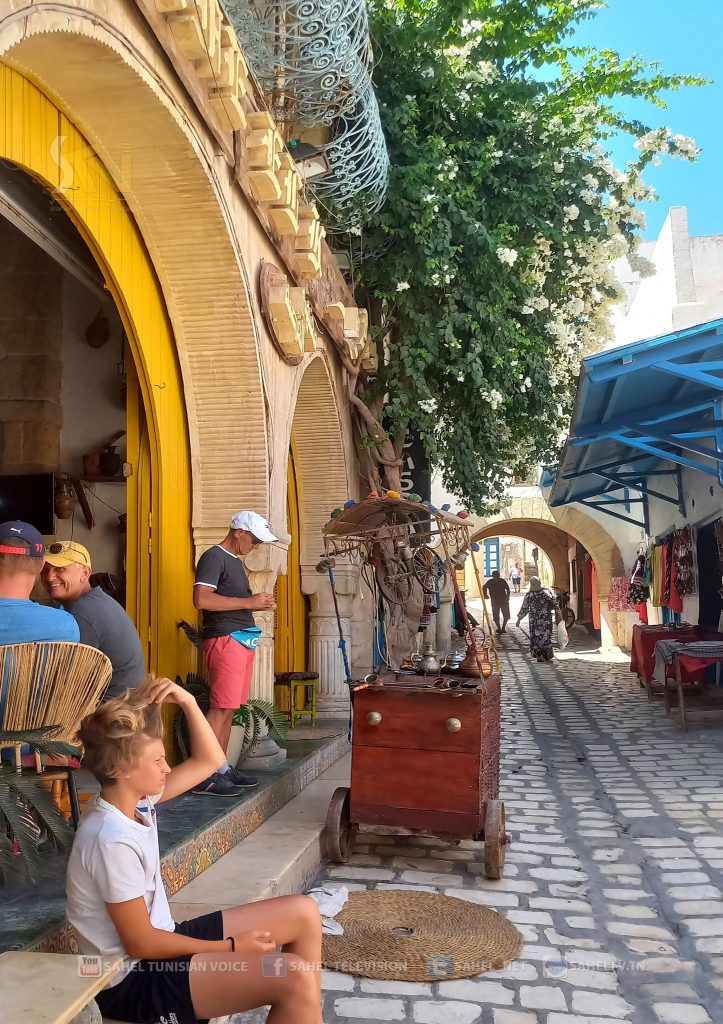
Between the Ribat and the Mosque, and spilling north and west from both, is the medina proper.
Sousse’s medina is smaller than Tunis’s, denser than Hammamet’s, and visibly more lived-in than either. The walls — built by the Aghlabids, rebuilt by the Fatimids, restored more times than anyone has counted — still trace most of the original perimeter. The main gate, Bab el-Khabli, opens onto Place des Martyrs and the Boujaafar seafront beyond. From there, the souks run uphill toward the Kasbah on the western corner.
The Souk er-Ribba — the souk of the quarter — is the central artery, covered with vaulted brick arches, lined with brassware and leather and ceramics on one stretch and food and household goods on the next. Tourist trade and resident trade coexist here without entirely mixing. The leather shops sell to tourists; the spice merchants three doors down sell mostly to women buying that evening’s couscous. The deeper you go into the side alleys, the more the second kind takes over.
Near the top of the medina, on the highest ground, stands the Kasbah — a 9th-century citadel rebuilt over Byzantine foundations, now the home of one of the country’s most important museums.
The Sousse Archaeological Museum
If you do one indoor visit in Sousse, do this.
The Sousse Archaeological Museum holds the most important collection of Roman mosaics in Tunisia outside the Bardo, and on certain comparisons (the quality of the mid-tier pieces, the state of preservation, the unbroken provenance from the surrounding sites) it is arguably more rewarding than the Bardo for the same time investment. Where the Bardo overwhelms with quantity, Sousse curates.
The headline pieces are extraordinary. The Triumph of Bacchus — the god in his chariot, drawn by tigers, mid-procession through a recognisably Mediterranean landscape — is a 3rd-century floor from a Hadrumetum villa, almost completely intact. The Head of Oceanus, weed-bearded and seaweed-haired, is one of the great single mosaic portraits to survive from the Roman world. The Mosaic of Virgil is here too (the more famous Virgil mosaic is at Bardo, but Sousse holds a smaller, earlier piece that is in some ways more affecting). Beyond these are dozens of marine, agricultural, and mythological floors, mostly lifted from the wealthy maritime villas that lined this coast in the 2nd and 3rd centuries.
The museum is housed in the Kasbah itself, which means the visit doubles as a walk through 11th-century military architecture, with views over the medina from the ramparts. A ticket runs around 8 dinars. The museum closes on Mondays — plan around it. For the wider context of Roman Tunisia, see the field guide to Tunisia’s ancient ruins.
The Catacombs
Below modern Sousse, in a hill on the western edge of the city, sit the Catacombs of Sousse — five and a half kilometres of underground galleries dug between the 2nd and 4th centuries CE by the city’s early Christian community, who buried perhaps fifteen thousand of their dead in loculi cut into the rock.
This is the largest paleo-Christian funerary complex in Africa and one of the largest in the Mediterranean. Most of it is closed to the public for conservation reasons, but a small section of the Catacombs of the Good Shepherd is open: a hundred metres of cool, low-ceilinged passage, niches stacked four high on either side, the occasional Greek or Latin inscription still legible where the carving was deep enough to outlast eighteen centuries of damp.
It is the strangest hour you can spend in Sousse, and the one most package tourists never know exists. Entrance is around 5 dinars. Bring a phone with a flashlight.
Boujaafar Beach and the Corniche
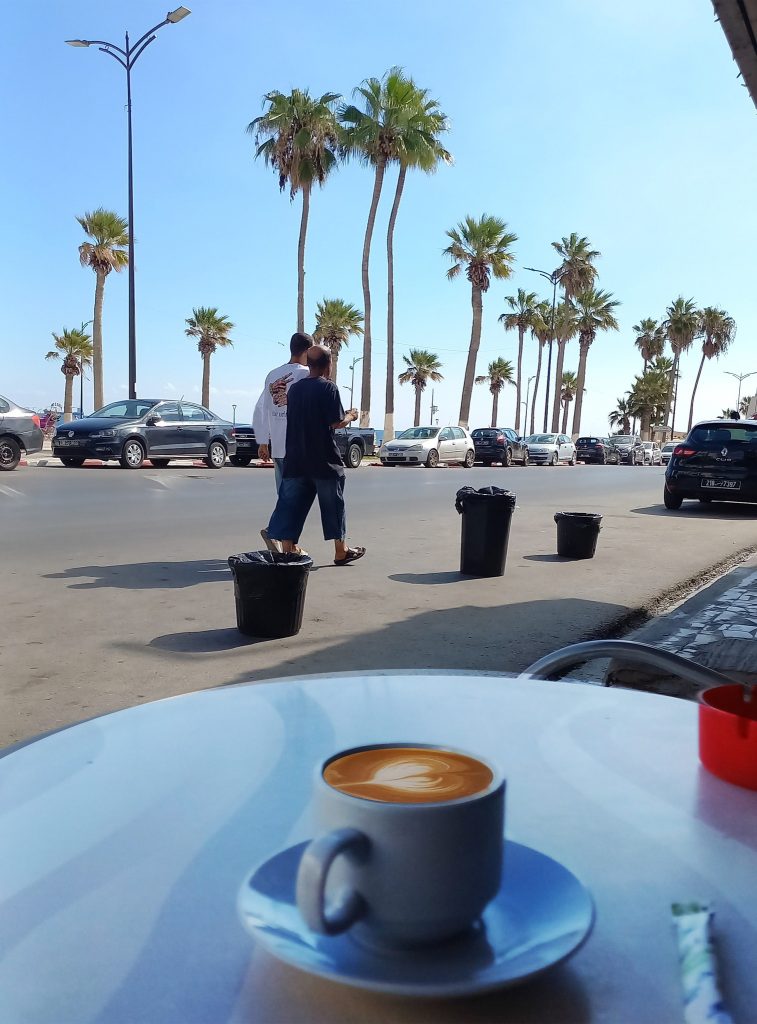
Sousse’s city beach — Boujaafar — is the long sweep of sand that begins at the medina walls and runs north for roughly two kilometres before merging into the Hammam Sousse hotel zone. This is the local beach: Sousse families, students, fishermen, and football matches on the firm sand at low tide. There is a corniche promenade along the back of it lined with cafés where, by tradition, you order a mint tea with pine nuts and stay for two hours.
Boujaafar is not what you book a package for, but it is the right place to be on a Friday afternoon in May. The water gets crowded by July. The seafood places at the southern end, closest to the medina, do a grilled sea bass and a complete poisson — a small fish, rice, salad, harissa — that costs a third of what the hotel buffet does and is, on most days, better.
Port El Kantaoui — and a Note About 2015
Ten kilometres north of central Sousse, past Hammam Sousse and Khzema, sits Port El Kantaoui — a purpose-built tourist complex opened in 1979 around an artificial marina, designed to look like a whitewashed Tunisian-Mediterranean village and inhabited almost exclusively by hotels, golf courses, restaurants, and the kind of shop that sells stuffed camels.
It is, as travel writing has been saying since the 1980s, not really Tunisia. That is also, for the millions of British, French, German, Polish, and Czech package tourists who fly into Monastir each year, exactly the point. Port El Kantaoui is what happens when a country gives itself permission to build a holiday infrastructure that is clean, safe, well-serviced, English-speaking, and architecturally pleasant without trying to be authentic. The marina is genuinely beautiful at sunset. The golf is some of the best on the southern Mediterranean. The hotels run from three-star to genuinely good. If you are travelling with small children, with elderly parents, or with someone who simply wants a beach holiday, Port El Kantaoui is a perfectly reasonable place to spend a week.
Honesty about Port El Kantaoui requires one more paragraph.
On 26 June 2015, a gunman opened fire on the beach of the Riu Imperial Marhaba hotel in Port El Kantaoui, killing thirty-eight people — thirty of them British. It was the worst attack on tourists in Tunisia’s modern history, and it collapsed UK and Northern European charter traffic to the country for the better part of three years. The site is unrecognisable from that day now: the hotel has been remodelled, a memorial sits quietly on the promenade, the beach has long since returned to families and parasols. The UK Foreign Office removed its advisory against travel in 2017, charter flights resumed in 2018, and Tunisian tourism numbers were back above pre-attack levels by 2019. Sousse has not pretended this didn’t happen; it has, instead, built it into the way it now handles tourist sites, with armed police visible at hotel entrances and the museum and a security infrastructure that is more apparent than it was. For the broader picture see CM’s piece on whether Tunisia is safe to travel. For practical purposes today: Sousse is safe in the way most Mediterranean tourist cities are safe, which is to say, alert and worth the visit.
Where to Eat
Sousse is a coastal city in a fishing region, and the right meal here is almost always seafood.
The fish you want is mérou (grouper) or loup (sea bass), grilled over wood charcoal, with a side of mechouia — the smoky tomato-and-pepper salad that is the universal Tunisian starter. Octopus — kerkana on Sahel menus — is the local speciality, sometimes stewed in tomato and harissa, sometimes simply grilled with olive oil and lemon. The Sahel does an excellent brik — the fried-pastry-with-egg envelope you’ll see at every restaurant — and a regional couscous slightly drier and more lamb-forward than what you’ll get in Tunis.
The honest geography of dining in Sousse: hotels in Port El Kantaoui are convenient and dull. Hotel buffets in Hammam Sousse are buffets. The good seafood is in two places: the small restaurants on the seafront immediately south of Boujaafar Beach (look for La Marmite, Le Lido, Restaurant Caracas), and the family-run places inside or just outside the medina (the streets behind Place Farhat Hached are the right hunting ground). Lunch is the meal Sousse does well; the markets are stocked in the morning and the fish is cooked by 1 p.m.
For the wider Tunisian food landscape, see the top twenty foods to eat in Tunisia.
Getting There, Getting Around
From Tunis, Sousse is 140 kilometres south on the A1 motorway. By car, the drive is 90 minutes; by SNCFT train from Tunis Ville station, it’s about two and a half hours and around 14 dinars in air-conditioned first class, with eight or nine departures a day. By louage from Moncef Bey, the trip is faster but less comfortable. From Hammamet, Sousse is an hour by car or train.
If you’re flying directly to the resort coast, Monastir Habib Bourguiba International Airport (MIR), 25 kilometres south of Sousse, takes most of the UK and Northern European charter traffic. For the wider picture see the guide to flights to Tunisia.
Inside Sousse, the Sahel Metro — a unique electrified light-rail line, the only one of its kind in Tunisia outside the Tunis TGM — runs from Sousse Bab Jedid station south through Hammam Sousse, Khzema, the airport, Monastir, and on to Mahdia. It is cheap (under 5 dinars end-to-end), clean enough, and the easiest way to get between the three Sahel cities without a car. Trains run every 30 minutes during the day.
Within central Sousse, taxis are abundant and metered; insist on the meter. Walking is the right way to do the medina and the corniche; the area between the medina and Boujaafar is flat and pedestrian-friendly. For Port El Kantaoui, take a taxi (10–15 dinars from central Sousse) or the dedicated tourist train that wobbles up the coast in summer.
When to Go
Sousse is the most reliably mild city in Tunisia. The Sahel climate is moderated by the sea in a way that the interior — Kairouan, El Jem, the Sahara — is not. May and June, September and October are the obvious sweet spots: 22°C to 28°C in the day, water warm enough to swim, the corniche cafés full but not heaving.
July and August are when the resort coast does its peak business — 32°C to 35°C, water at 26°C, every parasol on Boujaafar in use by 10 a.m., and Port El Kantaoui at full charter-flight capacity. The medina becomes hot but not unbearable; it is well-shaded and the souks remain a few degrees cooler than the seafront.
December through March are quiet, with daytime highs of 14°C to 17°C, occasional rain, and most beachfront restaurants and Port El Kantaoui hotels operating on reduced winter schedules. The medina, the Ribat, the museum, and the Catacombs are all open year-round and at their photogenic best with low winter sun. The trade-off is real but for cultural-tourist travellers the off-season is the right season. See the best time to visit Tunisia for the wider read.
A Few Practical Notes
The Sousse Pass. A combined ticket — sold at the Ribat, the Great Mosque, the Kasbah Museum, and the Catacombs — covers all four for around 15 dinars. Ask for the billet groupé or combined ticket. Valid for the day of issue.
Dress. Sousse is more relaxed than Kairouan but more conservative than Hammamet. Beachwear stays on the beach and the corniche; covered shoulders and knees are expected in the medina and required at the mosque entrance. Shawls are available at the door if you arrive without one.
Cash. ATMs are plentiful around Place Farhat Hached and along Avenue Bourguiba. Hotels and Port El Kantaoui restaurants take cards; medina shops mostly don’t. See Tunisia’s currency guide for the dinar’s current behaviour.
Alcohol. Sold in hotels, in Port El Kantaoui, in licensed restaurants along the corniche, and at the state-owned Magasin Général and Carrefour supermarkets. Not sold inside the medina. See alcohol in Tunisia for context.
Friday. The Great Mosque closes to non-Muslim visitors during midday prayers, between roughly noon and 2 p.m. The Ribat stays open. Plan accordingly.
Day trips. Sousse is the best base in Tunisia for cultural day-tripping. El Jem — the great Roman amphitheatre, the country’s most spectacular UNESCO site — is 60 kilometres south and reachable in 45 minutes by car or 90 minutes by train. Kairouan is 60 kilometres west and reachable in an hour. Monastir and Mahdia are an hour and 90 minutes south respectively, both via the Sahel Metro. Most travellers spending a week in Sousse will leave it for at least two of those.
What Sousse Is, Honestly
Sousse will not give you the discovery-moment of Kairouan or the photograph-moment of Sidi Bou Said. It is too busy for one and too working-city for the other. What it gives you instead is the most complete cross-section of Tunisia available in any single city: a 9th-century Aghlabid fortress and a 21st-century marina, a UNESCO medina and a charter-hotel strip, Roman mosaics and Polish package tourists, a fish market and a golf course, the call to prayer from a 1200-year-old tower and the thump of beach-bar bass from Port El Kantaoui. Most of it is in walking distance, and most of it works.
Tunisia’s tourism authorities have long called Sousse the Pearl of the Sahel. That is a tourism slogan and it is also, on a good afternoon in late May, walking out of the Ribat with the muezzin starting up below you and the sea full of small fishing boats turning home, completely accurate.
You should go.
From the Carthage Magazine Bookshelf
If Sousse is on the itinerary — whether the package version, the cultural version, or the one that tries to do both — three Carthage Magazine ebooks were built for the days between arrival and departure:
- All About Tunisia — the definitive English-language traveller’s guide. 572 pages, 27 chapters, all nine regions including a full chapter on the Sahel and its coastal cities, every UNESCO inscription, and five thematic trails — plus the practical answers (visa, currency, transport, etiquette) most travellers wish they’d had on the plane. $24.99 · PDF & EPUB
- Speak Like a Local — 200+ Tunisian Arabic phrases with native audio recorded in Tunis. The phrases for the souk, the taxi, the beach café, and the fish market — including how to order grilled grouper without being upsold to the lobster. $14.99 · PDF, EPUB, MP3
- The Authentic Tunisian Cookbook — sixty traditional recipes from the heart of North Africa, including the Sahel-style octopus stew and the mechouia salad you’ll spend the next year trying to recreate at home. $9.99 · PDF & EPUB
All three available as a bundle for $39.99 — guide, language, and food, delivered together.
