
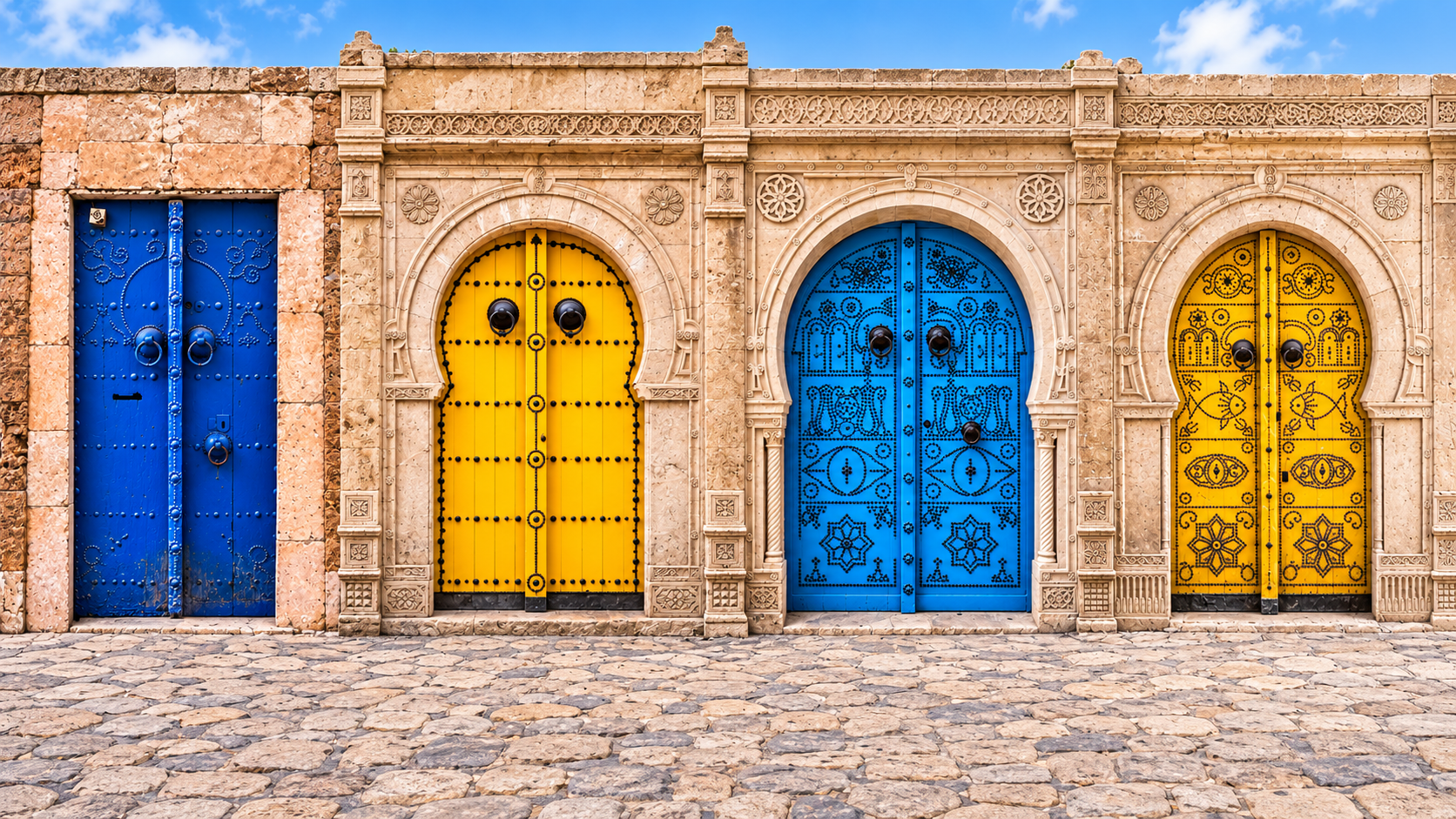
Nobody plans to photograph doors in Tunisia. You come for Carthage, or the beach, or the Sahara, and then you walk into a medina and the first one stops you: two tall leaves of dark wood under a stone arch, painted the blue of a swimming pool, studded with black nails in the shape of a fish. The second stops you too. By the fourth you have put the map away. By the end of the afternoon your camera roll is nothing but doors, and you still haven’t seen two alike.
That is the normal experience. Everyone has it. What almost nobody gets is an explanation, because the people who live behind the doors take them for granted and the guides mostly stick to “the nails bring luck.” So here is the explanation.
Quick Answer — Traditional Tunisian doors are heavy two-leaf wooden doors set under a stone arch, studded with iron nails arranged in symbolic patterns (the fish, the star, the crescent, the eye, the cypress, the hand) and usually painted blue or yellow. Most contain a smaller door, the khoukha, for everyday use. The blue of Sidi Bou Said was fixed by a decree of 28 August 1915, pushed through by Baron Rodolphe d’Erlanger; the medina of Tunis is the best place to see the full range.
How to read a Tunisian door
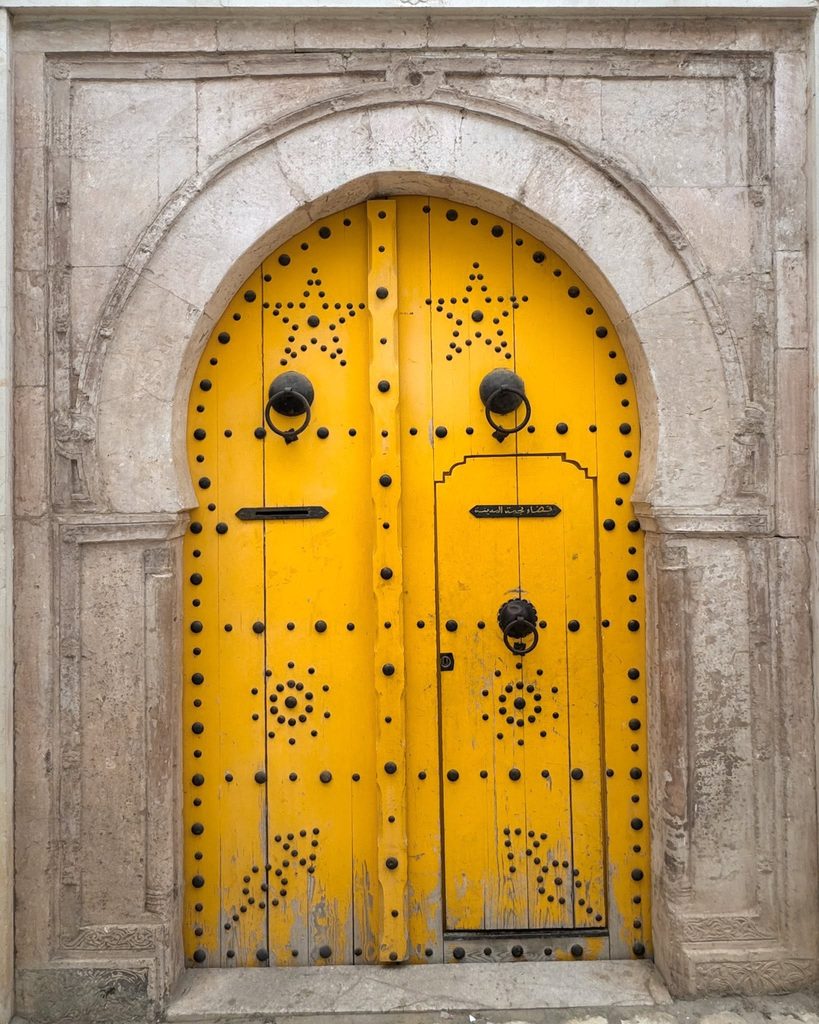
Start at the top. The arch over a medina door is almost always a horseshoe or a pointed horseshoe, the Andalusian shape, cut in pale stone and often carved with a band of rosettes or interlace. In Tunis the frame is frequently kadhel, the honey-colored limestone of the north, sometimes alternating with black stone in stripes. The arch is the oldest part of what you are looking at; the wood in front of it may have been replaced three times.
The door itself has two leaves, tall enough that a loaded donkey, and in the grandest houses a man on horseback, could pass without ducking. The wood is olive, palm, or imported pine, built from vertical planks held together by horizontal crossbars on the inside. That construction is the key to everything else. The planks have to be fixed to the crossbars somehow, and the way to do it is with big iron nails driven through from the front. The nails are structural first and decorative second. The pattern you admire is a carpenter hiding his joinery.
Then look low and to one side. Cut into one leaf is a small door, perhaps a meter and a half tall, with its own frame and its own lock. This is the khoukha. The big door opens for weddings, funerals, furniture, and the sheep at Eid. The small door is for everyone, every day. It makes you stoop as you enter, which is both humility and security, and it means the house can be lived in without ever showing the street its courtyard. Behind it, the entrance hall usually turns at a right angle, the skifa, so that even an open door reveals nothing. The Tunisian house faces inward. The door is the one thing it shows the world, which is why so much care went into it.
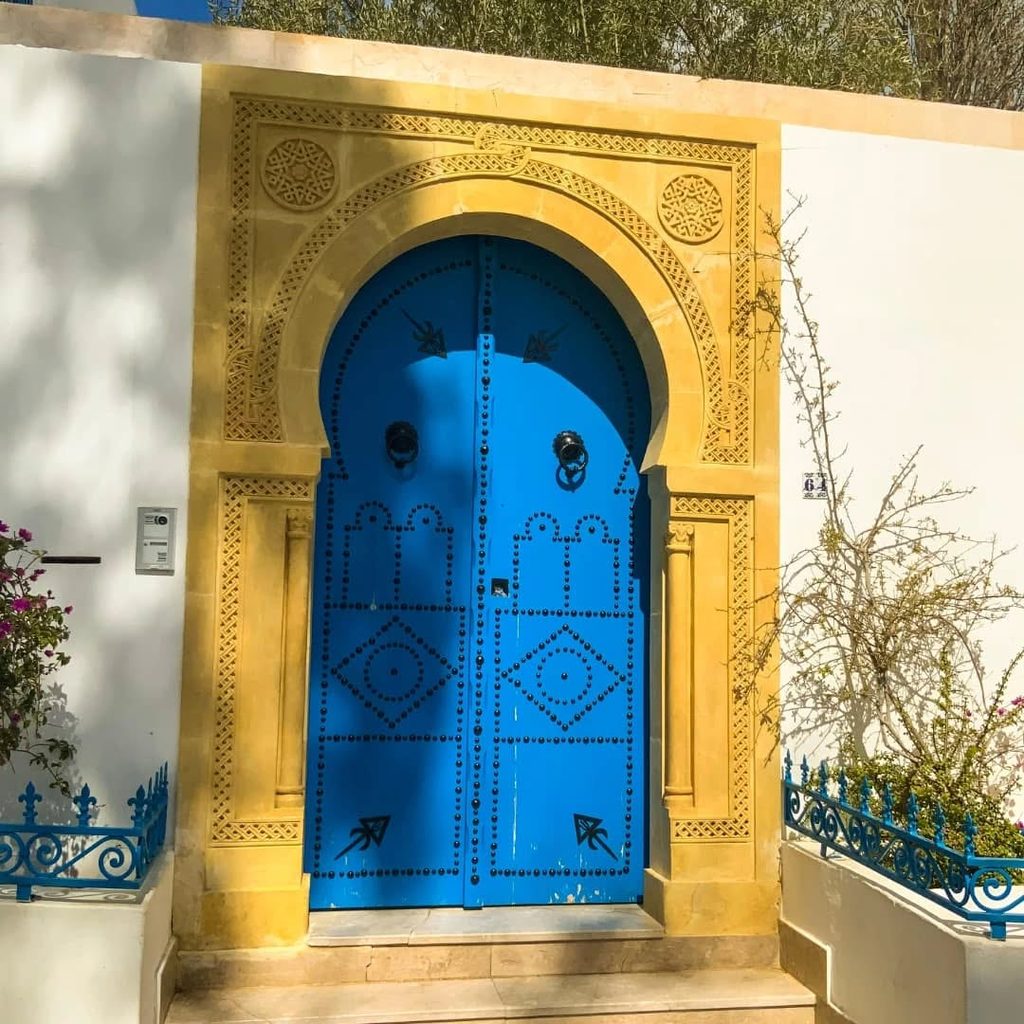
Finally, the knockers. Many older doors carry two, at different heights or on different leaves. The folk explanation, repeated by every guide, is that one is for men and one for women, so the household knows who is calling before it answers. The simpler explanation is that one is on the khoukha and one on the main leaf. Both are probably true somewhere.
What the nails mean
The nails are large, hand-forged, with domed heads the size of a coin, and they are driven in by the hundred. Once the carpenter has used the ones he needs to hold the planks, he keeps going, and the extra nails become a drawing. A handful of motifs account for most of what you will see.
The fish. The most Tunisian symbol of all, and the one you will see most often on doors in Tunis and on the coast. The fish is good luck, fertility, abundance, and a shield against the evil eye; it hangs over shop counters, rides on the back of wedding cars, and is pressed into the doors of houses whose owners wanted the sea’s protection on land.
The eye. A lozenge or an almond shape, sometimes with a single nail at the center for the pupil. It is the oldest apotropaic sign in the Mediterranean, and on a door it does exactly what it does everywhere else: it stares back at anyone who looks with envy.
The star and the crescent. Five-pointed, six-pointed, eight-pointed; alone or with a crescent beside it. The eight-pointed star is the same one that runs through Tunisian tilework and Sejnane pottery, a geometric signature far older than the flag that borrowed it.
The cypress. Guides call it a fir tree or a minaret, and from a distance it can look like either: a tall triangle of nails tapering to a point, sometimes two of them flanking the khoukha. The cypress is the tree of cemeteries and gardens, a sign of long life and of paradise, and it comes to Tunisia through Andalusia and the Ottoman decorative vocabulary at the same time.
The hand. The Khomsa, the open hand of Fatima, appears on doors less often in nails than as a knocker, cast in iron or brass with the fingers pointing down. When it is there, it is doing the same job as the eye and the fish, only more explicitly.
Flowers, vases, and arabesques. On the richest doors, and on later ones, the nails loosen into vines, rosettes, and vase shapes. This is the Italian and French influence of the 19th century arriving at the front door, and it is also how you can roughly date one: the tighter and more geometric the nails, the older the idea behind them.
The pattern was never random, and it was never purely for show. A family chose the symbols that spoke to what they feared and hoped for, and then a carpenter nailed them to the front of the house for two hundred years.
Why blue, why yellow, why green
The blue everyone comes for is a 20th-century invention, and it has a name attached.
Rodolphe d’Erlanger was a French-born painter and musicologist from a family of bankers who settled on the hill of Sidi Bou Said in 1909 and spent the next decade building Ennejma Ezzahra, the palace that is now a museum of Arab music. He loved the village and worried about what was coming for it. In August 1915 he persuaded the authorities to issue a decree, dated the 28th, protecting the character of Sidi Bou Said against alteration: no unregulated building, and façades in white with woodwork and ironwork in blue. It was one of the earliest heritage-protection orders of its kind anywhere, and it is the reason the village looks the way it does. Before the Baron, Sidi Bou Said was white and whatever color the owner liked. After him, it was white and blue, and the blue spread outward until half the Mediterranean assumed it had always been there.
The medina of Tunis never received such a decree, which is why its doors are more interesting. Blue is common there too, in a darker, greener shade than the Sidi Bou Said cobalt. But the other great color of the Tunis medina is yellow, a deep ochre that reads almost orange in afternoon light, and that nobody can quite explain. The likeliest answer is the least romantic: ochre and blue were the two pigments that were cheap, available, and held up to sun and salt. Green you will see on the doors of zaouias, mosques, and the houses of families who wanted the color of the Prophet on their threshold. Black and dark brown mark older doors, or doors that were never painted at all and simply oiled. Red is rare and worth a photograph when you find it.
In Kairouan the palette shifts again: blue and a chalky green against walls that are more cream than white. In the south, on Djerba, doors go blue or stay the color of the wood under whitewashed walls, with far fewer nails. Each town has a house style, which is why a seasoned door-watcher can usually tell you where a photograph was taken before reading the caption.
Where the door came from
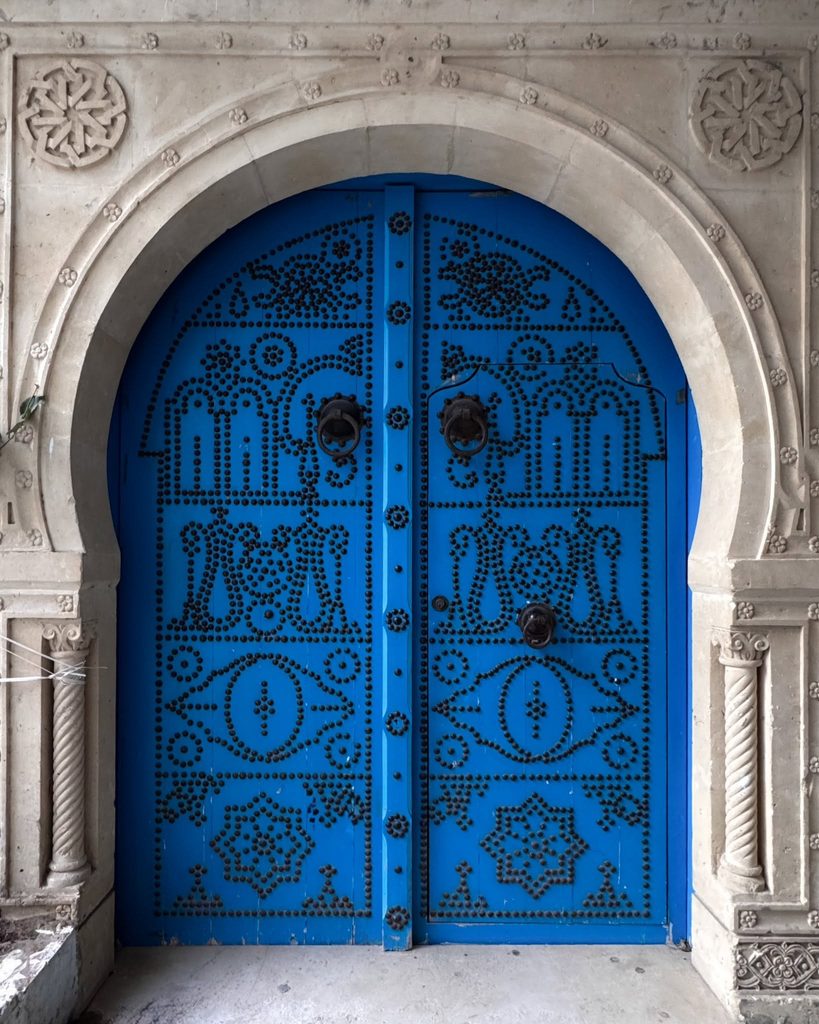
The studded door is not a Tunisian invention, but Tunisia is where it was perfected. The habit of decorating a door with its own nails is Andalusian, carried across the water by the Muslims and Jews expelled from Spain, first in 1492 and then, in a great final wave, in 1609. They settled in Tunis, Testour, Zaghouan, and across Cap Bon, and they built the houses they remembered: a plain wall to the street, a horseshoe arch, a courtyard inside. The Moorish door of Seville and Córdoba became the Tunisian door within a generation. Our comparison of Tunisia and Spain spends some time on that shared inheritance; the door is where you can see it fastest.
The Ottoman century added the second layer. After 1574, the great families of Tunis built palaces in the Istanbul manner, inward-facing, and the entrance became the one place where a household could display its rank. The doors of the beylical palaces and the big dars of the medina, Dar Lasram, Dar Ben Abdallah, Dar Hussein, grew taller and more elaborate: carved stone frames, double arches, more nails, finer patterns. The modest house copied what it could afford.
And the inward-facing house is the reason the door matters so much. A Tunisian dar has no windows on the street worth speaking of. Its beauty, the tiled courtyard, the carved plaster, the painted ceilings, is kept for the family. The door is the only sentence the house says in public. It had to say everything: who lives here, what they believe, what they fear, and whether they can afford iron.
Where to see the best doors
The medina of Tunis. The widest range in the country, and the only place to see the grand palace doors. Walk the streets around Rue du Pacha, Rue Sidi Ben Arous, and Rue des Andalous, where the Spanish refugees settled and where the horseshoe arches are thickest. Dar Lasram, now the Association de Sauvegarde de la Médina, and Dar Ben Abdallah, the museum of popular arts, both have doors worth the detour. Our guide to the medina will keep you from getting lost, but on this errand getting lost is fine.
Sidi Bou Said. The famous ones, and famous for a reason. Every door is blue, every wall is white, and the studding on the doors along Rue Habib Thameur and around the Café des Nattes is as fine as anything in Tunis. Go at nine in the morning, before the tour buses from Hammamet, and the lanes are yours. The Sidi Bou Said guide has the rest of the day.
Kairouan. Older, quieter, and less painted. The doors of the Kairouan medina are often bare wood under plain arches, with the nails doing all the talking; the ones around the Bir Barouta and the Zaouia of Sidi Abid el-Ghariani are the best.
Sousse. The medina of Sousse has fewer palace doors and more ordinary ones, which is its own pleasure: the fish and the eye on the house of a fisherman rather than a bey.
Djerba. On the island the door is lower, simpler, often set into a blind white wall with nothing else on it, which makes it almost more striking. Houmt Souk and the inland villages toward Erriadh are where to look; our Djerba guide covers the island.
Hammamet. The small walled medina of Hammamet is compact enough to see every door in an hour, and a good number of them are the full blue-on-white with heavy studding. Worth it if you are based on the coast and not going to Tunis.
Photographing them, and taking one home
Remember that every door you photograph has a family behind it. Shoot from the street, not the threshold; if the khoukha is open, don’t point the lens through it; and if someone comes out while you’re framing their house, a smile and a sahha costs nothing and usually gets you a conversation about when the door was made. Morning light in the medina comes down the alleys at a low angle and makes the nail heads cast small shadows, which is when the patterns read best. Midday flattens everything.
If you want a door of your own, be careful which one. Antique doors are pulled off abandoned houses in the medinas and sold through dealers in Tunis and on the road to Sidi Bou Said, and each one that leaves is a hole in a street that cannot be refilled. The better purchase is a knocker: a cast-iron hand of Fatima or a ring in a lion’s mouth from a blacksmith in the Souk des Forgerons in Tunis, or from the ironworkers’ lanes in Nabeul. They are light, they are made this year, and they carry the same meaning. A new door made to order is also possible, and Tunisian carpenters still build them with the crossbars and the nails, but shipping a hundred kilos of olive wood is a project for another article.
And if you only take home a phone full of pictures, that is the right souvenir. Look at them again in a month and you’ll find you can read them now: the fish for luck, the eye against envy, the cypress for a long life, the small door for every day.
The house says one thing
A Tunisian door is a paradox. It is built to keep you out, and it is the most generous thing on the street. It hides a courtyard and announces a family. It was nailed shut against the evil eye and painted to catch yours.
The Baron got his decree in 1915, and the blue has lasted. The carpenters got no decree at all, and the nails have lasted longer.
Suggested Read: The Khomsa: Tunisia’s Hand of Fatima
Suggested Read: Tunisia or Morocco? An Honest Comparison from Tunis
From the Carthage Magazine Bookshelf
The door is what Tunisia shows the street; these three are what it keeps inside.
- All About Tunisia — the definitive English-language traveler’s guide. 572 pages, 27 chapters, all nine regions, every UNESCO inscription, five thematic trails — and the practical answers (visa, currency, transport, etiquette) most travelers wish they’d had on the plane. $24.99 · PDF & EPUB.
- Speak Like a Local — 200+ Tunisian Arabic phrases with native audio recorded in Tunis. The phrases for the taxi, the souk, the café, and the dinner table. $14.99 · PDF, EPUB, MP3.
- The Authentic Tunisian Cookbook — sixty traditional recipes from the heart of North Africa. For when you get home and find yourself missing the food. $9.99 · PDF & EPUB.
All three available as a bundle for $39.99 — guide, language, and food, delivered together.
