
Quick Answer Tunisia is overwhelmingly Muslim — roughly 99% of Tunisians are Sunni Muslims of the Maliki school, the tradition that has shaped the country since the founding of Kairouan in the seventh century. But the full picture is more interesting than that number suggests. Tunisia is home to one of the oldest Jewish communities on earth, on the island of Djerba; a small Christian presence; the distinct Ibadi Muslims of Djerba; a deep Sufi undercurrent; and a famously relaxed, secular-leaning public life that sets it apart from most of the Arab world. Faith here is less a set of rules than a rhythm — the call to prayer, the fast of Ramadan, the saint’s shrine on the hill — woven quietly through ordinary days.
Stand in the medina of Tunis at the right hour and you will hear the whole story at once: the muezzin’s call rising over the rooftops, the clink of glasses on a café terrace below it, and somewhere nearby the murmur of a wedding that will, before the week is out, touch on customs older than Islam itself. Tunisia wears its faith the way it wears everything — confidently, and without much fuss.
For a country so often reduced to a single line in a guidebook (“99% Muslim”), the religious life of Tunisia is layered, ancient, and quietly remarkable. Here is the honest version.
So, What Religion Is Tunisia?
The short answer is the one the statistics give: around 99% of Tunisians are Sunni Muslims, following the Maliki school of jurisprudence — one of the four great schools of Sunni law, named for the eighth-century scholar Malik ibn Anas. The remaining sliver, well under one percent, is made up of Christians, Jews, a handful of Shia and Ibadi Muslims, Baha’is, and a growing number of Tunisians who quietly describe themselves as non-religious.
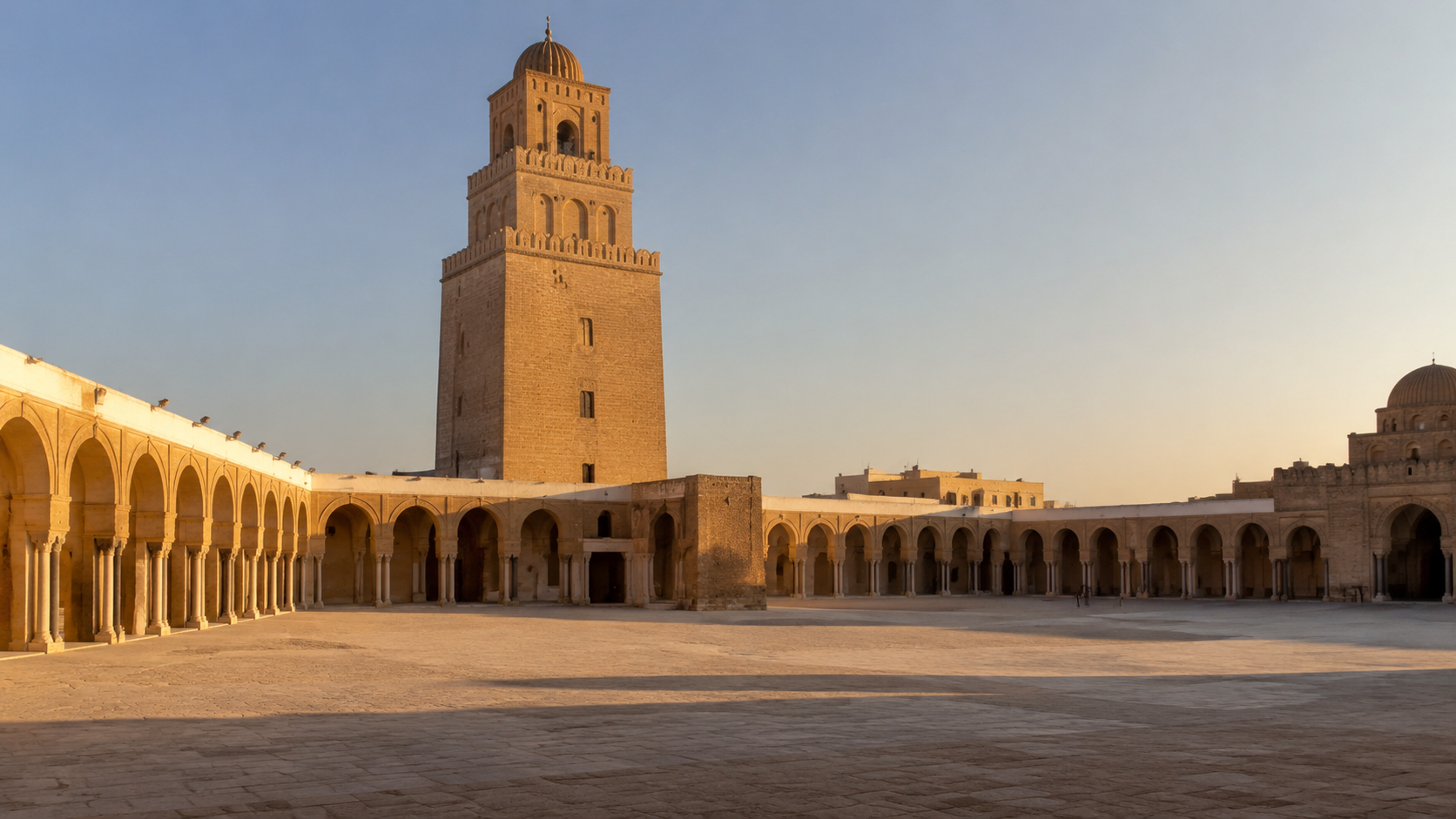
Maliki Islam did not arrive in Tunisia by accident. It put down roots here, in Kairouan, the holy city the Arabs founded in 670 — the oldest Islamic city in North Africa and, by tradition, the fourth holiest in all of Islam. The Great Mosque of Kairouan became the model from which mosque architecture across the western Islamic world was copied, and the city’s scholars carried the Maliki school across the Maghreb and into Muslim Spain. To understand Tunisian Islam, you really have to start in Kairouan.
The Famous Tunisian Tolerance — How Much Is Real?
Tunisia has a reputation, well earned, as one of the most liberal and secular-leaning states in the Arab world — and that reputation rests on more than vibes.
In 1956, weeks after independence, Habib Bourguiba pushed through the Code of Personal Status, a body of law that banned polygamy outright, abolished unilateral divorce by repudiation, and set a minimum age for marriage — reforms without parallel in the region then, and rare even now. They drew on the ideas of the reformer Tahar Haddad, who had argued a generation earlier that nothing in Islam required the subjugation of women. The result is a country where faith and a strikingly progressive civil law have coexisted for almost seventy years.
You can see the same easy secularism in daily life. Alcohol is legal, produced domestically, and served openly in much of the country — a reality that surprises many visitors and one worth understanding before you travel. Headscarves are common but far from universal. Cafés stay busy through prayer times. Even the constitution has softened: the 2014 text declared the state’s religion to be Islam, but the 2022 constitution dropped that line, describing Tunisia instead as part of the wider Islamic world while still requiring that the president be a Muslim.
None of this means religion is absent — far from it. It means Tunisians have long been comfortable holding faith and freedom in the same hand, and that comfort is one of the country’s defining traits.
Ramadan and the Two Eids: Faith You Can Feel
If you want to understand how Islam actually lives in Tunisia, watch the calendar rather than the constitution.
For one month a year, the whole country shifts into the rhythm of Ramadan — the daytime hush, the streets emptying toward sunset, and then the explosion of the iftar meal and the long, sociable nights that follow. It is the most visible expression of faith in the Tunisian year, and even the non-observant are carried along by its tide.
Then come the two great festivals: Eid al-Fitr, which closes Ramadan in a rush of sweets and new clothes, and Eid al-Adha, the feast of the sacrifice, when families across the country mark the day in the traditional way. These are the moments when religion becomes texture — food, family, ritual, the whole apparatus of belonging — rather than doctrine.
The Jews of Djerba: One of the World’s Oldest Communities
Tunisia’s most extraordinary religious story is also its smallest. On the island of Djerba, in the south, a Jewish community has lived continuously for well over two thousand years — by tradition since the destruction of the First Temple in 586 BC, which would make it one of the oldest surviving Jewish communities on the planet.
At its heart stands the El Ghriba synagogue, held to be the oldest synagogue in Africa, and each spring it draws Jewish pilgrims from around the world for the Lag B’Omer pilgrimage — a rare and moving sight in the modern Arab world. The community today numbers only around 1,500, most of them on Djerba and in nearby Zarzis, with a smaller presence around Tunis. It is a fragile inheritance, and Tunisians of all faiths tend to speak of it with real pride.
Christians, Ibadis, and the Sufi Undercurrent
The country’s other minorities are smaller still, but each adds a thread. The Christian community — perhaps 30,000 residents, mostly foreigners, the majority Roman Catholic — worships in a handful of churches, including the cathedral that still stands on the heights of ancient Carthage, a reminder that this was once one of the great centres of early Christianity. North Africa gave the Church towering figures in the first centuries after Christ, and the deep Christian past is part of Tunisia’s long, layered history, even if the present community is modest.
Djerba, characteristically, has its own exception: a community of Ibadi Muslims, a branch distinct from both Sunni and Shia Islam, who have given the island a quiet religious singularity to match its Jewish one.
And running beneath all of it is Sufism — the mystical, devotional current of Islam expressed through saints, shrines, and brotherhoods. Its fingerprints are everywhere once you know to look: in the whitewashed zawiyas (shrines) dotted across the countryside, in the festivals that blur the line between the sacred and the celebratory, and even in place names — the famous blue-and-white village of Sidi Bou Said is named for a thirteenth-century Sufi holy man whose shrine still crowns the hill.
Folk Belief: The Hand on Every Doorway
Then there is the religion that exists alongside the formal one — the everyday web of belief and custom that most Tunisians would not even call “religion.” Its emblem is the khomsa, the open right hand you will find painted on doors, hung over cradles, and worked into jewellery the length of the country, warding off the evil eye. This is the older layer — part Islamic, part pre-Islamic, part simply Tunisian — and it sits comfortably beside the mosque, the synagogue, and the café, the way everything in Tunisia eventually does.
How Faith Shapes a Visit
For the traveller, the practical upshot is simple and reassuring. Tunisia is an easy, welcoming place to visit as a non-Muslim. Modest dress is appreciated at religious sites, and you should expect most mosques to be closed to non-worshippers (the Great Mosque of Kairouan, which admits visitors to its courtyard, is a notable and generous exception). During Ramadan, daytime eating in public is best done discreetly out of courtesy, though tourist restaurants stay open. Beyond that, the country asks very little of you — only the same easy respect it extends so readily in return.
That, in the end, is the honest answer to “what religion is Tunisia?” Overwhelmingly Muslim, yes — but also Jewish and Christian and Sufi and secular and superstitious, all at once, and entirely unbothered by the contradiction. It is a country that has been absorbing faiths for three thousand years and has learned, better than most, how to let them live side by side.
From the Carthage Magazine Bookshelf
Faith is woven through so much of Tunisian life that understanding it makes the whole country read more clearly. Three Carthage Magazine ebooks go deeper into the culture it sits inside:
- All About Tunisia — the definitive English-language traveller’s guide. 572 pages, 27 chapters, all nine regions, every UNESCO inscription, and the practical answers — etiquette at religious sites included — most travellers wish they’d had on the plane. $24.99 · PDF & EPUB
- Speak Like a Local — 200+ Tunisian Arabic phrases with native audio recorded in Tunis, including the greetings of Ramadan and the two Eids. $14.99 · PDF, EPUB, MP3
- The Authentic Tunisian Cookbook — sixty traditional recipes, among them the dishes that fill the Ramadan table. $9.99 · PDF & EPUB
All three are available as a bundle for $39.99 — guide, language, and food, delivered together.
