
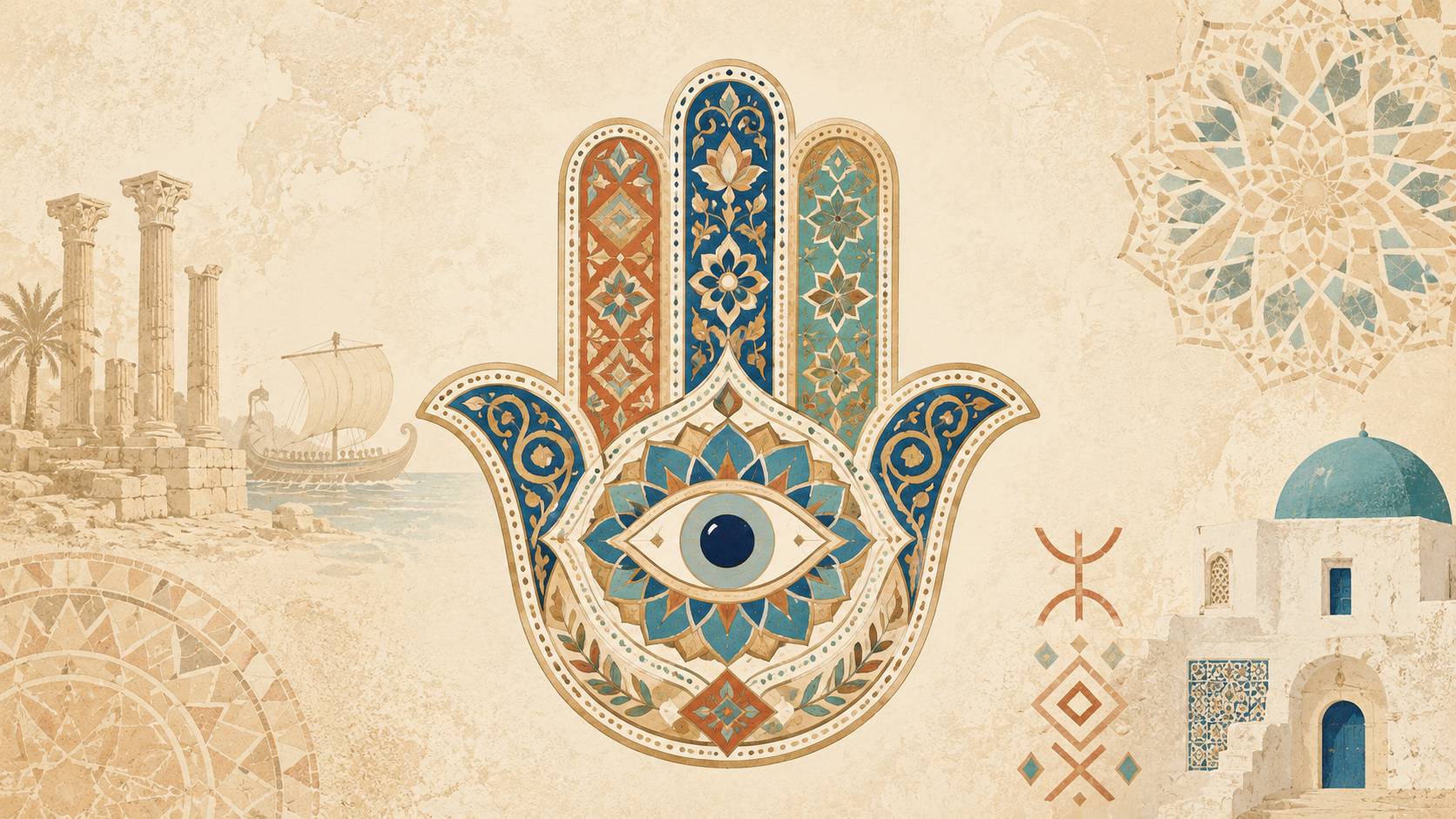
Walk a Tunis street and you will see her before you notice. She hangs above the front door of a freshly painted villa in La Marsa. She dangles from the rear-view mirror of every louage rattling toward Hammamet. She rests against the collarbone of the woman behind the spice counter in the medina. She is hammered into the silver of a bride’s wedding gift, painted onto the prow of a fishing boat at Mahdia, embroidered into the corner of a newborn’s swaddle, tattooed on the wrist of a teenager who has never set foot in a mosque. She is the Khomsa — Tunisia’s five-fingered hand — and she has been watching the country, by one reading of the evidence, for almost three thousand years.
A Five, Before It Was a Hand
The word itself gives the symbol away. Khomsa — sometimes written khamsa or khmissa — comes from the Arabic for five, and the symbol’s basic anatomy never strays from that count: five fingers, five points, five blessings, five pillars. In its most familiar form she is a stylised palm, thumb and pinky splayed outward in mirrored symmetry, three fingers held upright between them, the whole thing usually decorated with an eye, a fish, a crescent, or a smaller Khomsa nested inside the larger one. She is meant to be looked at. More importantly, she is meant to look back.
In the West she is most often called the Hand of Fatima, after the daughter of the Prophet Muhammad. In Tunisia she is simply el khomsa, and the name predates Islam by a long, long stretch.
From Tanit’s Palm to a Carthaginian Stele
Long before Fatima — before Islam reached Ifriqiya, before the Arabs founded Kairouan — an open right hand was already part of the religious vocabulary of this coastline. The chief goddess of Carthage was Tanit, great mother of the Phoenician-Punic world, and her iconography included a raised, outstretched palm. Stelae and votive tablets unearthed at the Carthage tofet, now preserved in the Bardo National Museum and the Carthage National Museum, repeat the gesture: a stylised hand, sometimes joined to Tanit’s famous triangular sign, sometimes standing alone, sometimes hovering above a worshipper as a sign of protection.
Historians of the Mediterranean are careful here. The Khomsa as Tunisians know her today is not a clean, unbroken line from Tanit; she was reshaped by Roman manus, by Berber tafust (the Amazigh word for the same symbol), by the Jewish Hand of Miriam, by Islamic theology, by French colonial taste. But the impulse — to make a five-fingered hand that defends — is older than every religion that has ever ruled this country. The Khomsa is what happens when an idea survives every empire that tries to overwrite it.
The Islamic Layer
When Islam arrived in the seventh century, the open hand was already culturally indispensable. Theology did the rest of the work. The five fingers became the Five Pillars — shahada, prayer, zakat, fasting, hajj. The hand was attributed to Fatima al-Zahra, the Prophet’s daughter, whose name in Tunisian households is still invoked at the threshold of a new home or the cradle of a new baby.
That layered identity is exactly why the Khomsa is so durable. To a believer she is the daughter of the Prophet. To a grandmother she is the hand that turns away the evil eye. To a teenager she is a piece of silver bought in Sidi Bou Said because it looks good against a sunburn. None of those readings contradict each other in Tunisia. They simply stack.
Where You Will Actually See Her

Tunisians do not display the Khomsa as ornament; they post her as a sentry. The most common positions are predictable once you know where to look.
- Above the door. Often nailed directly into the lintel of older houses in the Medina of Tunis, occasionally painted straight onto the wall. In Sidi Bou Said, look closely at the famous blue-and-white doors — those iron studs driven in patterns across the wood almost always form the silhouette of a Khomsa, the studs themselves traditionally five, fifteen, or twenty-five in number.
- On the rear-view mirror. Every taxi in this country, and a fair fraction of private cars, carries one. Drivers will tell you it is for luck. Most also drive better when one is hanging there.
- Around the neck of a bride. A Tunisian bride is, by tradition, gifted gold or silver Khomsas in the days before her wedding — at the outia, during the henna night, at the jalwa. Some are wearable. Some are ceremonial. All are meant to follow her into her new house.
- Above the cradle. The most ancient placement, and still the most universal. A small Khomsa — often with a turquoise bead or a fish set into the palm — is hung above a newborn for the first weeks of life. The child is too beautiful, the grandmothers say. Someone might look.
- On the back of a phone case. This is the newest position, and the one that tells you the symbol is in no danger of dying.
The Craft Behind the Object
A Khomsa is never just one thing. The shape multiplies across mediums.
In silver, which is the most prestigious material, the Khomsa is the speciality of Tunisia’s traditional silversmiths — the sayyaghin — concentrated historically in the Medina of Tunis around Souk el Berka, and in pockets of Djerba where Jewish craftsmen developed some of the finest filigree work in North Africa. Look for the qachabia engraving — fine, almost hair-like lines hand-incised into the surface — and the small filigree balls at the fingertips. The best examples are heavy in the hand and warm where they touch skin.
In ceramic, the Khomsa belongs to Nabeul, on Cap Bon, where potters glaze her in cobalt blue and Tunisian green and fire her for the wall. These are the ones you see hung beside front doors all across the country.
In glass and clay, she turns up at every souk in the south — from Houmt Souk to the markets of Tozeur — often cheap, often touristic, but rarely without genuine craft underneath the cheap.
The closer to the women’s hand-built traditions of Sejnane you look, the more interesting the variations get: a Khomsa with no fingers at all, only the silhouette; a Khomsa with the fish of Tanit inscribed inside the palm; a Khomsa whose surface is decorated with the same red-ochre geometric language the Sejnane potters have been firing for three thousand years.
How to Buy One
The two honest places to buy a real Khomsa are the Medina of Tunis and the souks of Houmt Souk on Djerba. In Tunis, walk to Souk el Berka — the old slave market turned silver market — and look for shops that weigh pieces in front of you. Genuine sterling silver should be stamped; the Tunisian hallmark is the head of a North African horseman.
Expect to pay 80 to 250 dinars for a good wearable silver Khomsa, more if it carries a serious stone or significant weight. Ceramic Khomsas from Nabeul run 15 to 60 dinars depending on size and glaze. Tourist-grade brass pieces — the kind sold at the airport — start at 10. They are not worthless. They are simply not what a Tunisian grandmother would actually give a granddaughter on her wedding day.
A note on bargaining: it is expected, even welcome, but never aggressive. The price is a conversation, not a contest.
A Symbol That Refuses to Mean Only One Thing
Try to pin the Khomsa to a single religion and she slips. The Jewish community of Djerba — home to El Ghriba, Africa’s oldest synagogue — has worn her for centuries as the Hand of Miriam. Tunisian Muslims wear her as the Hand of Fatima. Tunisian Christians of the colonial period kept her as a souvenir of the country they had never quite understood. Today’s secular Tunisian wears her because her grandmother gave it to her, and that is reason enough.
That is the Khomsa’s quiet genius. She is older than every religion that has tried to claim her, and she has outlasted all of them in turn. She is what Tunisia does best — stacking three thousand years of contradiction into a shape small enough to fit in the palm of a child’s hand.
Hang one above your door. Just in case.
