
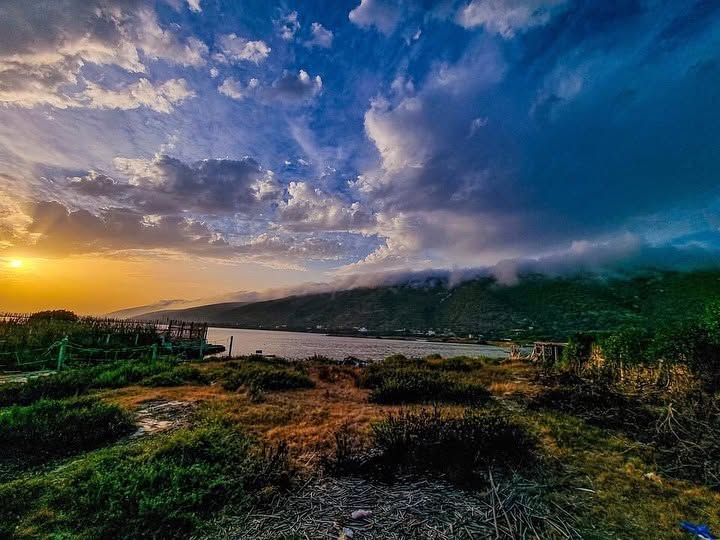
Quick Answer — Ghar El Melh is a former corsair port on a silted lagoon 50 km north of Tunis, with three Ottoman-era forts (added to ISESCO’s Islamic World Heritage list in February 2026), a 17th-century Andalusian system of sand-grown gardens that the FAO recognises as a global agricultural heritage site, and, five kilometres east, Sidi Ali El Mekki, the beach most people in Tunis would name as the best within an hour of the city. Rafraf, over the hill on the north side of the cape, is the quieter sibling: a muscat-grape village with a pine-backed beach and the Pilau rock sitting offshore. Together they make the best coastal day trip from the capital that almost no foreign visitor takes. Go in May, June, September or October; in August the beach is full of Tunis. Here’s the whole story.
For three centuries the port that mattered on this stretch of coast was not Bizerte but a place the Europeans called Porto Farina. Its harbour was deep, its position at the mouth of the Medjerda was useful, and in the 1630s an Italian renegade turned Ottoman corsair named Usta Murad made it his base, built forts across the harbour mouth, and invited Muslim refugees from Spain to settle the land behind it. For a while it rivalled Bizerte in size. Then the river did what the river does on this coast: it silted the harbour, pushed the sea back, and turned the port into a lagoon. The corsairs left. The Andalusians stayed and learned to farm sand.
That is the town you arrive in today: a white village on the edge of a shallow lake, with fishing boats drawn up in a stone basin that has not seen a warship since the British admiral Blake burned the fleet here in 1655, and three forts that have outlived everything they were built to defend.
The Three Forts
They sit in a line along the old waterfront, built around 1650 in a style that mixes Andalusian masonry with Ottoman military planning. Borj El Wistani, the middle one above the old port, is the oldest and the least restored; Borj Lazaret, nearest the sea, was the quarantine station; Borj El Loutani, the largest, served as a prison and now holds a small museum about the lagoon and the town.
The courtyards are open most days and admission is a few dinars. None takes long. The point is the setting: thick walls, a sliver of water, and the hump of Jebel Nadhour rising behind, which is why the ISESCO listing this year framed the town as an open-air museum rather than a collection of monuments. If you are interested in the Ottoman military landscape of the north, the old harbour of Bizerte is the natural companion visit.
The Ramli Gardens
The lagoon is the real curiosity. Between it and the sea runs a strip of sand, and on that sand, since the 1600s, the people of Ghar El Melh have grown potatoes, onions and beans in plots that float on a lens of fresh water a few centimetres above the salt. The gardens are built up by hand, fed by the tide pushing rainwater upward, and farmed in units so small that most families work less than five hectares.
In 2020 the FAO recognised the system as a Globally Important Agricultural Heritage Site, one of only two in Tunisia alongside the hanging fig gardens of Djebba. You can walk the dyke between the lagoon and the plots; in autumn the planting is going in and the flamingos are back on the water. The lagoon is also a Ramsar wetland, and birders who have done Ichkeul will find it a smaller, easier second stop.
Sidi Ali El Mekki
Drive east through the village and the road ends at the beach. It is a long curve of pale sand below a wooded headland, with water that shelves slowly and stays clear, and the shrine of the saint it is named for built into the hillside above, so that pilgrims and bathers have been sharing the same cove for centuries.
In summer there are straw-roofed cafés and a lot of Tunis families; outside summer there is almost nobody. The far end of the beach, towards the cape, is where the sand is best. It appears, deservedly, in our coast-by-coast guide to Tunisia’s beaches, and it is the reason to make this a full day rather than a stop.
Over the Hill to Rafraf
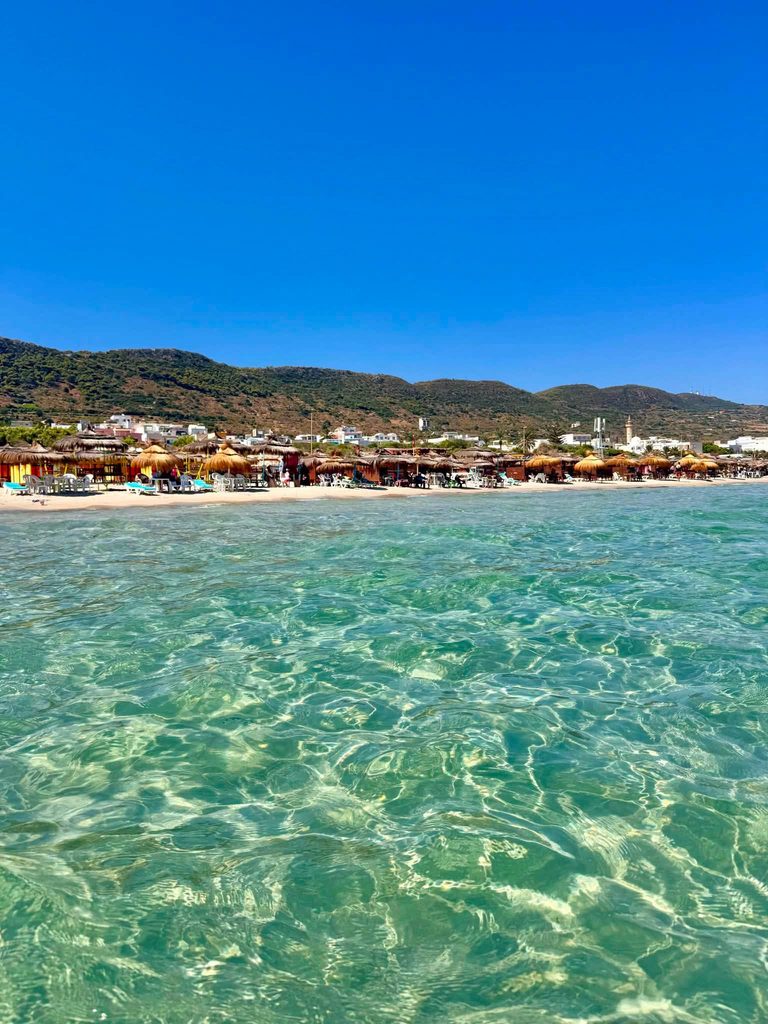
Rafraf is a 20-minute drive over the ridge, or a stiff walk along the crest of Jebel Nadhour with the Ghar El Melh lagoon on one side and the Rafraf bay on the other, one of the better short hikes in the north.
The village is known for three things: its muscat grapes, which go into a sweet local wine and a lot of September table fruit; its wedding costume, among the most elaborate in the country and the pride of the traditional-dress repertoire; and the Pilau, a steep rock island a few hundred metres off the beach that boats will run you out to for a swim.
The beach itself is backed by maritime pines, with a grey clay at the northern end that bathers smear on themselves and swear by. Beyond it, round the point, is the natural pool at Bounta and then, if you keep going, Cape Zbib.
Honestly
Neither village is set up for foreign tourists, and that is the attraction and the warning. There is no hotel of any standard in Ghar El Melh; there are a few guesthouses and summer rentals, and a cluster of fish restaurants by the port that are very good in season and closed out of it.
Rafraf has beach cafés and little else. Signage is in Arabic and French. In August both beaches are heaving, the road in is a queue, and the villages lose most of their charm. The forts have been restored unevenly and the museum keeps erratic hours. Come in the shoulder months, bring a car or hire a taxi for the day, eat fish at lunchtime, and treat it as what it is: the coast that Tunis keeps for itself.
Practicalities
Getting there. By car, Ghar El Melh is about 50 km from Tunis via the A4 and the Aousja road, 45 minutes to an hour depending on the capital’s traffic; Rafraf is 60 km. Louages run from Tunis’s northern station to Ras Jebel, from where local taxis cover the last few kilometres to either village; see our louage and taxi guides. A hire car is the sensible option, because the two villages, the beach and the ridge are 20 minutes apart and public transport does not link them.
Combine with. The Punic and Roman site of Utica is 15 minutes away on the Tunis road (see the Roman Tunisia field guide); Bizerte is 40 km north (our Bizerte guide); the Andalusian towns of Testour share the same Morisco story inland. For the full list of options, see day trips from Tunis.
When. May–June and September–October for the beach without the crowds. Autumn for the ramli planting and the birds. Grapes in Rafraf ripen in late August and September.
Time. A full day for both villages and a swim; a half-day for Ghar El Melh and Sidi Ali El Mekki alone.
From the Carthage Magazine Bookshelf
The northern coast rewards travellers who go with a map, a few words of Arabic, and a plan for what to cook when they get home.
- All About Tunisia — the definitive English-language traveler’s guide. 572 pages, 27 chapters, all nine regions, every UNESCO inscription, five thematic trails — and the practical answers (visa, currency, transport, etiquette) most travelers wish they’d had on the plane. $24.99 · PDF & EPUB.
- Speak Like a Local — 200+ Tunisian Arabic phrases with native audio recorded in Tunis. The phrases for the taxi, the souk, the café, and the dinner table. $14.99 · PDF, EPUB, MP3.
- The Authentic Tunisian Cookbook — sixty traditional recipes from the heart of North Africa. For when you get home and find yourself missing the food. $9.99 · PDF & EPUB.
All three available as a bundle for $39.99 — guide, language, and food, delivered together.
