
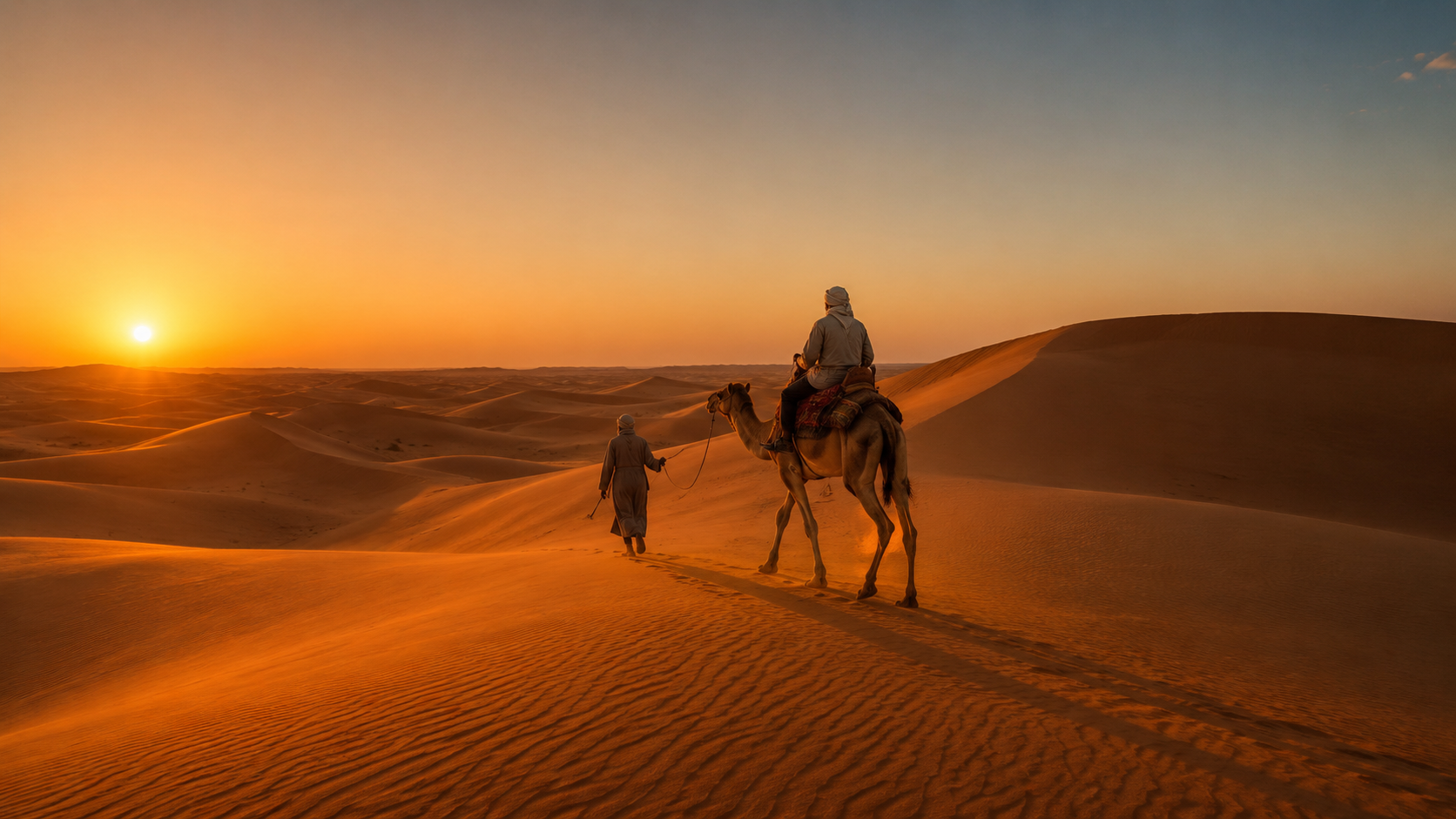
Quick Answer Tunisia offers some of the most accessible Sahara experiences in the world, launched mainly from two gateway towns: Douz, the classic camel-trek base on the edge of the Grand Erg Oriental, and Tozeur, an oasis city better suited to 4×4 tours, the Star Wars sets, and the Chott el Jerid salt lake. The honest truth: most “camel rides” sold to tourists are a 60–90 minute plod near town, not a trek. A real experience is an overnight bivouac — camel out to a desert camp, sunset, fire-baked bread, a night under the stars, sunrise, camel back — which runs roughly $100–150 per person in 2026. Go between October and April; the summer Sahara is genuinely dangerous. Book a small, reputable operator, bring warm layers for the cold nights, and treat the cameleers and their animals well.
The first thing you notice is the silence. Not quiet — silence. You are an hour out of Douz, the lights of the town gone behind a wall of dunes, the camel has folded its legs beneath you, the cameleer is coaxing a fire out of dead palm wood, and there is simply no sound at all except your own blood. Then the cold comes down with the dark, the first stars arrive in numbers a city dweller has never seen, and you understand why people have been crossing this desert for three thousand years and writing about it ever since.
That is the thing worth buying. The problem is that it is not, usually, the thing being sold. So before you book anything, here is the honest version — what these tours actually are, where to do them, what they cost in 2026, and how not to get burned.
What you’re actually booking
“Camel trek” and “Sahara desert tour” cover four very different experiences, and the gap between the cheapest and the best is enormous. Know which one you want.
The short camel ride is what most package tourists end up with: a 60–90 minute amble on a dromedary over the dunes nearest town, usually timed for sunset. It is pleasant, photogenic, and — let’s be honest — a little touristy. It is not a trek.
The overnight bivouac is the sweet spot for most travelers. You ride a camel out to a desert camp in the late afternoon, watch the sun go down over the dunes, eat dinner cooked over a fire, sleep in a tent or under the open sky, and ride back at dawn. This is where the silence lives.
The multi-day caravan trek is the real thing — two to six days walking and riding deep into the Grand Erg Oriental, moving camp each night, far beyond where any vehicle goes. It is demanding, unforgettable, and not for everyone.
And then there is the 4×4 “desert tour,” which despite the marketing photos often involves very little camel at all. These cross the Chott el Jerid, hit the Star Wars sets and the mountain oases around Tozeur, and may throw in a token sunset ride. There is nothing wrong with this — it covers a lot of ground — but go in knowing it is a road trip, not a trek.
The single most common disappointment in the Tunisian Sahara is a traveler who paid for one of these expecting another. Decide first.
Where the desert begins: Douz, Tozeur, and Ksar Ghilane
Three places launch the overwhelming majority of desert trips, and they are not interchangeable. (For the wider regional picture — the salt flats, the troglodyte villages of Matmata, the Berber ksour around Tataouine — see our field guide to the Tunisian Sahara; here the focus is the camel-and-dunes experience itself.)
Douz is the one to choose if the camel itself is the point. Known for generations as the Gateway to the Sahara, it sits right where the palm groves give way to the white dunes of the Nefzaoua and the Grand Erg Oriental. This is camel country: the local Mrazig people have desert in their blood, the camel trek is the signature local experience, and the Thursday market still draws traders from across the south. If you want to mount a dromedary in town and be in real dunes within twenty minutes, Douz is the answer.
Tozeur is the better base if you want variety over a pure camel experience. It is a beautiful old oasis city of brick-latticed walls and a vast palm grove, and it is the launch point for the region’s greatest hits: the Chott el Jerid crossing, the Star Wars filming sites at Ong Jmal and Mos Espa, and the cliffside mountain oases of Chebika, Tamerza, and Midès. Desert experiences here lean toward the 4×4; the big dunes are a little further out.
Ksar Ghilane is the wildcard — a remote oasis on the far eastern edge of the Grand Erg, famous for a natural hot spring you can bathe in beneath the dunes. It’s reached by 4×4 from Douz (about 80 km) or Matmata, and it makes a spectacular overnight or two-day target if you want deep desert with a soak at the end.
For most first-timers: Douz for the camel and the dunes; Tozeur for the scenery and the sites; Ksar Ghilane if you have an extra day and want to go further in.
What a night in the dunes is really like
If you book the overnight bivouac — and you should — here is the shape of it, so there are no surprises.
You meet your guide and cameleers in the early afternoon. They’ll often hand you a chèche, the long desert turban, and show you how to wind it; it is not a gimmick, it genuinely keeps the sun and sand off. Then you mount. A dromedary rises back-legs-first, which pitches you violently forward — hold the saddle horn and lean back, and do the reverse when it kneels to let you off. The ride out is slow, rolling, and a little hypnotic, an hour or two across the dunes to camp.
Then the desert does its work. The sun goes down in colors that don’t photograph properly. The cameleers bake khobz mella — bread cooked directly in the hot sand and embers — and serve a simple, good dinner, usually a stew and bread and sweet mint tea. Someone may bring out a drum. The temperature drops fast once the sun is gone, even in spring and autumn, and the sky fills with more stars than seems plausible. You sleep in a tent, or, if the night is mild, on a mat under the open sky. You wake stiff and cold to a pale dawn, drink tea, and ride back as the light comes up gold over the sand.
It is not luxurious. The toilet is a dune. The camel will make you sore in places you didn’t know you had. None of that is the point. The point is the silence, and the stars, and the morning.
When to go (and when not to)
This matters more than anything else in this guide, so read it twice: the Tunisian Sahara is a winter destination.
The season runs roughly October to April, when desert days are warm and bright and the nights are cold but bearable. The shoulder months — October, November, March, April — are arguably ideal: comfortable riding, dramatic light, fewer crowds.
Summer is a different and dangerous animal. From late May through September, daytime temperatures of 45°C and higher are routine in the deep south, the dunes offer no shade whatsoever, and heat exhaustion is a real risk on a midday camel. If you must come in summer, ride only at dawn or dusk and never push into the open desert in the middle of the day. For a full month-by-month breakdown of what the south is doing when, see our honest month-by-month guide to visiting Tunisia.
One bonus for late-December travelers: Douz hosts the International Festival of the Sahara, days of camel racing, music, and nomadic tradition that are worth planning a trip around.
What it costs in 2026
Prices in the desert are indicative and almost always negotiable, especially if you book locally and outside peak weeks. As a 2026 guide:
A short sunset camel ride near town runs only a few tens of dinars — roughly $10–25 for an hour.
An overnight camel trek with bivouac from Douz typically costs about $100–150 per person, including the ride, dinner, breakfast, the camp, and usually hotel pickup. This is the best value in the whole category.
A multi-day caravan trek (3–6 days) ranges widely with length and group size, from around $250 up to $600 or more per person for the longest, most remote routes into the Sabria dunes and the Grand Erg.
A full-day 4×4 tour out of Tozeur — Star Wars sets, Ong Jmal, the Chott el Jerid crossing — is usually priced per vehicle, around 80–150 dinars for the day (split that between everyone in the car).
A multi-day package from the coast (Tunis, Hammamet, Sousse, or Djerba) that bundles transport, hotels, and a desert night generally starts around $220–250 and climbs from there for private or longer trips.
Always confirm exactly what’s included — meals, water, camp, transfers — before you hand over money, and be wary of a price that seems too good; in the desert it usually means something has been left out.
What to bring — and the things no one warns you about
The desert punishes the unprepared in small, avoidable ways. Pack for it.
Warm layers are non-negotiable, even in spring and autumn. The same desert that hit 30°C at noon can drop toward freezing before dawn, and first-timers are routinely caught out. Bring a fleece or jacket and something for your head at night.
Closed shoes beat sandals for riding and for walking on cooling sand after dark. A scarf or chèche for sun and blowing sand. High-factor sunscreen and sunglasses — the glare off pale sand and the salt of the chott is fierce. More water than you think you need. Cash, in Tunisian dinars, in small notes, for tips and extras; cards are useless past the last town. And wet wipes, because the nearest tap is a long way off.
The thing no one tells you: the camel ride is genuinely uncomfortable. The gait rolls you side to side, the saddle is hard, and after an hour your hips and inner thighs will complain. This is normal. Shift your weight, don’t fight it, and know that the discomfort is a fair price for where it takes you.
How to choose a tour without getting burned
The Tunisian south is overwhelmingly safe and the people are famously hospitable — but tourism brings touts, and the desert brings real hazards. A few rules.
Book a small, reputable operator over a stranger with a truck, and read recent reviews. Smaller groups mean a better experience and a better-timed sunset. Confirm the itinerary and inclusions in writing — how long on the camel, how far out, what meals, private or shared. Never self-drive off-road onto the Chott el Jerid or into the open dunes; even serious 4×4s get stuck or lost, and the salt lake is genuinely dangerous off the marked road. Go with someone who knows the ground.
On animal welfare: choose cameleers whose dromedaries look healthy, well-fed, and unhurried, and don’t reward operators who overload or mistreat them. Walking part of the way yourself is kinder to the animal and often more pleasant anyway.
Tip the cameleers — they are skilled, low-paid, and the reason your night works; a few dinars per person is appreciated and expected. And a word for solo and women travelers: the desert south is one of the easier parts of Tunisia to travel, but going with a registered guide or established camp is the smart move out here. Our honest guide for solo female travelers covers the wider picture.
Finally, remember you are a guest in a living culture, not a theme park. The people you meet out here — many of them of Amazigh and nomadic heritage — have kept this desert’s traditions alive for centuries. A little respect goes a long way.
Starting from the coast: Djerba, Hammamet, Sousse
Plenty of travelers do the Sahara as a break from a beach holiday, and that’s fine — but be realistic about the geography. The dunes are a long way from the coast.
From Djerba and Zarzis you’re closest to the southern ksour and Ksar Ghilane; a 2-day desert tour is the sensible minimum. From Hammamet, Sousse, or Tunis, the deep south is a serious drive, so anything less than a 2- to 3-day trip means spending most of your time in a vehicle for a single night in the sand. If you only have one day, a Star Wars and Chott el Jerid run from Tozeur delivers more, more comfortably, than a rushed overnight. The general rule: the further your starting point, the more nights you should commit, or the more of your holiday you’ll spend on the road.
If you’re building the wider southern loop rather than a single desert night, our field guide to the Tunisian Sahara maps the whole circuit — Douz, Tozeur, Matmata, and the ksour — and our transport guide covers how to move between them.
Is it worth it?
Yes — emphatically, if you book the right version and go in the right season. A sunset plod bolted onto a bus tour will leave you wondering what the fuss is about. A night in the dunes will stay with you for the rest of your life.
The Sahara is the experience Tunisia does that almost nowhere else in the Mediterranean can match: close, affordable, astonishingly beautiful, and genuinely wild within an hour of a paved road. Buy the overnight. Bring the warm jacket. Tip the cameleer. Lie back on the sand when the fire dies down, and let the silence do the rest.
From the Carthage Magazine Bookshelf
If the desert is on your itinerary — or close to it — three Carthage Magazine ebooks were built for the days between arrival and departure:
- All About Tunisia — the definitive English-language traveler’s guide. 572 pages, 27 chapters, all nine regions, every UNESCO inscription, five thematic trails — including the deep south, the oases, and the dunes covered above, with the practical answers (transport, what to pack, when to go) most travelers wish they’d had on the plane. $24.99 · PDF & EPUB
- Speak Like a Local — 200+ Tunisian Arabic phrases with native audio recorded in Tunis. The phrases for the souk, the camp, the café, and the negotiation. $14.99 · PDF, EPUB, MP3
- The Authentic Tunisian Cookbook — sixty traditional recipes from the heart of North Africa. For when you get home and find yourself missing the bread baked in the sand. $9.99 · PDF & EPUB
All three available as a bundle for $39.99 — guide, language, and food, delivered together.
