
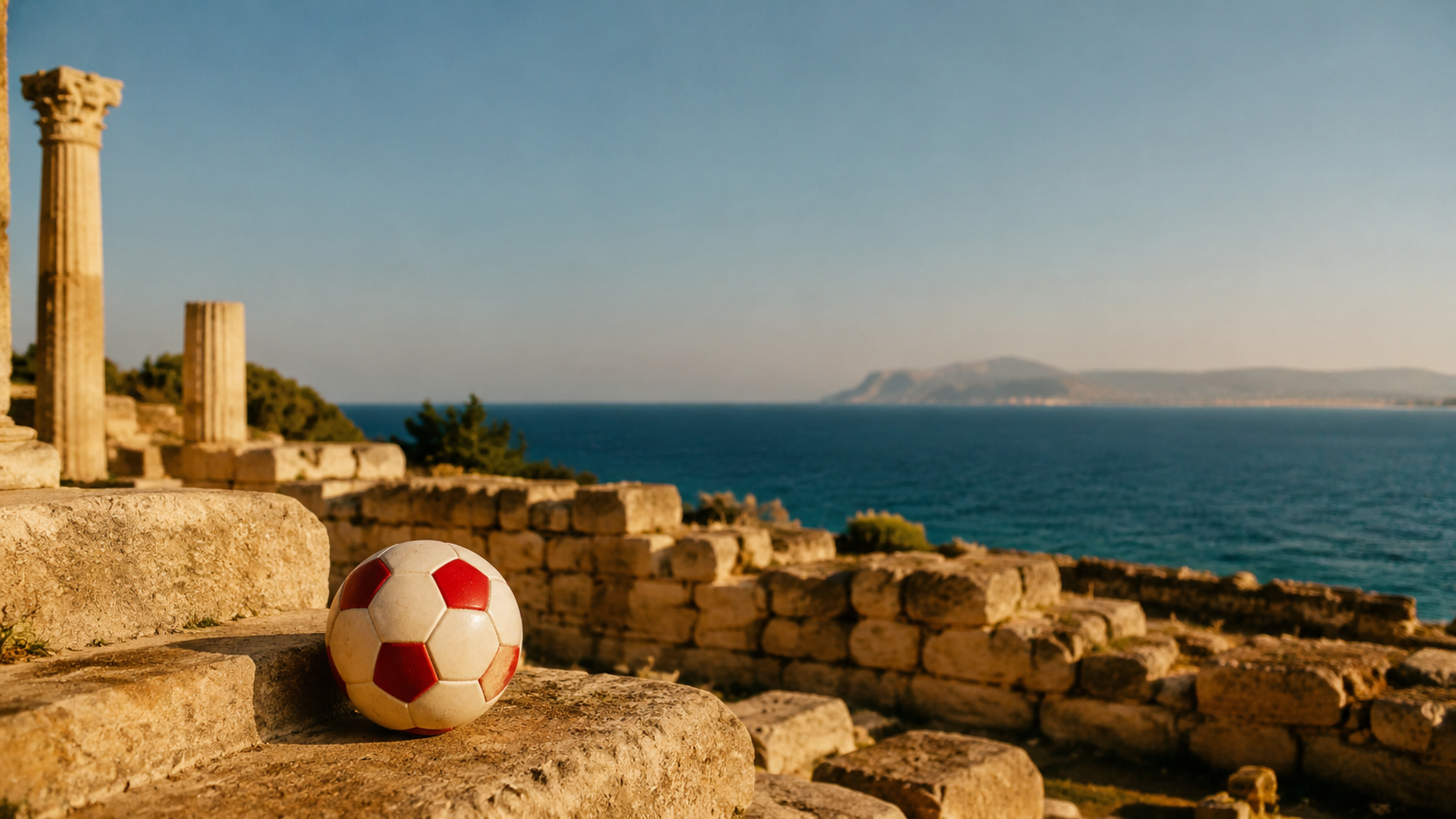
On the fourteenth of June, in a stadium in Monterrey with the heat still coming off the hills at kick-off, eleven men will walk onto the grass wearing red, and a commentator somewhere will call them the Eagles of Carthage. Most of the watching world will hear it as a flourish — the kind of nickname every national side seems to carry, alongside the Lions and the Dragons and the Indomitable somethings. Few will stop on the second word. But it is the second word that is the strange one. Tunisia’s footballers are named, in the end, for a city that Rome burned to the ground twenty-one centuries ago, and then salted, so that nothing would grow.
This is Tunisia’s seventh World Cup, and their third in a row — a run of consistency that quietly puts them among the most reliable teams Africa has sent to the tournament. They arrive in North America having done something almost no one else managed in qualifying: they did not concede a single goal across the entire campaign, winning nine of ten matches and drawing the other, and finishing with twenty-eight points from a possible thirty. The defence was a wall. And yet the team carries a name that is, if you think about it for a moment, a monument to a defeat.
Why “Carthage”?
To understand the badge, you have to go back to the headland north of modern Tunis, where a Phoenician trading post founded in the ninth century BCE grew into the great maritime power of the western Mediterranean. Carthage was a city of perhaps three hundred thousand people, with a navy large enough to make Rome nervous for a hundred years. Its merchants reached Britain and West Africa. Its general, Hannibal, marched elephants over the Alps and spent sixteen years loose in Italy, winning battle after battle and never quite taking the city he had come to break.
It ended the way these things tend to end. After three Punic Wars, Rome besieged Carthage for three years and took it by storm in 146 BCE, levelling the buildings and selling the survivors into slavery. The senator Cato the Elder had closed every speech, for years, with the same demand — Carthago delenda est, Carthage must be destroyed — and in the end he got his wish. If you want the full arc of that civilization, from trading post to superpower to cautionary tale, our guide to the Punic civilization is the place to start.
What survives today is quieter than the story suggests. There is no Colosseum, no single skyline ruin. The remains are scattered through a leafy residential suburb where the Tunisian president keeps his palace — columns rising out of lawns, baths above the sea, a hill that still watches the bay. We wrote an honest guide to visiting Carthage for travellers who arrive expecting drama and find, instead, gardens. It is no less moving for that.
An eagle over Carthage
Here is the small irony buried in the name. The eagle was never Carthage’s emblem — it was Rome’s. The aquila, the silver eagle on a pole, was the standard each Roman legion carried into battle and would die rather than lose. Carthage’s heirs now play beneath the very bird that crowned the army which destroyed them. Nobody planned it that way; nicknames accrete rather than get designed. But there is something fitting in a modern Tunisia reclaiming the eagle and pinning it, this time, to Carthage — a small rewriting of the ending, in red and white, three thousand years late.
The badge is sincere about its history in another way too. Tunisia’s most-watched player is a 23-year-old midfielder, born in a Paris suburb and now at Burnley in England, who goes by a single name on the back of his shirt: Hannibal. Hannibal Mejbri carries the name of the general who terrified Rome, onto pitches in Texas and Mexico, in 2026. The country does not let the past go easily, and it is not trying to.
The team that forgot how to concede
The football itself deserves its moment. Drawn into Group F alongside the Netherlands, Japan, and Sweden, Tunisia open against Sweden in Monterrey on 14 June, meet Japan in the same city on 20 June, and close the group against the Netherlands in Kansas City on 25 June. It is not a kind draw. The Dutch are among the tournament’s contenders, Japan are quick and organised, and Sweden are no one’s idea of a soft opener.
But this is a side built on a defensive record that borders on the absurd, marshalled now by the French coach Sabri Lamouchi, who took over in January after a disappointing Africa Cup of Nations exit to Mali. Around the veteran Youssef Msakni and the relentless Mejbri sit a clutch of players quietly having good seasons — the attacking left-back Ali Abdi, who set up a goal in a 1-1 draw with Brazil last year, and the emerging forward Hazem Mastouri, who scored in that same match. They are not favourites. They have rarely been favourites. It has rarely mattered to how they play.
The glass ceiling
Everything about Tunisia’s World Cup history runs into one wall: in six previous tournaments, they have never once advanced past the group stage. They have produced moments — most famously beating a France side that were the reigning world champions, 1-0, at Qatar 2022 — but the moments have never quite added up to a knockout berth.
The expanded 48-team format, which sends the best four third-placed teams through, gives them a wider door than they have ever had. For a country of twelve million that has watched its team go home early for nearly fifty years, simply surviving the group would land as something close to history. The Eagles have spent decades being admired for their discipline and pitied for their ceiling. This is the best chance they have had to break it.
A name older than the game
If the football sends you looking — and World Cups have a way of doing that — the country behind the badge is more reachable than most people assume. The headland where Hannibal once paced is a fifteen-dinar taxi from central Tunis, and the capital itself rewards a few unhurried days: our honest guide to Tunis covers the medina, the boulevards, and the light-rail line out to the coast. That line ends, more or less, at Sidi Bou Said, the blue-and-white village on the cliff where you can order a mint tea with pine nuts and watch the sun go down over the same gulf the Carthaginian fleet once sailed from.
And the ruins are only the beginning. The greatest concentration of preserved ancient sites in North Africa lies inland, at El Jem, Dougga, and Bulla Regia — a route we trace in our tour of Tunisia’s ancient wonders and our guide to the imperial cities. The team will spend the summer reminding the world what the word Carthage used to mean. The country has been quietly keeping the answer the whole time.
From the Carthage Magazine Bookshelf
If the football has you wondering what it would actually be like to stand on Byrsa Hill yourself, three Carthage Magazine ebooks were built for exactly that trip:
- All About Tunisia — the definitive English-language traveler’s guide. 572 pages, 27 chapters, all nine regions, every UNESCO inscription, five thematic trails — and the practical answers (visa, currency, transport, etiquette) most travelers wish they’d had on the plane. $24.99 · PDF & EPUB
- Speak Like a Local — 200+ Tunisian Arabic phrases with native audio recorded in Tunis. The phrases for the taxi, the souk, the café, and the dinner table. $14.99 · PDF, EPUB, MP3
- The Authentic Tunisian Cookbook — sixty traditional recipes from the heart of North Africa. For when you get home and find yourself missing the food. $9.99 · PDF & EPUB
All three available as a bundle for $39.99 — guide, language, and food, delivered together.
