
There are certain things you expect to encounter on the island of Djerba.
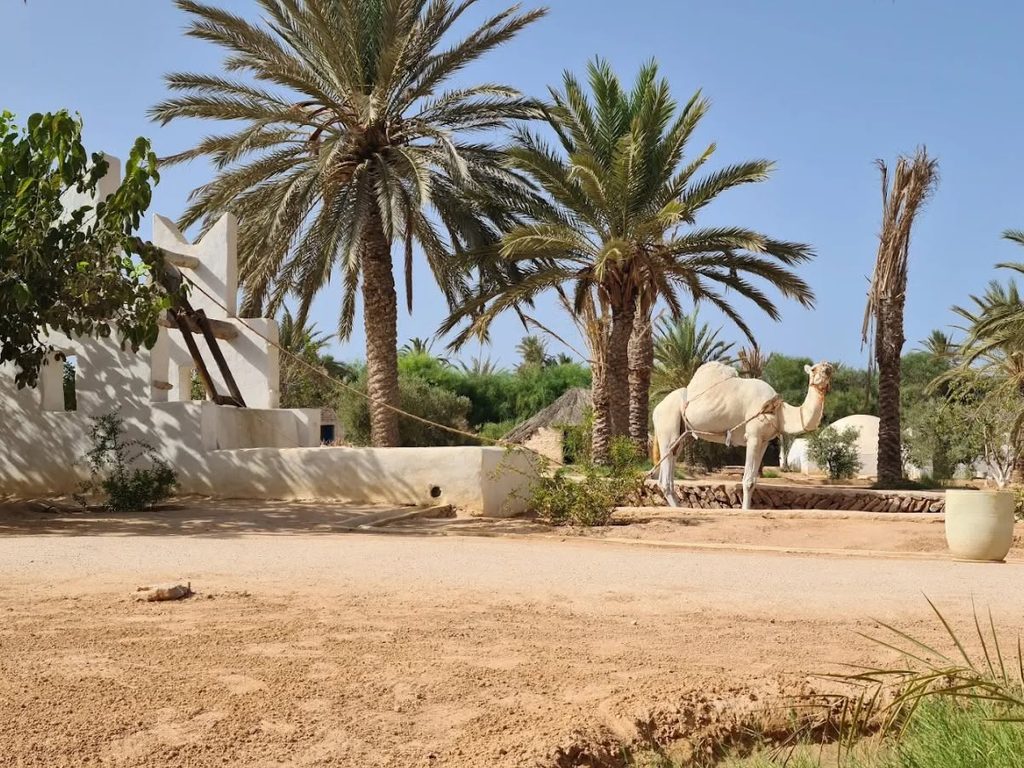
Whitewashed houses, palm trees, pottery workshops, fishing boats, and beaches where the Mediterranean seems to stretch indefinitely toward the horizon.
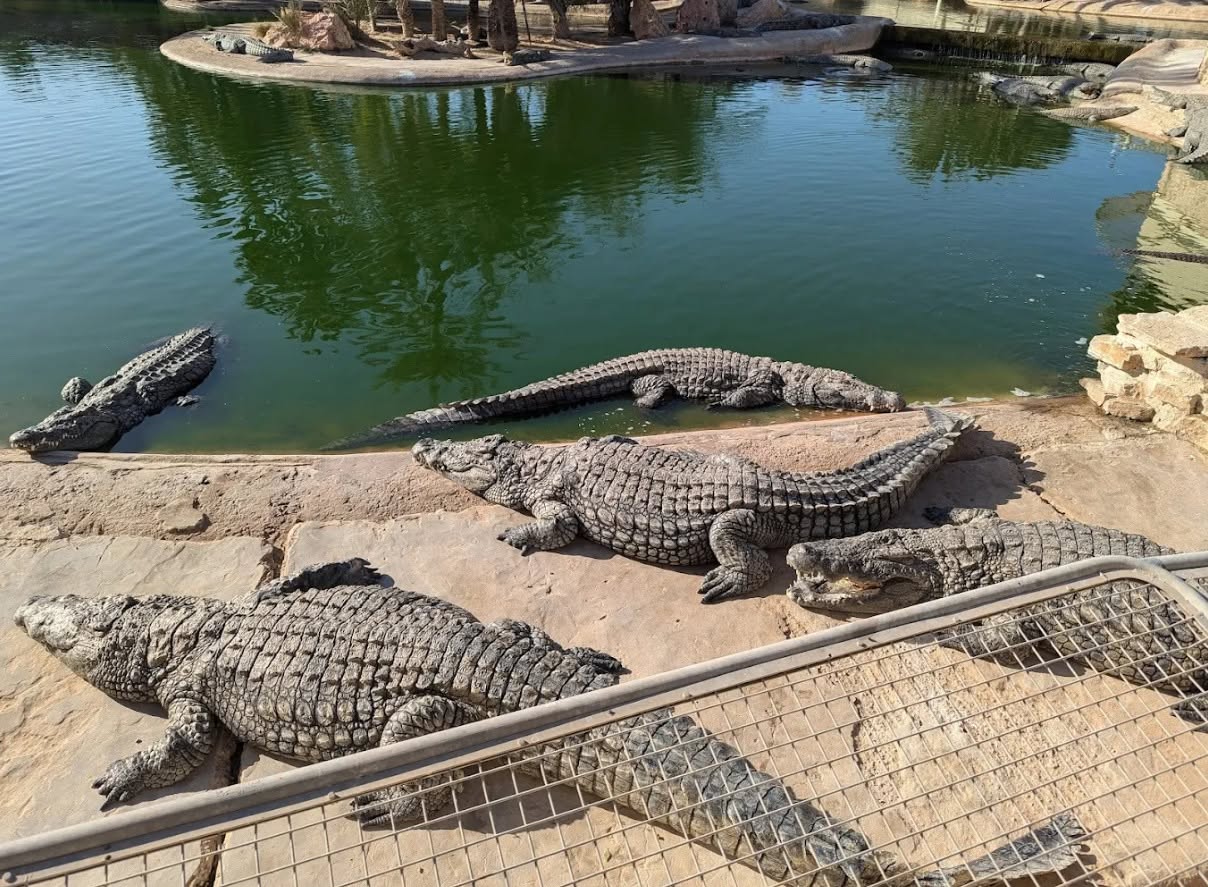
Four hundred Nile crocodiles are probably not among them.
Yet in the tourist district of Midoun, beneath the lighthouse of Taguermess, one of Tunisia’s most unusual attractions has become a favorite excursion for families, curious travelers, and anyone who has ever wondered what happens when several hundred crocodiles decide it is lunchtime.
Djerba Explore is more than a crocodile enclosure. The complex combines a reptile park, a museum of Islamic art, traditional Tunisian architecture, restaurants, cafés, and a reconstructed heritage environment.
It is also one of those attractions where timing matters. Arrive at the right moment and you can watch the crocodiles being fed. Arrive too late and you may miss the day’s most dramatic activity.
Here is how to plan your visit.
Djerba Explore at a Glance
Quick Answer — Djerba Explore is a cultural and wildlife complex in the Midoun tourist area of Djerba. Adult admission is officially listed at 37 Tunisian dinars, with children aged four to twelve paying 24 TND and children under four entering free. The museum, heritage area, and crocodile park are generally open daily from 9 a.m. to 5 p.m. Crocodile feeding is advertised in the afternoon, but the operator’s English and French information currently disagrees on the exact time. Confirm the schedule before visiting.
| Visitor information | Details |
|---|---|
| Location | Route touristique de Midoun, Taguermess |
| Adult ticket | 37 TND |
| Children aged 4–12 | 24 TND |
| Children under 4 | Free |
| Main visiting hours | 9 a.m.–5 p.m. |
| Free village area | 8 a.m.–10 p.m. |
| Main attraction | Nile crocodile park |
| Other attractions | Lalla Hadria Museum, heritage village |
Prices and schedules reflect the operator’s published information in October 2026.
What Is Djerba Explore?
Djerba Explore occupies a purpose-built leisure complex in the eastern part of Djerba, close to the island’s principal hotel zone.
Rather than functioning as a conventional zoo, it is organized around several distinct spaces.
The first is a village-style area with streets, courtyards, cafés, restaurants, and shops. Entry to this section is free.
The paid visitor areas include the Lalla Hadria Museum, a traditional heritage environment, and the crocodile park.
That combination makes Djerba Explore rather different from the small animal attractions found in many seaside resorts.
You can spend part of the visit learning about Islamic art, another part exploring traditional architecture, and finish by watching reptiles that have changed remarkably little over millions of years.
For families, this variety is one of its greatest strengths.
Children who might not be especially interested in museum galleries are unlikely to forget the crocodiles.
The Crocodile Park: What Will You See?
The crocodiles are the reason most visitors come.
Djerba Explore advertises approximately 400 Nile crocodiles housed in pools and a landscaped environment of palms, papyrus, and tropical vegetation.
The Nile crocodile is among Africa’s largest reptiles and one of the continent’s most formidable predators.
Here, the animals can be observed from designated visitor areas rather than from the edges of their habitats.
Some lie almost completely motionless in the sunshine. Others drift through the water with only their eyes visible.
The stillness is deceptive.
A crocodile that has remained apparently asleep for half an hour can move with extraordinary speed when food appears.
The park also provides an opportunity to learn about the reptiles’ development, including young crocodiles and the circumstances of breeding in captivity.
Children often find the contrast fascinating: the tiny hatchlings bear an unmistakable resemblance to adults that can grow several metres long.
The important thing is to respect the barriers. Do not lean over enclosures, throw objects, or attempt to attract the animals’ attention.
These are powerful wild animals, even when living under human care.
When Is Crocodile Feeding Time?
For many visitors, feeding is the highlight.
The crocodiles gather around the food, transforming what had looked like an almost motionless collection of reptiles into a remarkably active spectacle.
However, there is an important discrepancy in the operator’s published schedule.
The official French practical-information page lists feeding at 4 p.m., except Mondays. The English practical-information page contains a conflicting reference to 5 p.m., while its repeated French footer says 4 p.m.
That means neither time should be presented as universally guaranteed.
The best approach is to contact Djerba Explore on the morning of your visit and ask when the feeding will take place.
The operator also advertises a reptile presentation at 11 a.m. except Tuesday and opportunities to photograph young crocodiles at scheduled times.
These activities may change without much notice.
If feeding is your main reason for visiting, confirm it before purchasing transport or arranging the rest of your day.
How Much Are Djerba Explore Tickets?
The official published admission prices are straightforward.
Adults and visitors over twelve pay 37 TND. Children aged four to twelve pay 24 TND, and children under four enter free.
The admission ticket covers the three principal paid areas: the museum, heritage displays, and crocodile park.
For a family of two adults and two children aged between four and twelve, the published total is 122 TND.
The village-style public areas, including its streets and squares, can be accessed without purchasing the full attraction ticket.
That makes it possible to visit for a coffee or short wander without committing to the paid experience.
Before traveling, confirm whether any special events, private activities, or guided experiences involve additional charges.
Official visitor information: Djerba Explore
Don’t Miss the Lalla Hadria Museum
It is easy to treat the museum as something you walk past on the way to the crocodiles.
That would be a mistake.
The Lalla Hadria Museum presents collections of Islamic art and cultural objects in a setting inspired by traditional architecture.
Its galleries offer a quieter counterpart to the wildlife park, particularly for adults interested in the island’s wider cultural context.
Djerba is not simply a beach destination. Its identity has been shaped by Berber, Arab, Jewish, Mediterranean, and African influences over many centuries.
The museum is an opportunity to connect some of those histories with objects rather than merely reading about them.
If traveling with children, consider visiting the galleries first, when everyone is still relatively fresh, and saving the crocodiles for later.
That sequence also works well if you are timing your arrival around the afternoon feeding.
How to Get to Djerba Explore
The complex is situated on the tourist road in Midoun, near the Taguermess lighthouse.
It is conveniently located for many travelers staying in eastern Djerba’s beach hotels.
The operator describes the park as less than ten minutes from the main hotel districts and approximately twenty kilometres from the airport and Houmt Souk.
Actual journey times depend on your accommodation.
For most visitors, a taxi is the simplest option.
If you are staying farther away, arranging a driver can make it easier to combine the attraction with Midoun, the eastern beaches, or another stop.
Our guide to getting around Djerba explains local taxis, private drivers, and other transport options.
And for a wider introduction to the island, see our guide to the best things to do in Djerba.
Is Djerba Explore Good for Children?
For many families, yes.
The animals provide a memorable central attraction, and the broader complex offers opportunities to eat, rest, and explore other exhibits.
Unlike a full-day theme park, Djerba Explore can be enjoyed without spending hours moving between rides.
That makes it practical for families whose children have limited patience for lengthy excursions.
Allow approximately two to three hours for an unhurried visit, potentially longer if you attend demonstrations and spend substantial time in the museum.
Bring water, hats, and suitable footwear.
The Djerba sun can be strong even outside the peak summer months.
Parents should supervise children closely around animal enclosures and make clear that the barriers are there for a reason.
Our Tunisia with Kids guide covers more family-friendly experiences across the country.
Is the Crocodile Park Worth Visiting?
If you are spending several days on Djerba, Djerba Explore is a worthwhile half-day excursion, particularly for families.
The combination of reptiles, museum collections, and traditional architectural displays gives it more variety than a single-purpose animal attraction.
For adults without children, the museum and wildlife displays may still appeal, although the decision depends on personal interests.
There is also an ethical consideration.
As with any captive-animal attraction, visitors should think critically about animal welfare, enclosure conditions, and the value of the educational experience. The operator’s claims about its collection should not be confused with independent welfare certification.
Travelers who prefer observing wildlife in natural habitats may choose a different excursion.
Frequently Asked Questions
The published admission is 37 TND for adults and 24 TND for children aged four to twelve. Younger children enter free.
Official pages disagree between 4 and 5 p.m. The French information lists 4 p.m., except Mondays. Confirm the time directly before visiting.
The operator advertises daily opening throughout the year, with the main paid attractions generally available from 9 a.m. to 5 p.m. Holiday schedules may vary.
A Different Side of Djerba
There is a familiar version of Djerba that exists in holiday brochures.
The palm trees, the white sand, the warm Mediterranean, and the quiet afternoons beside a hotel swimming pool.
Djerba Explore belongs to another version of the island.
One where visitors encounter a remarkable collection of reptiles, wander through galleries of Islamic art, and discover that even an afternoon away from the beach can carry a little surprise.
Come for the crocodiles if you like.
But leave enough time to discover the rest.
From the Carthage Magazine Bookshelf
If Djerba Explore has shown you how much history and culture lies beyond the island’s beaches, these three guides will help you discover more.
- All About Tunisia — the definitive English-language traveler’s guide. 572 pages, 27 chapters, all nine regions, every UNESCO inscription, five thematic trails — and the practical answers (visa, currency, transport, etiquette) most travelers wish they’d had on the plane. $24.99 · PDF & EPUB.
- Speak Like a Local — 200+ Tunisian Arabic phrases with native audio recorded in Tunis. The phrases for the taxi, the souk, the café, and the dinner table. $14.99 · PDF, EPUB, MP3.
- The Authentic Tunisian Cookbook — sixty traditional recipes from the heart of North Africa. For when you get home and find yourself missing the food. $9.99 · PDF & EPUB.
All three available as a bundle for $39.99 — guide, language, and food, delivered together.
