
Quick Answer — Tunisia’s olive harvest runs from late October into February, peaking in November and December, when families across the country decamp to their trees and the mills run around the clock. The heartlands: Sfax, the self-declared capital of olive oil with its millions of trees; the Sahel plains around El Jem; and the Chetoui country of the north and Cap Bon, where a 2,500-year-old olive tree said to have been planted by Hannibal’s soldiers still fruits at El Haouaria. There is no Tuscan-style agritourism machine here — which is exactly the appeal. Come in November, find a mill, taste oil pressed that morning — green, bitter, peppery enough to catch your throat — and you’ll understand why Tunisians say the best of it never survives the journey into an export bottle.
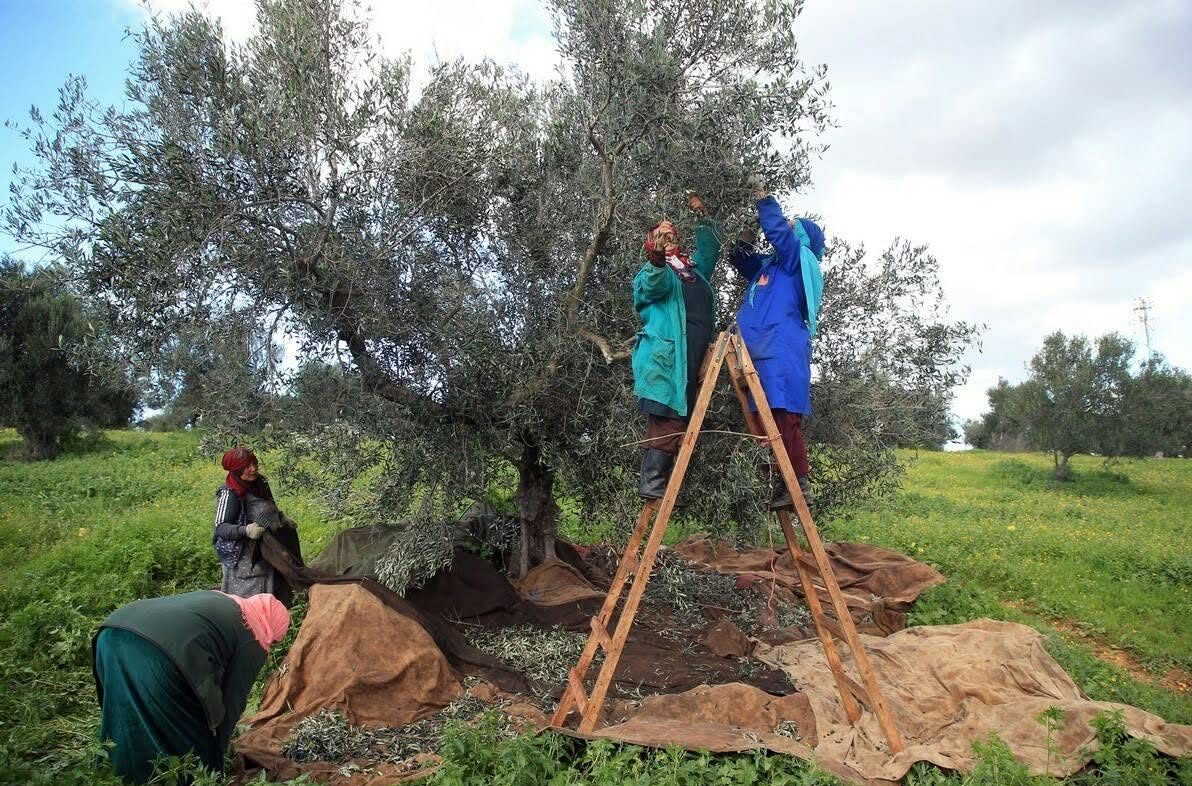
There is a sound the Tunisian countryside makes in November, and it is not one the beach brochures know. It is the patter of olives hitting a tarp — thousands of them, hour after hour, raked and combed and hand-stripped from branches by families who have done this on these same slopes for longer than anyone has kept records. Drive any road between Zaghouan and Sfax in the harvest weeks and you will see the double ladders leaning into silver-green canopies, the tarps spread like picnic blankets that got ambitious, the pickup trucks sagging under sacks on their way to a mill that will not close before midnight.
Summer performs for Tunisia’s visitors. The harvest does not perform for anyone. It is the country at work on its oldest job — and for a traveler willing to trade the beach for a grove, it is the most honest few weeks of the Tunisian year. We’ve written about why autumn is the golden season; this is the deep guide to the season’s main event.
When the Harvest Happens
The picking begins in the earliest groves in late October and runs, region by region and variety by variety, into February. November and December are the peak everywhere: the weeks when schools empty a little in rural areas, when city cousins suddenly remember their village roots, and when the question “jitou zitounkom?” — did you do your olives yet? — replaces the weather as small talk.
Timing is not tradition for its own sake. As our guide to Tunisian olive oil explains, quality is a race: olives picked from the tree (never off the ground), moved to the mill within hours, crushed before fermentation can start. That urgency is why the mills run through the night in season, and why the harvest has the atmosphere it does — festive and slightly frantic at once, a deadline three thousand years old.
It is worth knowing what the harvest means here beyond the picturesque. Olive oil is the backbone of Tunisian agriculture — the sector’s single largest earner — and last season was one for the history books: a record crop that ranked Tunisia among the top two or three producers on the planet, supplying a meaningful share of all the olive oil on Earth. The tree you stand under in November is not heritage décor. It is the national economy, in leaf.
Where the Harvest Lives
Sfax and the south. Sfax calls itself the capital of olive oil, and the claim survives scrutiny: the governorate alone holds on the order of ten million trees, endless low groves planted in the wide-spaced grid the region perfected — trees given room to drink a desert’s worth of ground. This is Chemlali country, the hardy, drought-tolerant variety behind most of Tunisia’s volume. The groves here are a landscape in their own right, best seen from the Tunis–Sfax road as the orchards of the Sahel thicken toward the city.
The Sahel. The coastal plain between Sousse and El Jem is old olive money — this was the oil district that helped feed Rome, which is why the amphitheatre of El Jem stands where it does, funded by olive fortunes seventeen centuries before anyone said “superfood.” Harvest season is the best excuse to see the monument and the crop that built it in a single day.
The north and Cap Bon. Cooler, greener, and home to Chetoui, the northern variety prized for its bite. The hills around Zaghouan, Béja, and the Cap Bon peninsula mix olives with vineyards and citrus — and hold the harvest’s great pilgrimage site: the ancient olive of El Haouaria, a tree some 2,500 years old, planted (so the story goes) by Hannibal’s soldiers, and still producing. Standing under a living thing that predates Rome’s victory over Carthage recalibrates what “old grove” means.
What a Harvest Day Actually Looks Like
It looks like work, because it is. Tarps go down at first light. Pickers climb the double ladders with rakes, combs, or gloved hands and strip each branch toward the ground — hand-harvesting is still the norm, one reason the overwhelming majority of Tunisian groves remain chemical-free and the fruit arrives at the mill unbruised. Children get the low branches. Somebody’s grandmother supervises from a folding chair with total authority and a thermos. Lunch happens in the grove — bread, harissa, the last of the summer’s el oula preserves — and the sacks are at the mill by dark.
Then the mill takes over. In season, a Tunisian ma’sra is the best free theatre in the country: farmers queuing with their sacks, the roar of the crushers, the first oil running green-gold into tanks while the owners watch like expectant fathers. Some mills still work the old way — granite stones and press mats, a method essentially unchanged since antiquity, in a country where farmers still irrigate trees with buried clay pots as their ancestors did. Most are gleaming stainless-steel operations. Both smell the same: sharp, grassy, unmistakable — the smell of the Tunisian year being pressed into liquid.
And then there is the tasting. Fresh oil, days old, is a different substance from anything in a supermarket: cloudy, intensely green, bitter and pungent in a way that fades within weeks. Tunisians eat it the honest way — poured into a bowl, spiked with harissa, mopped with bread, no cutlery required. If your throat catches on the pepper, congratulations: that’s the polyphenols, and the sign you’re tasting the real thing.
Chemlali and Chetoui: A Two-Word Tasting Course
Tunisia’s two great varieties split the country between them. Chemlali, the workhorse of the center and south, gives a softer, fruitier, almond-touched oil. Chetoui, from the north, is the character actor: grassy, bitter, black-pepper finish, among the most polyphenol-rich oils made anywhere. Taste them side by side at any mill or producer shop and you will never again believe that olive oil is one flavor. Bring home a bottle of each; they are the cheapest great souvenir in the country.
How to Experience It — Honestly
Now the honest section. Tunisia has no Tuscany-style harvest-tourism industry: no glossy agriturismo network, no drop-in picking experiences bookable in three clicks. The harvest is a family and commercial affair on private land, and it should be approached the way you’d approach someone else’s workplace — with interest, courtesy, and an invitation.
That said, the doors are opening. Sfax has begun building an oleotourism circuit — guided routes taking visitors through groves, working mills (including historic stone-press houses nearly two centuries old), and producers’ tasting rooms (offerings change season to season; verify current tours before travelling). The city has also hosted an olive festival in the winter — worth checking dates if you’re nearby in late January. Several estate producers in the north and Cap Bon receive visitors for tastings, particularly those already set up for wine tourism. And the unofficial route works as it always has: be on a country road in November, show genuine interest, and there is a fair chance you’ll be handed a rake before you’re handed a glass of tea. Ask before entering a grove, ask before photographing people at work, and buy some oil on your way out — it is both good manners and the best purchase you’ll make.
Making It Work
The season’s logistics are blessedly simple. November weather is mild everywhere — light-jacket north, shirtsleeve south (month-by-month numbers here) — and the harvest pairs naturally with the sights that share its geography: Sfax’s medina and groves, El Jem’s amphitheatre, the Cap Bon loop, or the classic seven-day circuit with grove stops threaded through it. Trains and louages reach every olive town on this page; a rental car reaches the groves between them. Pack shoes you can stand in a field with — the rest of the packing list is here. And if the dates line up, keep going south: October through December is also Deglet Nour season in the oases, and the two harvests make one unimprovable food-lover’s itinerary.
One last honest note. The harvest is weather’s hostage — a drought year thins it, a blessed year like the last one breaks records — and no two seasons look alike. That is not a flaw in the experience. It is the experience: a country reading its sky, tree by tree, the way it has since Carthage kept the accounts.
FAQ
When is olive harvest season in Tunisia? From late October to February, depending on region and variety, with the peak in November and December — when most family harvests happen and the mills run day and night.
Where is the best place to see the olive harvest in Tunisia? Sfax (the country’s olive-oil capital), the Sahel plains around El Jem, and the Chetoui-growing north and Cap Bon. Each offers a different landscape and a different oil.
Can tourists visit olive farms and mills in Tunisia? Yes, with light planning. Sfax has a developing oleotourism circuit, some estates in the north receive visitors for tastings, and many mills welcome polite walk-ins during the pressing season. Always ask before entering private groves.
What is the difference between Chemlali and Chetoui olive oil? Chemlali, grown in the center and south, is softer and fruitier; Chetoui, from the north, is grassy, bitter, and peppery, with notably high polyphenol levels.
How old is the Hannibal olive tree in Tunisia? The ancient olive at El Haouaria, on the Cap Bon peninsula, is estimated at around 2,500 years old and is traditionally said to have been planted by Hannibal’s soldiers. It still produces olives.
Is Tunisia a major olive oil producer? One of the world’s largest. In the record 2025/26 season it ranked among the top two producers globally, and olive oil is consistently Tunisia’s leading agricultural export.
From the Carthage Magazine Bookshelf
If the harvest has you planning a November trip, these three take you from the itinerary to the table:
- All About Tunisia — the definitive English-language traveler’s guide. 572 pages, 27 chapters, all nine regions, every UNESCO inscription, five thematic trails — and the practical answers most travelers wish they’d had on the plane. $24.99 · PDF & EPUB.
- Speak Like a Local — 200+ Tunisian Arabic phrases with native audio recorded in Tunis. Including the ones that get you invited into the grove. $14.99 · PDF, EPUB, MP3.
- The Authentic Tunisian Cookbook — sixty traditional recipes from the heart of North Africa, most of them beginning with good olive oil. $9.99 · PDF & EPUB.
All three available as a bundle for $39.99 — guide, language, and food, delivered together.
