
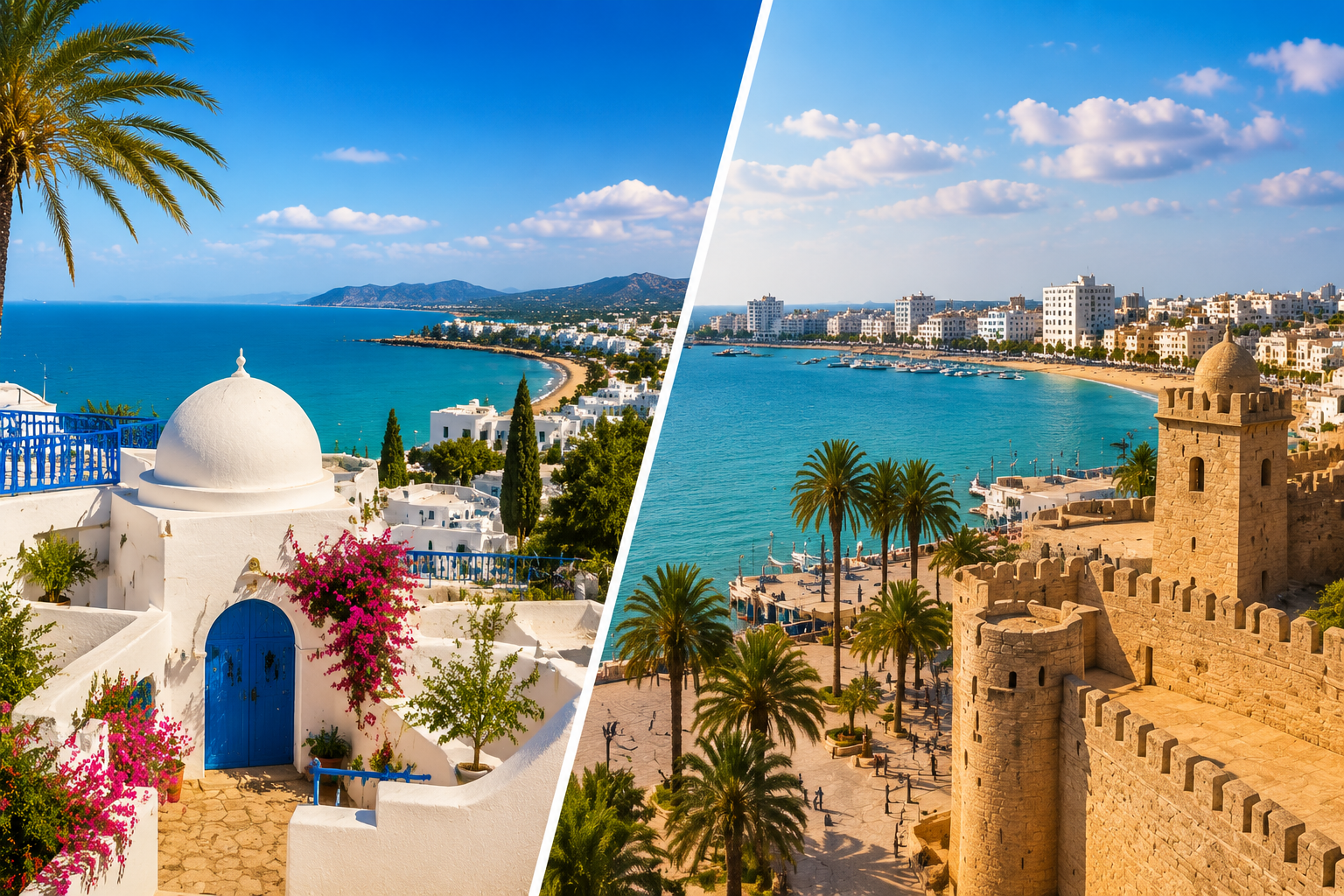
Quick Answer — Hammamet and Sousse are Tunisia’s two flagship resort destinations, an hour apart on the same eastern coast, and both deliver the core package: long sandy beaches, big hotels, reliable sun. The honest difference: Hammamet is the prettier, gentler, more garden-like resort town — closer to Tunis, with a small whitewashed medina and the purpose-built Yasmine zone. Sousse is a real city that happens to have a resort attached — a UNESCO-listed medina, genuine urban life, and the best day-trip position in the country. Choose Hammamet for a relaxed beach holiday with charm; choose Sousse for beach-plus-culture and easy excursions. Families and first-timers lean Hammamet; the curious and the restless lean Sousse. Nobody chooses badly.
This is the question we get from readers more than almost any other, usually attached to a screenshot of two package deals at nearly identical prices. It’s also a question the booking sites can’t honestly answer, because they sell both. We don’t sell either. So here is the comparison the way we’d give it to a friend across a café table in Tunis, category by category, the same way we’ve weighed Tunisia against Morocco and its other rivals — except this time both contenders are ours.
The Short Portraits
Hammamet is Tunisia’s original resort — the place where European artists and aristocrats discovered Tunisian summer in the 1920s and where the country’s beach tourism was invented. It sits at the southern hinge of the Cap Bon peninsula, barely an hour from Tunis, and it is really two places: the old town, with its small medina and seafront kasbah wrapped in gardens and jasmine, and Yasmine Hammamet, the purpose-built marina-and-hotels zone a few kilometres south. The full portrait is in our Hammamet guide.
Sousse is the third city of Tunisia and the capital of the Sahel — a working urban centre of a quarter-million people whose medina, ribat, and Great Mosque earned UNESCO inscription in 1988, and whose beaches run north into the polished resort strip of Port El Kantaoui. It is older, bigger, busier, and more layered than Hammamet in every direction. The full portrait is in our Sousse guide.
Beaches
Both coasts are long, sandy, and genuinely good — this category is closer than partisans of either town admit. Hammamet’s beaches curve in gentle, shallow, family-friendly arcs, with the fine white sand the town built its name on; the stretch fronting the old town, with the kasbah at one end, is among the most photogenic urban beaches in the country.
Sousse’s Boujaffar beach is a proper city beach — lively, sociable, and busy with locals, which is either its charm or its drawback depending on your temperament — while the northern sands toward Port El Kantaoui are wider, cleaner, and hotel-groomed. Verdict: Hammamet by a nose for pure beach quality and calm; Sousse if you like your beach with people-watching. The national ranking is in our best beaches in Tunisia.
History and Culture
No contest, honestly. Hammamet’s medina is small and pleasant — an hour’s wander, a photogenic kasbah, and it’s done. Sousse’s medina is a UNESCO World Heritage Site and a functioning medieval city: the Ribat, one of the great fortress-monasteries of early Islam; the ninth-century Great Mosque; the catacombs; the archaeological museum with its superb mosaics. You can spend two full days in Sousse’s old town and not exhaust it. Verdict: Sousse, decisively.
Day Trips
Hammamet opens onto Cap Bon — Nabeul’s pottery and Friday market, Kelibia’s fort, El Haouaria’s caves — and sits close enough to Tunis that Carthage and Sidi Bou Said are a realistic day out. Sousse counters with the heavyweight circuit: the amphitheatre of El Jem, the holy city of Kairouan, and — via the Sahel Metro light rail that no other resort coast in Tunisia has — Monastir and Mahdia for a few dinars each way. Two UNESCO-calibre monuments and two coastal towns within an hour beat one pretty peninsula. Verdict: Sousse, and it isn’t close.
Nightlife, Food, and Atmosphere
Yasmine Hammamet and Port El Kantaoui are near-equivalents — marinas, hotel bars, discos in season. Outside the zones, the difference shows: Sousse has real urban nightlife and restaurant depth year-round because a real city sustains it; Hammamet’s scene contracts sharply outside summer.
Atmosphere is the reverse trade: Hammamet’s jasmine-and-bougainvillea register is simply more romantic, which is why it anchors so many itineraries in our honeymoon guide. Verdict: a draw — Sousse for energy, Hammamet for mood.
Families, Logistics, and Getting There
For families, Hammamet’s shallow beaches, Carthage Land waterpark, and compact scale give it the edge — it does heavy duty in our Tunisia with kids guide. On logistics: both are served by Enfidha-Hammamet airport, roughly equidistant between them; Sousse additionally sits near Monastir airport with its light-rail link, and on the Tunis–Sfax train line. Transfers from Tunis-Carthage run about an hour to Hammamet, two-plus to Sousse — the routing options are in our flights to Tunisia guide. Verdict: Hammamet for families and for proximity to Tunis; Sousse for rail connections and independent movement.
So: Which One?
Choose Hammamet if the holiday is the point — beach mornings, garden afternoons, a pretty medina hour, dinner by the marina — especially with young children, or on a first, short trip anchored near Tunis.
Choose Sousse if you get restless on a sunlounger by day three — if you want a UNESCO medina outside the hotel door, El Jem and Kairouan within day-trip range, a light rail to two more historic towns, and a city that exists for its own sake eleven months a year.
And the wildcard: if what you actually want is neither — an island pace, whitewashed villages, winter sun — the answer may be Djerba, which is a different holiday altogether. Whichever you pick, go in the shoulder seasons if you can; the case is made month by month in the best time to visit Tunisia.
From the Carthage Magazine Bookshelf
Whichever coast wins, these three cover everything from the transfer to the table.
- All About Tunisia — the definitive English-language traveler’s guide. 572 pages, 27 chapters, all nine regions, every UNESCO inscription, five thematic trails — and the practical answers (visa, currency, transport, etiquette) most travelers wish they’d had on the plane. $24.99 · PDF & EPUB.
- Speak Like a Local — 200+ Tunisian Arabic phrases with native audio recorded in Tunis. The phrases for the taxi, the souk, the café, and the dinner table. $14.99 · PDF, EPUB, MP3.
- The Authentic Tunisian Cookbook — sixty traditional recipes from the heart of North Africa. For when you get home and find yourself missing the food. $9.99 · PDF & EPUB.
All three available as a bundle for $39.99 — guide, language, and food, delivered together.
