
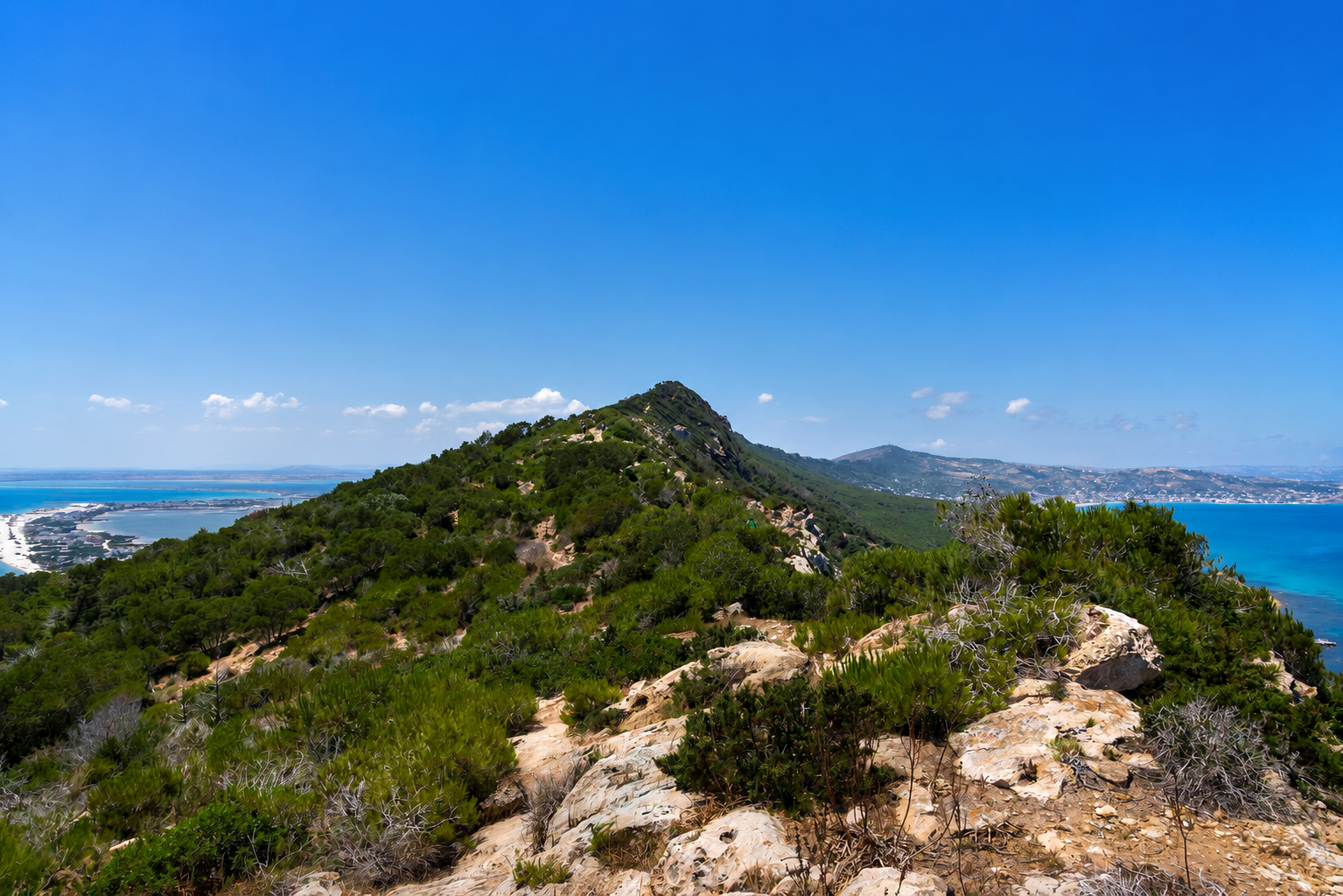
Tell someone you’re going hiking in Tunisia and watch the confusion. Beaches, yes. Ruins, obviously. The Sahara, of course. But trails? Here is what the brochures never mention: Tunisia is a country where the Atlas Mountains meet the Mediterranean, where cork-oak forests roll for a hundred kilometres along the northern coast, where limestone peaks rise straight off the plains within sight of the capital, and where the walking season runs right through the months when the Alps are under snow. The landscapes were always here. What’s new is that Tunisians themselves have discovered them — weekend hiking clubs have boomed in the last decade, marked circuits are appearing, and a Trans-Tunisia trail project is slowly stitching the best of it together. The foreign traveller who packs boots is still, for now, ahead of the curve.
This is the honest guide: where the walking is genuinely good, how the seasons work, what infrastructure exists and doesn’t, and the one thing about Tunisian mountains you need to know before you plan anything.
Quick Answer: Tunisia’s best hiking splits into four zones: the day-hike mountains near Tunis (Boukornine, Ressas, and above all Jebel Zaghouan); the green Kroumirie forests of the northwest around Aïn Draham; the canyon and oasis trails of the south around Tozeur and the Dahar village paths near Tataouine; and the coastal walks of Cap Bon and the north shore. Prime seasons are March–May and September–November, with the south best in winter. Trails are mostly informal — GPS tracks and local guides matter more than signposts — and one honest caveat: the country’s highest peak, Jebel Chaambi, sits in a closed military zone, so the practical summits are Zaghouan and Jugurtha’s Table.
The Capital’s Mountains
The happiest surprise for visitors based in Tunis is how fast the city gives way to real mountains. Half an hour southeast, the twin-horned silhouette of Jebel Boukornine rises above Hammam-Lif — a national park of pine and wild orchids with a steady track most of the way up and views back over the whole Gulf of Tunis. (One local quirk: the true summit area is a military installation, so the done thing is to stop at the viewpoints below it, which lose you nothing.) A little further inland, the bare limestone wedge of Jebel Ressas — “Lead Mountain,” mined since Carthaginian times — offers the area’s most satisfying scramble, a proper little mountain day with Tunis shimmering on the horizon, best done with one of the local hiking groups that run it most weekends.
The crown of the region, though, is Jebel Zaghouan, an hour south of the capital. The massif erupts from the plain to nearly 1,300 metres, and the classic route starts at the most atmospheric trailhead in North Africa: the Roman Temple of the Waters, the sacred spring that fed the great aqueduct to Carthage. From there a well-trodden path climbs through juniper and raptor country toward the ridge; strong walkers can push for the summit, gentler parties can turn the lower loop into a perfect half-day. Zaghouan is also the centre of Tunisia’s small climbing scene, and the one Tunisian massif with a dedicated English-language hiking guidebook — a measure of how good it is.
The Green Northwest: Kroumirie Forests
The Kroumirie range, running along the Algerian border behind Tabarka, is the Tunisia nobody expects: mountains of cork oak and fern, mist in the mornings, wild boar on the trails, and in winter, actual snow. The hub is Aïn Draham, the old hill station, where forest tracks radiate in every direction and local guides — worth hiring, both for navigation and for the stories — run everything from two-hour strolls to full traverses toward the coast. Eastward, the forests around Sejnane hide easy, lovely walking of the ten-kilometre-morning variety, and the shoreline itself offers one of the country’s great coastal hikes, the wild stretch around Cap Serrat toward Sidi Mechreg — empty beaches, dunes, and headlands within an hour of Bizerte. Down on the plains, the wetland circuit at Ichkeul National Park and the trail onto Jebel Ichkeul above it make the best walking-with-binoculars day in the country, especially in the flamingo months. This whole region pairs walking with camping better than anywhere else in Tunisia.
The High Tell: Jugurtha’s Table and the Lonely Interior
Deep in the northwest interior, the mesa of Jugurtha’s Table at Kalaat es-Senam is the single most spectacular short hike in the country — an ancient rock-cut staircase onto an eighty-hectare sky-island fortress at 1,271 metres, dolmens and cisterns on top, wheat plains falling away in every direction. It deserves the detour from anywhere. The surrounding High Tell — the mountains of Siliana, Jebel Bargou, the saddle of Jebel Serj — offers genuine wilderness walking for the self-sufficient, and this is also where the new Trans-Tunisia Trekking Trail initiative has been marking its first circuits, linking landscapes to Numidian and Roman sites like Althiburos. It is early days for that project, but it is the shape of things to come.
Which brings us to the honest caveat. Tunisia’s literal high point, Jebel Chaambi above Kasserine, has been a closed military operations zone for years, and some remote terrain hugging the Algerian border carries travel-advisory restrictions. None of this touches the hikes in this guide — Zaghouan, the Kroumirie, Jugurtha, the south — but it is why Tunisian hikers treat Zaghouan and Jugurtha as the country’s practical summits, and why checking current advice before heading into the far west is simply part of trip-planning here.
The South: Canyons, Oases, and Village Trails
Southern Tunisia flips the calendar — hike it from October to April — and rewards you with the country’s most cinematic walking. In the Jerid, the mountain-oasis trio near Tozeur delivers three classic short hikes: the palm gorge and waterfall at Chebika, the cascades of Tamerza, and best of all the walk through the sheer-walled canyon between Mides and Tamerza, four and a half kilometres of gorge that film location scouts have loved for decades.
Nearby, the ravine of Sidi Bouhlel — Star Wars Canyon, to a certain audience — is a superb morning’s walk regardless of your feelings about droids. Further east, the Dahar massif behind Matmata and Tataouine has quietly become Tunisia’s most rewarding multi-day trekking country: village-to-village trails linking Amazigh settlements and hilltop ksour — Tamezret toward Matmata, the cliff villages of Chenini and Douiret — walked with local guides and slept in guesthouses, a Berber answer to the Atlas treks of Morocco at a tenth of the traffic. And where the trails end, the sand begins: for dune country proper, the Sahara field guide and our guide to camel trekking take over where boots leave off.
The Coastal Walks
Not every good walk here needs a mountain. Cap Bon’s tip at El Haouaria offers clifftop paths above the strait to Sicily, falcon country in spring; the closed-to-traffic old corniche road at Korbous makes a gorgeous sea-cliff walk that can end, unimprovably, in a hot spring; and half the pleasure of the northern beaches is that the coast path between them is yours alone.
Making It Work
Practicalities, honestly stated. Seasons: spring and autumn are prime nationwide; winter belongs to the south and the coast; summer confines serious walking to the Kroumirie forests and early mornings — the seasonal guide has the detail. Infrastructure: outside a few marked circuits, Tunisian trails are informal — download GPS tracks (the international trail apps cover the classics), carry more water than feels reasonable, and for anything remote hire a local guide, which is cheap, easy to arrange through guesthouses, and transforms the day. Company: Tunisia’s weekend hiking associations welcome visitors warmly, and joining one of their outings is both the safest and the most sociable way onto the less-documented mountains. Wildlife and hazards are modest — sun, terrain, and the occasional snake in the warm months — and the national parks that anchor several of these hikes are free or nearly so. The only real barrier to hiking in Tunisia, in the end, is that nobody told you it existed. Consider that fixed.
From the Carthage Magazine Bookshelf
If your boots are coming to Tunisia, these three ebooks cover everything the trailhead doesn’t:
- All About Tunisia — the definitive English-language traveler’s guide. 572 pages, 27 chapters, all nine regions, every UNESCO inscription, five thematic trails — and the practical answers (visa, currency, transport, etiquette) most travelers wish they’d had on the plane. $24.99 · PDF & EPUB
- Speak Like a Local — 200+ Tunisian Arabic phrases with native audio recorded in Tunis. The phrases for the taxi, the souk, the café, and the dinner table. $14.99 · PDF, EPUB, MP3
- The Authentic Tunisian Cookbook — sixty traditional recipes from the heart of North Africa. For when you get home and find yourself missing the food. $9.99 · PDF & EPUB
All three available as a bundle for $39.99 — guide, language, and food, delivered together.
