
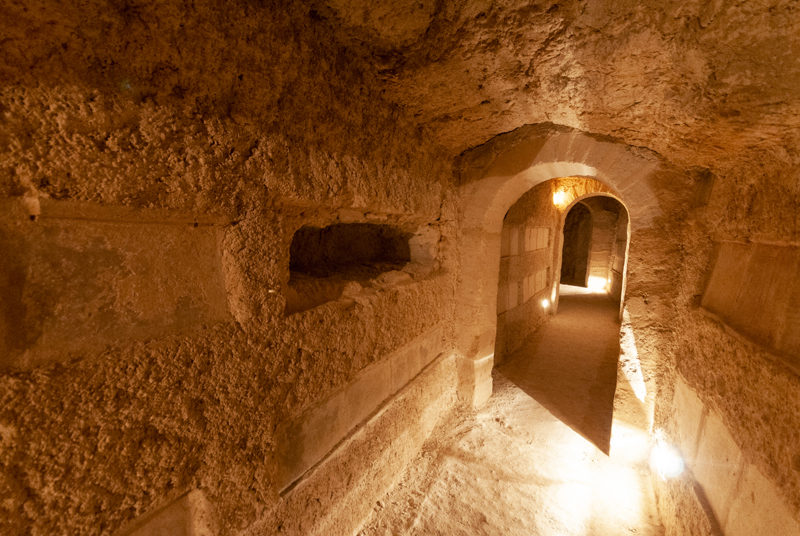
Most visitors to Sousse come for the medina, the ribat, and the beach, and never suspect that beneath the modern city runs a second city — a silent one, of the dead. Cut into soft rock west of the old town are nearly five kilometres of underground galleries, lined floor to ceiling with tombs, dug by some of the earliest Christians in Africa. They are among the most remarkable early-Christian sites anywhere in the Mediterranean, and they are the doorway into a chapter of Tunisia’s history that tends to get skipped entirely: the centuries when this country was one of the beating hearts of the Christian world.
It’s a chapter worth recovering, because it sits in the gap most itineraries leave blank — between the fall of Punic Carthage and the arrival of Islam — and because, once you know it’s there, you start seeing its traces all over the country.
A City of the Dead Beneath the City of the Living
In Roman times Sousse was Hadrumetum, the second city of Roman Africa after Carthage and, eventually, capital of the province of Byzacena. Christianity was present here at least from the second century, and its community buried — and hid — its dead underground.
The numbers are genuinely staggering. The catacombs of Sousse comprise around 240 galleries, running for roughly five kilometres in total, and they held in the region of 15,000 burials. There are four catacomb complexes, three Christian and one pagan, each named for something found inside: the Good Shepherd, Hermes, Severus, and the pagan Agrippa. The tombs themselves are loculi — slots cut into the gallery walls, stacked two and three levels high — sealed and inscribed, the carvings and symbols among the oldest Christian art in North Africa.
The finest is the Catacomb of the Good Shepherd, which alone stretches over a kilometre and a half and holds some 6,000 tombs. It takes its name from a marble slab that once sealed a wall tomb, engraved with the image of a shepherd carrying a sheep across his shoulders — the early Christian image of Christ, drawn from the Gospel of John and the parable of the lost sheep. That slab is now one of the treasures of the Sousse Archaeological Museum, up in the kasbah, which holds much of what came out of the galleries.
What You’ll See — and an Honest Word on Scale
Let me set expectations, because this is one of those sites where knowing the truth in advance makes the visit better, not worse. The catacombs were lost for centuries and only rediscovered in 1888. They were beautifully preserved when found — better, some said at the time, than the catacombs of Rome — but the rock is soft and friable, and since being opened they have suffered badly from damp and collapse. As a result, only a short section of the Good Shepherd catacomb, a corridor of a few hundred metres, is open to visitors today.
So you won’t roam five kilometres of tunnels. What you get instead is a quiet, atmospheric, genuinely moving walk down a lamplit gallery, past wall-tombs stacked in rows, some still sealed with their inscribed slabs, the air cool and close. It is short, and it is humble, and that is rather the point: this was a clandestine cemetery and refuge for a persecuted community, not a monument built to be seen. Pair the underground walk with the museum’s collection of tomb slabs, lamps, and Christian mosaics, and you have the full picture in an easy half-day. The catacombs sit a little outside the old centre, so a short taxi or louage hop is the simplest way to reach them.
The Bigger Story: When Tunisia Was a Christian Heartland
The catacombs are the vivid, physical entry point — but they’re only the beginning. For roughly five centuries, Roman Africa, with its capital at Carthage, was one of the most important centres of Christianity on earth, and several of the faith’s foundational figures were Tunisian in all but the modern name.
Latin Christianity was, in large part, invented here. Tertullian, born in Carthage around 155 AD, was the first major Christian writer to work in Latin rather than Greek — the man who effectively built the vocabulary of Western theology, coining terms still in use today. A generation or so later, Cyprian, bishop of Carthage, led the African church through persecution before being martyred in 258. And in 203, in the arena at Carthage, a young noblewoman named Perpetua and her companion Felicity were put to death for their faith; the account of their martyrdom, partly written in Perpetua’s own voice, is one of the earliest surviving Christian texts attributed to a woman, and it is still read today.
Even Augustine — the towering figure of the early Western church, bishop of Hippo in what is now neighbouring Algeria — belongs partly to this Tunisian story: it was to Carthage that he came as a restless young student, a city whose pleasures and debates fill the early pages of his Confessions before his conversion. The great church councils of Carthage, the bitter Donatist schism that split African Christianity for over a century — these were the dramas of a confident, populous, deeply rooted Christian society, not a fringe.
Reading the Traces Across the Country
Once you’ve caught the thread, you find it everywhere in Tunisia’s ruins — which is what makes this such a rewarding lens for a trip. At Sbeitla, the Roman Sufetula, a cluster of early Christian basilicas and a baptismal font stand among the temples, marking the town’s Christian centuries. The Roman cities more broadly — Bulla Regia, Dougga, and others — carry churches layered over their pagan cores. Tabarka, on the north coast, gave its name to a famous series of Christian funerary mosaics. And the Bardo Museum in Tunis devotes whole rooms to early Christian mosaics, baptismal fonts, and tomb art gathered from across the country.
The era didn’t end neatly so much as fade. The Vandals took Hadrumetum in 434; the Byzantines retook and rebuilt it a century later; and with the Arab conquest of the seventh century the city became Susa and a new faith reshaped the land. You can read that final turn in stone right here in Sousse: the city’s famous ribat, the oldest Islamic fortress-monastery of its kind, is said to stand on the site of an earlier church — one religious age built quite literally on the foundations of the one before.
Why It’s Worth Your Time
The Catacombs of Sousse won’t take long, and they won’t overwhelm you with grandeur. What they offer is rarer than grandeur: a direct, slightly eerie, deeply human connection to people who lived and worshipped and were buried here eighteen centuries ago, in a Tunisia most travellers never imagine existed. Treat the galleries as the keyhole and the wider Christian story as the room beyond, and an ordinary beach city turns into one of the most layered places in the Mediterranean — Punic, Roman, Christian, and Muslim, stacked one atop the next. For the traveller who likes their history with depth and surprise, few things in Tunisia deliver quite like this.
From the Carthage Magazine Bookshelf
If Tunisia’s deeper layers are what you travel for, three Carthage Magazine ebooks were built to go further:
- All About Tunisia — the definitive English-language traveler’s guide. 572 pages, 27 chapters, all nine regions, every UNESCO inscription, five thematic trails, and the practical answers most travelers wish they’d had on the plane. $24.99 · PDF & EPUB
- Speak Like a Local — 200+ Tunisian Arabic phrases with native audio recorded in Tunis. $14.99 · PDF, EPUB, MP3
- The Authentic Tunisian Cookbook — sixty traditional recipes from the heart of North Africa. $9.99 · PDF & EPUB
All three available as a bundle for $39.99 — guide, language, and food, delivered together.
