
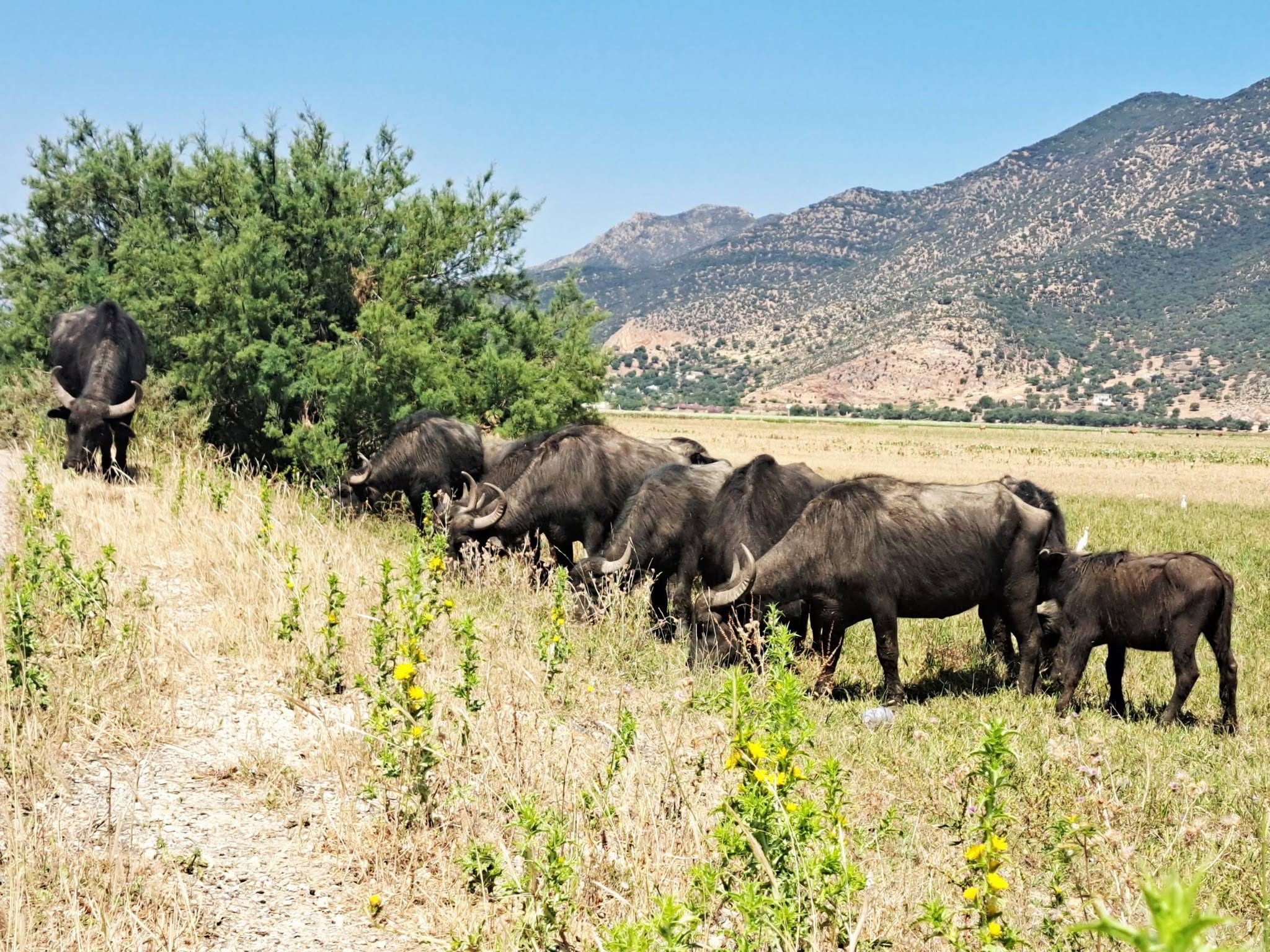
Stand on the lower slopes of Jebel Ichkeul on a still winter morning and you may hear the lake before you see it: a low, shifting murmur that resolves, as the mist lifts, into tens of thousands of birds spread across the shallows. Wigeon, pochard, coot, greylag geese — northern birds that have flown the length of Europe to spend the cold months on a sheet of brackish water in northern Tunisia. There is nowhere else in the country quite like it, and there is nowhere else in the country with quite its title. Of Tunisia’s nine UNESCO World Heritage Sites, eight are cultural — Carthage, Kairouan, Dougga, El Jem. Ichkeul is the only natural one. It is also, quietly, one of the most fragile.
The Last Lake of a Vanished Chain
Lake Ichkeul is a survivor. It is the last great freshwater-to-brackish lake of a chain that once stretched across the whole of North Africa, the others long since drained or dried. It sits in a shallow basin in the Bizerte Governorate, fed by half a dozen seasonal rivers and connected to the sea — to the Lac de Bizerte — through a single channel, the Oued Tinja. That connection gives the lake its strange, defining rhythm: fresh water pours in through the rainy winter and pushes the salt back; in the dry summer the flow reverses and seawater creeps in, turning the lake brackish. This seasonal swing of water level and salinity is what makes the place biologically extraordinary, and it is exactly what makes it vulnerable.
Above the water rises Jebel Ichkeul, a limestone mountain of 511 metres cloaked in Mediterranean scrub — wild olive, carob, lentisk, juniper. At its foot, hot thermal springs surface at around 42°C, used since antiquity. In Carthaginian times the lake is said to have wrapped almost entirely around the mountain. The park earned its first international recognition as a UNESCO Biosphere Reserve in 1977, was named a Ramsar Wetland of International Importance, and in 1980 was inscribed as a natural World Heritage Site.
A Crossroads for Half a Million Wings
Ichkeul’s importance is written in feathers. It is one of the most significant wintering grounds for western Palaearctic waterbirds in the entire Mediterranean. In its strongest years, the lake and its marshes held two to three hundred thousand ducks, geese, and coots at once, arriving from October and staying through February. Among the multitudes were three globally threatened ducks — the white-headed, the ferruginous, and the marbled duck — that birdwatchers travel a long way to see. Over two hundred bird species have been recorded here in total: grey heron, great egret, spoonbill, purple heron and purple gallinule in the reeds, marsh harrier quartering the marshes, and Bonelli’s eagle riding the air above the Jebel. In spring, greater flamingos stalk the shallows. For a serious birder, this is one of Tunisia’s essential wild places.
The Honest Part: A Wonder Under Pressure
Here is what the glossy descriptions leave out, and what an honest guide owes you. From the 1980s onward, dams were built on the rivers that feed Ichkeul, diverting their fresh water to cities and farms. Deprived of its inflow, the lake grew saltier and saltier; salinity at times reached levels that killed off the freshwater plants the birds depend on for food. The waterfowl numbers collapsed. Ichkeul was placed on UNESCO’s List of World Heritage in Danger from 1996 to 2006, and although it was removed after several wet winters and improved water management eased the crisis, the recovery has been partial and precarious. Recent winter counts have at times fallen to a small fraction of the historic figures — in some years a few thousand birds where there were once a quarter of a million — with evidence that many migrants now pause at Ichkeul in autumn only to move on elsewhere.
None of this is a reason to skip it. It is a reason to arrive with clear eyes. On a good wet winter, Ichkeul can still stop you in your tracks; in a dry year, it is quieter, and what you are looking at is a landscape holding on. That tension — a place of global importance, sustained by a balance humans keep nearly tipping over — is part of what makes a visit meaningful rather than merely scenic.
What There Is to See
The park is compact and uncommercial. Near the main entrance, at the base of the mountain, an ecomuseum lays out the lake’s ecology, hydrology, and bird life — worth twenty minutes before you walk, to understand what you’re looking at. From there, trails lead along the marsh edge and up the flank of Jebel Ichkeul, where a short climb is rewarded with a wide panorama over the water and, in places, a simple birdwatching hut for patient observation. Bring binoculars; bring water; wear shoes you don’t mind getting muddy. This is not a manicured park with cafés and a gift shop — visitor numbers run only in the tens of thousands a year, and that emptiness is precisely its charm.
When to Go
For birds, November to February is the season — the depth of winter, when the wintering flocks are at their fullest and the lake is at its freshest. March and April bring the greater flamingos and the spring wildflowers on the Jebel, a gentler visit for those who aren’t dedicated twitchers. Summer is hot and the lake at its most saline and subdued; the spring and winter windows are far the better bet. For the wider seasonal picture, our month-by-month guide to the best time to visit Tunisia sets it in context.
Getting There
Ichkeul sits roughly 25 kilometres south of Bizerte and about 80 kilometres northwest of Tunis, which makes it an easy half-day trip from either. There is no public transport to the gate, so a hire car, a taxi arranged for the round trip, or a guided excursion is the practical way in; our transport guide covers the options. Pair it with Bizerte’s old harbour for a full day in Tunisia’s far north, or fold it into a northern loop that takes in the forests of Aïn Draham. Travelers who’d rather sleep under canvas nearby will find ideas in our guide to camping in Tunisia.
From the Carthage Magazine Bookshelf
If wild, uncrowded Tunisia is what you’re after, three Carthage Magazine ebooks will help you find — and understand — it:
- All About Tunisia — the definitive English-language traveler’s guide. 572 pages, 27 chapters, all nine regions, every UNESCO inscription including Ichkeul, five thematic trails, and the practical answers most travelers wish they’d had on the plane. $24.99 · PDF & EPUB
- Speak Like a Local — 200+ Tunisian Arabic phrases with native audio recorded in Tunis. The phrases for the road, the café, and asking directions to places the guidebooks skip. $14.99 · PDF, EPUB, MP3
- The Authentic Tunisian Cookbook — sixty traditional recipes from the heart of North Africa, for when you’re back home and missing the country. $9.99 · PDF & EPUB
All three available as a bundle for $39.99 — guide, language, and food, delivered together.
