
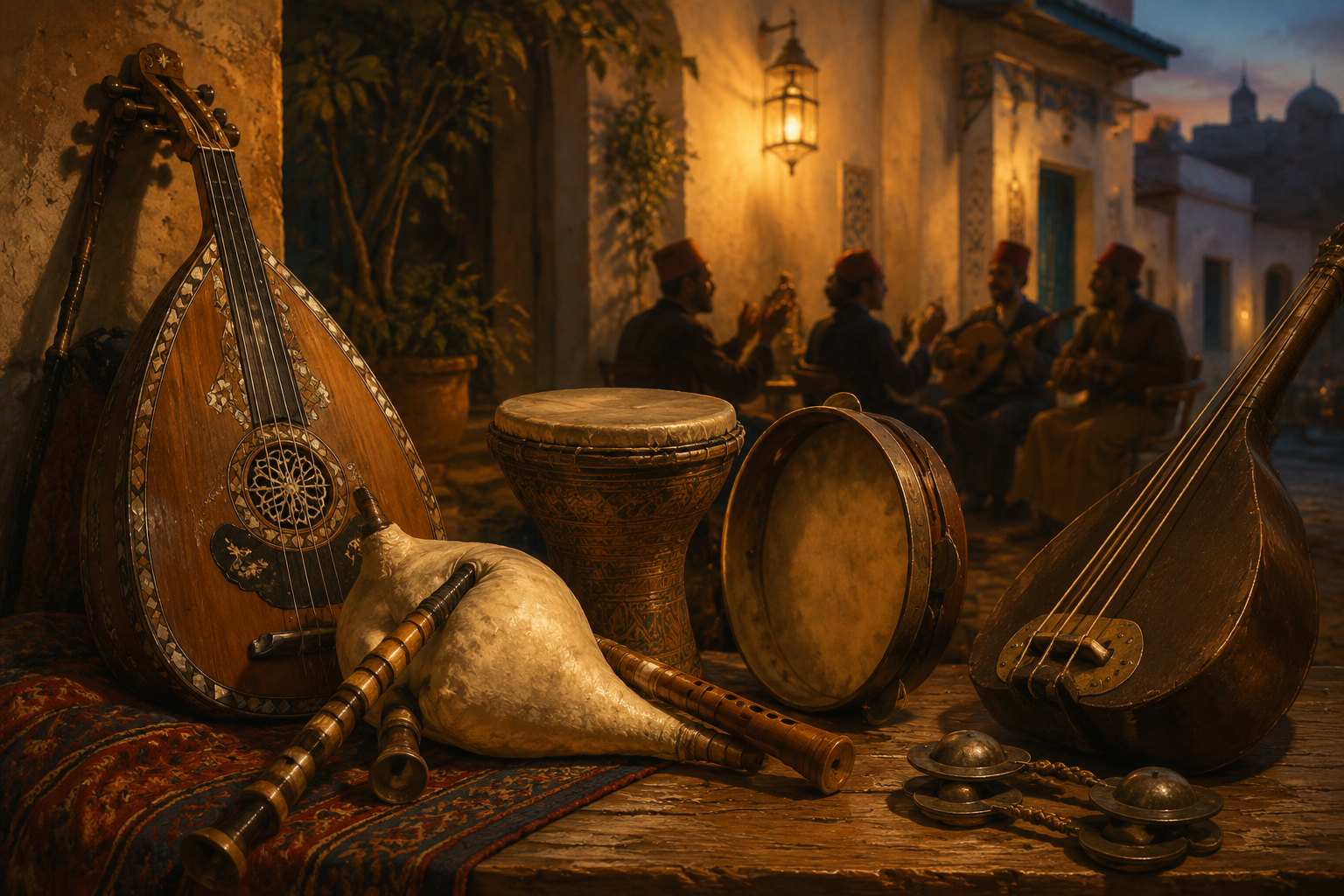
There is a moment, late on a Tunisian wedding night, when the music changes. The polite songs are over, the older guests have drifted to the edges, and a drummer leans into a rhythm called the fezzani — fast, lurching, impossible to sit still through. Within seconds every hand in the room is in the air. This is a rhythm that, by common agreement, exists nowhere else on earth, and when it starts, the whole country seems to recognize it in its body before its mind catches up.
Tunisia is a small place that has been listening to everyone for three thousand years — Phoenicians, Romans, Arabs, Andalusians, Ottomans, sub-Saharan Africans, the French — and it has turned all of that listening into a soundscape that is impossible to reduce to a single style. There is the refined classical music the elites love, the working-class music they once tried to ban, the trance music born in slavery, and a new generation fusing all of it with bass and synths and beaming it to the world. Here is how to tell them apart, and where to hear each one.
Malouf: The Sound Spain Exiled
Start with the music Tunisia considers its classical heritage: malouf, an Andalusian tradition carried across the sea by Muslim and Jewish refugees expelled from Spain. As the Reconquista and the later expulsions emptied Andalusia, its musicians scattered across North Africa, and they brought with them a sophisticated suite form, the nūba — long, structured cycles of instrumental preludes and sung poetry, performed on oud, rebab, and percussion, moving through fixed modes and rhythms.
The word malouf means, roughly, “the familiar” or “the customary,” and for centuries it lived up to the name: handed down by ear, anchored in Sufi brotherhoods and a handful of musical families, threatened more than once with being lost entirely. It was rescued, in the early twentieth century, by an unlikely figure — Baron Rodolphe d’Erlanger, a French-British painter and musicologist who settled in Sidi Bou Said and devoted himself to documenting and codifying the tradition from his cliff-top palace, Ennejma Ezzahra. His work helped lead to the founding of the Rashidiyya Institute in 1934, which formalized malouf, trained generations of musicians, and turned a fragile oral inheritance into a national art form. To hear malouf today — at a festival, in a concert hall, drifting from a radio during Ramadan — is to hear the sound of a homeland that no longer exists, kept alive on a foreign shore.
Mezoued: The Music They Tried to Ban
If malouf is the music of the salon, mezoued is the music of the street — and for most of the twentieth century, the gap between the two was a class war fought in sound.
Mezoued takes its name from its lead instrument: a goatskin bagpipe, droning and insistent, paired with hand drums and a singer working through lyrics about heartbreak, hard luck, exile, and the grind of ordinary life. It emerged in the 1950s as the music of the working class and rural migrants pouring into the cafés and back streets of Tunis. The establishment despised it. For decades mezoued was effectively banned from national television and radio, dismissed as crude, unworthy, an embarrassment best kept out of the official picture of Tunisian culture.
The ban failed, because the people never stopped playing it. Mezoued was the soundtrack of the wedding, the café, the neighborhood celebration — the music that actually moved the country, whatever the state broadcaster preferred. And it absorbed everything around it: you can hear Sufi devotional hymns, malouf melodies, and ancient folk songs folded into a single mezoued repertoire, all of it built to fill a dance floor. In recent years the genre has undergone a full reappraisal, traveling from banned to beloved, from shameful to a genuine source of national pride. The thing the elites tried to silence turned out to be the most honestly Tunisian music of all.
Stambeli: Trance, Healing, and the Music of Black Tunisia
The deepest and least-known layer is stambeli — ritual trance music brought to Tunisia by sub-Saharan Africans who came north through the slave trade, migration, and commerce over many centuries.
Stambeli is not entertainment. It is a healing and devotional practice, a cousin of Morocco’s gnawa, performed in ceremonies meant to summon spirits and guide the afflicted into a curative trance. Its sound is built around the gumbri, a deep three-stringed bass lute, and the shqashiq, large iron clappers whose relentless metallic pulse drives the ritual forward for hours. The music carries the memory of the people who made it — the descendants of the enslaved, whose history and continuing struggle against anti-Black racism in Tunisia is one of the country’s least-told stories. In a handful of Tunis houses, most famously Dar Barnu, the tradition has been kept alive against long odds. Stambeli is proof that a musical tradition can survive enslavement, marginalization, and near-erasure, and still be playing.
The New Wave: From the Revolution to the Global Stage
Then there is the Tunisia that is making new music right now — and for a moment in 2011, the whole world was listening.
In the final months before the revolution, a young rapper from Sfax who performed as El Général released a track addressed directly to the president, an act of raw political nerve that turned him into an overnight symbol and his song into an anthem of the uprising. Rap became the sound of a generation’s anger, and it never went away: a crowded scene of Tunisian hip-hop artists now fills stadiums and streaming charts. Alongside it, the singer Emel Mathlouthi gave the revolution one of its most enduring songs and carried Tunisian protest music onto the world’s stages, from the Nobel ceremony to international festivals.
The most striking recent development is the fusion of Tunisia’s oldest sounds with its newest technology. The producer Sofyann Ben Youssef, who records as Ammar 808, has spent the last several years dragging mezoued and stambeli onto the global dance floor — pairing goatskin bagpipes and gumbri with the thump of a Roland drum machine and walls of bass, most explosively on his 2025 album built entirely around mezoued. The electronic artist Deena Abdelwahed and the Tunisian-French Shouka collective have done something similar from the club side, mining the country’s ritual and folk traditions for a sound that feels both ancient and science-fictional. Percussionist Imed Alibi has bridged the traditional and the contemporary from yet another angle. The throughline is a generation that no longer treats heritage and modernity as opposites — the same impulse that produced Tunisia’s young DJs and a club culture that samples the call of the reed flute over a four-on-the-floor beat.
Where to Hear It Live
Tunisia is a country of festivals, and summer is when the music comes out of doors.
The International Festival of Carthage is the giant — held each summer in the ancient Roman theater above the bay, mixing malouf masters, Arab pop stars, and international headliners under the open sky. The El Jem Symphonic Festival sets classical concerts inside the floodlit Roman amphitheater. The Sahara Festival of Douz brings Bedouin music and poetry to the edge of the desert, and the coastal towns run their own jazz and world-music programs through the warm months. For malouf in its proper setting, the d’Erlanger palace at Ennejma Ezzahra in Sidi Bou Said still hosts concerts in the rooms where the tradition was rescued.
And then there is the music you cannot buy a ticket for — the mezoued that erupts at a wedding, the stambeli pulsing from a doorway in the old city, the rap leaking from a passing car, the radio in a café threading malouf through the afternoon. If you want to understand Tunisia, the songs are as good a place to start as any. Listen for the fezzani. When the hands go up, you’ll know you’ve found it.
From the Carthage Magazine Bookshelf
Music in Tunisia is never far from a table, a wedding, or a long café afternoon — and three Carthage Magazine ebooks were built for the traveler who wants to understand the country these songs come from:
- All About Tunisia — the definitive English-language traveler’s guide. 572 pages, 27 chapters, all nine regions, every UNESCO inscription, five thematic trails — and the practical answers (visa, currency, transport, etiquette) most travelers wish they’d had on the plane. $24.99 · PDF & EPUB
- Speak Like a Local — 200+ Tunisian Arabic phrases with native audio recorded in Tunis. The phrases for the taxi, the souk, the café, and the dinner table. $14.99 · PDF, EPUB, MP3
- The Authentic Tunisian Cookbook — sixty traditional recipes from the heart of North Africa. For when you get home and find yourself missing the food. $9.99 · PDF & EPUB
All three available as a bundle for $39.99 — guide, language, and food, delivered together.
