
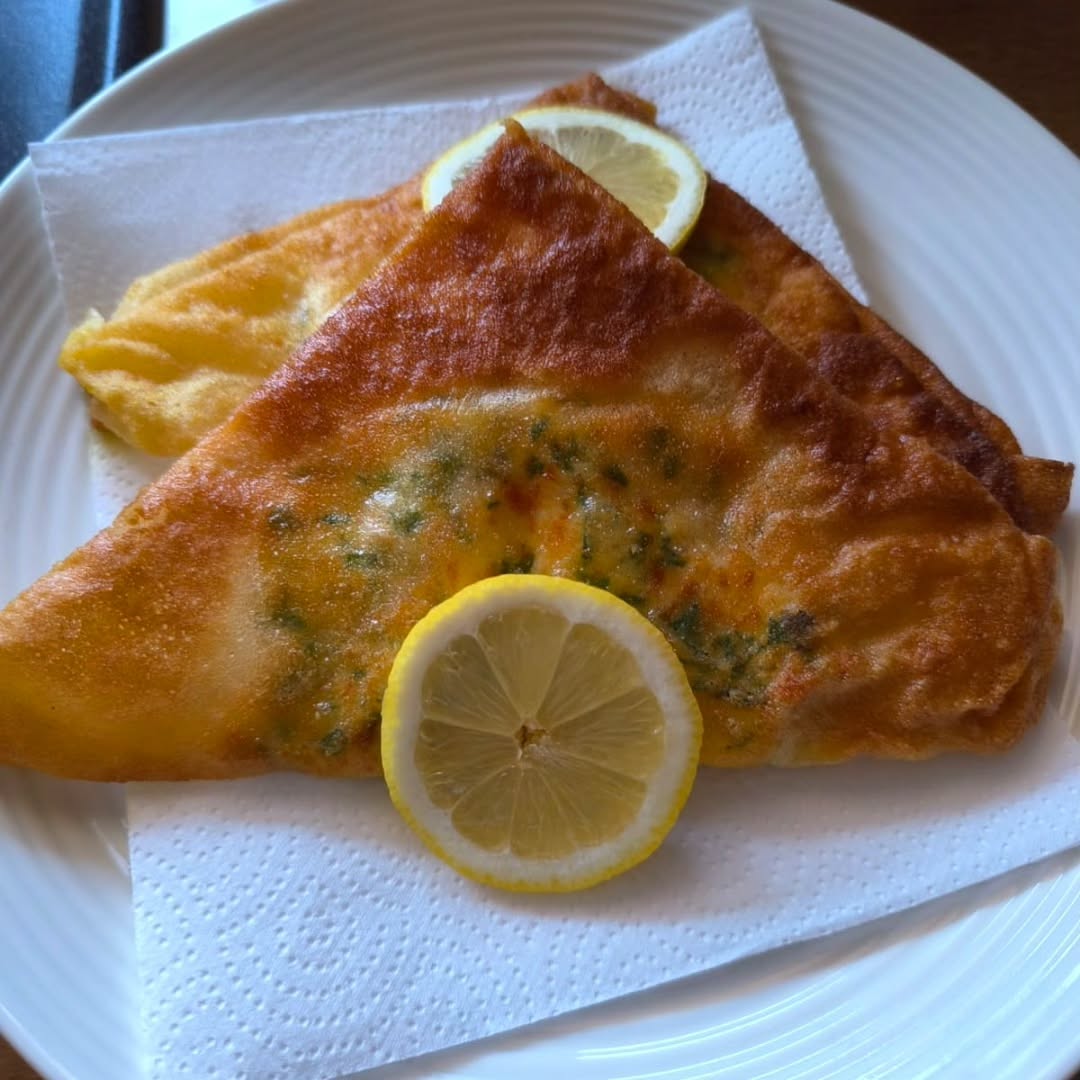
Quick Answer Brik, pronounced breek, is a thin, crisp Tunisian pastry folded into a triangle around a savoury filling — most famously a whole egg with tuna, capers, parsley, and harissa — then fried in olive oil until shattering-golden. It is eaten with the fingers, yolk-first, and is the unofficial opening act of nearly every Tunisian feast. Outside Ramadan it is street food, lunch, a wedding starter, a café-bar accompaniment to a cold beer. During Ramadan it is non-negotiable.
There is a small ritual every Tunisian family performs on the first evening of Ramadan, somewhere between the call to prayer and the first sip of water. The grandmother — it is always the grandmother — lifts a folded triangle of pastry out of a pan of olive oil, holds it briefly against the side to drain, and lays it on the family plate. The pastry is the colour of late-afternoon sun on a Sidi Bou Said wall. The edges crackle as they cool. Someone calls a child to the table.
This is brik. And the next few seconds — the lift, the careful bite into one corner, the rush of warm egg yolk down the wrist — are arguably the most photographed sixty centimetres of Tunisian cuisine.
What is brik, exactly?
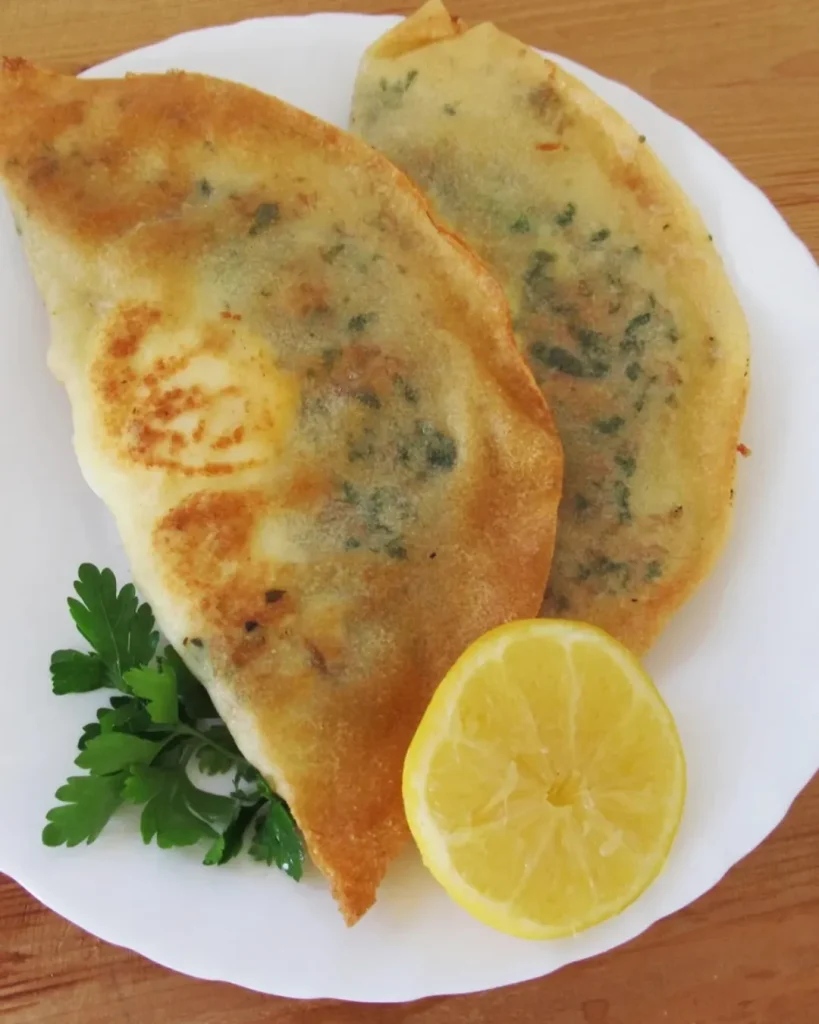
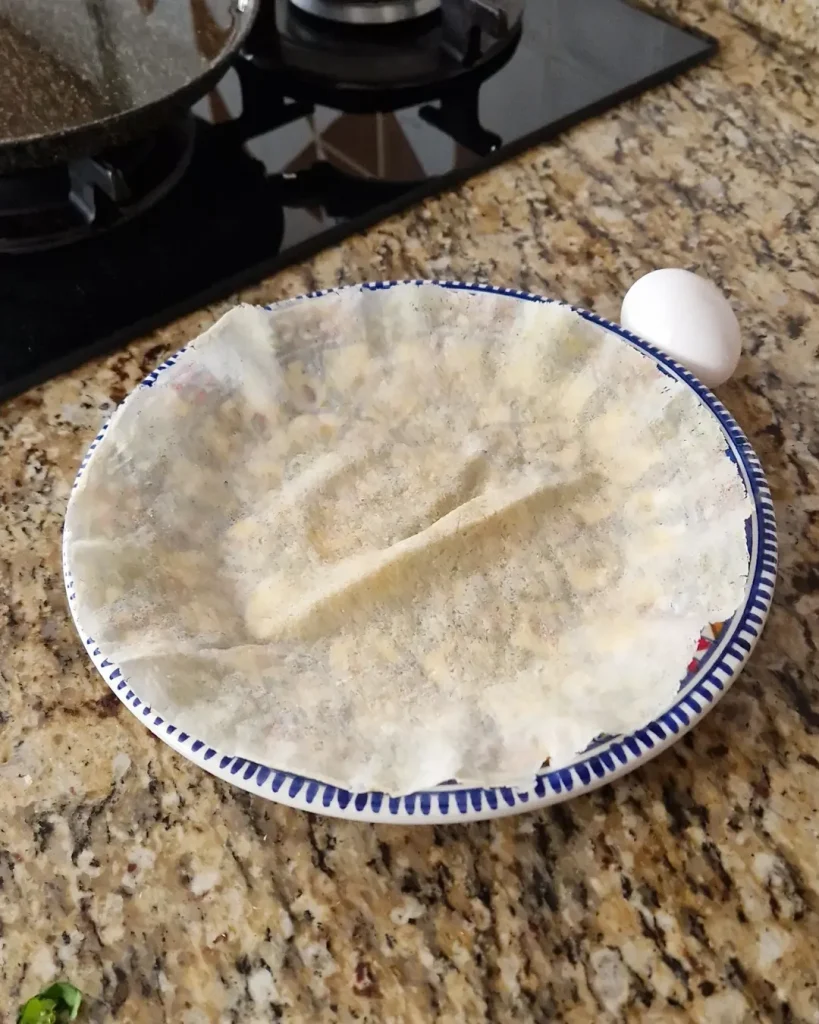
Brik is not, strictly speaking, a dish so much as a vessel. The word refers to two related things: the pastry sheet itself (called malsouka or warka in Arabic, feuille de brik in French) and the finished, stuffed-and-fried object you eat. Malsouka is roughly the thickness of two layers of tracing paper. It is brittle when raw, pliable when slightly damp, and, when dropped into hot oil, transforms within seconds into something closer to glass than bread.
Into this paper-thin envelope goes a filling. The classic Tunisian version — what you will be served if you walk into any restaurant in Tunis and order without specifying — is brik à l’œuf, also called brik au thon: mashed potato seasoned with parsley and onion, flaked tuna, capers, and a raw egg cracked into the centre at the moment the pastry is folded. The whole thing is sealed into a triangle and slid into hot olive oil. The egg cooks just enough that the white is set and the yolk is still molten. That is the entire point.
There are dozens of regional and household variations — minced meat, prawns, mashed brain (yes, really), spinach, three kinds of cheese, leftover stew — but the egg version is the diplomat. It is the brik you serve guests. It is the brik your mother makes.
The pastry: a thousand-year-old technique
Malsouka is made by pressing a sticky lump of wet dough onto a hot, flat metal surface in overlapping circles, then peeling off the resulting paper-thin sheet a moment later. The method requires a wrist that has done it ten thousand times. In Tunis, on the narrow streets behind the central market, you can still watch women — and it is almost always women — making malsouka the same way their grandmothers did, working a hot copper dome with bare fingertips that have long since stopped registering the heat.
The technique is shared across the Maghreb and into the Levant — Algerian bourek, Libyan brik, Moroccan briouat, Turkish yufka — and ultimately descends from Ottoman börek, which spread westward across the empire’s North African provinces in the sixteenth century. But the Tunisian version diverged early. The pastry got thinner. The fold became a tight equilateral triangle rather than a roll. And, crucially, somewhere along the way a Tunisian cook decided to crack a whole egg into the centre — a small piece of culinary audacity that has defined the dish ever since.
You can buy malsouka at any Tunisian épicerie in vacuum-sealed packets of ten. Outside the country it is harder to find. The standard substitutions, in descending order of fidelity: Filipino lumpia wrappers, Chinese spring roll wrappers, and — only as a last resort — phyllo. None are quite right. Phyllo, in particular, will give you something edible, but it will not give you brik. The shatter is wrong.
The filling: tuna, egg, and the things that hold them together
The canonical filling is built around five ingredients, none of them difficult, all of them assertive.
- Tuna. Tinned, in olive oil, drained but not too thoroughly. Tunisia is one of the great tuna-fishing nations of the Mediterranean — the bluefin grounds off Sidi Daoud have been worked since Phoenician times — and the country takes its tinned tuna seriously enough that the better local brands cost more than the imported French ones. Use what you can find, but use it generously.
- Potato. Boiled, peeled, mashed roughly with a fork — not whipped smooth. It is the body of the filling, the thing that keeps the tuna from sliding around, the thing that absorbs the yolk on the second bite.
- Capers and parsley. Tunisian flat-leaf parsley, chopped fine, in quantities that would alarm a French cook. Capers in brine, also chopped, never whole. Together they cut through the richness.
- Onion. Grated, not diced. Squeezed slightly to lose some water before going into the bowl.
- The egg. Cracked whole into the centre of the assembled triangle at the last possible moment before folding. Some cooks add a dot of harissa beside the yolk; the harissa-averse leave it out. The egg’s job is to be runny. If your egg is hard, you have failed. Begin again.
A few cooks add grated gruyère or local gouda. A few add a pinch of tabil, the Tunisian dried spice blend of caraway, coriander, garlic, and chilli. A few add nothing at all, and these are usually the best. The dish does not need help.
The oil matters. Tunisian olive oil — the country produces some of the finest in the world, and frying with it at home is a small daily luxury — is what most Tunisian cooks use, though for high-volume restaurant kitchens a neutral oil is more common. The pan should be deep enough that the brik can float briefly, hot enough that the pastry seals on contact, not so hot that the egg overcooks before the white sets. Around 170°C. Forty-five seconds a side.
How to eat a brik
There is a correct way to eat a brik, and there is the wrong way, and the wrong way ruins shirts.
The correct way: hold the triangle by one of the two long edges, not the point. Bite into the corner closest to your thumb — the corner above the egg, not the one containing it. This releases steam. Tilt your head slightly forward. Take the second bite from the opposite long edge to make a small reservoir. Now eat into the yolk-bearing pocket from the top, letting the molten yolk run into the pocket you have created rather than down your hand. Lemon, if served, goes on the next bite.
The wrong way: lift the brik flat from the centre, like a slice of pizza. The yolk runs sideways. It runs onto your wrist. From your wrist, into your sleeve. You will not get the stain out.
If you are eating brik in a restaurant and a server brings you a knife and fork, you may use them. You will, however, be quietly identified as a tourist. (There are other quiet identifications.)
Why brik belongs to Ramadan
Every Tunisian household has its own answer to why brik is essential at iftar — the meal that breaks the fast at sundown. The practical answer is that it is hot, salty, fatty, and protein-rich, which is exactly what a body needs after fifteen hours without food or water. The cultural answer is that brik makes the table feel like a celebration. The honest answer is that it is the thing the children watch for. A Tunisian iftar without brik is a Tunisian iftar that has gone wrong somewhere.
It is served alongside tchich or chorba, dates, bouza, salads, and bread. (The full Ramadan table is its own subject.) But brik is the one that arrives first and disappears fastest. In the weeks before Ramadan, supermarkets stock pyramids of malsouka packets near the entrance. By the second week of the month, they are sold out.
The regional accents
If you are travelling through Tunisia, the brik you eat in one city will not be the brik you eat in the next.
- Tunis and the north. The canonical version. Tuna, egg, capers, parsley, potato. Restraint. Often served with a wedge of lemon and a small dish of harissa on the side.
- Sfax. Smaller, neater triangles. More fish-forward. Some Sfax cooks add a touch of preserved lemon to the filling, which is unusual and excellent.
- Djerba. Heavier on harissa, sometimes smoked. The island’s Sephardic Jewish community developed its own brik traditions over centuries, often with potato, capers, and a more aggressive chilli profile. The famous brik counter at Hara Kebira draws queues that loop around the block.
- The south. Larger, more rustic, sometimes wrapped in two layers of malsouka for a sturdier eating-with-fingers experience. Fillings can include lamb or merguez.
- The Tunisian diaspora — Paris, Marseille, Montreal. Brik has travelled. In France it appears on bistro menus as brick à l’œuf, sometimes filled with goat cheese and honey, which is a French innovation Tunisians regard with the same affection one reserves for a well-meaning relative.
Where to try it in Tunisia
There is no list of “best brik” worth writing, because the best brik is almost always the one being made in someone’s home kitchen at 6:45 p.m. on the eighteenth day of Ramadan. But a few public-facing options worth seeking out:
- Le Café Vert, Tunis (rue Charles de Gaulle). Classic Tunis brik, served with a cold Celtia, lunch hour.
- Brik Ishak, Hara Kebira, Djerba. A counter, not a restaurant. Cash, queue, two minutes’ wait. Eat it standing.
- Any neighbourhood gargote at iftar. Walk past one. Smell the oil. Go in.
Making your own
If you want to make brik at home, you will need malsouka or a thin substitute, good olive oil, a wide shallow pan, and the willingness to crack an egg with your weak hand while folding pastry with your strong one. It is not a difficult dish. It is a dish that rewards a confident wrist and a hot pan. The sixty traditional recipes in The Authentic Tunisian Cookbook include a full brik chapter — variations from Tunis, Sfax, and Djerba, with notes on the malsouka shortcuts that actually work.
Besmellah, as one says in Tunis before the first bite.
