• About Us
  • Readers Write
Carthage Magazine
  • Home
  • News
  • Food & Drinks
    • Taste Tunisia
  • People
    • Interviews
    • No Sugarcoating
    • Environment
  • Style & Travel
    • Attractions
    • Trip Planning
      • Travel Information
      • Hotels in Tunisia
      • Cost of Living
      • Tunisia’s Language
      • Tunisia’s Weather
      • Tunisia’s Currency
      • Tunisia’s Visa
    • Transport in Tunisia
      • Traveling Around
      • Local Transport
      • Flights to Tunisia
      • Ferries to Tunisia
      • Tunisia Overland
    • Things to Do
      • Leisure
  • Local History
    • Museums
    • Monuments
    • Heritage Sites
    • Historical Figures
  • Education
  • Innovation
  • Editors’ Picks
Editors' PicksLocal HistoryPeople

What Did Wealthy Ancient Carthaginians Smell Like?4 min read

By Contributing Editor January 21, 2024
Written by Contributing Editor January 21, 2024
What Did Wealthy Ancient Carthaginians Smell Like

Oleo-resins, scented oils from aromatic plants such as Jasmine, along with other woods, incense, and perfumes lost to us today, tell us what Ancient Carthaginians smelled like.

The Smells of Carthage

Some evidence from several tombs at Carthage indicates that some bodies most likely of wealthy, priests or other elites were subsumed in what have been termed “resin baths,” in one instance forming a smooth-surfaced resinous bubble-filled layer at the bottom of a sarcophagus, encasing the skeletal remains.

Late twentieth-century testing determined these were likely composed primarily of the oleo-resin of the Pistacia terebinthus, or Chio terebinth, though some of the resins were probably perfumed with aromatic plants or other additives.

Similar Reads:

  • Carthaginian Trade: Trade Routes of Ancient Carthage
  • How Carthaginians Helped Shape What We Eat Today

Researchers have previously revealed that a base or binder of olive oil was usually among ingredients of any perfume, which would help facilitate the application and preservation of the aroma.

Most scholars worldwide agree that perfumed oils were often part of the burial rituals in tombs during the Ancient Carthage era. Olive, sesame, linseed/flax, and almond oils were used as liquid carriers for other scented additives or spices, and animal fat could be used for thicker scented or medicated unguents.

Molecular traces of essential oils from aromatic plants such as jasmine were found in sediment tested from a sixth-century BCE monumental tomb in Carthage, suggesting the body was anointed or dressed in scented animal fat and perfumed oil.

Of the most recent discoveries, in 2019, Juan Manuel Román, an archaeologist at Pablo de Olavide University in Seville, Spain, was called to the small town of Carmona. Residents were constructing a swimming pool and had uncovered an intact Roman family tomb from the 1st century AD with six burial urns still in place.
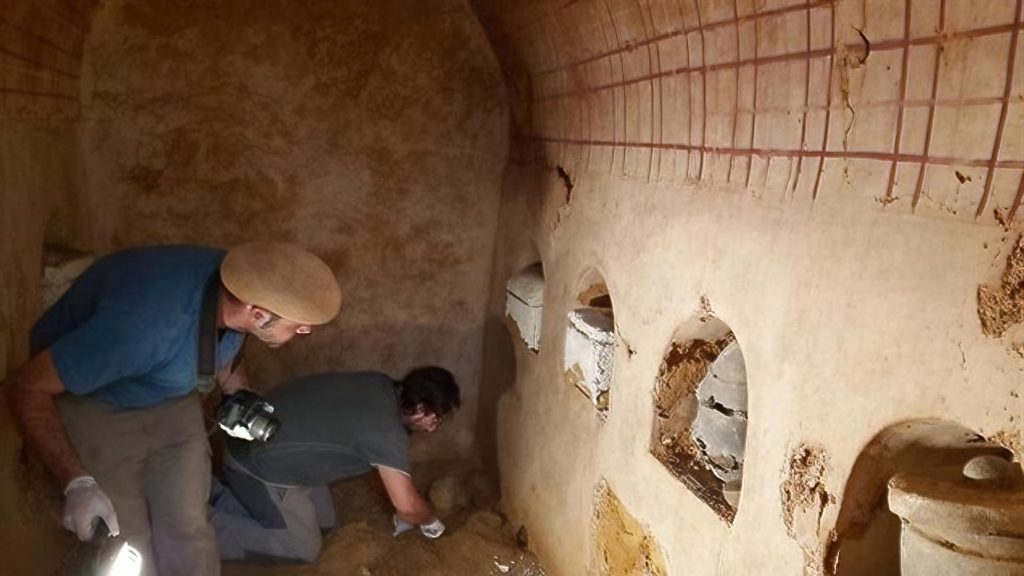
The ancient perfume bottle was found inside an urn inside the egg-shaped container. The mausoleum where it was found contained eight niches (two shown here), six of which were occupied by urns with different forms. It’s possible that all held the cremated remains of members of the same family.
The mausoleum where it was found contained eight niches (two shown here), six of which were occupied by urns with different forms. It’s possible that all held the cremated remains of members of the same family.

The tomb, undisturbed for two millennia, was the final resting place for three men and three women. Among the funerary offerings to a woman was a bottle carved from quartz crystal, sealed with a bitumen stopper and with its congealed contents preserved inside. Using state-of-the-art scanning techniques like X-ray diffraction, dispersion X-ray spectroscopy, and scanning electron microscopy, experts were able to determine the exact composition of the substance inside the vessel without opening it.

That the bottle would contain scented oil – a common offering in Roman and Carthaginian graves – was not in itself a surprise but the precise essence was of great interest. Analysis revealed the perfume was made of two ingredients: abase of olive oil and Patchouli. This surprisingly well-preserved perfume bottle is providing a rare olfactory window to ancient Carthage and Rome era.

The ancient perfume bottle was found inside an urn inside the egg-shaped container.

With all the discoveries and available data we have so far, one can tell that each funeral in the Ancient Carthage rituals was likely unique, fragranced by combinations of scents specific to that family, place, or ritual community, though drawing from a limited palate of appropriate and symbolic aromatic substances: myrrh, bdellium, cedar, sycamore, almond, terebinth, along with other woods, resins, incense, and perfumes lost to us today.

Some families with lavish resources may have incorporated large quantities of myrrh, what looks like the most expensive of these options as far as it is known, while others might have used valuable oleo-resins more sparingly when they could get any at all.

Whatever the final bouquet, in these various Carthaginian mortuary settings would have evoked at the same time the mortal and divine spheres, the living and deceased, and would have aided the transition into the permanent, undisturbed resting place of the ideal Phoenician tomb.

Suggested Reads:

  • Antonine Baths: The Famous Baths of Carthage
  • The Roman Theatre of Carthage

If you would like to comment on this article or anything else you have seen on Carthage Magazine, leave a comment below or head over to our Facebook, X and Instagram pages. You may also message us via this page.

And if you liked this article, sign up for the monthly features newsletter. A handpicked selection of stories from Carthage Magazine, delivered to your inbox.

0 comment
2
FacebookTwitterEmail
Contributing Editor

Contributing Editor account at Carthage Magazine. Tunisia's premier English general-interest Magazine with thousands of page-views per month and over 200,000 social media followers.

previous post
El Jem Amphitheatre — The Greatest Roman Colosseum in North Africa
next post
Municipal Theatre of Tunis, A Gem of A Theater

Related Articles

UNESCO World Heritage Sites in Tunisia

April 28, 2026

Tunisia Emerges as Global Leader in Organic Olive...

March 30, 2026

حق الملح: A Tunisian Tradition of Appreciation and...

March 21, 2026

How to Stick to a Healthy Iftar Table...

February 26, 2026

Octopus Barley Soup “Tchich” — Tunisia’s Favorite Ramadan...

February 26, 2026

Guide to Spending a Tunisian-Spirited Ramadan Alone Abroad

February 26, 2026

9 Things to Know about Ramadan in Tunisia

February 26, 2026

Maison de l’Île: Where Timeless Elegance Meets Comfort

February 5, 2026

Tunisia’s Dam Levels Still Hover at 32–33% Capacity

January 21, 2026

People Wake Up to Damages as Storm Harry...

January 20, 2026

Leave a Comment Cancel Reply

Save my name, email, and website in this browser for the next time I comment.

Flavors of Tunisia

Taste-Tunisia-Tunisian-Cuisine-3

Want more top stories?

Carthage Magazine Newsletter

Sign up today and you’ll get our latest stories delivered straight to your inbox.

Just For You

  • 1

    April 9th, Tunisian Martyrs’ Day 🇹🇳

    April 2, 2025
  • 2

    Fruits From Tunisia: 15 Tunisian Fruits to Eat When Traveling

    August 20, 2023
  • 3

    Alcohol in Tunisia: What Visitors Need to Know

    August 2, 2021
  • 4

    Top 3 Largest Colosseums Around the World

    October 4, 2024
  • 5

    ChatGPT’s Logo Inspired by a 2200-Year-Old Mosaic from Tunisia

    January 13, 2026

Latest

  • UNESCO World Heritage Sites in Tunisia

  • Tunisia Leads Global Ranking in STEM Graduates

  • Tunisia: Sharp Declines in Marriages & Births Between 2019 and 2023

  • Tunisia Inaugurates Four Solar Power Plants in Medenine

Sections

  • Editors' Picks
  • Education
  • Environment
  • Food & Drinks
  • Innovation
  • Local History
  • News
  • No Sugarcoating
  • People
  • Quizzes
  • Style & Travel
  • Things to Do
  • Videos

E᙭ᑭᒪOᖇE

Carthage Magazine

We’re on a mission to create content that inspires people about experiences, places, products and people in Tunisia!


— About Us

— Media Kit

— Adverstising

— Transparency

— Contact Us

Facebook Twitter Instagram Linkedin Youtube

ᗯᗩᑎT ᗰOᖇE TOᑭ ᔕTOᖇIEᔕ?

Carthage Magazine Newsletter

Sign up today and you’ll get our latest stories delivered straight to your inbox.

ᔕᑭᖇEᗩᗪ TᕼE ᗯOᖇᗪ

Spread the word

Our goal is to get these stories out in the public arena, and by doing this, keep promoting Tunisia and changing attitudes towards the MENA region.


— Ambassadors

— Readers Write

— What You Can Do to Help

EᗪITOᖇᔕ’ ᑭIᑕKᔕ

  • UNESCO World Heritage Sites in Tunisia

    April 28, 2026
  • Octopus Barley Soup “Tchich” — Tunisia’s Favorite Ramadan Soup

    February 26, 2026
  • 9 Things to Know about Ramadan in Tunisia

    February 26, 2026

© 2019 - 2026 Carthage Magazine. Privacy Policy

Carthage Magazine
  • Home
  • News
  • Food & Drinks
    • Taste Tunisia
  • People
    • Interviews
    • No Sugarcoating
    • Environment
  • Style & Travel
    • Attractions
    • Trip Planning
      • Travel Information
      • Hotels in Tunisia
      • Cost of Living
      • Tunisia’s Language
      • Tunisia’s Weather
      • Tunisia’s Currency
      • Tunisia’s Visa
    • Transport in Tunisia
      • Traveling Around
      • Local Transport
      • Flights to Tunisia
      • Ferries to Tunisia
      • Tunisia Overland
    • Things to Do
      • Leisure
  • Local History
    • Museums
    • Monuments
    • Heritage Sites
    • Historical Figures
  • Education
  • Innovation
  • Editors’ Picks
Carthage Magazine
  • Home
  • News
  • Food & Drinks
    • Taste Tunisia
  • People
    • Interviews
    • No Sugarcoating
    • Environment
  • Style & Travel
    • Attractions
    • Trip Planning
      • Travel Information
      • Hotels in Tunisia
      • Cost of Living
      • Tunisia’s Language
      • Tunisia’s Weather
      • Tunisia’s Currency
      • Tunisia’s Visa
    • Transport in Tunisia
      • Traveling Around
      • Local Transport
      • Flights to Tunisia
      • Ferries to Tunisia
      • Tunisia Overland
    • Things to Do
      • Leisure
  • Local History
    • Museums
    • Monuments
    • Heritage Sites
    • Historical Figures
  • Education
  • Innovation
  • Editors’ Picks
© 2019 - 2026 Carthage Magazine. Privacy Policy

Read alsox

10 Tunisian Lifestyle Habits to Adopt Immediately

September 30, 2025

Democracy Without Prosperity? Demystifying The Tunisian Model

August 1, 2021

Learn Arabic in Tunisia: All What You...

October 29, 2021