
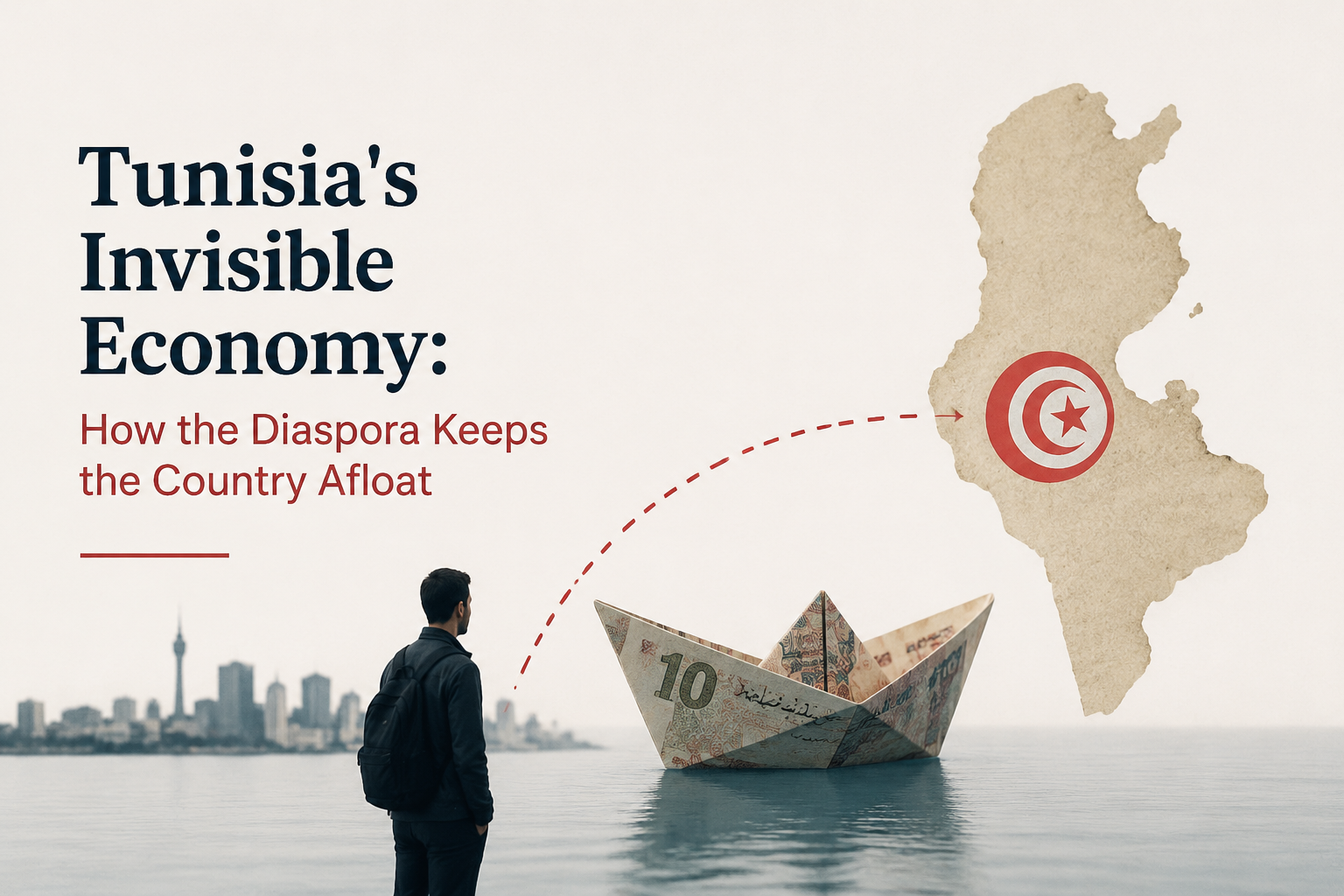
Every month, in apartments across Paris, Turin, and Frankfurt, Tunisians sit down at their phones and do something quietly extraordinary. They send money home.
It might be a few hundred euros to cover a mother’s rent, a transfer to help a sibling through university, a contribution toward a family medical bill that the public system can no longer fully cover. Individually, these transactions are acts of love. Collectively, they form one of the most significant — and least celebrated — pillars of the Tunisian economy.
The numbers tell a story that demands attention. According to data published by the Central Bank of Tunisia on May 8, cumulative workers’ remittances reached 2.9 billion dinars in the first four months of 2026 alone — a 5.2% increase over the same period last year. Annualized, that puts Tunisia on track to surpass recent records in a financial lifeline that has, over the past decade, grown by 55% while foreign direct investment has declined by nearly half.
Tunisia’s diaspora, it turns out, has become a kind of parallel central bank. And like any central bank, it is indispensable — and entirely outside the government’s control.
A Nation Abroad
To understand the scale of what is happening, consider this: more than 12% of the Tunisian population lives outside of the country. The Tunisian diaspora is concentrated primarily in France — home to roughly 669,000 Tunisians — followed by Italy with around 189,000 and Germany with approximately 87,000. Beyond Europe, communities stretch across the Gulf states, North America, and beyond.
These are not just emigrants. They are, in the most practical sense, the country’s most reliable investors. World Bank figures rank Tunisia 47th globally for remittances as a share of GDP, with diaspora transfers representing 6.34% of the national economy in 2024. To put that in perspective, the global average is just 0.82%. Tunisia sits ahead of Ukraine, in the same bracket as Bangladesh and Sri Lanka — countries where mass migration has long been a structural economic reality.
More striking still: remittances to Tunisia now exceed both foreign direct investment and official development assistance. They are more stable than FDI, more unconditional than aid, and they arrive directly into the hands of families rather than passing through bureaucratic channels.
The Real Cost of Every Transfer
Behind the headline figures are individual stories that rarely make it into economic reports.
Abir is a Tunisian researcher living in Romania. Three or four times a year, she sends money to her mother still living in Tunisia — for birthdays, for the start of the school year, for unexpected medical costs. “We are six children in the family and I am the only one who finished her studies and is working,” she has said. “When I have money to spare, I want to make my mum happy. After all the years of sacrifices, it is my responsibility to give something back.”
What Abir — and thousands like her — rarely talks about is the cost of giving back. The average transaction fee for sending money to Tunisia sits at around 8.7%, according to World Bank data. That means for every 100 dinars sent home, nearly nine disappear in fees before they reach a family in Tunis, Sfax, or Sidi Bouzid.
This cost has driven much of the diaspora toward informal channels: cash carried in luggage, goods brought back during visits, transfers routed through acquaintances. Estimates suggest that only around 5% of Tunisian remittances pass through formal banking systems. The World Bank cautions that informal flows could add 50% or more on top of what official statistics capture — meaning the true scale of diaspora support to Tunisia may be dramatically larger than any published figure shows.
An Anesthetic for Structural Reform?
The flows are impressive. But economists are increasingly asking an uncomfortable question: is Tunisia’s dependence on its diaspora a strength, or a symptom?
Remittances do not fall from the sky. They are the direct product of emigration, driven by a domestic labor market that cannot absorb graduates, wages that remain low relative to European alternatives, and insufficient industrialization to retain skilled workers. The money that arrives stabilizes household consumption and props up the balance of payments — but it does not build factories, seed industries, or create the jobs that might persuade the next generation to stay.
In this sense, remittances function as what analysts have called an “anesthetic”: they ease the immediate pain of economic underperformance while delaying the structural reforms that would address the underlying condition. Tunisia’s economy looks more stable than it is, partly because hundreds of thousands of families are being quietly sustained by relatives working abroad.
There is also a vulnerability built into the model. The Tunisian diaspora is concentrated in France, Italy, and Germany — all countries currently navigating economic uncertainty and tightening immigration policy. A slowdown in European labor markets, a shift in migration regulations, or even an increase in transfer fees could rapidly reduce the flows that Tunisia’s families — and budget — have come to depend on.
What Morocco and Jordan Do Differently
Tunisia is not alone in relying on its diaspora, but the comparison with its neighbors is instructive.
Morocco posts a slightly higher remittance-to-GDP ratio (around 7.79%) and Jordan higher still (8.31%). But both countries have done something Tunisia has largely not: they have built active policies to channel diaspora money into productive investment. Dedicated financial instruments, diaspora investment funds, streamlined processes for emigrants to invest in their home country’s real estate and business sectors — these mechanisms exist in Rabat and Amman in ways that remain underdeveloped in Tunis.
In Tunisia, remittances arrive, cover consumption, and help stabilize the balance of payments. But they are not yet integrated into a structured development strategy. They remain private transfers responding to family logic — not national capital being mobilized for growth.
This is changing, slowly. Tunisia was among the country case studies presented at a United Nations roundtable in New York earlier this month, examining how diaspora remittances can be embedded into national development planning. The country’s next five-year plan (2026–2030) is reportedly incorporating remittances as an alternative source of development financing for the first time, with technical support from the UN Economic Commission for Africa.
The Question Worth Asking
There is something quietly heroic about what Tunisia’s diaspora does every month. They left, often reluctantly. They built lives in difficult circumstances, navigating language barriers, uncertain legal status, and the particular loneliness of building a home far from the one you grew up in. And still they send money back.
For Tunisia, the challenge ahead is not to question their generosity — it is to be worthy of it. That means reducing the ruinous cost of transfers so more of each dinar actually reaches its destination. It means creating conditions that make it possible for diaspora Tunisians to invest in their country, not just support their families. And it means building an economy that eventually retains the talent it currently exports.
The diaspora has held the economy together through revolution, pandemic, and years of political turbulence. They have done so without fanfare, without policy support, and largely without recognition. The least Tunisia can do is build a future that makes staying — or returning — feel like a real option.
Sources: Central Bank of Tunisia (May 2026), World Bank / Visual Capitalist (April 2026), African Manager, UN Economic Commission for Africa, Inkyfada, Amnesty International
