
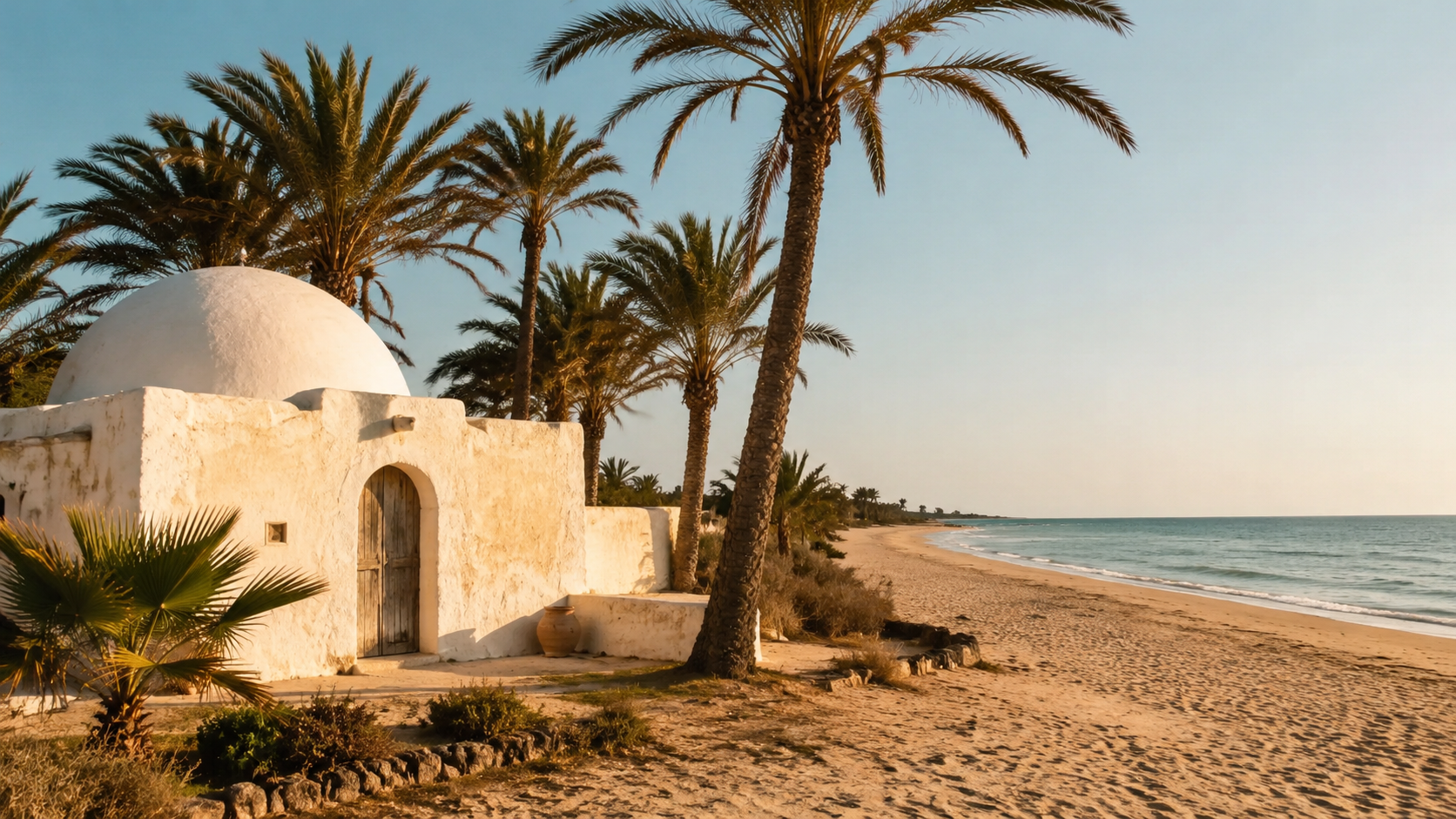
Djerba has a gift that most Mediterranean islands lack: it is pleasant almost all year round. It sits in Tunisia’s deep south, catches more sun than the north, and even its winters are mild enough for long walks in shirtsleeves. So the question is not really whether to come, but what kind of Djerba you want — the warm, busy, sea-swimming island of high summer, or the quiet, golden, near-empty island of the shoulder months. They are almost two different places, and the calendar is how you choose between them.
Here’s the honest breakdown, season by season.
High summer: June to September
This is Djerba at full volume. The sea is warm, the days are long, and the beaches are at their best for swimming and lounging. It’s also when the charter flights are most frequent, the resorts are fullest, and prices peak. The northeast beaches around Sidi Mahres get genuinely busy in July and August; the quieter southern and western beaches stay calmer.
The one real caveat is heat. Midsummer can be intense, especially inland and on any desert day trip you might attempt — the south of Tunisia is no joke in August. On the island itself, the sea breeze takes the edge off, but plan sightseeing for mornings and evenings and save the middle of the day for the water or the shade. If you want the classic beach holiday and don’t mind crowds or prices, this is your window.
The shoulder seasons: spring and autumn (the local’s choice)
Ask someone who lives on the island when they’d tell a friend to visit, and they’ll usually point here.
Spring — March to May brings gentle warmth, empty beaches, and the clearest, softest light of the year. It’s the perfect window for the things that aren’t swimming: wandering Houmt Souk, photographing the Djerbahood murals, visiting El Ghriba synagogue, and taking inland day trips before the high-summer heat arrives. The sea is warming but not yet at its best for long swims early in the season.
Autumn — October and November is, in many ways, a second spring. The sea stays warm well into mid-October — often warm enough to swim comfortably — while the summer crowds thin out and prices drop. Late September into November is also date-harvest season, when the Midoun markets fill with fresh dates. For the traveller who wants warm water and breathing room, the first half of October is arguably the single best time to be on Djerba.
Winter: December to February
Djerba’s winter has nothing in common with a northern one. Days are mild — comfortable enough for a t-shirt and a terrace lunch — though the sea is too cold for most people to swim, and evenings call for a light jacket. What winter offers instead is profound calm: empty beaches, quiet villages, low-season rates, and the space to visit the synagogue, the Guellala potteries, and the heritage sites without another tourist in sight. It’s also flamingo season in the southern lagoons. For long-stay travellers and remote workers, winter Djerba is a genuinely appealing, inexpensive proposition — see our cost of living in Tunisia guide for what that looks like in practice.
A note on the El Ghriba pilgrimage
One date worth knowing regardless of when you visit: each spring, usually around Lag BaOmer (April or May), the El Ghriba synagogue hosts an annual Jewish pilgrimage that draws visitors from around the world. It’s a remarkable expression of the island’s centuries-old religious coexistence, and the 2024 and 2025 pilgrimages were held without incident under enhanced security. If you’re visiting around then, expect the Erriadh area to be busier and more tightly secured; if you specifically want to witness the pilgrimage, plan and book well ahead.
Sea temperature, at a glance
Since so many people come to Djerba to swim, the water is worth its own note. The sea is at its warmest from roughly July through mid-October, comfortable for swimming. It cools through late autumn, sits too cold for most swimmers in the depths of winter, and warms again gradually through spring — usable by late May, properly warm by June. If swimming is the priority, aim for June to mid-October; if you’re flexible, the shoulders give you most of the warmth with a fraction of the crowds.
So, when should you go?
If you want the full beach-resort experience and don’t mind the heat, crowds, and prices, come in summer. If you want the island at its best-balanced — warm enough, quiet enough, beautiful light — come in May or October. And if you want solitude, mild sunshine, rock-bottom prices, and flamingos, winter is Djerba’s best-kept secret. There’s no wrong answer; there’s only the version of the island that matches what you’re after.
Whenever you come, the practical questions are the same — how to get from the airport, how to move around an island with no ride-hailing apps. Our guides to Djerba airport and getting around Djerba cover both.
From the Carthage Magazine Bookshelf
Once the dates are set, three Carthage Magazine ebooks were built for the days between arrival and departure:
- All About Tunisia — the definitive English-language traveller’s guide. 572 pages, 27 chapters, all nine regions, every UNESCO inscription, five thematic trails, and the practical answers — visa, currency, transport, etiquette — most travellers wish they’d had on the plane. $24.99 · PDF & EPUB
- Speak Like a Local — 200+ Tunisian Arabic phrases with native audio recorded in Tunis. The phrases for the taxi, the souk, the café, and the dinner table. $14.99 · PDF, EPUB, MP3
- The Authentic Tunisian Cookbook — sixty traditional recipes from the heart of North Africa. For when you get home and find yourself missing the food. $9.99 · PDF & EPUB
All three available as a bundle for $39.99 — guide, language, and food, delivered together.
