
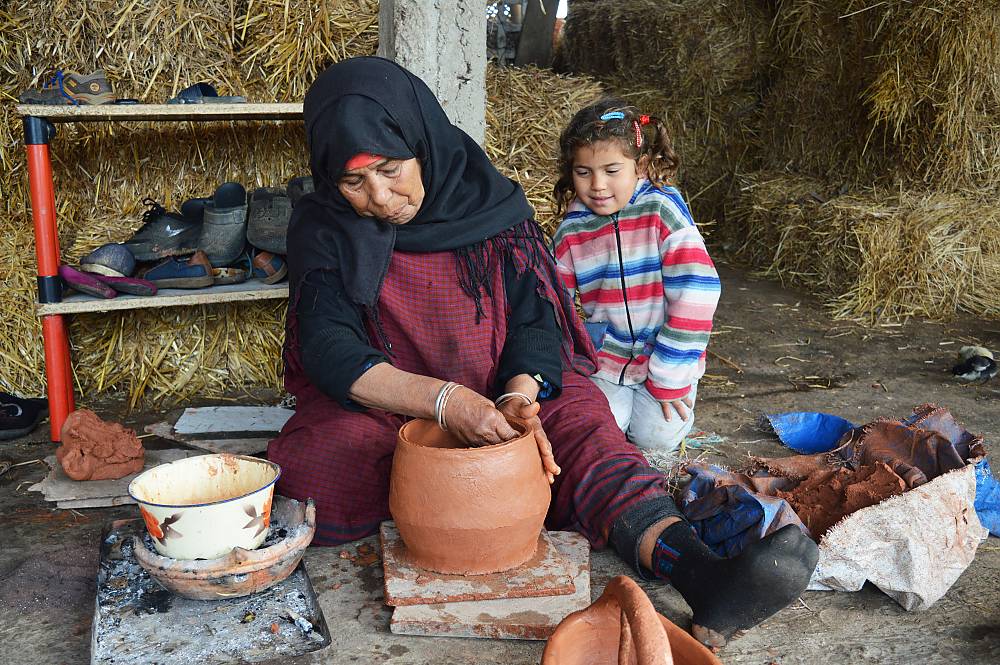
In a village tucked into the Mogod hills of northern Tunisia, a woman crouches beside a small fire of straw and dung. There is no kiln. No wheel. No electricity in the work. She turns a terracotta bowl in the heat with a pair of iron tongs, judges the color of the clay, lifts the piece out, and sets it on the ground to cool. Her grandmother did it this way. So did her great-grandmother. So, almost certainly, did the woman who lived on this same hillside three thousand years ago.
Welcome to Sejnane.
About two hours northwest of Tunis, in the Bizerte governorate, the small town of Sejnane is the unlikely home of one of the most stubbornly preserved craft traditions in the Mediterranean. Its women are potters. They have always been potters. And in 2018, UNESCO inscribed their know-how on the Representative List of the Intangible Cultural Heritage of Humanity — a global acknowledgement of something the women of Sejnane never needed an acronym to understand.
A craft that begins in the wadi
Every Sejnane piece begins with a walk. The clay is dug by hand from the beds of the seasonal rivers, the wadis, that thread through the Mogod hills. It is carried home — often on a donkey, sometimes on a head — in dense, heavy blocks.
What happens next looks, at first glance, like very little. The clay is broken up, crushed, picked clean of stones and roots, soaked in water, and kneaded until it has the silk of well-rested dough. There is no pottery wheel anywhere in this process. The potters shape each piece entirely by hand, turning the work on a flat surface while their fingers do the lifting and pulling. Bowls, jugs, water containers, oil lamps, kuskusu steamers — the everyday vocabulary of a Tunisian kitchen — emerge slowly, one at a time.
Once a piece dries, it gets two coats of color. Red comes from local ochre, drawn from the same hills as the clay. The vegetal pigment — a darker, more brooding shade — is extracted from the leaves of the lentisk shrub (Pistacia lentiscus), boiled into a slip and brushed on. The surface is then polished, sometimes for hours, with a sea-worn pebble or a fragment of mother-of-pearl, until it takes on a soft burnished glow.
Then comes the fire.
“The fire is for the clay alone”
Firing in Sejnane is, by the standards of modern ceramics, almost shockingly simple. A bed of straw, dry branches and animal dung is built on open ground. The pieces are arranged within it, covered, and lit. The fire is short and hungry. It is not for warmth; it is, as one Sejnane potter recently told the journalist Diana Issa, for the clay alone.
If the maker wants the deep, sooty black that Sejnane pieces are famous for, she does one more thing once the piece is fired and still glowing: she smothers it under more straw and wood shavings. The smoke seeps into the porous surface and stains it from the outside in. The result is the contrast every collector recognizes — a chalky red-orange and a smoke-deep black, traced over with the same geometric language you’ll find on a Berber rug, or on the tattoos that older women of these mountains still carry on their hands and chins.
Look closely at the motifs and you are reading a 3,000-year-old vocabulary: zigzags, triangles, lozenges, eight-pointed stars, sun wheels. They are not just decoration. They are also protection, identity, and a record of where you sit in your lineage — meanings carried across so many generations that the women who paint them today often draw them as instinctively as a signature.
Suggested Read: 10 Tunisian Myths Uncovered
A women’s craft, in a country still figuring out what that means
Every step of Sejnane pottery — the digging, the kneading, the shaping, the polishing, the firing — is done by women. The men of Sejnane participate at the very end, helping to load pieces into vans and selling them at the roadside or in the markets of Bizerte and Tunis. UNESCO, when it inscribed the tradition, was careful to note that this division of labor makes the craft a family-based one. It would be just as fair to call it a quietly matriarchal one.
In a country where women’s economic agency is still uneven — celebrated in some sectors, invisible in others — the women of Sejnane have, for centuries, simply controlled their own means of production. The clay is theirs. The pieces are theirs. The income — modest, sometimes meager — is theirs.
Names matter here. Sabiha Ayari, one of the senior figures of the village, has been working clay since she was a child and was among the first artisans interviewed when the Tunisian Ministry of Cultural Affairs began documenting the craft in earnest after the UNESCO inscription. Warda Michrigui, in her late forties, has spoken openly to the international press about how completely her family depends on the craft: “This is the only source of income here for us women.” Hajer, twenty-four, learned from her grandmother at the age of ten, and now talks about pottery the way a translator talks about a poem — something she has a duty to carry across.
There is also Zaineb, who has become a kind of bridge between the village and the wider world. Working with the collective Sejnane, Human Wealth, she has pushed the prices of authentic Sejnane pieces from the 200-millime trinkets sold on a tarp at the side of the road to handcrafted plates that now move at 30 dinars and up. That is not a small jump. That is the difference between a craft that sustains itself and one that dies.
After 2011, and after UNESCO
The decade since the Tunisian revolution has not been gentle on Sejnane. In the immediate post-2011 years, the region was destabilized by armed groups operating in the Mogod hills; tourism collapsed, and so did the foot traffic that the roadside potters had quietly relied on. Some of the smaller dolls and figurines were even targeted as “un-Islamic” by extremists — an absurd charge against a craft that predates Islam by two and a half millennia.
The 2018 UNESCO inscription mattered. It brought international attention, an influx of journalists, a state-funded “Pottery of Sejnane, Our Pride” festival, and the publication of an academic-grade book on the craft by archaeologist Adnan Louhichi and ethno-anthropologist Neziha Skik. It also brought partnerships — Tunisian design houses like Made by Tinja and Flaÿou now work directly with the women of Sejnane to produce contemporary pieces for export, giving the craft a second life in living rooms from Paris to Montreal.
But the underlying pressure has not gone away. The work is brutally physical. Younger women in Sejnane increasingly turn toward salaried jobs in Bizerte or Tunis. Imitation pieces, mass-produced in factories and dumped at tourist sites under the Sejnane name, undercut the real artisans. And the village still lacks the kind of structural support — a stable cooperative, year-round marketing, fair-trade certification — that would protect the tradition long-term.
What to bring home
If you go to Sejnane, go honestly. Buy directly from the potter when you can. Pay what the piece is worth, not what you can bargain it down to. Ask the seller her name. Ask whose hands made the bowl you are holding. The answer is part of what you are taking with you.
A real Sejnane piece is easy to identify once you know what you are looking at. The surface will be slightly uneven where her thumb pressed too hard. The black will not be paint — it will be smoke, and it will smell faintly of fire even months later. The red will not be uniform. The geometry on the side will be drawn freehand, not stenciled, and you will see the tiny hesitation in the line where her brush paused.
That hesitation is the signature of a tradition that has refused, for three thousand years, to be standardized.
The women of Sejnane have shaped a great deal more than clay.
- Suggested Read: UNESCO World Heritage Sites in Tunisia
- Suggested Read: ‘How I Fell in Love with Bizerte, a City Full of Contrasts’
