
Quick Answer — Gabès is the only place in the Mediterranean where a palm-grove oasis runs straight down to the sea, and it is the gateway to the Berber villages of the Dahar — Matmata, Tamezret, Toujane — and to the hot springs of El Hamma. Come for Chenini Nahal, the layered oasis with its Roman dam; Souk Jara, the henna and basket market; the mausoleum of Sidi Boulbaba; and, in autumn, the best pomegranates in the country. The honest part: Gabès is also home to a state phosphate complex whose emissions triggered Tunisia’s largest protests in a decade in October 2025, and the movement to shut it is ongoing. The city is safe to visit, the oasis and the markets are unaffected on most days, but skip the beach near the industrial zone and go in as an informed guest. Here’s the whole story.
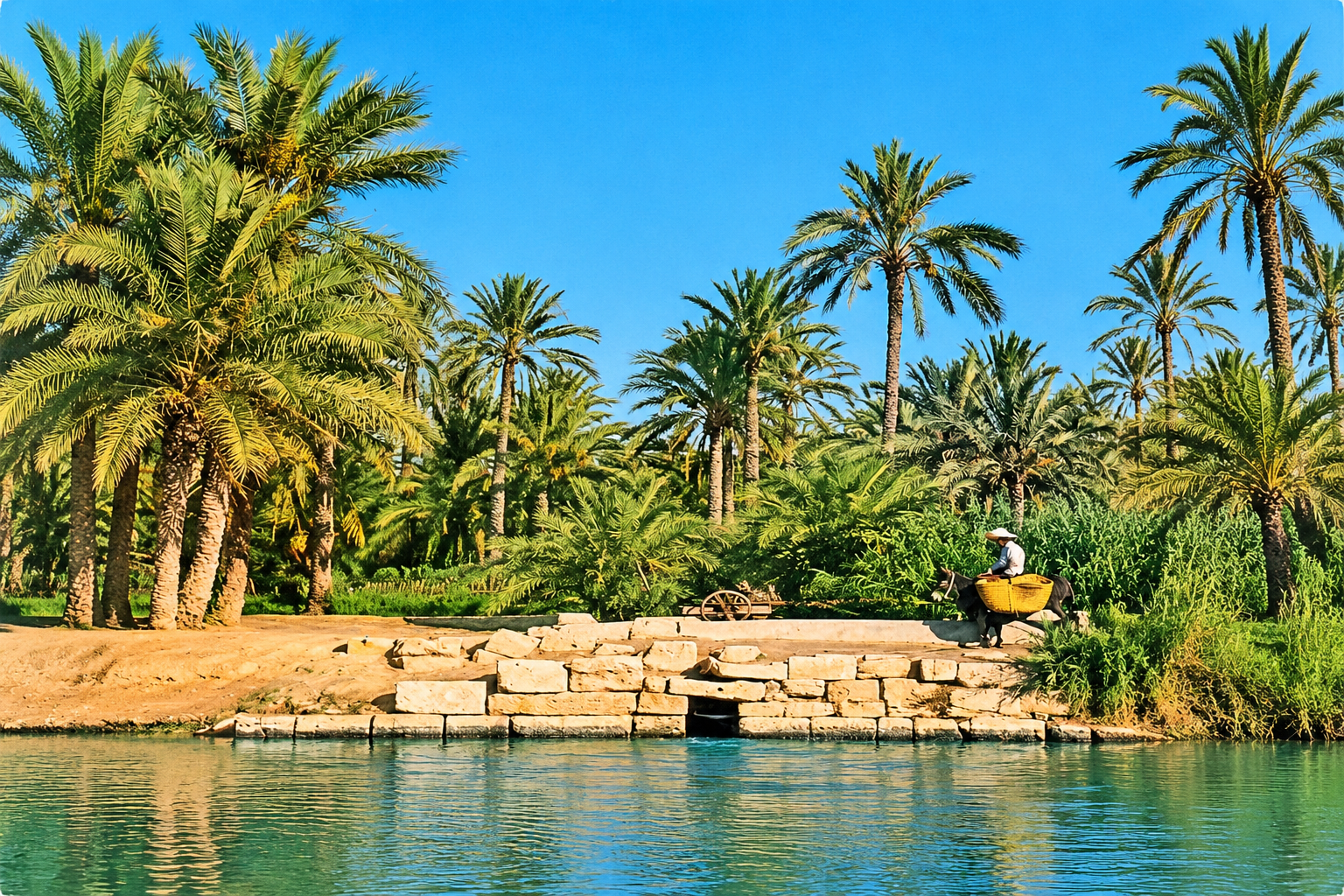
Every oasis in Tunisia has the same first sight — the wall of green after hours of nothing — but Gabès has a second one that no other oasis can offer. Walk far enough through the palms of Chenini Nahal, past the pomegranate trees and the channels of running water, and the ground gives way to sand and then to the sea.
Pliny the Elder, who called the place Tacapae, marvelled two thousand years ago at land in the middle of the desert that was miraculously fertile; medieval Arab travellers called it Little Damascus. It is the only maritime oasis in the Mediterranean, and one of very few on earth.
That fact would make Gabès one of the country’s great stops. What actually keeps most visitors away is a plume of yellowish air on the northern edge of town, and it is impossible to write honestly about the city without starting there.
The Elephant on the Shore
Since 1972, a complex run by the state-owned Groupe Chimique Tunisien (GCT) has processed phosphate rock from the Gafsa mines into phosphoric acid and fertilizer on the coast at Ghannouch, just north of the port. Its by-product, phosphogypsum, has been discharged into the Gulf of Gabès for half a century; Stop Pollution, the residents’ movement founded in 2012, says industrial activity has destroyed most of the gulf’s marine biodiversity, and fishermen who once worked one of the richest fisheries in the Mediterranean now speak of empty nets.
Residents of the neighborhoods nearest the plant — Ghannouch, Chott Essalem — have long reported elevated rates of respiratory illness, and a European Commission study found concentrations of sulfur dioxide, ammonia, and fluorides near the site far above Tunisian and international limits.
The crisis broke open in autumn 2025. After a summer of heatwaves that trapped the fumes over the city, a series of gas leaks in September and October sent dozens of people to hospital, among them schoolchildren who collapsed with breathing difficulties; local authorities counted 122 cases of intoxication. On 15 October, Stop Pollution brought some 40,000 people into the streets, and a general strike called by the UGTT union on 21 October drew a crowd estimated at 130,000 — in a city of about 150,000. Solidarity marches followed in Tunis.
The government, which in 2017 had promised to dismantle the polluting units and never did, sent ministers, arrested protesters it accused of violence, and faced a court case in Gabès demanding the plant’s closure. The story has not ended: a further leak in July 2026 sent residents of Chott Essalem out of their homes at dawn, and the movement — much of it led by women — says it will continue until the units are shut.
What this means for a visitor is more modest than the headlines suggest. The plant sits at the northern edge of the city; the oasis, the old quarters, the markets, and the road south to Matmata are on the other side of town, and on most days you will notice nothing. On still, hot days with a northerly wind you may smell it.
Don’t swim near Ghannouch, and prefer the beaches south of the city or, better, Djerba. And understand what you are walking into: Gabès is where Tunisia’s environmental movement was born, and where the country is arguing, in real time, about what it owes the people who live beside its industry. Going there, spending money in the market and the oasis, and listening is not tourism in spite of the crisis. It is the most useful kind.
Chenini Nahal: The Oasis Itself
The oasis is why Gabès exists, and it starts about three kilometres west of the centre at Chenini Nahal — not to be confused with the cliff village of Chenini near Tataouine. It is the classic three-storey Saharan garden: date palms on top, fruit trees in their shade, vegetables and henna in the shade of those. But here the middle storey is the star. This is the terroir of the Gabsi pomegranate, Tunisia’s most prized, ripening under the palms from mid-September, and the whole system runs on a network of channels fed by springs that the Romans dammed — the small Roman dam and a Roman arch are still in the grove, a few minutes’ walk from the village.
Go early, on foot or by the horse-drawn calèches that wait at the entrance, when the light comes through the fronds and the water is loud. The dates here are not the Deglet Nour of Tozeur — the sea air makes for softer, darker fruit — but the pomegranates have no rival. The honest note: the oasis is thirsty, the water table is falling, and the cement works nearby draw heavily on it; several NGOs are working with farmers on more sustainable irrigation, and the calèche drivers will tell you exactly what they think of it all.
Skip the zoo at the grove’s entrance; locals will tell you the same.
Souk Jara, Henna, and the Old Town
Back in town, the neighbourhood of Jara is the old commercial heart, and its market is the one place in Tunisia where henna is the main event. Gabès grows the country’s henna in the oasis, and the powder — sold loose, by the scoop, in shades from green to rust — is what Tunisian brides have been painted with for centuries. Around it are the other Gabès crafts: baskets and mats woven from palm fibre, the alfa grass hats of the south, and a spice section that runs to dried rosebuds and the chilies for harissa.
Few of these are made for tourists, because Gabès sees few, which makes them the rare souvenir that is simply what people here buy — see our guide to what to buy in Tunisia for the wider list. Around the market are the covered passages of Old Menzel, built narrow and roofed to keep the heat out, and the new mosque of Jara.
A short walk south is the mausoleum of Sidi Boulbaba — Abu Lubaba al-Ansari, said to have been the Prophet’s barber and companion, who died here in the seventh century. The zaouia, with its courtyard and green-tiled dome, is the town’s spiritual centre; the seventeenth-century madrasa beside it now houses the small Museum of Arts and Popular Traditions, worth twenty minutes for the costumes and the oasis tools. Non-Muslims can visit the courtyard.
And in the morning, the drink. Gabès is the capital of legmi, the fresh sap of the date palm tapped at dawn and sold from jugs at the roundabouts before it starts to ferment — the whole ritual is in our piece on Tunisia’s mysterious drink. Ask for it sweet and fresh; the other kind is a young men’s game.
The Dahar: Matmata, Tamezret, Toujane
The reason most travellers pass through Gabès is what lies forty kilometres inland. The road climbs out of the oasis into the Dahar, the dry limestone range where Tunisia’s Amazigh villages survived by disappearing into the rock.
Matmata is the famous one: courtyard houses dug straight down into the earth, rooms hollowed out of the pit walls, one of them — the Hotel Sidi Driss — the Lars homestead from the first Star Wars film, and still serving lunch. It is touristed, and the underground homes that open to visitors do so for a tip, but it remains extraordinary.
Push on to Tamezret, a stone village coiled around its hill with a good Berber museum and a couple of guesthouses that make the best base in the area, and to Toujane, spilling down a mountainside above the plain with views to the sea. All three are still partly Tamazight-speaking; our field guide to Tunisia’s Amazigh heritage explains what you are seeing, and the Star Wars sets piece maps the film locations. Louages run to Matmata all day from Gabès; for Tamezret and Toujane you want a car or a driver.
Two other excursions earn their place. El Hamma, thirty kilometres west on the Kebili road, is a hot-spring town where the hammams need no boilers — the water comes out of the ground near 45°C, and the public baths are cheap, segregated by sex and time of day, and exactly the thing after a day in the hills. And south of the city at Mareth, a small museum tells the story of the Mareth Line, the French-built fortifications where Rommel’s Afrika Korps made its last stand in Tunisia in March 1943 before the Allies retook Gabès.
The Gulf, the Birds, and the Season
The Gulf of Gabès is shallow, warm, and — despite everything — still one of the most important stopovers for migratory waders in the Mediterranean. In winter, the mudflats south of the city and the Kneiss islands fill with flamingos, avocets, and tens of thousands of shorebirds, part of the great migration described in our guide to Tunisia in winter and the islands. Birders should base at Gabès or Mareth and go at dawn.
Timing matters here more than in most Tunisian cities. October is the moment: the pomegranates are in, the air has cooled, the calèches are busy in the grove, and the small pomegranate festival at Kettana, just south of town, marks the harvest. Winter is mild and the birds are in. Summer is hard — the heat pins the industrial haze over the city, and it is the season the protests were born in.
Practicalities
Getting there. Gabès is on the main line from Tunis — around six hours by train via Sousse, El Jem and Sfax, which is the pleasant way — and about four and a half hours by car on the motorway. Louages connect it to Sfax, Medenine, Kebili and Djerba (about 100 km, via the Roman causeway). It is the natural hinge of a southern loop: Tozeur and the Chott el Jerid to the west, Matmata and Tataouine to the south, Djerba to the east.
Staying. The city has a handful of tired business hotels; better to sleep in a guesthouse in Chenini Nahal, in the oasis, or in Tamezret in the hills, and treat the city as a day. If you are in a hotel in town, ask for a room facing south.
Money and manners. Gabès is conservative and unfussy; dress as you would for Kairouan, and expect to be the only foreigner in the market. Fridays the souk is quieter. The one word to learn beyond the usual is romman — pomegranate — because from September the answer to most offers of hospitality here is a bowl of seeds and a spoon.
Gabès is not a pretty city. It is a real one, with a garden at its heart that has fed people for two thousand years and a fight going on for the air above it. Come in autumn, walk the oasis early, buy your henna in Jara, eat the pomegranates, drive into the hills — and leave understanding a little better what Tunisia is arguing about.
From the Carthage Magazine Bookshelf
If Gabès is your hinge between the oasis, the Dahar, and the island, these three cover the whole southern loop.
- All About Tunisia — the definitive English-language traveler’s guide. 572 pages, 27 chapters, all nine regions, every UNESCO inscription, five thematic trails — and the practical answers (visa, currency, transport, etiquette) most travelers wish they’d had on the plane. $24.99 · PDF & EPUB.
- Speak Like a Local — 200+ Tunisian Arabic phrases with native audio recorded in Tunis. The phrases for the taxi, the souk, the café, and the dinner table. $14.99 · PDF, EPUB, MP3.
- The Authentic Tunisian Cookbook — sixty traditional recipes from the heart of North Africa. For when you get home and find yourself missing the food. $9.99 · PDF & EPUB.
All three available as a bundle for $39.99 — guide, language, and food, delivered together.
