

Quick Answer — Chebika, Tamerza, and Midès are three mountain oases strung along the Algerian border an hour northwest of Tozeur, where the last ridge of the Atlas meets the Sahara: spring-fed waterfalls, palm-filled canyons, and the ruins of three villages abandoned after the catastrophic floods of 1969. Chebika is the waterfall-and-palm-gorge walk; Tamerza, the largest, pairs a bigger cascade with a haunting ghost village; Midès is the canyon — a sheer, layered gorge the movies discovered decades ago. The standard visit is a half-day loop from Tozeur by hired car or driver (roads are paved; no 4×4 needed for the circuit itself), best begun early. Budget for small local-guide tips at the sites, wear real shoes, and calibrate the word “waterfall” for the edge of a desert.
There is a spot on the road out of Tozeur — somewhere past the last palms of the great oasis, with the salt shimmer of the Chott El Jerid behind you — where the flat world ahead suddenly buckles. The Djebel el Negueb rises off the plain like a reef, ochre and folded, and the road climbs toward the Algerian frontier into a landscape that seems to have no business holding water at all.
Then the first palm crowns appear in a crease of the rock, and you understand what pulled travellers up here for two thousand years: springs. Three of them, each with its village, each village now doubled — a living settlement below and a ruined one above — and each ruin telling the same story about twenty-two days in 1969 when the desert’s sky forgot itself.
That autumn, rain fell on southern Tunisia almost without pause for over three weeks — a meteorological freak in a region that sees sun 350 days a year — and the floods that followed dissolved the old earthen-built villages of these mountains and killed hundreds across the region. The inhabitants rebuilt in concrete on safer ground nearby and left the old stones where they stood. Half a century on, those abandoned villages, mid-crumble against their canyons, have become — with the water that betrayed them — the reason everyone comes.
Chebika: The Palace of the Sun
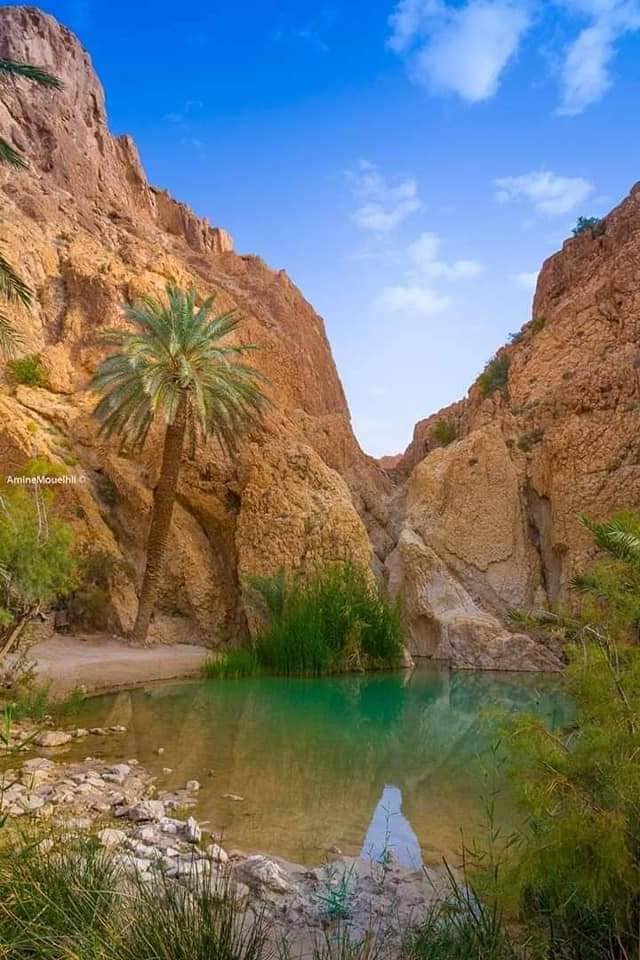
The first and prettiest stop, Chebika sits where a spring-fed stream tumbles off the mountain into a steep palm gorge — the site the Romans knew as a frontier outpost and locals still call Qasr el-Shams, the Palace of the Sun, because the ridge keeps it lit from first light to last. The set walk is a loop of an hour or so: up past the ruins of the old village on its slope, along the rim, and down into the canyon itself, where the stream runs cool between the palms, frogs sing from the pools, and a small waterfall gathers in a bathing basin.
Do it in that direction early in the morning and you’ll have the gorge’s best stretch largely to yourself; by mid-morning the coach groups arrive and the low-key souvenir sellers set up along the path. Informal local guides attach themselves at the entrance — genuinely useful for the route, and a tip of around 20 dinars is the going expectation; agree it at the start.
Tamerza: The Cascade and the Ghost Town
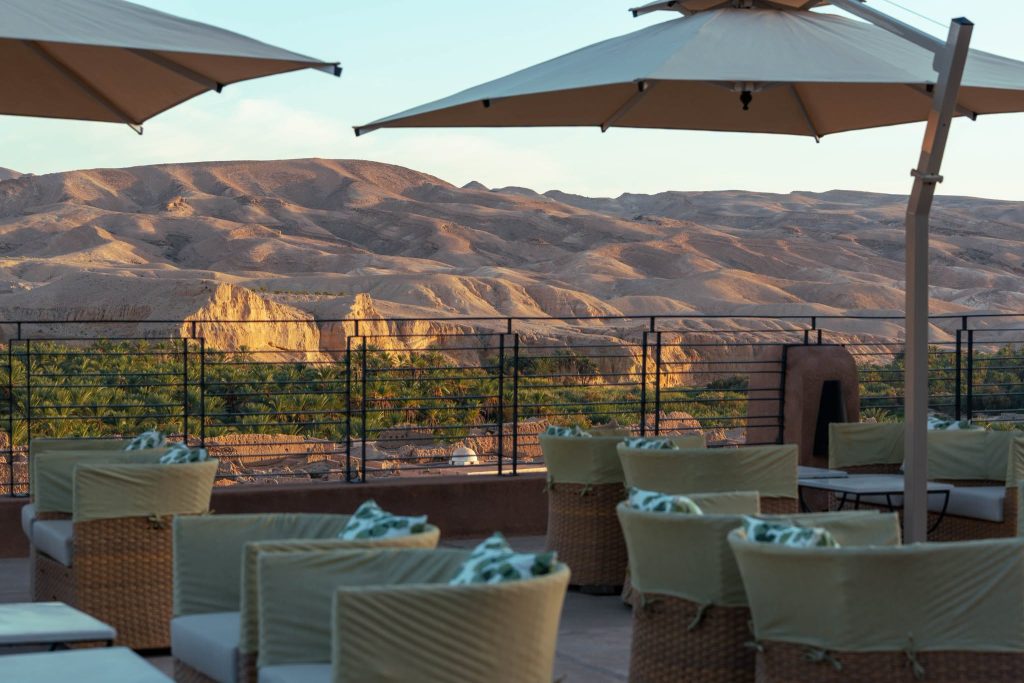
Ten minutes on, Tamerza is the region’s capital and its most complete drama. The living town faces, across a wide dry riverbed, the roofless shell of Tamerza El Gdima — the old village the 1969 waters emptied — a long, low ruin of ochre walls, a marabout’s white dome still standing amid the collapse, photographed most beautifully in late light. The oasis below is fed by the Grande Cascade, the largest waterfall in Tunisia, which in honest terms means a broad, lovely veil in a good season and a determined trickle in a dry one; the canyon it has cut is worth the scramble either way.
Above the gorge, the clifftop Tamerza Palace hotel has hosted every film crew that ever pointed a camera at these mountains — this is The English Patient country, its aerial panoramas shot over these very ruins, and the Star Wars productions based themselves here while working the desert locations covered in our Star Wars in Tunisia field guide. A café terrace, a pot of tea, and the ghost village going gold across the wadi is the circuit’s essential pause.
Mides: The Canyon at the Border
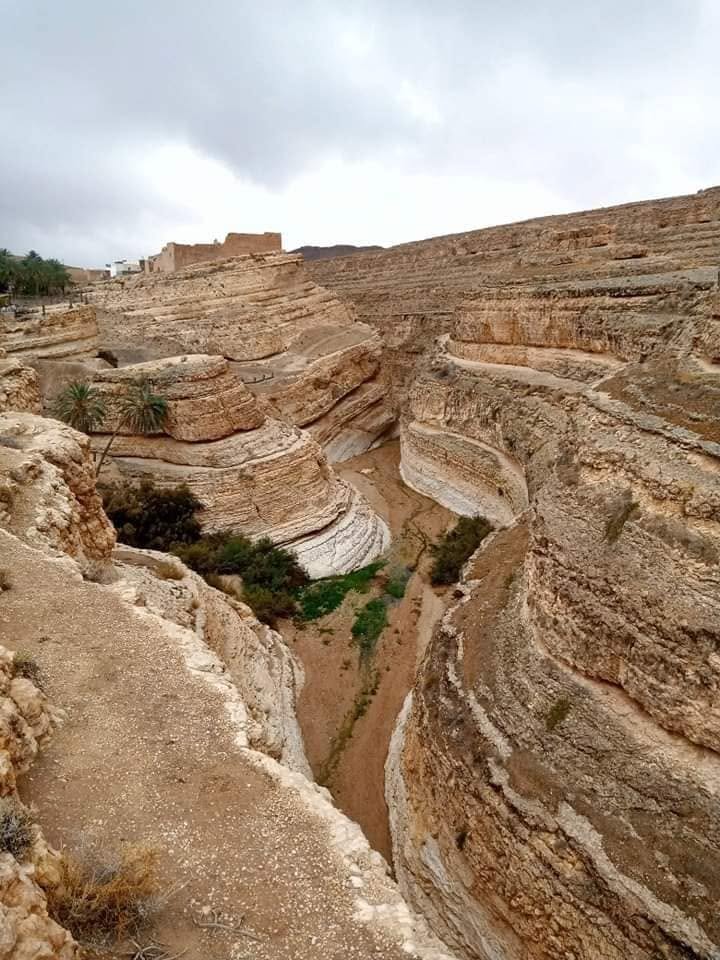
The loop’s finale is the smallest oasis and the biggest landscape. Midès clings to the very edge of Algeria — the border fence runs close enough to see — where its stream has carved a gorge of extraordinary, layered, wind-smoothed rock, wrapping the old village on three sides like a natural moat.
The Romans garrisoned this defensible perch, the Berbers held it for centuries after, and the 1969 floods emptied it like its sisters; today the drama is geological. You walk the rim (guides can take the sure-footed down into the gorge itself), the vendors offer desert roses and — improbably, genuinely — fossilised shark teeth from the surrounding beds, and the canyon views are the ones The English Patient and Fort Saganne came for. Of the three stops, this is the one that silences a vehicle.
The Practicalities
The three sites form a natural loop of roughly 120 kilometres from Tozeur, and the roads — despite what a hustling driver may claim — are paved and fine for an ordinary rental car; the only 4×4 territory is the optional desert extension to the dune film sets. Most visitors take the standard half-day tour by private driver from Tozeur or Nefta, universally offered and cheap by any European measure — agree the exact stops (all three, named) before setting off, since the region’s one recurring complaint is circuits quietly shortened around shopping stops.
Start at eight and you’ll do Chebika before the crowds, Tamerza by late morning, and Midès before the heat peaks; there’s no shade to speak of between the palm gorges, so hat, water, sunscreen, and shoes with grip are the kit. October to April is the season — summer is punishing here — with spring the sweet spot, when the winter’s rain gives the waterfalls their best voice; the calendar logic is in the best time to visit Tunisia. The circuit slots naturally into any southern swing: pair it with the salt lake, the dunes, and the rest of the deep south mapped in our Tunisian Sahara field guide, and it becomes the mountain morning of the desert trip — the day the Sahara shows you the one thing nobody expects of it, which is the sound of running water.
From the Carthage Magazine Bookshelf
Mountain oases, salt lakes, dune seas — the whole improbable south is mapped in these three.
- All About Tunisia — the definitive English-language traveler’s guide. 572 pages, 27 chapters, all nine regions, every UNESCO inscription, five thematic trails — and the practical answers (visa, currency, transport, etiquette) most travelers wish they’d had on the plane. $24.99 · PDF & EPUB.
- Speak Like a Local — 200+ Tunisian Arabic phrases with native audio recorded in Tunis. The phrases for the taxi, the souk, the café, and the dinner table. $14.99 · PDF, EPUB, MP3.
- The Authentic Tunisian Cookbook — sixty traditional recipes from the heart of North Africa. For when you get home and find yourself missing the food. $9.99 · PDF & EPUB.
All three available as a bundle for $39.99 — guide, language, and food, delivered together.
