
This article contains affiliate links. If you book through them, Carthage Magazine earns a small commission at no extra cost to you — it’s part of how we keep our guides free and independent.
There is a particular feeling you get at Kerkouane that you get almost nowhere else in the ancient world, and it took me a moment to name it. It isn’t grandeur — the walls here rarely rise above your knee. It’s intimacy. You are not looking at a temple built to impress an emperor; you are standing in someone’s house, beside the bathtub they actually used, on a street laid out to a plan a Carthaginian town planner drew more than two thousand three hundred years ago. Nobody came along afterward and built over it. What you see is what they left.
That is the whole point of Kerkouane, and the reason it deserves far more visitors than the trickle it gets.
The Only One of Its Kind
Here is the fact that makes this site extraordinary, and I’ll state it plainly because it’s easy to miss the weight of it: Kerkouane is the only example of a Phoenician-Punic city to have survived. Every other great Punic centre — Carthage itself, Tyre, Byblos — was conquered, flattened, and rebuilt by the Romans on top of the old stones. Kerkouane was not. This Phoenician city was probably abandoned during the First Punic War, around 250 BC, and as a result was not rebuilt by the Romans — so its port, ramparts, houses, shops, workshops, streets, squares, and temples remain essentially as they were in the third century BC.
In other words, if you want to know what a Punic town actually looked like — not the war and the elephants and Hannibal, but the ordinary fabric of daily life — this is the only place on the planet you can stand and see it. UNESCO recognised exactly that, inscribing Kerkouane and its necropolis as a World Heritage Site in 1985.
What Happened Here
Kerkouane was founded by Phoenician settlers in the sixth or fifth century BC, out on the tip of the Cap Bon peninsula, and it lived for roughly four hundred years. It was never a capital or a fortress of the first rank — it was a modest, prosperous coastal town of perhaps a thousand or so people, fishermen and craftsmen, who made their living from the sea and from industry. Above all they made the famous Tyrian purple, the costly dye extracted from murex shellfish whose crushed shells still litter the site, alongside evidence of salt and garum, the fermented fish sauce of the ancient Mediterranean.
Its end came with the First Punic War. The Romans landed in Cap Bon and took the nearby town of Aspis (modern Kelibia) in 255 BC, and Kerkouane — lightly walled, never built to withstand a real army — was pillaged and then simply abandoned. Its people left and never came back, and the sand and scrub closed over it. It lay forgotten until 1952, when two French archaeologists rediscovered it. That long sleep is precisely what preserved it.
What You Actually See
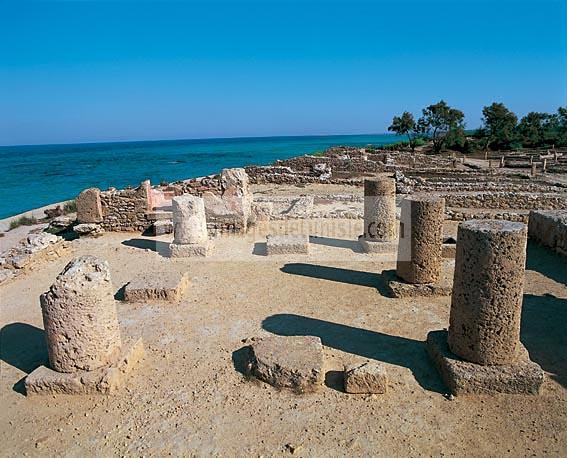
Let me be honest about the scale first, because it sets expectations: almost nothing here stands higher than a metre. This is a town you read at your feet, not one you crane your neck at. But once you adjust to that, the detail is astonishing.
The baths. This is Kerkouane’s signature, and it’s genuinely moving. Almost all the houses are equipped with elaborate bathrooms, the most typical being a shoe-shaped bathtub made from red concrete, with a seat for the bather. A private bath, in nearly every home, more than two millennia ago — connected, no less, to a sophisticated system of pipes and drains that carried wastewater out to the sea. It’s a window into a level of domestic comfort and hygiene most of us never associate with the ancient world, and it quietly upends the assumption that private bathing was a Roman luxury.
The streets and houses. The town was laid out to a deliberate plan — wide, fairly straight streets, courtyard houses built to a standard design. You can walk the grid and read the shape of rooms, doorways, and shops, with good signage and, in places, 3D reconstructions showing how a house once rose above its surviving footprint.
The red floors and the sign of Tanit. The waterproof pink-red flooring you’ll see — opus signinum, what the Romans sniffily called pavimenta punica, “Punic floors” — was made from crushed terracotta and lime. In one celebrated house, white stones set into the floor form the unmistakable symbol of Tanit, the great Carthaginian goddess, placed at the threshold to protect the home. To see her sign laid into a private floor, rather than carved on a grand stele, is to meet Punic religion at the level of the household.
The temple, the workshops, the sea. At the centre are the remains of a temple to the town’s deities; around it, the kilns and workshops of a working community. And all of it sits on a low cliff directly above the Mediterranean — the same blue the townspeople looked at, the setting itself half the reason to come.
Less than a kilometre away lies the necropolis of Arg el-Ghazouani, the town’s cemetery cut into the rocky hills, worth the short extra effort for anyone who wants the full picture.
Why It Matters — Especially If You’ve Seen Carthage
If you’ve already stood among the ruins of Carthage and felt the strange thinness of it — the sense that Rome scraped the Punic city away and wrote over it — Kerkouane is the antidote. It is the chapter Carthage can’t give you. Here the Punic world wasn’t erased and overwritten; it was paused. Reading the two sites together is the closest you can come to understanding the civilisation that fought Rome to a standstill, and it’s a pairing almost no visitor makes. Kerkouane belongs on the same itinerary as the Bardo’s Punic rooms and the broader Punic story — the small domestic counterpart to the grand imperial tragedy.
Getting There & Practicalities
Kerkouane guards its solitude the old-fashioned way: no railway, thin bus service, and a glorious clifftop position at the tip of Cap Bon that public transport approaches reluctantly. It’s the crown jewel of the peninsula’s driving loop — pair it with El Haouaria’s caves and the back-road beaches — and a rental is the practical way in. Compare your options on DiscoverCars, and our rental guide covers the rest.
A few things that will save your visit:
- Opening hours are limited and it closes early — typically by late afternoon, and it is closed on Mondays. Plan around that; people do drive out and find a locked gate.
- Give it about an hour. The site is compact, and an hour of unhurried wandering covers it comfortably, the necropolis included.
- Bring water, sun cover, and decent shoes. There’s little shade and little around the site itself — no town, few facilities. Don’t count on lunch on-site.
- There’s a small on-site museum worth ten minutes for context before you walk the ruins.
One last, honest note, and a poignant one: because Kerkouane sits right on the shore, it is among the Tunisian heritage sites most exposed to rising sea levels over the coming century. It survived two and a half thousand years because the Romans left it alone; its longer future is less certain. That’s a quiet argument for going while it’s there to see.
The Verdict — Who Should Make the Trip
Kerkouane is not for the traveller who wants towering columns and a quick photograph. It’s for the one who finds it thrilling to stand in a real Punic bathroom, to trace a stranger’s house plan from two thousand years before, to see the sign of Tanit set into a floor. If that’s you — and especially if Carthage has already got under your skin — the long drive out to Cap Bon repays itself many times over. There is genuinely nowhere else like it.
From the Carthage Magazine Bookshelf
If the Punic world is pulling you in, three Carthage Magazine ebooks were built to go deeper:
- All About Tunisia — the definitive English-language traveler’s guide. 572 pages, 27 chapters, all nine regions, every UNESCO inscription, five thematic trails, and the practical answers most travelers wish they’d had on the plane. $24.99 · PDF & EPUB
- Speak Like a Local — 200+ Tunisian Arabic phrases with native audio recorded in Tunis. $14.99 · PDF, EPUB, MP3
- The Authentic Tunisian Cookbook — sixty traditional recipes from the heart of North Africa. $9.99 · PDF & EPUB
All three available as a bundle for $39.99 — guide, language, and food, delivered together.
