
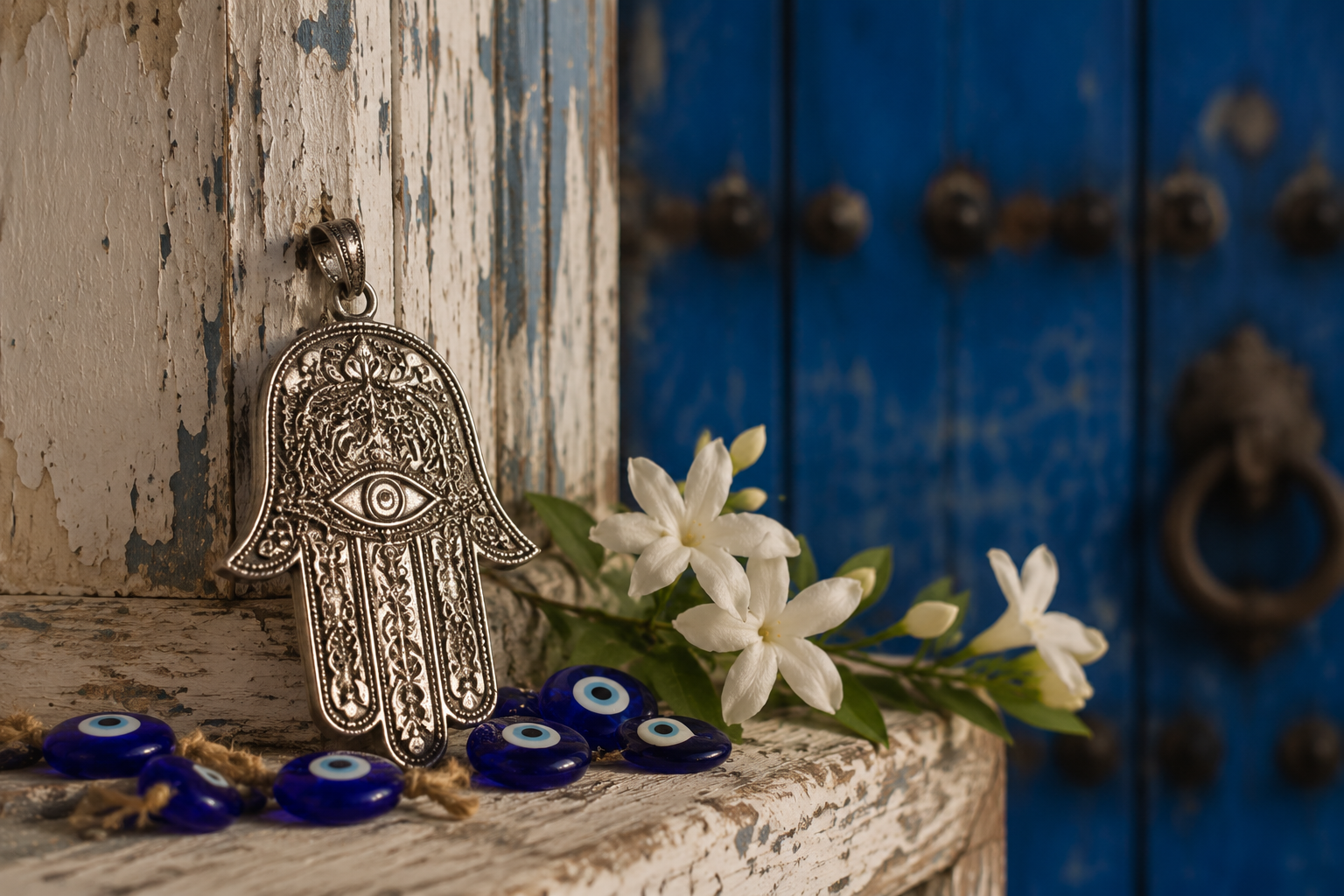
Quick Answer Tunisian superstition revolves around one great fear — el-ain, the evil eye, the idea that envy and excessive admiration can bring real misfortune. Almost every Tunisian charm and habit exists to deflect it: the open blue hand of the khomsa on doors and jewellery, the word mashallah murmured after a compliment, a pinch of salt, a blue bead, incense smoke, the number five. Beneath the Islamic surface run older currents — Berber and Carthaginian beliefs about jinn, the moon, and protective symbols that long predate them. Whether Tunisians “really” believe is the wrong question. The gestures persist among the devout and the sceptical alike, half faith, half affectionate habit.
Compliment a Tunisian mother on her beautiful, healthy baby and watch what happens. She will thank you — and then, almost reflexively, she will add “mashallah”, perhaps touch the child, perhaps mutter something to send your admiration safely on its way. She is not being strange. She is doing what Tunisians have done for three thousand years: guarding what is precious against the oldest danger of all — the envious glance.
Superstition in Tunisia is not a fringe curiosity. It is a quiet, everyday grammar of protection, woven through doorways and jewellery and the smallest turns of speech. Here is a warm guide to it — the evil eye at its centre, the charms that fend it off, and the deep layers of belief underneath.
The Evil Eye: The Fear Behind Everything
To understand Tunisian superstition, you only really need to understand one thing: el-ain, the eye.
The belief is simple and ancient. Envy is dangerous. When someone looks upon another’s good fortune — a beautiful child, a new car, a happy marriage, good health — with admiration that curdles into jealousy, that look can carry a real, harmful power, bringing illness, accident, or ruin to the very thing admired. It need not even be malicious; an over-warm compliment, sincerely meant, can do the damage just the same.
This is why Tunisians can seem oddly reluctant to celebrate their own luck too loudly, and why a grandmother might wave away praise of her grandchild or even pretend the baby is nothing special. To boast is to invite the eye. To deflect admiration is simply sensible. Nearly every other Tunisian superstition is, at heart, a tool for managing this single, looming risk.
The Khomsa: The Hand That Watches Back
The great weapon against the eye is the khomsa — the open right hand, often rendered in blue, that you will find painted on house doors, hung over cradles, dangling from rear-view mirrors, and worked into silver jewellery the length of the country. Its name comes from khamsa, the Arabic for “five,” and the five fingers are themselves protective: to “raise five” against someone, or to say khamsa fi ainek — “five in your eye” — is to throw the evil eye back where it came from.
The khomsa is the single most recognisable symbol of Tunisian folk belief, and we’ve devoted a whole piece to its meaning and three-thousand-year history. For the purposes of superstition, the essential thing is this: the hand is a guard that never sleeps, watching the doorway so the family inside doesn’t have to.
The Everyday Arsenal: Blue, Salt, Smoke, and Beads
Beyond the hand, Tunisians deploy a whole toolkit against misfortune, most of it hiding in plain sight.
The colour blue is everywhere — on doors, shutters, window frames, and beads — and it is no accident. Blue is held to repel the eye, which is one reason villages like Sidi Bou Said are so insistently blue and white, and why a small blue eye-bead is pinned to so many babies’ clothes.
Salt is a classic purifier and protector, sometimes scattered or carried to absorb bad energy. Incense — the fragrant smoke of bخور, often burning harmal (wild rue) — is wafted through homes and over people to cleanse a space of envy and bad luck, its sharp, resinous smell one of the defining scents of a Tunisian threshold. And jasmine, Tunisia’s beloved national flower, carries its own gentle aura of good fortune and welcome, its scent threaded through summer evenings and offered as a token of affection.
Then there are the small reflexive gestures, familiar the world over but with a Tunisian accent: a quiet tfou-tfou (a symbolic spit) to ward off a jinx, a touch of wood or iron, a hand laid protectively on a child after praise.
Words That Protect
Some of the most powerful charms in Tunisia are not objects at all, but words — said quickly, almost unconsciously, to neutralise danger.
Mashallah (“what God has willed”) is the great one: said after any compliment or expression of admiration, it acknowledges that the good thing comes from God and removes the sting of envy from the praise. Tabarkallah (“blessed be God”) works the same way. Bismillah (“in the name of God”) opens actions and journeys safely. To learn to drop a mashallah into conversation at the right moment is, in a small way, to learn to speak Tunisian — and our field guide to Tunisian Arabic phrases will get you started on the rest.
Weddings, Babies, and the Vulnerability of Joy
Superstition clusters most thickly around life’s happiest, and therefore most exposed, moments — the times when the eye is most likely to fall.
A bride is considered especially vulnerable to envy, which is one reason a Tunisian wedding is layered with so much protective ritual — the henna ceremony, the intricate harqus patterns, the gold, the days of careful custom all serving, among other things, to shield the couple’s happiness. New babies are guarded with kohl-lined eyes, hidden blue beads, and a studied refusal to praise them too openly. New homes and new cars often get a khomsa, a verse, or a discreet charm before anyone dares enjoy them out loud. The pattern is always the same: the greater the joy, the greater the care taken to protect it.
The Old Gods Underneath
What makes Tunisian superstition so deep is that it is not really Islamic, or not only. It is a layered inheritance, with Berber and Carthaginian beliefs surviving quietly beneath the Muslim surface.
The reverence for protective symbols, the moon, and the open hand reaches back to the world of Tanit, the great goddess of Carthage, whose sign Tunisians never stopped drawing and whose raised-arm emblem some scholars connect to the khomsa itself. The fish — a common motif on charms and doorways — is an ancient symbol of fertility and protection from long before Islam. These older layers were never erased; they simply slipped into the background and kept working, the way so much in Tunisia does.
Jinn and the Unseen
Folk belief also includes the jinn — the unseen beings of Islamic and pre-Islamic tradition, thought to inhabit liminal, in-between places: thresholds, drains, the hammam after dark, lonely ruins. Caution around such spots, a bismillah before stepping into uncertain ground, a wariness of sweeping or pouring water at night — these are the quiet courtesies a careful person extends to the unseen. To outsiders they read as superstition; to many Tunisians they are simply good manners in a crowded, invisible world.
So — Do Tunisians Really Believe All This?
The honest answer is: it depends entirely on who you ask, and it doesn’t quite matter.
For some, especially of older generations, the evil eye is a literal and serious danger, and the charms are genuine protection. For many younger, secular Tunisians, it’s something gentler — a half-belief, a cultural reflex, a mashallah that slips out before the rational mind can object, a blue bead kept “just in case.” Almost nobody fully renounces it. Even the most modern Tunisian will likely touch a child after a compliment, or feel a flicker of unease when their own good luck is praised too loudly.
That is the charm of it. Tunisian superstition isn’t a system anyone has to defend. It’s a shared inheritance — older than the mosque, older than the language, as old as the hand painted on the door — and the country carries it lightly, affectionately, and almost universally. Compliment that beautiful baby, and you’ll hear the proof for yourself. Mashallah.
From the Carthage Magazine Bookshelf
The beliefs that protect a Tunisian home are part of a culture worth knowing from the inside. Three Carthage Magazine ebooks take you there:
- Speak Like a Local — 200+ Tunisian Arabic phrases with native audio recorded in Tunis, including the mashallahs and blessings that do half the protective work in daily life. $14.99 · PDF, EPUB, MP3
- All About Tunisia — the definitive English-language traveller’s guide. 572 pages, 27 chapters, all nine regions, every UNESCO inscription, and the deep culture behind the customs. $24.99 · PDF & EPUB
- The Authentic Tunisian Cookbook — sixty traditional recipes from the heart of North Africa, the food at the centre of every wedding, seboua, and feast. $9.99 · PDF & EPUB
All three are available as a bundle for $39.99 — guide, language, and food, delivered together.
