
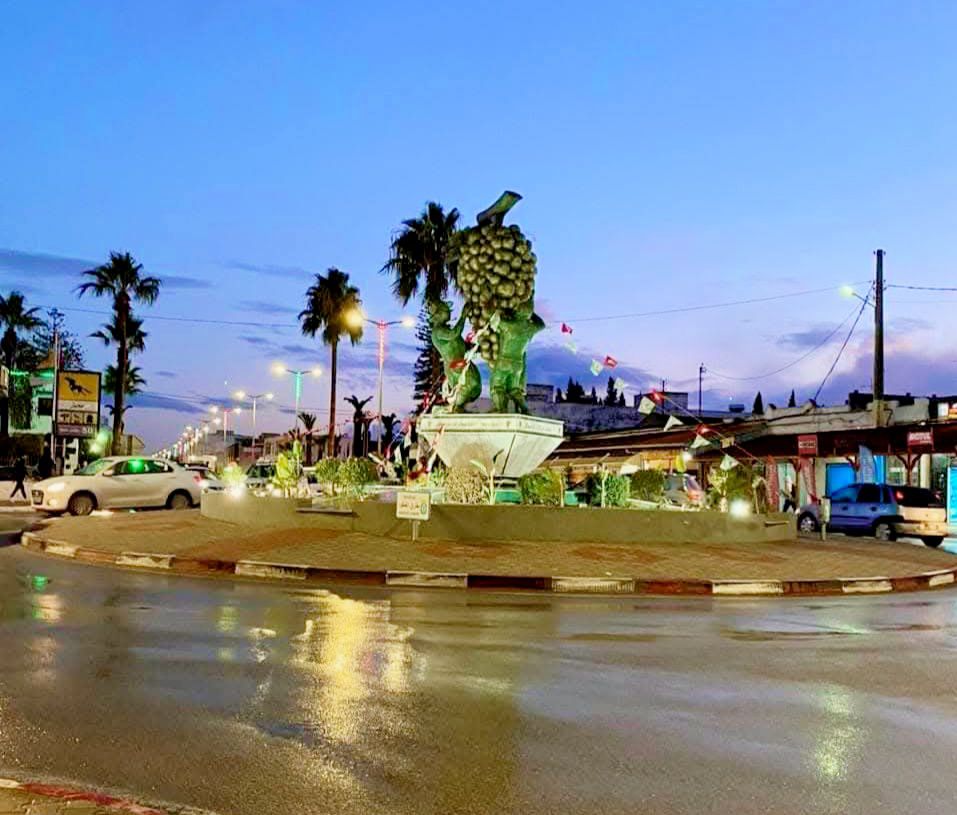
Quick Answer Cap Bon is the thumb-shaped peninsula that juts northeastward from Tunis into the Mediterranean, separating the Gulf of Tunis from the Gulf of Hammamet. It is roughly 80 kilometres long, 25 wide, and contains, in that small space, Tunisia’s pottery capital (Nabeul), the birthplace of harissa, the only UNESCO-listed purely Punic archaeological site (Kerkouane), the country’s largest fortress (Kelibia), the falconers and ancient Roman caves of El Haouaria at the peninsula’s tip, the Roman-era hot springs of Korbous, the resort beaches of Hammamet at the southern anchor, and the citrus orchards, vineyards, and jasmine fields that earned the region its enduring local nickname — the garden of Tunisia. It is the easiest weekend trip from the capital and one of the most rewarding pieces of countryside on the Tunisian coast.
Drive northeast from Tunis on the A1, and after thirty kilometres the motorway bends inland and the landscape changes. The flat coastal plain of the Gulf of Tunis gives way to low rolling hills planted with citrus. The road widens. The light turns. By the time you reach the exit for Soliman, the air smells of orange blossom for half the year and of jasmine for the other half, and you understand why Tunisians from the capital have, for two centuries, made this their weekend country.
This is Cap Bon. The peninsula is small. The history is dense. The food is excellent. The beaches, on the eastern side, are the best in the country by general agreement and by serious surveys alike. A weekend covers the highlights; a week starts to do it justice.
Why Cap Bon Matters
Cap Bon has been the agricultural and strategic backyard of every civilisation that ruled this coast.
The Phoenicians settled it first, in the 8th and 7th centuries BCE, establishing trading posts at Aspis (modern Kelibia), Neapolis (modern Nabeul), and the small purely-Punic town of Kerkouane on the eastern shore. The peninsula was prime agricultural land — soil rich enough for grain, irrigation deep enough for vegetables, slopes warm enough for vines — and it served Carthage as the food basket immediately to the city’s east.
The Romans inherited it intact. Neapolis, the Greek-founded Punic city, became the principal Roman town of the peninsula. The Roman writer Diodorus Siculus, walking through Cap Bon in the 1st century BCE, described it as cultivated with vines, olive trees, and a wealth of fruit trees — a sentence that could, with two small adjustments, describe the same hills today. The famous Roman agronomist Mago, whose writings on agriculture would shape Mediterranean farming for a thousand years, had his estates here. So did the senatorial absentee landlords of Rome, for whom Cap Bon was the second-best private investment in the western empire after southern Italy itself.
The Arab conquest in the 7th century brought new crops — citrus, sugar cane, hard wheat — and new trade networks. The Andalusian refugees of the 17th century, expelled from Spain, brought their irrigation techniques and their citrus varietals; the orchards you drive through today are largely their inheritance. The Ottomans built the great fortress at Kelibia. The French Protectorate planted the vineyards that produce the muscat of Kelibia and the table wines of Tunisia. The 20th-century resort developments at Hammamet brought the package tourism.
What survived all of it is the peninsula’s underlying agricultural calm. Cap Bon is the part of Tunisia that has been continuously farmed for the longest, with the smallest gaps, in the most layered way. The result is a particular character — fertile, prosperous, slightly bourgeois, slightly conservative, deeply local — that does not exist anywhere else in the country.
Nabeul
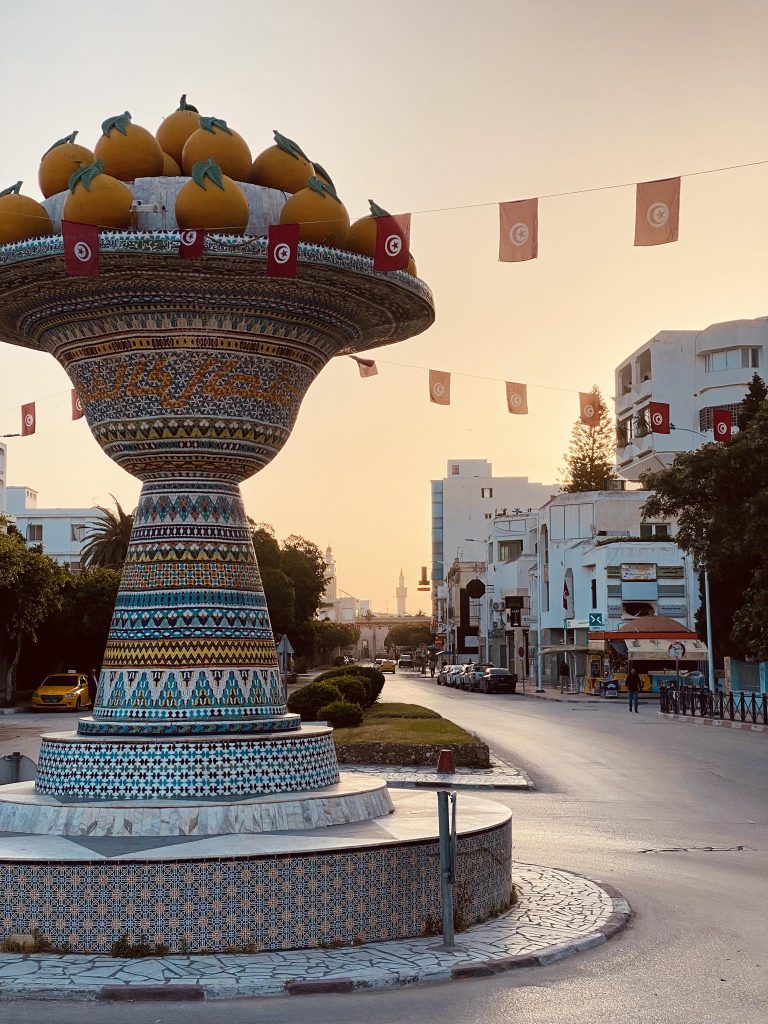
The capital of the peninsula sits halfway down the western coast, about 70 kilometres from Tunis and a 75-minute drive.
Nabeul (population about 85,000) is the practical centre of Cap Bon and the city most visitors actually base themselves in. The town is, by Tunisian standards, prosperous and walkable, with a tree-lined central avenue, a large weekly market, a working medina, and a coastline that runs uninterrupted south into the Hammamet resort zone.
Three things make Nabeul itself worth a full day.
The pottery. Nabeul has been Tunisia’s pottery capital since at least the Phoenician period and produces, by some estimates, eighty per cent of the country’s ceramics today. The trade is concentrated along Avenue Habib Thameur and the streets immediately west of it, where perhaps a hundred small workshops still produce the distinctive Nabeuli style — glazed earthenware in yellow, green, and brown over a cream slip, painted with stylised fish, eight-pointed stars, palmettes, and the khomsa hand. The work runs from very cheap tourist trinkets (3–10 dinars) to genuinely fine pieces by named master potters (200–1,500 dinars for a major decorated jar). The single best workshop for serious work is Slama Céramique on Avenue Habib Thameur, which has been operating since the 1880s and supplies the Tunisian presidency. For a wider survey, the smaller cooperative shops along the same street are reliable. Beware that some of what is sold as “Nabeul pottery” is now mass-produced in factories elsewhere; the genuine hand-painted pieces have small irregularities and a slightly textured glaze.
Harissa. Nabeul is the historical birthplace of Tunisian harissa — the chili paste that is now the country’s most recognisable culinary export and was inscribed on UNESCO’s Intangible Cultural Heritage list in 2022. The conditions on the peninsula — particular varieties of red chili (baklouti, gabsi), particular cultivation methods, particular ratios of sun and water — produce the chilies that the rest of the country uses. The peak harissa-making season is September and October, when the chilies are sun-dried on rooftops across the city, and the smell, in a good year, is everywhere. Small artisanal producers sell direct from their workshops; the larger commercial brands (Cap Bon, Le Phare du Cap Bon, Sicam) are distributed nationally. The deeper story is in the Tunisian harissa piece.
The Friday market. Every Friday morning, the Souk el-Jemaâ of Nabeul spreads across several streets at the eastern edge of the medina. The market combines a working livestock auction (sheep, goats, the occasional camel), a vegetable and fruit market, a textile and clothing section, and a craft section selling pottery, basketry, leatherwork, and household goods. The animals start changing hands around 5 a.m.; the human commerce runs until about 1 p.m. It is one of the largest weekly markets in Tunisia and one of the few that has not been substantially modified for tourists.
The Archaeological Museum of Nabeul, on Avenue Habib Bourguiba, holds the Roman mosaics, statues, and household objects excavated from the Roman Neapolis — the largest single site of which lies a few hundred metres west of the museum, currently being slowly excavated by Tunisian and German teams. The museum is small but well-curated; allow forty-five minutes. Entrance is around 5 dinars.
Kerkouane
Forty kilometres east of Nabeul, on the rocky coast facing Sicily, sits one of the most remarkable archaeological sites in the Mediterranean — and one of the least visited.
Kerkouane is the only known purely Punic city that was abandoned in 146 BCE — during the Roman destruction of Carthage — and never rebuilt over. Every other major Punic settlement in North Africa became a Roman town, then a medieval one, then a modern one, with the earlier layers buried or scraped away. Kerkouane was simply abandoned. The Roman administration did not bother with it. The Arab conquerors found ruins. The site sat under a thin layer of sand and grass for 2,100 years.
When it was excavated, starting in the 1950s, what emerged was a complete Punic provincial town as it stood in the 3rd century BCE: streets laid out on a grid, houses with their floor plans intact, courtyards, baths, dyeing workshops, a small temple, the foundations of the city walls, and — most remarkably — a series of preserved floor mosaics depicting the Tanit sign in pebble inlay. It is the only place in the world where you can see this. UNESCO inscribed the site in 1985.
The visit takes about ninety minutes. The site is open, signage is in Arabic and French, and a small museum at the entrance displays grave goods, ceramics, and the famous Lady of Kerkouane — a fragmentary wooden sarcophagus lid carved into the figure of a serene woman, almost certainly representing a Punic priestess. Entry is around 8 dinars.
Few sites in Tunisia reward serious advance preparation more than this one. Reading the Punic civilization piece before you go will roughly double what you see.
Kelibia
Ten kilometres north of Kerkouane, the small fishing port of Kelibia sits beneath the largest fortress in Tunisia.
The Kelibia Fort — Punic in origin, expanded by the Romans, refortified by the Byzantines, rebuilt by the Hafsids, and given its current shape by the Ottoman corsair commander Sinan Pasha in the 16th century — occupies the entire summit of a 150-metre limestone bluff overlooking the harbour. The walls are 12 metres thick at the base. The bastions still hold their cannon. The view from the parapets reaches across the Sicily Channel — on a clear day, the volcano of Pantelleria is visible to the east, and very occasionally Sicily itself.
The fortress is open daily, entry around 5 dinars, allow an hour. The climb from the harbour is moderate.
The town below the fortress is a working fishing port — Tunisia’s fourth largest by tonnage — with a small medina, a long pleasant corniche, and a particular reputation for two things: muscat wine and deep-water fish. The Kelibia muscat is a sweet white wine made from the Muscat of Alexandria grape and has been produced here since at least Roman times. The local cooperative, UCCV, sells from a small boutique near the fortress entrance. A bottle of the standard Muscat Sec de Kelibia runs around 25 dinars; the better Muscat Doux slightly more. For the wider Tunisian wine landscape, see the Tunisian wine guide.
The fish restaurants along the corniche — Restaurant Le Lido, Le Pirate, Mansoura — serve straight-off-the-boat sea bream, sea bass, octopus, and the local cuttlefish (soupia) at very fair prices. Mansoura Beach, three kilometres north of the town, is one of the most beautiful single beaches on the Tunisian coast: a long crescent of fine sand backed by low cliffs, almost no development, and the kind of clear water that makes the rest of the Mediterranean look murky.
El Haouaria
At the tip of the peninsula, the small village of El Haouaria sits where the land runs out into the sea. From its cliffs you can see, on a clear day, both Sicily and the volcanic island of Pantelleria. It is the easternmost settled point on the Tunisian mainland.
Two things make El Haouaria worth the drive.
The Roman caves. Cut into the limestone cliffs below the village are a series of enormous chambers — the Ghar el-Kebir, the Big Cave — quarried by the Carthaginians and the Romans for the building stone used to construct Carthage. The blocks were cut underground, then shipped across the Gulf of Tunis by barge. The caves are spectacular: vaulted rooms 20 metres tall, sea light filtering through openings cut for crane platforms, the marks of two thousand years of quarrying still legible in the stone. Entry around 5 dinars, allow an hour, bring something warm — the caves stay cool year-round.
The falconry. El Haouaria has hosted a famous annual falconry festival every June for several decades. The peninsula sits on a major north-south migration route, and the village’s hunters — descendants of an Andalusian tradition brought here in the 17th century — capture sparrowhawks during the spring migration, train them through the summer, and release them back into the autumn migration. The June festival celebrates the tradition with demonstrations, competitions, and a small fair. It is one of the more genuine cultural events on the Tunisian calendar — small, local, slightly chaotic, deeply uncommercial.
Korbous
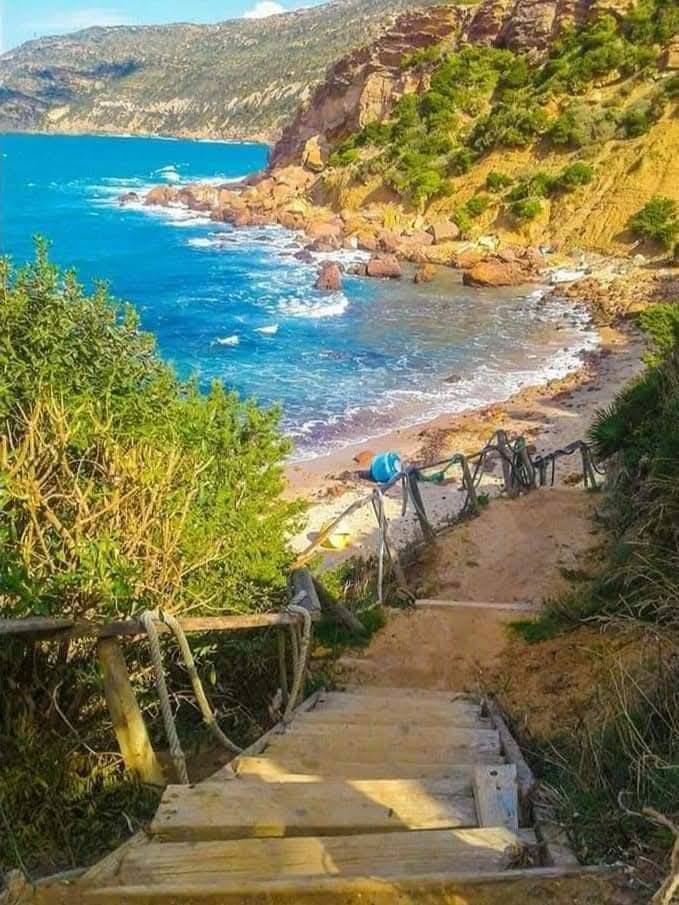
On the western side of the peninsula, halfway between Tunis and Cap Bon’s tip, the village of Korbous sits in a steep ravine cut into the coastal cliffs. The village has perhaps two hundred permanent residents and one major asset: the hot springs that have been bringing visitors here since at least Roman times.
There are seven principal springs, ranging from about 50°C to over 60°C, each with slightly different mineral content (sulphurous, ferrous, calcium-rich) and slightly different traditional therapeutic claims. The Ain el-Atrous — the spring of the ram, named for a rock formation just offshore — is the most dramatic: hot water cascades directly into the cold sea, allowing bathers to stand in the line between the two and feel the temperature change against their skin.
The Roman emperor Antoninus Pius’s wife is said to have come here to bathe in the 2nd century CE. The Hafsid sultans built bathhouses here in the 14th century. The French Protectorate built the modernist Thermes de Korbous, which still operates today as a thermal resort hotel. The whole valley is a strange, slightly run-down, deeply atmospheric place. A day-trip from Tunis (90 minutes by car) is feasible; an overnight in the Thermes hotel or one of the small guesthouses is more rewarding.
Hammamet
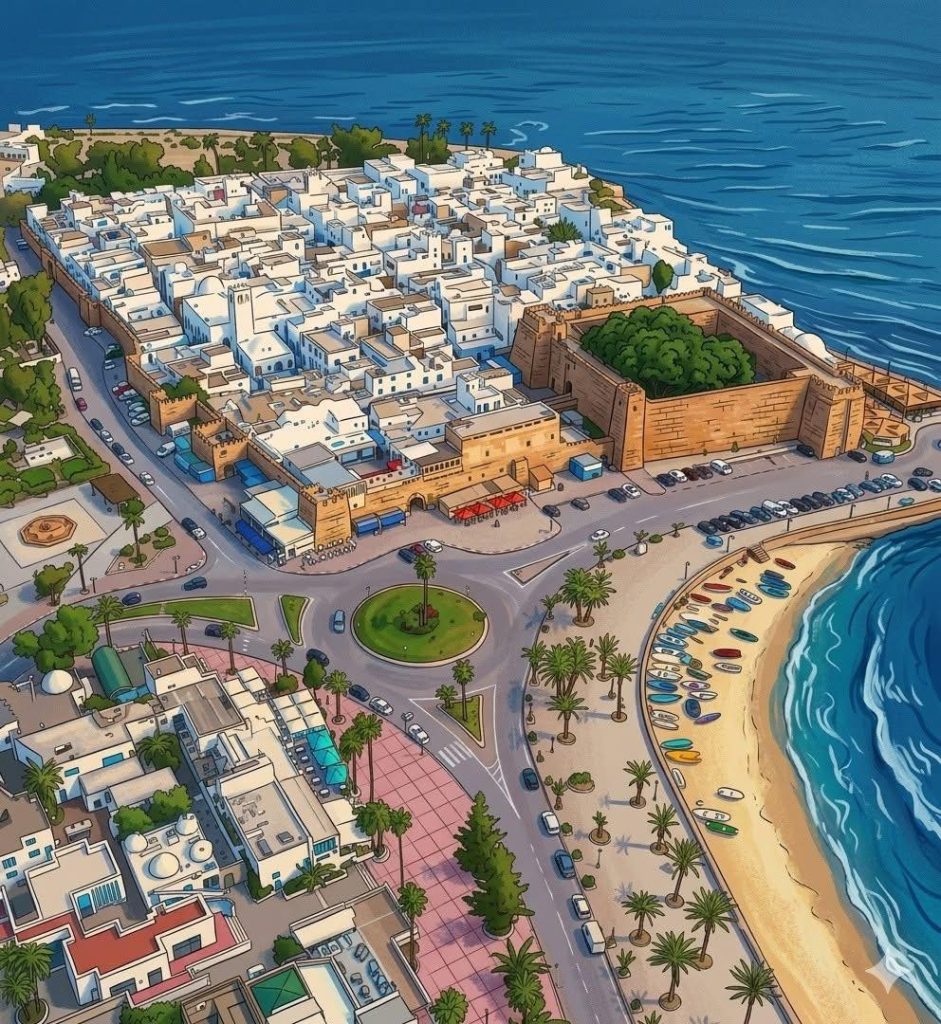
The southern anchor of Cap Bon is the resort town of Hammamet, 65 kilometres southeast of Tunis. Hammamet is, by some distance, Tunisia’s most developed beach destination — a chain of large resort hotels stretching for fifteen kilometres along the gulf, with a small old medina and a Hafsid kasbah at the historic centre.
Hammamet has its own field guide on this magazine. The short version is that it works very well for travellers who want a beach week with one historical day-trip and a few medina afternoons, and works less well for travellers looking for an unmediated experience of Cap Bon. The town is the gateway to the peninsula rather than its essential expression.
A serious Cap Bon trip uses Hammamet for the airport (Enfidha-Hammamet International, IATA: NBE, is 40 kilometres south) and either bases in the medina for the architecture or pushes north into the peninsula for the country.
The Beaches
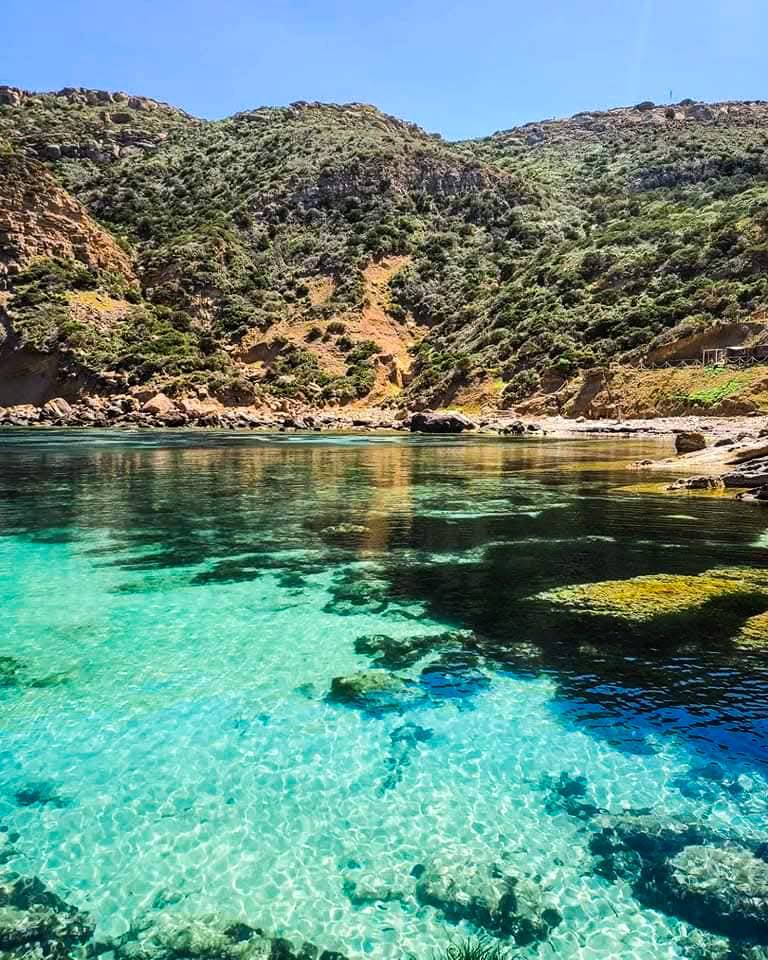
The beaches of Cap Bon — particularly along the eastern coast between Kelibia and El Haouaria — are widely considered the best in Tunisia. The water is clearer than on the Sahel coast (the rocky coastline produces less silt), the sand is finer, the crowds are thinner, and the development is, with a few resort exceptions, minimal.
The standout beaches:
- Mansoura Beach (just north of Kelibia) — long, fine sand, low cliffs, almost no development.
- Plage El Haouaria — the long curved beach below the village, with the dramatic backdrop of the cliffs and the Roman caves.
- Sidi Daoud and Ras el-Drek — west-coast beaches with the smell of the wild thyme that grows behind the dunes.
- Plage de Korba — a long sandy stretch midway up the eastern coast, lightly developed, popular with Tunisian families.
For the wider picture of the Tunisian beach landscape, see the best beaches in Tunisia.
What Cap Bon Eats
The peninsula’s food is the food of a productive agricultural region. The fish is fresh because the boats come in three times a day. The harissa is local because the chilies were grown on the next hill. The wine is local. The olives are local. The citrus is local. The almonds are local. Most of what you eat in a Cap Bon kitchen was, three days ago, still in a field within sight of the restaurant.
The signature regional dishes are: kafteji of Nabeul (the local version of the fried vegetable salad, made with the peninsula’s particular peppers and pumpkin); the fish couscous of Kelibia (grouper or sea bass over couscous, with the broth coloured by saffron and the local baklouti harissa); brik with seafood (cuttlefish, shrimp, or octopus, all local); and the muscat-glazed almond pastries that are a specialty of Soliman and Nabeul.
A meal in a small unmarked workshop restaurant in Nabeul or Kelibia runs 15–25 dinars per person. A meal at one of the better fish places along the Kelibia corniche runs 35–55 dinars. The local muscat is good with all of it. See the Tunisian harissa and top foods pieces for the wider landscape.
Getting There, Getting Around
From Tunis, the western edge of Cap Bon (Soliman, Korbous) is 40 kilometres east — 45 minutes by car on the A1. The peninsula’s interior (Nabeul, Hammamet) is 60–70 kilometres — about an hour. The eastern coast (Kelibia, Kerkouane) is 100–120 kilometres — about an hour and forty-five minutes. The tip (El Haouaria) is 130 kilometres — about two hours.
By public transport, the SNCFT train runs from Tunis to Hammamet and Nabeul (90 minutes, 8 dinars). Louages from Tunis (Moncef Bey) run to Nabeul, Kelibia, and El Haouaria at roughly 10–15 dinars. Local buses connect the smaller villages but are slow and not designed for visitors.
For Cap Bon, a rental car is by far the most rewarding option. The roads are good, the distances are short, the countryside is the point, and the small villages are difficult to reach without a vehicle. Most major rental companies operate from Tunis-Carthage Airport and from Enfidha-Hammamet. A small economy car runs 80–150 dinars a day in season.
Inside Nabeul, walking covers the medina, the museum, and the pottery quarter. Inside Kelibia, walking covers the town; the fortress is a 15-minute climb from the harbour.
Cap Bon is a driving itinerary. The peninsula’s whole point — the vineyard back roads, Kerkouane’s clifftop ruins, El Haouaria’s caves, the beaches between the headlands — sits in the gaps public transport crosses slowly or not at all. This is the loop that justifies a rental more than anywhere else in the north: collect a car in Tunis or at the airport, and the peninsula becomes a two-to-three-day circuit at your own pace. Compare agencies for your dates on DiscoverCars — the deposit, insurance excess, and ratings are shown before you book — and our guide to renting a car in Tunisia covers the paperwork and the road culture before your first roundabout.
When to Go
Cap Bon’s climate is the warmest, sunniest, and most stable in Tunisia — Mediterranean in a fairly extreme sense. April–June and September–October are the sweet spots: 22–28°C, sea warm enough to swim, citrus orchards in flower (April–May) or in fruit (October), jasmine season for the western villages.
July–August are hot (28–34°C) and busy on the beaches but cooler than the Tunisian interior; the sea breeze keeps the peninsula manageable. November–March is mild (14–20°C daytime) and very quiet; the beach hotels operate at low capacity and the inland villages settle into their winter rhythm. Citrus harvest runs October through January; harissa-making is September–October. See the best time to visit Tunisia for the regional comparison.
A Few Practical Notes
Hotels. In Nabeul: a mix of mid-range city hotels (the Hotel Lido, Hotel Khayem) at 80–150 dinars and a small number of restored medina guesthouses. In Hammamet: the full resort spectrum, see the Hammamet field guide. In Kelibia: a handful of small seafront hotels (Hotel Mamounia, Florida Beach) at 60–120 dinars. In Korbous: the Thermes de Korbous and a few small guesthouses.
Cash. ATMs in every major town along the peninsula. The smaller villages are mostly cash-only.
Pottery shipping. If you buy a serious piece in Nabeul, the larger workshops will pack and ship internationally — DHL or local equivalent — at fair rates. Most international air carriers will not accept large ceramic items as checked baggage, and the workshop packing is worth the cost.
Wine and alcohol. The Kelibia muscat is sold at the UCCV cooperative shop and at most licensed restaurants. Magasin Général and Carrefour in Nabeul carry the wider Tunisian wine range. For the rules generally, see alcohol in Tunisia.
Dress. Cap Bon is on the relaxed end of conservative — closer to Hammamet than to Kairouan. Beachwear on the beach, modest dress in the towns and villages, covered shoulders in the small interior settlements where most foreign visitors never reach.
Combining the trip. Cap Bon makes a comfortable two- or three-day loop from Tunis: Nabeul Friday morning for the market and the pottery; Kerkouane and Kelibia on Saturday; El Haouaria and Korbous on Sunday, returning to Tunis via the western coast road. Add a fourth day for the beaches and a fifth for the citrus orchards in season.
What Cap Bon Is, Honestly
Cap Bon is the part of Tunisia that produces the rest of Tunisia. The chilies that become the country’s harissa. The clay that becomes the country’s pottery. The grapes that become much of its wine. The fish that fills its kitchens. The citrus that scents its winters. The almonds, the olives, the jasmine, the strawberries. None of this is invented for tourism. The peninsula was already producing all of it three thousand years ago, when the Phoenicians chose this coast for the same reasons every later civilisation would.
The result is a region that does not perform Tunisia for visitors. It is, instead, the country at work. You can walk a Friday market in Nabeul, climb a Hafsid fortress in Kelibia, swim off Mansoura beach, sit in a workshop in El Haouaria watching a falconer’s apprentice with a sparrowhawk on his wrist, eat a fish couscous on the corniche with a glass of cold muscat, and at no point during the day will anyone be doing any of it because you are there.
That is, in the end, what makes Cap Bon worth a trip. Whether you stay in a Hammamet resort and do the peninsula as a series of day-trips, or rent a car in Tunis and base in Nabeul or Kelibia for a serious week, or take the long route through the interior and out to the tip, you will see a piece of Tunisia that has been doing what it does for a very long time and is in no particular hurry to stop.
You should go.
From the Carthage Magazine Bookshelf
Cap Bon rewards the slow traveller. Three Carthage Magazine ebooks make the trip more rewarding:
- All About Tunisia — the definitive English-language traveller’s guide. 572 pages, 27 chapters, all nine regions — with a full chapter on Cap Bon, the harissa and pottery traditions, and the wider northern coast. $24.99 · PDF & EPUB
- Speak Like a Local — 200+ Tunisian Arabic phrases with native audio recorded in Tunis. Essential in the Friday market in Nabeul and the fishing port in Kelibia. $14.99 · PDF, EPUB, MP3
- The Authentic Tunisian Cookbook — sixty traditional recipes from the heart of North Africa, including the harissa, the fish couscous of Kelibia, and the slow-simmered Cap Bon stews. $9.99 · PDF & EPUB
All three available as a bundle for $39.99 — guide, language, and food, delivered together.
