
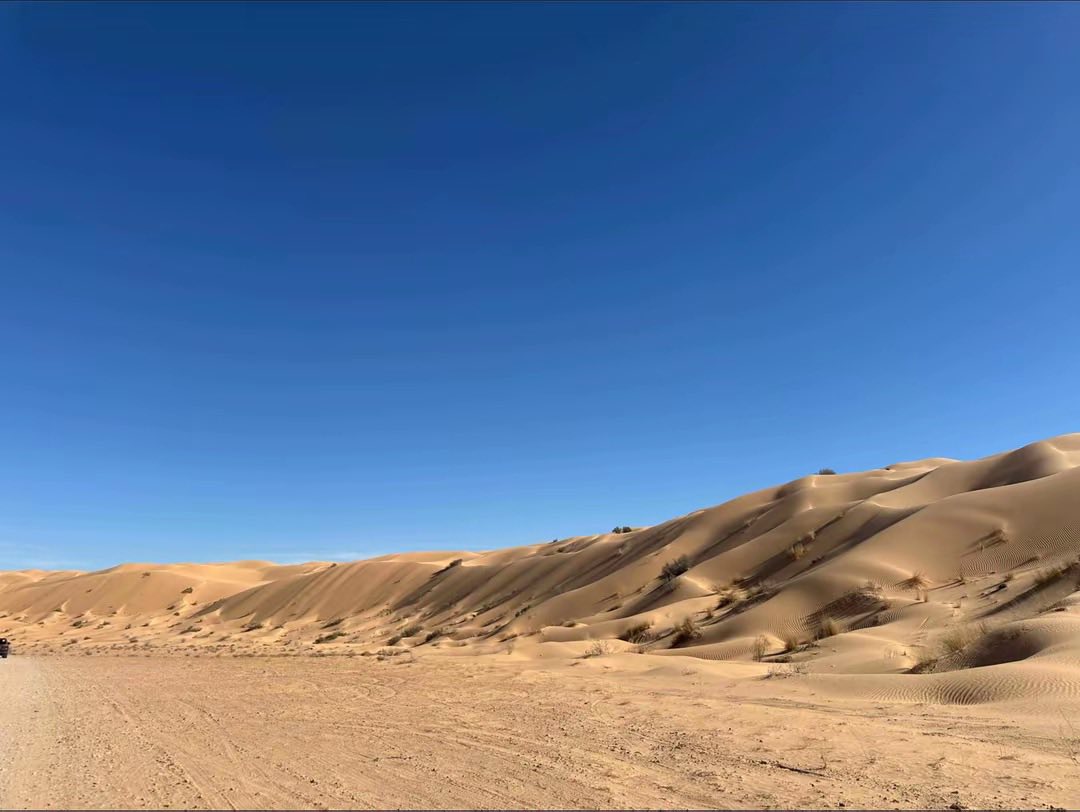
Quick Answer Tunisia’s Sahara begins about four hundred kilometres south of Tunis and stretches to the Algerian and Libyan borders. The country holds three of the world’s classic desert landscapes in close proximity — a salt flat the size of a small sea (Chott el Jerid), a sand sea of rolling dunes (the Grand Erg Oriental), and a stone-and-rock plateau (the Reg) — plus oasis cities, troglodyte villages, fortified Berber granaries, and several of the most-photographed film locations on Earth. The four bases are Tozeur, Douz, Matmata, and Tataouine. You can see the headline experiences in five days; the deeper Sahara takes a week.
The first time you cross Chott el Jerid is the moment you understand you have left one Tunisia and arrived in another.
The road from Tozeur to Kebili runs for nearly eighty kilometres in a perfectly straight line across the largest salt flat in Africa, and there is nothing on either side. The horizon does not behave. Distant palm groves float a metre above the surface and then dissolve when you drive at them. A figure that looks like a Bedouin walking with a camel turns out, ten minutes later, to have been a single tamarisk bush. In summer the surface is bone-white and cracks underfoot; in winter, after the rains, parts of it flood into a wafer-thin mirror of sky and the whole thing tilts. Salt vendors have built small huts along the road and sell bags of pink crystal pulled from the brine. There is a famous abandoned bus marooned in the middle of the lake. No one quite remembers who left it there.
This is the threshold. North of it, Tunisia is Mediterranean — vineyards, olive groves, the Roman ruins of Dougga, the cafés of Tunis. South of it, Tunisia is something else: a country of palm oases, sandstone canyons, mud-brick towers, dune seas, and a particular evening silence that travellers come a long way to find and almost never describe accurately when they get home.
This is what to do once you have crossed.
Where Tunisia’s Sahara Sits
The Sahara is twice the size of India and Tunisia’s slice of it is small. But Tunisia’s slice is, for the visitor, almost ideal: close to the cities, varied in landscape, and threaded by a road network that works.
Geographers and Tunisian guides talk about three kinds of desert here, and you will see all three. The Chott is the salt flat — Chott el Jerid is the largest, but there are smaller ones across the south, all of them remnants of a Mediterranean sea that withdrew from the interior tens of thousands of years ago. The Reg is the stony, gravelly plain — flat or gently rolling, scattered with hardy shrubs, the colour of pale brick. And the Erg is the sand sea, the cinematic desert of postcards: the Grand Erg Oriental, the dune system that begins just south of Douz and reaches all the way into Algeria and Libya.
The four bases you want to know are:
- Tozeur, the oasis capital of the southwest, anchor for the western desert and the mountain oases
- Douz, the gateway to the Grand Erg Oriental, anchor for dune trekking
- Matmata, the troglodyte village in the hills, anchor for Berber underground architecture
- Tataouine, the small southern town that lent George Lucas its name, anchor for the ksour — the fortified Berber granaries that ring it
The four can be linked into a single loop in four to six days, and most serious Sahara itineraries do exactly that.
Douz — The Gateway and Its Festival
Douz sits at the edge of the Grand Erg Oriental, four hundred and seventy-five kilometres south of Tunis, in the Kebili Governorate. Step out of town in almost any direction and the dune sea is already there — small ridges at first, then larger ones, then the great rolling forms that march southeast all the way to the Libyan border.
The town itself is unhurried, sand-coloured, oriented around its market square and the surrounding palmery. You come here for one of three reasons. The first is the dunes themselves — Douz is where most short Sahara experiences begin and end, with camel treks of an hour or a day or a week setting off from the edges of town. The second is the museum: the Museum of the Sahara is a small but genuinely useful introduction to nomadic Bedouin culture, the kind of place where you wish you had spent thirty minutes before climbing on the camel rather than after.
The third reason is the International Festival of the Sahara, which Douz has been running, in one form or another, since 1910. Held over four days in late December — the most recent edition ran 25–28 December — the festival is the largest celebration of Saharan culture in North Africa and the country’s oldest cultural event. The opening day brings camel marathons, fantasia horse displays, sloughi greyhound races, traditional wrestling, poetry contests, and a reenactment of a Bedouin marriage. The evenings bring music. Fifty thousand people come. If your trip lands anywhere near the last week of December, plan around it. The hotels fill months in advance and Douz becomes briefly the centre of Saharan tourism in the Maghreb.
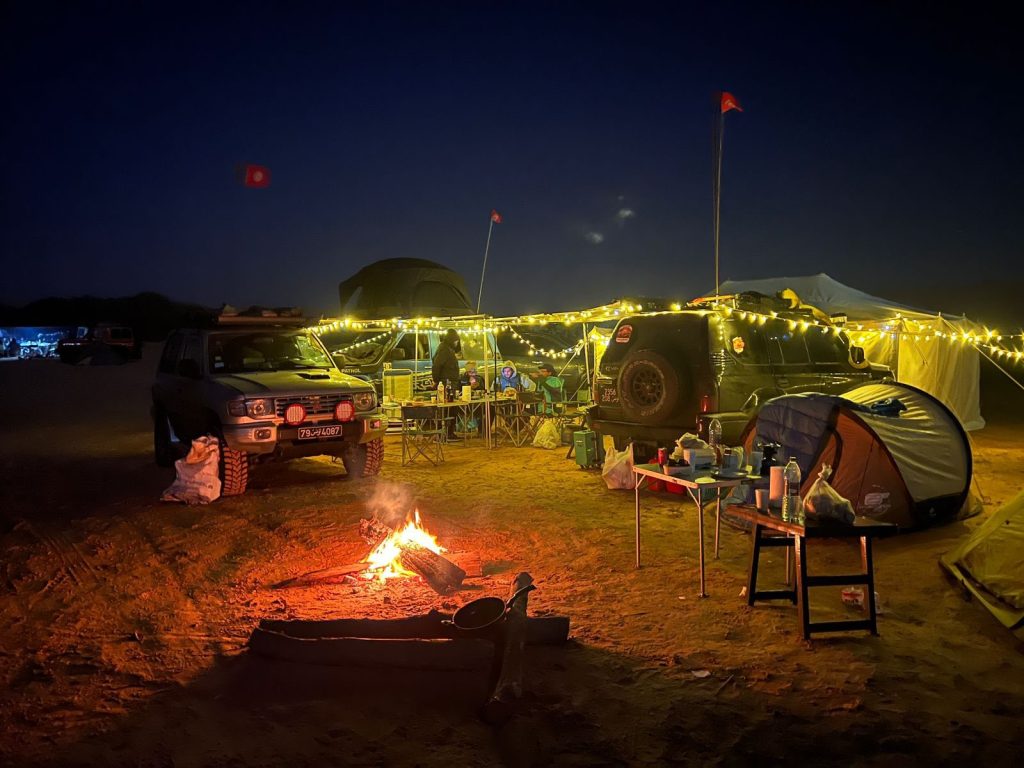
A practical word. The dune experiences sold to day-trippers from coastal resorts are short — an hour on a camel, a quick photo, back on the bus. The dune experiences sold from Douz itself can be a full sunset trek, an overnight in a Bedouin camp, a three- or four-day expedition into the Erg. Do the longer one if you can. The desert at three in the afternoon, with a tour bus running its engine, is not the desert. The desert at four in the morning, with the wind down and the cold real, is.
Tozeur — The Oasis Capital
A hundred and twenty-five kilometres west of Douz, on the far side of the Chott, Tozeur is the largest and most cultured of the southern oasis cities. It is also the easiest in: a small domestic airport puts you on the ground here from Tunis in just under an hour.
The medina of Tozeur is unlike any other in the country. The local builders developed, somewhere in the fourteenth century, a distinctive technique of laying yellow-ochre bricks in raised geometric patterns across the entire face of a building — diamonds, chevrons, alternating panels of light and shadow — so that the older streets of the old town look like vast pieces of carved jewellery, the brickwork shifting as the sun moves over it. Walk the Ouled el-Hadef quarter in the late afternoon and you will understand why some travellers come to Tunisia primarily for this.
The palm grove of Tozeur — the Jrid — covers more than a thousand hectares immediately south of the city and produces some of the country’s finest Deglet Nour dates, the variety the Tunisians call “the queen of dates” and which the rest of the world buys at Christmas without quite knowing where it comes from. Hire a calèche — a horse-drawn carriage — and trot the palmery’s red dirt paths in the cool of the morning. It is a touristy thing to do and it is genuinely worth doing.
From Tozeur, three of the country’s most photogenic small destinations are within ninety minutes by 4×4:
- Chebika — a mountain oasis tucked into a sandstone cliff at the Algerian border, with a small waterfall, a ruined Roman watchtower, and a view down a steep gorge that has appeared in roughly every Tunisian tourism advertisement of the last forty years
- Tamerza (sometimes written Tamaghza), the largest mountain oasis, with palm groves cascading through a canyon and a swimmable pool at the base of its waterfall
- Mides, the smallest and most dramatic of the three, on the edge of a deep gorge that doubled as a canyon shot in The English Patient
These three are usually grouped into a single half-day loop from Tozeur. The combination of palm-shaded oasis, sandstone canyon, and ruined Roman fort, all within a few kilometres of each other, is unusual in the desert anywhere.
Matmata and the Berber Underground
A long day’s drive east of Tozeur, in the low hills that separate the desert from the coast, the Berber villagers of Matmata solved a problem most desert peoples didn’t bother to solve: the heat.
They went underground.
A Matmata house is a hole. Specifically, a circular crater seven or eight metres across and four or five deep, dug into the soft sandstone, with rooms hollowed horizontally into the walls of the crater at the bottom. From the surface you see almost nothing — a stone wall around the lip, perhaps a chimney, perhaps a few clothes drying. Descend the stone staircase into the crater and you are in a courtyard, with bedrooms and storage rooms and a kitchen all carved out of the rock, ten degrees cooler than the desert above, and the sky a circle of intense blue overhead.
People still live this way. Not many — a few hundred, in Matmata and the surrounding villages of Tamezret, Toujane, and Haddej — but enough that walking the village is an act of looking at a culture that has lasted, not visiting one that has ended.
One Matmata troglodyte house is famous beyond its size: the Hotel Sidi Driss, a working guesthouse built around three connected craters, which George Lucas used in 1976 as the interior of Luke Skywalker’s childhood home. The bar where Aunt Beru served blue milk is still there. You can sleep in the rooms where the original A New Hope was filmed for the price of a modest dinner. It is one of the more pleasingly low-key film-pilgrimage experiences in the world.
The Ksour of Tataouine
South of Matmata, in the hilly border country toward Libya, the Berber communities developed a different architectural response — not underground but upward, and not for living but for storage.
A ksar (plural ksour) is a fortified granary. Imagine a courtyard the size of a small football pitch, walled by a multi-storey honeycomb of barrel-vaulted cells called ghorfas, each cell the property of a single family, each one used to store grain, olive oil, and the year’s harvest against raids and drought. The cells stack four and five high. The outer wall is featureless. From a distance a ksar looks like a mud-brick beehive built into the side of a hill.
The town of Tataouine itself — yes, the source of the name Tatooine — is a modest administrative centre with little to do but eat kefteji and drink mint tea, which is fine, because the ksour are spread across the hills around it. The essential ones:
- Ksar Ouled Soltane, the most photogenic, with a great oval courtyard ringed by four storeys of ghorfas, still partly in agricultural use
- Ksar Hadada, used as the slave quarters of Mos Espa in The Phantom Menace
- Chenini, the cliffside Berber village built into the hillside above a still-functioning underground mosque
- Douiret, Chenini’s quieter cousin, equally vertical and almost untouristed
If the ksour interest you at all, spend a full day. If they don’t, half a morning is enough.
Ksar Ghilane and the Deep Sahara
For travellers who want the real Erg — the Sahara of silence and stars, with no village and no other tourists — the standard destination is Ksar Ghilane, an oasis at the eastern edge of the Grand Erg Oriental, reachable only by 4×4 across an hour of dunes from the nearest paved road.
What is at Ksar Ghilane: a natural hot spring, gloriously warm year-round, ringed by date palms; the remains of Tisavar, a small Roman fort that watched the southern limes of the empire from the early third century onward; and several Bedouin-style permanent camps where you can sleep in a tent of woven goat hair with a proper bed inside it. What is not at Ksar Ghilane: light pollution. On a moonless night, the sky over the camp is one of the densest you will ever stand under.
The journey in is part of the journey. You ride out from Douz or Matmata across an hour of open desert, with the dunes building and breaking against each other, the dune-buggies coming back the other way, the silence of the camp arriving in stages.
It is one of the easier deep-desert experiences anywhere — accessible, well-organised, available in three-star comfort — and the easiness is what makes it possible to recommend to people who would otherwise never get this far into a real Erg.
When to Go
The Sahara has a clean climate calendar.
- October to April is the window. Days are warm to hot, nights are cool to cold, the dunes are walkable, and the deep blue mid-afternoon sky is the one you’ll want for your photographs. The festival in Douz at the end of December is in this band. So is the cool, clear, occasionally cold high winter of January, when the desert temperature can drop to single digits at night and the stars are at their hardest.
- May, June, and September are shoulder months. Hot but manageable. Fewer travellers.
- July and August are not really tourist months for the desert. Daytime temperatures cross forty-five degrees Celsius and stay there for weeks. The dunes turn into a frying pan. Most Saharan tour operators wind down or pivot entirely to coastal work, and the smart traveller does the same — coastal Tunisia (Hammamet, Djerba, Sidi Bou Said) is at its summer best while the south is at its summer worst.
We’ve written a fuller month-by-month guide to visiting Tunisia for the wider seasonal picture.
Getting There and Moving Through It
The shortest version: fly to Tunis-Carthage or Djerba-Zarzis or Tozeur-Nefta and drive.
- From Tunis: Tozeur is a one-hour domestic flight or a seven-hour drive (the country has been investing in the southern road network, and the journey is faster than the distance suggests). Douz is a further two hours by car from Tozeur. Tataouine is a day’s drive from Tunis via the coastal road.
- From Djerba: Djerba is the smartest entry point for the south. The island has direct international flights and is within driving distance of the entire southern circuit — Matmata in two and a half hours, Ksar Ghilane in four, Tozeur in five. Many of the better operators are based here.
- On the ground: the headline route — Chott el Jerid, the mountain oases, the deep Erg — is a 4×4 itinerary. You can self-drive parts of it (the paved roads to Tozeur, Douz, and Matmata are fine in a regular car) but for Ksar Ghilane, the mountain oases tracks, and the ksour you’ll want a guide who knows the small roads. Day rates with a licensed guide and 4×4 run modestly by Western standards. See our cost of living guide for orientation, and our dinar primer for the practical side.
Getting there Under your Own Steam
The south is where a rental car earns its keep: distances stretch, louages thin out past Gabès, and the landscape between the oases is half the point of coming. Every sealed road a normal itinerary uses — Tozeur, Douz, the great chott causeway between them — is fine in an ordinary compact; the 4×4 is only for leaving the asphalt, and genuine dune driving is best left to the excursion operators whose drivers read sand for a living. Compare rentals for your dates on DiscoverCars — deposit, excess, and agency ratings shown before you book — and read our guide to renting a car in Tunisia for the full paperwork picture, including the one rule that matters most down here: plan every drive to end by dusk.
A few quiet realities. The desert is cold at night even when it is hot at noon; bring layers. Connectivity is patchy in the deep Sahara and absent at Ksar Ghilane; let people know you’ll be off-grid. Distances are larger than the map suggests; allow an extra hour between any two stops. And the polite formulas in Tunisian Arabic open doors here that nothing else opens — see our primer on the Tunisian Arabic dialect and, for the phrases you’ll actually use at the gate of a ksar or the door of a camp, our phrasebook.
A Reasonable Five-Day Itinerary
- Day one — Tunis to Tozeur. Morning flight or an early start by car. Afternoon in the Tozeur medina; calèche through the palmery at sunset. Dinner of kabkabou (Tunisian fish stew) at a courtyard restaurant in the old town.
- Day two — Mountain Oases and Mos Espa. Early start by 4×4 to Chebika, Tamerza, and Mides. Late afternoon to the Star Wars set at Mos Espa, fifteen kilometres outside Nefta, for the long shadows. Back to Tozeur for the night.
- Day three — Chott el Jerid to Douz. Cross the salt lake in the morning, when the mirages are at their most active. Arrive in Douz for a late lunch, the Museum of the Sahara in the afternoon, sunset camel trek into the Erg, dinner under stars at the edge of the dunes. Sleep in a Bedouin camp if you can.
- Day four — Douz to Matmata. Drive east through the reg in the morning. Afternoon in Matmata, visiting the troglodyte houses; dinner and a night at the Hotel Sidi Driss for the Star Wars pilgrimage.
- Day five — Matmata to Tataouine, then home. Morning drive south to Tataouine and the ksour — Ksar Ouled Soltane, Chenini, and as many others as your appetite allows. Late afternoon on to Djerba (90 minutes) for an evening flight out, or back to Tunis by overnight stop.
If you have a sixth and seventh day, add Ksar Ghilane. The deep Erg is what you came for.
Why You Should Bother
There is a way of writing about the Sahara that romanticises it past the point of usefulness — the eternal desert, the timeless dunes, the silent Bedouin against the setting sun. The Tunisian south deserves better than that, partly because the people who live in it are very much of the present, and partly because the desert itself is more interesting than the cliché lets it be.
What is actually here, in five days from Tunis, is one of the most efficient introductions to the Sahara in the world. You can walk a salt flat and a sand sea and a Roman fort in the same afternoon. You can sleep in a hole in the ground that a Berber family dug eight centuries ago. You can stand on a dune ridge at six in the morning and watch the wind erase the previous evening’s footprints in real time. You can drink mint tea, very slowly, with someone whose grandfather did the trans-Saharan caravan trade and whose nephew is at university in Tunis studying engineering, and you can come away with the small but durable understanding that the desert is not a place where time stopped — it is a place where time has been working, patiently, on a different set of problems.
That is what the south of Tunisia is for. Go for the dunes. Stay for the people who have learned to live well alongside them.
From the Carthage Magazine Bookshelf
For the south specifically, and for Tunisia more broadly:
- All About Tunisia — the definitive English-language traveler’s guide. 572 pages, 27 chapters, all nine regions including the full southern circuit, every UNESCO site, and five thematic trails. The Sahara trail covers what this article does and what it can’t. $24.99 · PDF & EPUB
- Speak Like a Local — 200+ Tunisian Arabic phrases with native audio recorded in Tunis. The southern dialect is its own creature; the phrasebook gets you the formulas that work everywhere. $14.99 · PDF, EPUB, MP3
- The Authentic Tunisian Cookbook — sixty recipes including mloukhiya, kabkabou, and the slow-cooked tagines you’ll meet in the desert oasis kitchens. $9.99 · PDF & EPUB
All three available as a bundle for $39.99 — guide, language, and food, delivered together.
