
This article contains affiliate links. If you book through them, Carthage Magazine earns a small commission at no extra cost to you — it’s part of how we keep our guides free and independent.
Quick Answer — Hammamet is really two resorts sharing a name. Hammamet town — the original — wraps a walkable centre, garden villas, and a line of classic hotels around the medina and the loveliest urban beach on the gulf; this is the charming, strollable version. Yasmine Hammamet, 10 km south, is the purpose-built zone: a marina, a promenade, big modern all-inclusives, and the flattest, most accessible resort environment in the country. Between them, the Hammamet Nord strip runs quieter mid-range hotels along an excellent beach. The honest rule: book the town if atmosphere is the point, Yasmine if facilities are, and check the calendar either way — Hammamet in July and Hammamet in November are different places at different prices.
Tunisia’s original resort town has been seducing visitors since the 1920s, when European artists and aristocrats built garden villas by the medina and accidentally invented the country’s tourism industry. A century on, the seduction works differently in each of Hammamet’s three zones — and booking the wrong one for your kind of trip is this coast’s most common unforced error. Here’s the honest map.
1. Hammamet Town & the Medina — For Charm and Walkability
Best for: couples, culture-plus-beach trips, travelers who want a town, not a compound.
Trade-off: the classic hotels trade newness for gardens and character; nightlife is dinner and a stroll, not a strip.
The old heart of Hammamet is what made its name: a small white medina at the water’s edge, a kasbah above the fishing harbour, the town beach curving away from the walls, and the jasmine-and-bougainvillea streets that gave the town its honeymoon register (it does heavy duty in our honeymoon guide). Staying here means walking to everything — the medina, the cafés, the beach — and it’s the version of Hammamet that feels like Tunisia.
La Badira — the modern statement: adults-only five-star above the beach, all white minimalism and sea horizon; the address for the grown-up, phone-down version of the trip.
The Sindbad — the old-school grande dame near the medina: gardens, low buildings, and the classic Hammamet register kept alive.
Dar Hayet — the boutique option on the shore: traditional architecture, small scale, steps from the old town.
2. Hammamet Nord — For the Quiet Middle
Best for: families, longer stays, value on a very good beach.
Trade-off: neither the town’s charm nor Yasmine’s facilities — you’re on a hotel strip, pleasant but anonymous.
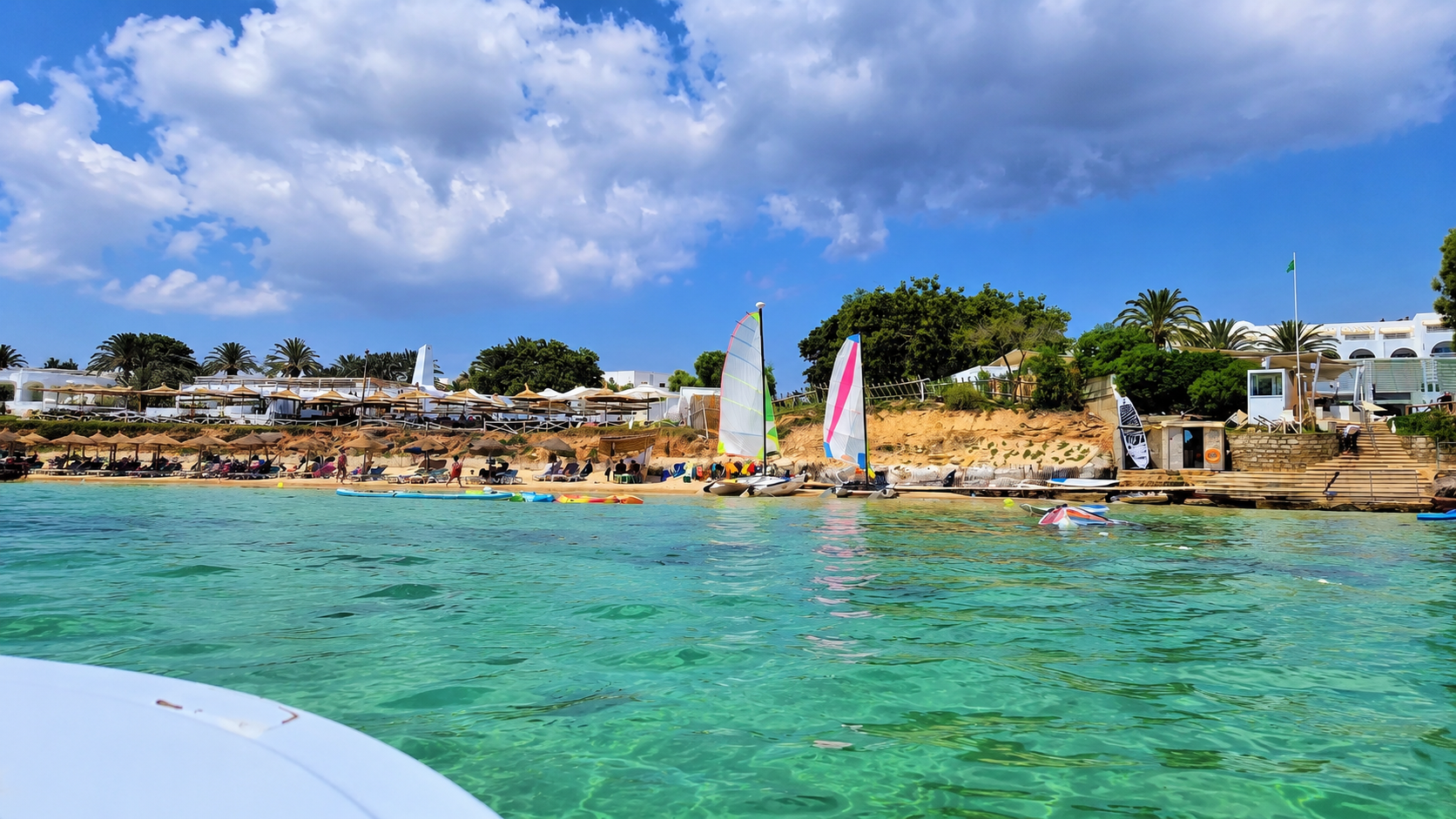
North of the centre, the coast runs in a long line of mid-range and four-star hotels along some of the gulf’s best sand. It’s the sensible-shoes choice: quieter than Yasmine, cheaper than the town’s boutique tier, with taxis making both ends of Hammamet a ten-minute hop. Family logic lives here — the shallow beach does the entertaining (the wider case is in our Tunisia with kids guide).
Les Orangers Beach Resort — the strip’s dependable classic: big gardens, big beach, the all-inclusive formula done properly.
3. Yasmine Hammamet — For Full-Scale Resort Facilities
Best for: all-inclusive holidays, accessibility, marina evenings, thalasso, anyone who wants everything on-site.
Trade-off: purpose-built means exactly that — polished, flat, and about as Tunisian as an airport duty-free. You’ll need to travel for the real town.
Built from scratch around a marina in the 1990s–2000s, Yasmine is the industrial-strength version of Hammamet: a long promenade, a replica-medina shopping quarter, a casino, water parks (Carthage Land keeps children euphoric), and the largest concentration of modern four- and five-star all-inclusives in the country. It’s also, for what it’s worth, the most wheel-friendly resort environment in Tunisia — wide, flat, ramped — a point our accessible Tunisia guide develops.
The Russelior Hotel & Spa — Yasmine’s polished five-star, with the spa doing serious work.
Medina Solaria & Thalasso — the big thalassotherapy option on the zone’s southern sand.
How to Choose, Honestly
Couples and first-timers who want Tunisia with their beach: the town, every time.
Families optimizing beach + budget: Hammamet Nord, or Yasmine if the kids’ facilities decide it.
All-inclusive, zero-decisions holiday: Yasmine — and break out at least once for a medina evening in the old town.
Honeymoon: La Badira or Dar Hayet, and dinner by the kasbah.
Undecided between here and the other coast entirely? Our Hammamet vs Sousse and Djerba vs Hammamet comparisons settle it category by category.
Practical Notes Before You Book
Season is everything here. July–August is full-throttle; June and September are the connoisseur’s months; winter runs on thalasso, golf, and half-price five-stars — the trade-offs are in best time to visit and Tunisia in winter.
Airport: Enfidha-Hammamet is ~40 minutes; Tunis-Carthage about an hour. Day trips are Hammamet’s secret weapon — the Cap Bon loop (Nabeul’s pottery, Kelibia’s fortress and El Mansoura beach, El Haouaria’s cliffs) is one of Tunisia’s best drives, and a one- or two-day rental car unlocks it on your own clock (the rental guide covers the rest).
Land connected: transfer confirmations and maps work from the runway with an eSIM installed before you fly — options compared in our SIM & eSIM guide.
One last honest word: whichever zone you book, walk the old medina at least once at golden hour, when the walls turn honey and the fishing boats come in below the kasbah. It’s the postcard that started this whole coast, and it still doesn’t charge admission. The full town — beaches, eating, the lot — is in our Hammamet guide; the country-wide view is in hotels in Tunisia.
More where-to-stay guides: Djerba · Tunis · Sousse · Monastir · Tozeur — or the country-wide view in Hotels in Tunisia.
From the Carthage Magazine Bookshelf
Booked the beach? These three fill the shade.
- All About Tunisia — the definitive English-language traveler’s guide. 572 pages, 27 chapters, all nine regions, every UNESCO inscription, five thematic trails. $24.99 · PDF & EPUB
- Speak Like a Local — 200+ Tunisian Arabic phrases with native audio recorded in Tunis. $14.99 · PDF, EPUB, MP3
- The Authentic Tunisian Cookbook — sixty traditional recipes from the heart of North Africa. $9.99 · PDF & EPUB
All three available as a bundle for $39.99 — guide, language, and food, delivered together.
