
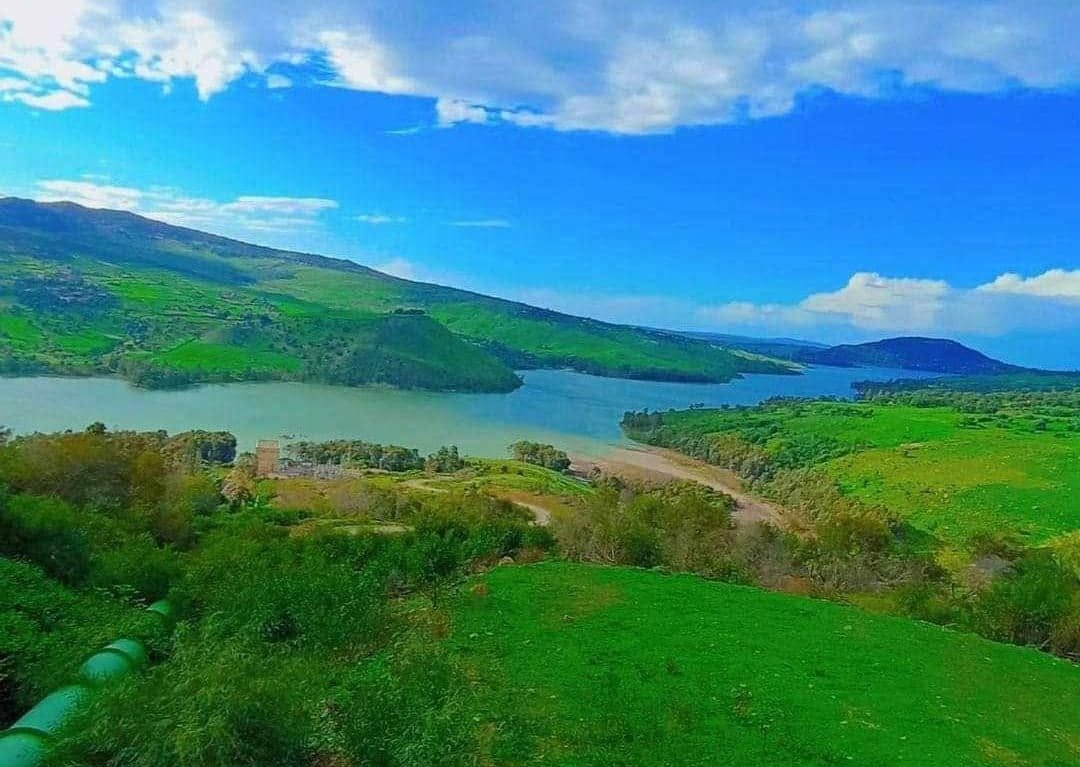
The country’s dams are fuller than they have been in years. That has not stopped the rationing — because Tunisia’s water problem was never really about rain.
In January, Tunisia recorded its heaviest rainfall in roughly seventy years. Wadis that had been dust for four summers ran hard enough to kill people; the floods made international news. By early June, the national dam filling rate had climbed past 60 percent, holding around 1.4 billion cubic metres — a surplus of something like 500 million cubic metres on the same point last year, according to figures reported in the Tunisian press and cited by water specialists including Houcine Rhili.
By any reasonable reading, that is a good year.
And yet this month, as temperatures pushed toward 45°C, Tunisians were still watching the pressure drop out of their pipes at night. Rationing that began on 31 March 2023 has not been lifted. A UN-linked estimate puts the number of rural Tunisians without running water in their homes above 650,000.
This is the part of the story that gets lost every time the rain returns: filling a dam and delivering water to a kitchen are two different engineering problems, and Tunisia has largely solved the first.
The average conceals the country
Start with the fact that a national filling rate is close to meaningless in a country shaped like Tunisia.
In early June, the Cap Bon dams were above 90 percent. Northern Tunisia sat around 68 percent. Central Tunisia was at 13 percent. The north holds the overwhelming majority of the country’s usable surface reserves — the Sidi Salem dam alone accounts for roughly a quarter of the national total — which means the water is concentrated several hundred kilometres from a large share of the people and farmland that need it. Moving it requires transfer infrastructure, and moving it uphill requires electricity, which is its own expensive problem: the water cycle consumes a substantial share of Tunisia’s energy budget, and nearly all of the country’s electricity comes from imported natural gas.
So a wet January in the northwest does comparatively little for a farmer in Kairouan or a household in the interior. The rain fell where the dams are. The dams are not where the need is.
Thirty percent of it never arrives
The second constraint is the network itself, and here the numbers are uncomfortable in a way that has nothing to do with the weather.
SONEDE, the national water utility, serves about 3.3 million subscribers through some 59,000 kilometres of pipe. Roughly a fifth of that network is classified as obsolete. Non-revenue water — the share lost to leaks, breaks and unbilled use before it reaches a tap — has run around 30 percent nationally, above 35 percent in Greater Tunis, where parts of the system date to the 1960s, and past 40 percent in some rural schemes.
Read that against the reservoir figures and the arithmetic turns bleak. Of the extra water January delivered, close to a third will be lost in transit regardless of how carefully anyone rations at the household end. Tunisia is, in effect, storing water in order to leak it.
The renewal programme aims to replace 1,000 kilometres of pipe a year. At that pace, working through the currently obsolete portion alone takes more than a decade — and the rest of the network keeps ageing while the crews work. This is not a scandal so much as a scale problem: the sums involved are large, the visible payoff is slow, and a replaced pipe never makes a headline.
Agriculture is the real meter
The third constraint is demand, and it is the one least often discussed in public.
Agriculture accounts for around 80 percent of Tunisia’s total water consumption. Every debate about seven-hour overnight household cuts is therefore a debate about the remaining fifth. Drinking-water abstraction has risen steadily — from roughly 296 million cubic metres in 2002 to about 447 million by 2018 — but it is not the dominant draw, and it never has been.
Tunisia’s per-capita renewable water availability sits below 500 cubic metres a year, the conventional threshold for absolute scarcity. At that level, the question stops being how to get through a dry spell and becomes which uses the country intends to keep. Thirsty export crops, tourism in the coastal belt, and municipal supply are drawing on the same constrained pool, and the trade-offs among them are agronomic and economic rather than meteorological.
Redefining the problem
The most consequential development this year may be a document rather than an event.
In May, the African Development Bank and the Tunisian government published a joint study on drought planning and resilience, assembled through consultation with 22 institutions. Its central argument is a reframing: Tunisia is not experiencing a water crisis that will end, but a permanent shift in its climate regime that requires permanent institutional architecture rather than recurring emergency decrees.
The evidence is hard to argue with. Between 1950 and 2018, 59 percent of years in Tunisia qualified as dry. Projections point to rainfall declining by as much as a quarter across the centre and south by 2100, with average temperatures rising somewhere between 2.5°C and 5°C depending on emissions.
Under that framing, a wet year is noise, not a trend — and treating it as relief is the characteristic mistake.
The response now taking shape reflects that. The National Water Strategy to 2050 runs to some 74.5 billion dinars across 43 programmes, with just over half the budget directed at two things that are not dams: non-conventional resources — desalination, and treated wastewater reused in agriculture — and network efficiency. Work continues on hydraulic projects worth roughly 1.8 billion dinars this year, including the Upper Mellegue dam, which is expected to raise the share of surface water Tunisia can actually capture from about 95 to 98 percent. Smart meters are being deployed. The Water Code, drafted for a different climate, is being revised. Photovoltaic capacity is planned specifically to cut the energy cost of pumping.
None of it is glamorous. Most of it is pipes, membranes, tariffs and metering.
The number to watch
The temptation each spring is to check the dam gauge and conclude something about the year ahead. It is the wrong instrument.
The figures that will determine whether Tunisians get water reliably in 2035 are the leakage rate, the kilometres of pipe replaced, the volume of treated wastewater actually reused rather than discharged, and the share of irrigated agriculture that shifts to crops matched to the country’s real hydrology.
January proved that Tunisia can still have a wet year. This July proved that a wet year is no longer enough.
