
This article contains affiliate links. If you book through them, Carthage Magazine earns a small commission at no extra cost to you — it’s part of how we keep our guides free and independent.
Quick Answer — Ksar Ghilane is Tunisia’s southernmost oasis, a palm grove wrapped around a warm spring on the eastern edge of the Grand Erg Oriental, where the country’s stony desert finally gives way to real Saharan dunes. Once reachable only by 4×4 track, it is now connected by asphalt to Douz and to the Matmata road, and it anchors the most popular desert day trip sold from Djerba and Zarzis. The spring pool sits at around 32°C year-round; the ruined Roman fort of Tisavar lies in the dunes just beyond the palms; and accommodation runs from simple Berber-tent camps to a long-established luxury camp of air-conditioned tents. A day trip works. An overnight is the point. Come between October and April.
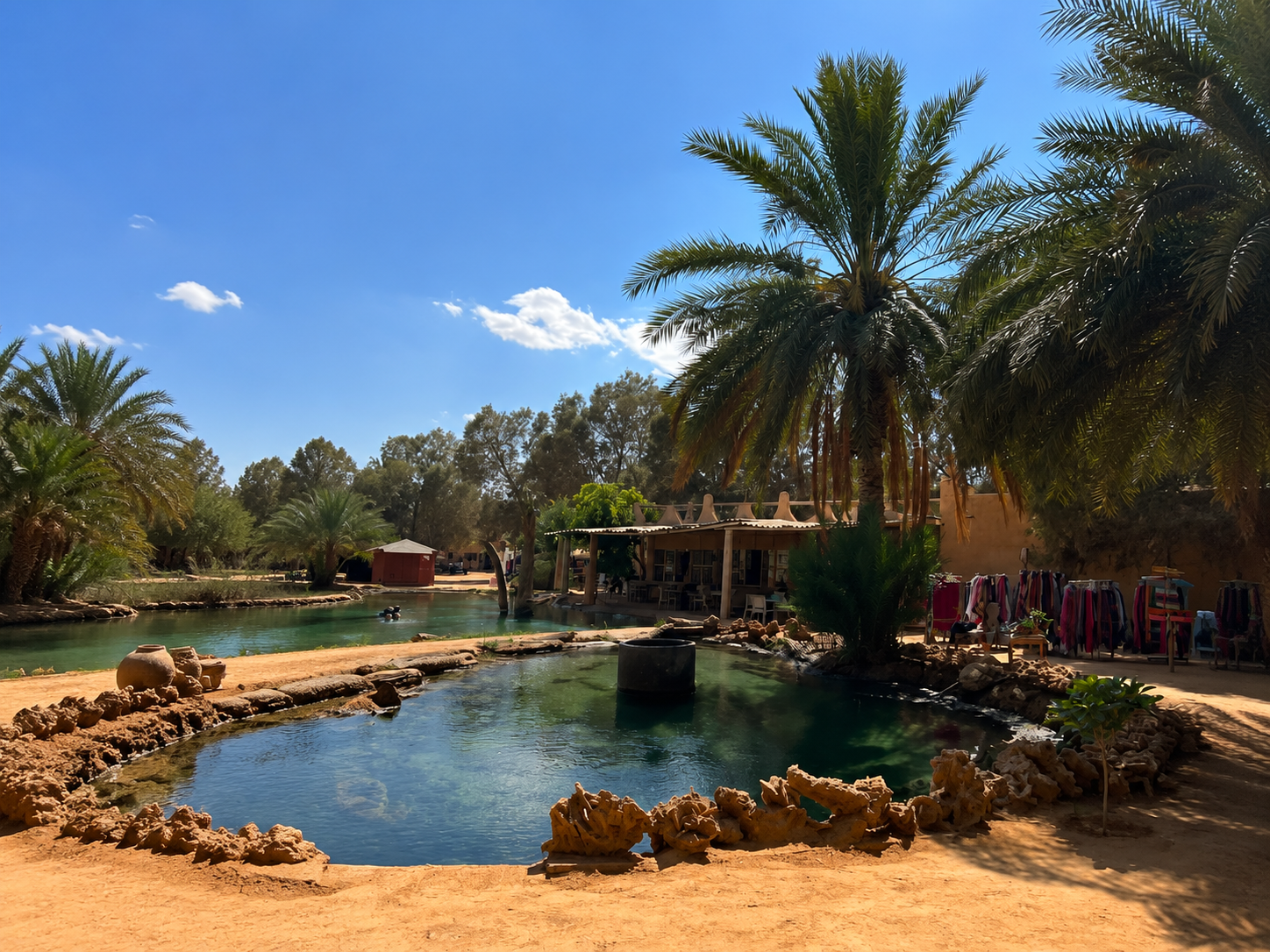
You will do a strange and wonderful thing at Ksar Ghilane, and everyone who has been will tell you about it in the same slightly disbelieving tone: you will swim in warm water in the middle of the Sahara. The pool sits at the edge of the palm grove, fed by a spring that comes up at about 32 degrees, and while you float in it the view over the lip of the water is sand — proper sand, the first true dunes of the Grand Erg Oriental, rolling away south and west toward Algeria in waves that do not stop for a very long time. Behind you, palms. Around you, the shrieks of whoever arrived on the last 4×4. Beyond, nothing, magnificently.
This is the southernmost oasis in Tunisia and the place where the desert changes character. Everything north of here — the Chott El Jerid, the stony plateaux of the Dahar, the reg the day-trip drivers rattle across — is desert of one kind; Ksar Ghilane is the doorstep of the other kind, the erg, the sand sea of the imagination. Around fifty families, formerly nomadic and now settled, live from the date palms, the goats, and — increasingly, and by a wide margin — from you. There are cafés around the spring, camel men and quad-bike men negotiating by the pool, and a handful of camps in and beyond the palms. It is not a secret place, and this guide will not pretend it is. It is, however, still one of the easiest points anywhere in North Africa to touch the real Sahara, and handled right — which mostly means staying the night — it earns every bit of its reputation.
Getting There
For decades Ksar Ghilane was 4×4-only, reached along the old pipeline track through the desert, and the arrival was half the adventure. The asphalt changed that. A paved road now runs in from the north — Douz is about eighty kilometres away as the crow flies, a drive of two hours and change by road — and from the east off the Matmata–Tataouine corridor, which means an ordinary rental car can make it, with the usual southern caveats: fill the tank before you leave the last town, carry water, and don’t drive the desert stretches at night. Our guides to renting a car in Tunisia and getting around the country cover the fundamentals. Note that some camps sit a further stretch of sandy track beyond the oasis proper — that last piece is genuinely 4×4 territory, and the camps will collect you.
Most visitors, though, arrive the other way: on an organised 4×4 excursion from Djerba or Zarzis, typically bundled with Matmata’s cave dwellings into a long ten-to-twelve-hour day, or stretched into a two-day loop with a night in the desert — the classic itineraries we break down in day trips from Djerba. Coming from the west, Ksar Ghilane slots into the Douz–Tozeur circuits described in our Tunisian Sahara field guide. There is no public transport of any kind; this is one corner of Tunisia where the louage network finally gives up.
Getting here is half the adventure, so plan it honestly: an ordinary rental car handles the sealed road as far as Douz or the pipeline-road turnoff with ease — compare agencies on DiscoverCars and see our rental guide for the paperwork — but the final approach to the oasis crosses real desert, and that leg belongs to a 4×4 with a driver who reads sand for a living, arranged in Douz or through your camp. Drive yourself to the edge of the erg; let a professional take you into it.
The Spring, Honestly
The pool is the oasis’s engine and its crowd. The water rises warm and faintly mineral, fills a bathing pool shaded by tamarisks and palms, and runs off to irrigate the grove — a piece of hydraulic generosity in a place that sees almost no rain. Between late morning and mid-afternoon, when the day-trip convoys are in, the pool is a lively, splashy, family scene with café tea circulating and quads buzzing the perimeter; if that sounds like your afternoon, it’s a good one. The transformation comes when the convoys leave. Stay the night and you get the spring at dusk and at dawn — steam lifting off the water in the cold early air, the dunes going rose and violet, nobody around but the camp’s other guests and the camels waiting for work. Those two hours are the entire argument for overnighting, and they are a winning argument. Bring a swimsuit, sandals, and a towel; the camps can lend the latter, the cafés cannot.
Rome’s Last Outpost, and a Column from 1943
Walk (or ride) out of the palms to the west and the dunes produce one of the more improbable sights in the country: the ruins of Tisavar, a Roman frontier fort built under the emperor Commodus in the 180s CE. This was the limes Tripolitanus, the empire’s Saharan edge, and a detachment of the Legio III Augusta garrisoned this small stone castellum — walls, gate, barracks rooms around a courtyard, a temple to Jupiter at its centre — watching the desert for Rome. Sand has taken back a good share of it, which is precisely its magic: broken walls emerging from a dune face, seventeen centuries after the last legionary was recalled. Tunisia proposed it for UNESCO’s tentative list in 2012. The camel men by the spring will take you out for roughly the price of an hour’s ride; quads do it faster and louder. Sunset from the fort, looking into the erg, is the photograph everyone leaves with.
History made a second pass at Ksar Ghilane. A kilometre east of the oasis stands a stone column commemorating General Leclerc’s Force L — the Free French column that marched from Chad, across the entire Sahara, and in the two weeks from 23 February to 10 March 1943 held this ground against Axis attack in the battle of Ksar Ghilane. That an army walked here from Lake Chad rather rearranges your sense of the road in. (The desert had one more surprise to give: in 2010 a fragment of Martian meteorite — catalogued as Ksar Ghilane 002, the hundredth Martian rock ever registered — was found on the nearby plateau. Rome, the Free French, and Mars; not bad for one palm grove.)
Staying the Night
Accommodation spans the full desert spectrum. At the top sits a long-established luxury camp of some sixty air-conditioned tents with a pool — the “glamping under the stars” end of the market. Around and beyond it are several simpler Berber-tent camps: shared facilities, dinner cooked over fire, bread baked in the sand, blankets piled high, and some of them a further twenty-odd kilometres of track deeper into the erg, where the only light after dinner is the sky. What that sky does on a moonless night is not something this magazine can render in prose; it is the single best free spectacle in Tunisia. Camel treks of an hour or a half-day and quad hires are arranged on the spot — budget very roughly the equivalent of €15 an hour for a camel and double that for a quad, negotiable and seasonal — and the longer expedition options are compared in our camel trekking and Sahara tours guide.
The day-trip-versus-overnight verdict, then, is simple. A day trip delivers the swim, the dunes, and the photographs, at the cost of seeing the oasis only at its busiest. The overnight delivers the sunset, the sky, the dawn spring, and the silence — the actual Sahara, in other words. If your itinerary can possibly spare the night, spare it.
When to Go
October through April is the season. Autumn and spring give warm days and comfortable nights; midsummer is fierce — 45°C afternoons are normal, and the day trips run at a trot between air-conditioning and water. Winter is a genuine pleasure by day and cold by night — pack for near-freezing in a tent in January, a trade-off we weigh in our guide to Tunisia in winter — and late December brings the region’s great gathering, the Sahara Festival in Douz, an easy pairing. The broader calendar logic is in the best time to visit Tunisia. Whatever the month: sunscreen, a hat, more water than seems reasonable, and a swimsuit you’d forgotten you’d need in the Sahara.
From the Carthage Magazine Bookshelf
The desert asks for a little preparation; these three carry more of it than any roof box.
- All About Tunisia — the definitive English-language traveler’s guide. 572 pages, 27 chapters, all nine regions, every UNESCO inscription, five thematic trails — and the practical answers (visa, currency, transport, etiquette) most travelers wish they’d had on the plane. $24.99 · PDF & EPUB.
- Speak Like a Local — 200+ Tunisian Arabic phrases with native audio recorded in Tunis. The phrases for the taxi, the souk, the café, and the dinner table. $14.99 · PDF, EPUB, MP3.
- The Authentic Tunisian Cookbook — sixty traditional recipes from the heart of North Africa. For when you get home and find yourself missing the food. $9.99 · PDF & EPUB.
All three available as a bundle for $39.99 — guide, language, and food, delivered together.
