
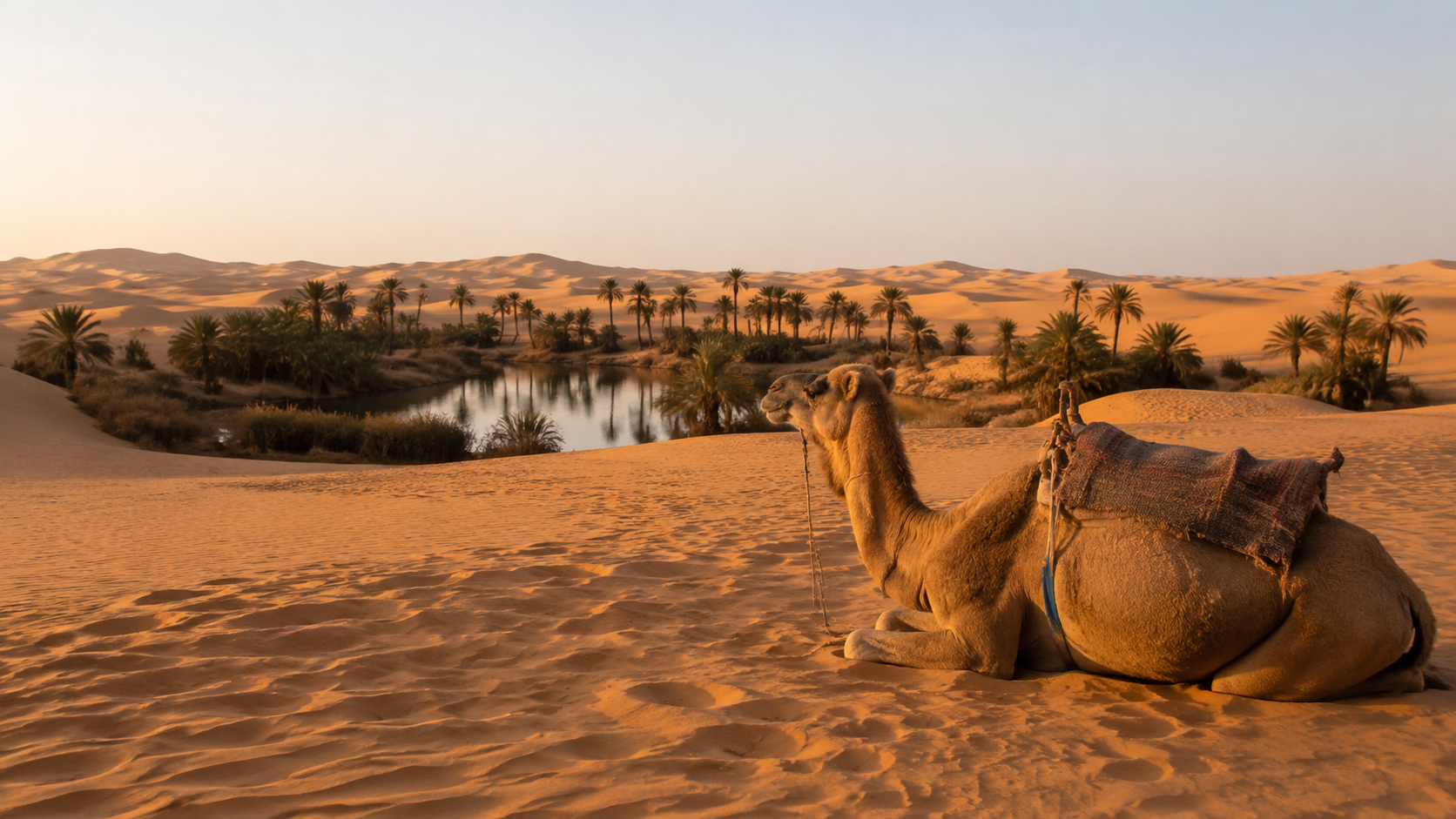
Djerba is an island of beaches and whitewashed villages, but it has a secret advantage that pure beach destinations lack: it sits at the doorstep of one of the most cinematic landscapes on earth. Cross the ancient Roman causeway to the mainland and within a couple of hours you’re among troglodyte houses dug into the earth, Berber villages clinging to mountaintops, and the first golden dunes of the Sahara. For a traveller who came for the sea but wants one day that stays with them forever, the desert south is right there.
These are the day trips worth taking from Djerba, what each one offers, and the honest truth about distances and logistics.
Matmata: the underground village (and Star Wars)
The closest of the great southern excursions, Matmata is famous for its troglodyte dwellings — homes carved down into the soft earth around sunken courtyards, a form of desert architecture developed over centuries to escape the heat. It’s also a pilgrimage site for film fans: the Sidi Driss Hotel, a real troglodyte structure, served as the Lars homestead — Luke Skywalker’s boyhood home — in Star Wars, and you can step inside the very rooms.
Matmata makes a comfortable day trip from Djerba, often combined with the mountain villages or folded into a longer desert loop. It’s the gentlest introduction to the strangeness and beauty of the Tunisian south.
Tataouine and Chenini: the Berber mountain country
Push further inland and you reach the Dahar region, a landscape of bare ridges and hilltop villages that feels like another planet — which is partly why the Star Wars production borrowed the name Tataouine for an entire world. The town of Tataouine itself is a market crossroads, but the real reward is nearby Chenini: a Berber village built vertically into a mountainside, its houses and a startlingly white mosque folded into the rock, with views across the plains that make the climb (hot work in summer) entirely worth it.
This is a longer haul — roughly 130 to 160 kilometres each way from the island — so it’s a full day, and the most rewarding way to do it is with the kind of granaries (ksour), hilltop hamlets, and lunar valleys that reveal themselves slowly between the headline stops.
Ksar Ghilane: the oasis at the edge of the Sahara
If you only do one desert trip and you want the desert — real dunes, a hot spring, the silence of the sand — Ksar Ghilane is the answer. It’s an oasis on the fringe of the Grand Erg Oriental, the great eastern sand sea, with a natural hot spring you can swim in, the ruins of a Roman fort nearby, and dunes stretching to the horizon. The classic experience here is a camel ride into the sand (a quad bike is the noisier alternative), a soak in the warm spring, and lunch at the foot of the dunes.
Ksar Ghilane is doable as a long day trip from Djerba with an early start, though it’s far enough that many travellers prefer to fold it into a two-day tour with an overnight in a desert camp under the stars. If your appetite is for the deep Sahara rather than the island’s gentler edges, this is the trip — and it connects naturally to Carthage Magazine’s guide to camel trekking and Sahara desert tours.
Douz: the gateway to the dunes
Sometimes called “the gateway to the Sahara,” Douz sits where the cultivated land gives way to open desert, and its market and dune-edge setting make it another classic jumping-off point for camel treks and dune excursions. It’s reachable as a day trip from Djerba with an optimised schedule, though like Ksar Ghilane it rewards the traveller willing to give it an overnight.
On the island itself: the easy half-days
Not every worthwhile trip involves crossing to the mainland. Djerba itself offers a full roster of half-day outings — the pottery village of Guellala, the markets of Midoun and Houmt Souk, El Ghriba synagogue and the Djerbahood murals of Erriadh, the crocodile farm at Djerba Explore, and the wild western beaches. For the full menu of on-island experiences, see Carthage Magazine’s guide to things to do in Djerba. These pair well with the bigger desert excursions: a hard day in the south, then an easy island day to recover.
The honest logistics: how to actually do these trips
Here’s the practical reality. The desert day trips from Djerba are long, the distances are real, and the destinations — oases, mountain villages, dune camps — are not places you reach by public transport or by flagging a taxi. Tour operators sell group excursions in shared minibuses, which are the cheapest option but mean fixed schedules, a coach full of strangers, and waiting around at each stop.
The alternative, and for many travellers the better one, is a private driver. For the on-island half-days especially — Guellala, the beaches, the synagogue, the souks — a local driver who knows the timing and the backroads turns a logistical puzzle into a relaxed day at your own pace. Marwen Gzam, born and raised on Djerba, builds custom full-day and half-day itineraries around exactly what you want to see, in a comfortable air-conditioned car, with the price agreed up front over WhatsApp (+216 98 617 679) — no group, no convoy, no waiting.
For the deep-desert overnights to Ksar Ghilane or Douz, a specialised 4×4 Sahara operator is the right tool; for everything on the island and the nearer mainland stops, a trusted private driver is hard to beat. Either way, since Djerba has no ride-hailing apps, arranging your transport in advance is the difference between a smooth day and a stranded one.
The bottom line
The beaches are why most people come to Djerba. The day trips are what they talk about when they get home. Whether it’s the underground houses of Matmata, the vertical village of Chenini, or a swim in a hot spring at the edge of the Sahara, the island’s great advantage is that the extraordinary south is close enough to taste in a single day. Pick one, start early, sort your transport in advance — and give the desert its due.
From the Carthage Magazine Bookshelf
If a Djerba trip is taking shape — beaches one day, the desert the next — three Carthage Magazine ebooks were built for the days between arrival and departure:
- All About Tunisia — the definitive English-language traveller’s guide. 572 pages, 27 chapters, all nine regions, every UNESCO inscription, five thematic trails, and the practical answers — visa, currency, transport, etiquette — most travellers wish they’d had on the plane. $24.99 · PDF & EPUB
- Speak Like a Local — 200+ Tunisian Arabic phrases with native audio recorded in Tunis. The phrases for the taxi, the souk, the café, and the dinner table. $14.99 · PDF, EPUB, MP3
- The Authentic Tunisian Cookbook — sixty traditional recipes from the heart of North Africa. For when you get home and find yourself missing the food. $9.99 · PDF & EPUB
All three available as a bundle for $39.99 — guide, language, and food, delivered together.
