
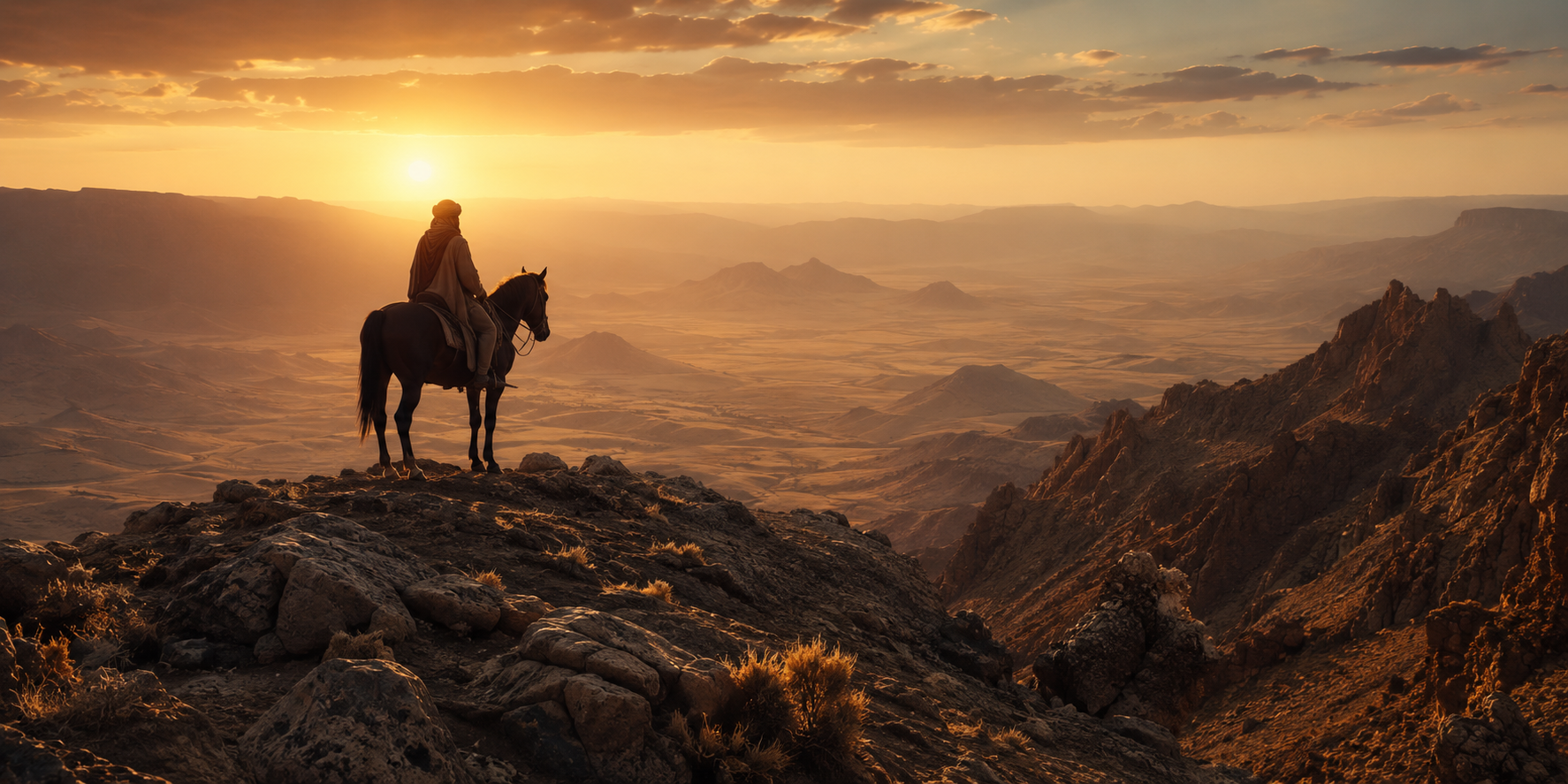
Quick Answer Al-Kahina — her real name was likely Dihya — was a 7th-century Amazigh (Berber) queen who led the last major resistance to the Arab-Muslim conquest of North Africa. From a base in the Aurès massif, on what is now the Algeria–Tunisia frontier, she united Berber tribes, defeated the Umayyad army around 698 CE, and ruled much of the Maghreb for several years before her final defeat and death. “Al-Kahina” — the soothsayer or the priestess — was the name her enemies gave her. Much of her story comes from Arab chroniclers writing centuries later, so it blends documented history with legend. She remains one of the most powerful and most contested symbols in North African memory: of indigenous resistance, of Amazigh identity, and of women’s power.
She has been called a priestess, a witch, a Jewish queen, a Christian queen, a freedom fighter, a sorceress, and the African Joan of Arc. She has been claimed by Amazigh nationalists, Tunisian and Algerian patriots, feminists, French colonisers, and Arab historians — each remaking her in the image they needed. Beneath all of it is a real woman who, thirteen centuries ago, did something almost no one else in her world managed: she stopped an empire, for a while.
Her name was Dihya. History remembers her as Al-Kahina. This is what we know, what we don’t, and why she still matters.
Who was Al-Kahina?
She was a queen and a war leader of the Amazigh — the indigenous people of North Africa, the ones who were here long before the Phoenicians built Carthage, before Rome, before the Arab conquest. The Amazigh are the deep substrate of the whole region, and Dihya is one of the figures their history turns on.
Her own name, in Tamazight, was Dihya (also rendered Damya, Daya, or Dahia). The name the wider world knows her by — Al-Kahina (الكاهنة) — is not a name at all but an epithet, an Arabic word meaning roughly the soothsayer, the diviner, or the priestess. It was given to her by her Arab adversaries, who attributed her uncanny success in battle to powers of prophecy: she was said to be able to foresee the enemy’s movements. Whether that reflected genuine belief, propaganda, or her own cultivated mystique, no one can now say. But the label stuck so hard that her actual name nearly disappeared beneath it.
She led the Jarawa, a tribe of the Zenata Berber confederation, from the Aurès mountains — a rugged massif in what is today eastern Algeria, close to the Tunisian border, and part of the same Amazigh world that stretches across the Maghreb into southern Tunisia.
The world she was born into
To understand Dihya, you have to understand the wave that was breaking over North Africa in her lifetime.
In the 7th century, the armies of the new Islamic caliphates swept westward out of Arabia and Egypt at astonishing speed, absorbing the old Byzantine provinces of North Africa one by one. The Amazigh kingdoms and confederations of the interior — heirs to a history that ran back through Rome and Carthage to the Numidian kings — stood in the path of that expansion.
Resistance had a first great leader in Kusayla, a Berber chieftain who inflicted serious defeats on the Arab advance before being killed in the 680s. When he fell, the mantle of resistance passed, extraordinarily for the age, to a woman. Dihya took command of the Amazigh confederation and became the central obstacle to the Umayyad conquest of the Maghreb.
The warrior queen
Around 698 CE, the Umayyad general Hassan ibn al-Nu’man, fresh from finally taking Carthage from the Byzantines, marched inland to break the Berber resistance. He met Dihya’s forces — and lost.
At the battle remembered as Meskiana (sometimes placed on the Oued Nini), Dihya’s coalition routed the Arab army so completely that Hassan was forced to retreat all the way back to Cyrenaica, in modern Libya, and wait. For roughly five years afterward, Dihya was the effective ruler of much of the Maghreb — a Berber queen holding the line against the most dynamic military power of the age. In an era that produced few women rulers anywhere, she governed a confederation and commanded its armies in the field.
It is the high point of her story, and the reason she became a legend rather than a footnote.
The scorched-earth decision
Then came the choice that made her tragic.
Dihya, the tradition holds, concluded that the Arabs were not after the land for its own sake but for its cities, its wealth, and its plunder. So she made a brutal strategic calculation: if there were nothing left worth taking, the invaders would have no reason to come. She ordered a scorched-earth campaign across Ifriqiya — burning towns, felling orchards, destroying the settled wealth of the region to make it worthless to a conqueror.
It was a catastrophic misreading of her own people. The nomadic tribes of the interior could absorb such a policy; the settled populations — the farmers, the townspeople, the old Romano-African and Christian communities of the coast and the plains — could not. They depended on exactly the cities and orchards she was destroying. Many turned against her. When the decisive moment came, the support she needed had been burned away with the fields.
The last stand
Hassan ibn al-Nu’man returned, reinforced and patient, around 701–703 CE. This time the disaffected populations did not rally to Dihya, and some actively aided the Arabs. Her coalition broke.
Knowing the end was near, she is said to have done something that complicates every heroic retelling: she sent her two sons to the enemy camp, instructing them to convert and join the Arab army, so that her line — and her people — would survive her defeat. Then she rode out to fight.
She died in battle, by most accounts, somewhere in the eastern Maghreb. Tradition places her death at a desert well thereafter called Bir al-Kahina, the Well of the Kahina; some accounts locate her last stand further east, in what is now Tunisia, where she is claimed as part of the country’s deep story. Her head, the chroniclers say, was sent to the caliph in Damascus as proof. Her sons lived, converted, and led Berber troops into the new order — which is, in its bitter way, the reason her descendants and her legend both endured.
With her death, organised Amazigh resistance to the conquest effectively ended. North Africa entered its long Arab-Islamic chapter. But the region never forgot the queen who had nearly stopped it.
Fact, legend, and the problem of the sources
Here is the honest part, and it matters.
Almost nothing about Dihya was written down in her own time. The detailed accounts we have come from Arab historians writing centuries later — most influentially the great 14th-century scholar Ibn Khaldun, some seven hundred years after her death, along with earlier chroniclers like al-Maliki. Everything vivid about her — the prophecy, the scorched earth, the sons sent to the enemy, the well — reaches us filtered through generations of retelling, by writers from the very tradition she fought, each with their own purposes.
This means her biography is part history, part legend, and the two are now almost impossible to fully separate. Even the most basic facts are contested:
- Her religion is genuinely unknown. Sources variously make her a Jew, a Christian, or a follower of traditional Berber religion. The popular image of a “Jewish warrior queen” rests largely on a remark by Ibn Khaldun that her tribe, the Jarawa, may once have been Judaised — a claim historians treat with caution. The truth is that we do not know what Dihya believed.
- Her age and reign are inflated in the sources to legendary proportions (one tradition gives her a 127-year life), which tells you how quickly history shaded into myth.
- The geography of her battles and death shifts from one account to another.
None of this makes her unreal. It makes her a real person around whom a great legend grew — which is exactly what happens to figures who matter.
The many faces of Al-Kahina
Part of what makes Dihya so fascinating is that almost everyone who has told her story has used her for something.
To Amazigh nationalists, she is the supreme symbol of indigenous North African identity and resistance to outside domination — her image and name appear across the modern Amazigh cultural revival. To Algerians and Tunisians alike, she is a patriotic ancestor, an early figure of resistance to invasion. To feminists across the Maghreb, she is proof that a woman led armies and ruled here thirteen centuries ago, and a rebuke to anyone who claims female power is foreign to the region.
She has also been claimed by people who had no business claiming her. French colonial writers seized on her as a convenient anti-Arab, anti-Islamic heroine — a way of suggesting that “real” North Africa had always resisted the Arabs, and might welcome a new European master. Arab-nationalist narratives, conversely, sometimes minimised her. The “Jewish queen” tradition has been embraced and amplified by those who wanted a Jewish heroine in North African history.
A single woman, pulled in every direction by everyone who came after — which is its own kind of proof of how much she still means.
Where to feel her world in Tunisia
You cannot visit Dihya’s palace; there isn’t one to visit. But the world she came from is alive in Tunisia, and you can feel it.
It lives in the country’s Amazigh heritage — the Tamazight-speaking villages of the south around Tataouine and Matmata, the hilltop ksour, the faces and place-names of the whole country. It lives in the hands of the women of Sejnane, who still shape and fire clay figurines by a method three thousand years old — an unbroken thread of Amazigh women’s craft running straight back past Dihya’s time. And it sits within the larger story of the women who built Tunisia, from the Carthaginian Dido who founded the city to the goddess Tanit whose sign Tunisia has never stopped drawing.
Dihya belongs in that company: not a Tunisian in the modern sense — the borders did not exist — but a daughter of the same Amazigh land, claimed across the Maghreb, and woven deep into the story of this corner of it.
Why she still matters
Thirteen hundred years on, Al-Kahina endures because she sits at the hinge of North African history — the last great stand of the old indigenous world against the wave that would reshape it — and because she did it as a woman, at the head of an army, in an age that gave women almost no such room.
The legend has grown thick over the history, and the honest reader should hold both at once: a real Amazigh queen who beat an empire and then lost everything, and a symbol so potent that everyone since has wanted to own her. The Amazigh have the strongest claim. But she belongs, in the end, to the land itself — and the land is still here, still speaking some of her language, still drawing her people’s signs on its walls.
Dihya lost her war. She has been winning the memory ever since.
From the Carthage Magazine Bookshelf
If Dihya’s North Africa is the part of Tunisia you want to understand, three Carthage Magazine ebooks were built for the traveler who wants the real cultural keys:
- All About Tunisia — the definitive English-language traveler’s guide. 572 pages, 27 chapters, all nine regions, every UNESCO inscription, five thematic trails — including the deep Amazigh south where the old world is still living. $24.99 · PDF & EPUB
- Speak Like a Local — 200+ Tunisian Arabic phrases with native audio recorded in Tunis. The language layered over the older Amazigh ground — for the taxi, the souk, the café, and the dinner table. $14.99 · PDF, EPUB, MP3
- The Authentic Tunisian Cookbook — sixty traditional recipes from the heart of North Africa, many of them Amazigh at the root. $9.99 · PDF & EPUB
All three available as a bundle for $39.99 — guide, language, and food, delivered together.
