• About Us
  • Readers Write
Carthage Magazine
  • Home
  • News
  • Food & Drinks
    • Taste Tunisia
  • People
    • Interviews
    • No Sugarcoating
    • Environment
  • Style & Travel
    • Attractions
    • Trip Planning
      • Travel Information
      • Hotels in Tunisia
      • Cost of Living
      • Tunisia’s Language
      • Tunisia’s Weather
      • Tunisia’s Currency
      • Tunisia’s Visa
    • Transport in Tunisia
      • Traveling Around
      • Local Transport
      • Flights to Tunisia
      • Ferries to Tunisia
      • Tunisia Overland
    • Things to Do
      • Leisure
  • Local History
    • Museums
    • Monuments
    • Heritage Sites
    • Historical Figures
  • Education
  • Innovation
  • Editors’ Picks
No SugarcoatingPeople

Op-Ed: The Erasure of El Hara!7 min read

By Contributing Editor April 7, 2022
Written by Contributing Editor April 7, 2022
Brusk Djerbahood

Written by: Rafram Chaddad

Yes, I am amazed each time I return to the Hara, looking at the walls of my own life, only to run into another giant colorful painting from some Brazilian/British artist. These works are getting bigger and bigger, transforming the Hara into a Luna park that might excite some tourists, but is deleting my old world.

I am propelled to express my opinion on the Djerbahood project in the Hara Sghira, the small Jewish quarter on the island of Djerba off the coast of Tunisia. Not only because I was born there, a place in which my mother’s family has lived for the past 2700 years, but because I am a visual artist who works primarily in non-commercial spaces and has even done a small mural of a hand holding five fish, known for fighting the evil eye in our Djerbian tradition.

When I paint it on a new house entry in Djerba, the work gains quasi-functional quality. I have also worked for some time now on memories of women in my family and how generational trauma has been passed down through their experiences.

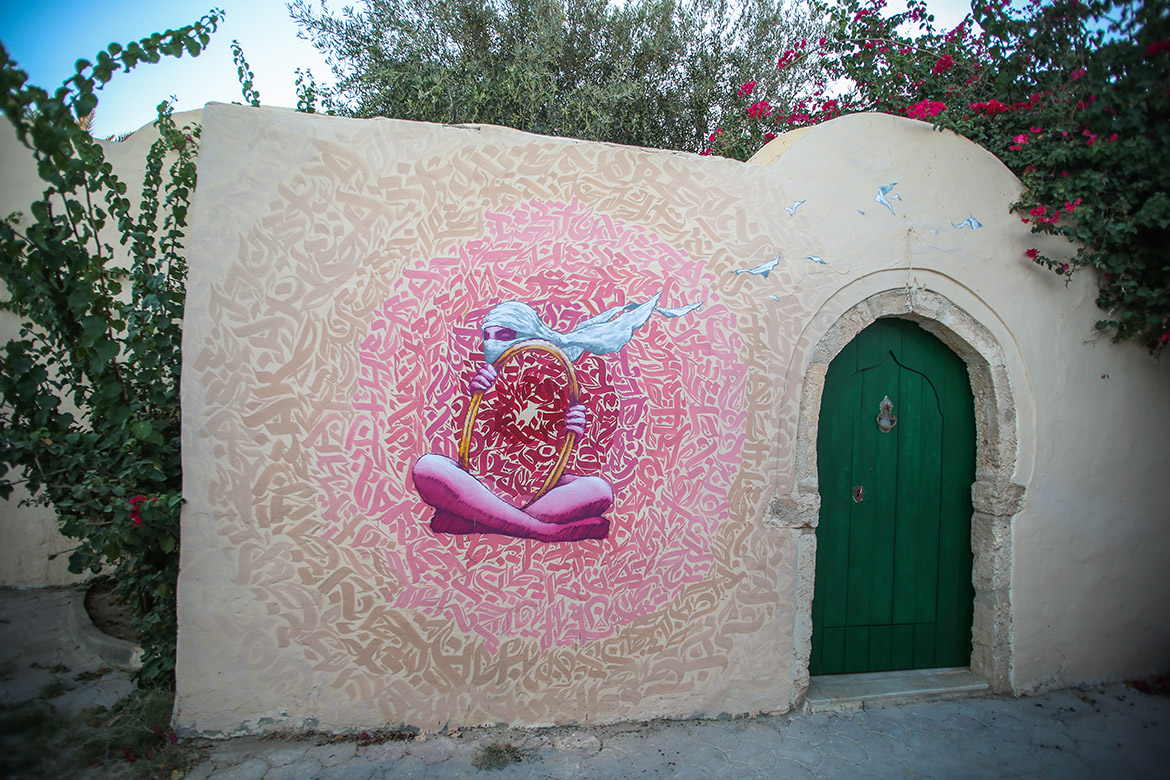
Brusk Djerahood
Work of art by Brusk part of Djerbahood project. Photos taken from djerbahood.com/portfolio/brusk

Djerbahood is a ‘street art project carried out on houses in the Hara Sghira. Mural artists from all over the world were brought in to paint on the walls of the old Hara. This project receives generous support from the EU, the Tunisian art establishment, and the culture ministry. In terms of tourism, this project has been a success. Buses stop there now, on the way to the nearby famous El Ghriba synagogue. They stop, snap photos of the murals, buy maybe a giant amphora with the same painting, and continue on their way.

The history of murals and street has a rich history of political, activism, and social justice. From Mexico City, Belfast, East Berlin, New York City, and the separation wall in Palestine. in Tunisia, the situation is such that the visual art scene is not reflective, personal, or critical, but rather decorative or modernist.

The history of this art practice should be studied, but colonialism, dictatorship, and today’s agents of orientalism want mostly to enjoy the savage beauty rather than deal with our life. Tunisia is a country that is starving for a critical, kicking, and bold visual art scene and a similar street art scene.

Instead, murals projects like Djerbahood and recently in Djebel Jelloud are decorating the houses, claiming they promote them. Local visual artists are also working on these projects without other support, while heavy budgets for art are mainly moving towards these projects.

These projects claim to make poor areas more attractive. But for whom? Perhaps, rather than painting a mural on the walls of poor neighborhoods, you paint the houses white and arrange the trash, benches, and green areas. If you are an artist, you research and connect to the DNA of the place, and you do some work related to it. You don’t arrive at a location and ask the poor inhabitants rhetorically if you can paint on their houses because people with less luck in life can’t answer no. The assumption that you improve people’s lives by painting cats in their homes is almost degrading. That’s not what street art is. It’s decorative art.

Djerbahood could be a thoughtful project if they were to use research-based art practices. That is, learning the history of the Hara, working with the locals, and creating some art intervention that doesn’t simply paint on people’s houses and delete the historical identity of this place.

Photos from an old Synagogue in El Hara in Djerba. Taken by Rafram Chaddad.
Photos from an old Synagogue in El Hara in Djerba.
Photos from an old Synagogue in El Hara in Djerba. Taken by Rafram Chaddad.

The Hara is not an abandoned factory or a police station that calls for street artists to show their skills and opinions. It’s an inhabited space with one of the oldest communities on the planet. It’s too easy, especially for the Europeans who sponsor it, to look at this kind of project as a charity, a way to improve the life of locals. Still, without genuinely engaging the people who live in the neighborhood, it’s but another orientalist project.

Yes, I am amazed each time I return to the Hara, looking at the walls of my own life, only to run into another giant colorful painting from some Brazilian/British artist. These works are getting bigger and bigger, transforming the Hara into a Luna park that might excite some tourists, but is deleting my old world.


*The opinions and ideas expressed in this article do not reflect the views of Carthage Magazine’s editorial team. To submit an opinion article, please email info@carthagemagazine.com. Learn more.


If you would like to comment on this article or anything else you have seen on Carthage Magazine, leave a comment below or head over to our Facebook page. You may also message us via this page.

And if you liked this article, sign up for the monthly features newsletter. A handpicked selection of stories from Carthage Magazine, delivered to your inbox.


Born on the island of Djerba off the coast of Tunisia, Rafram Chaddad (b. 1976) is an artist whose photographs, films, and multi-media installations rethink the archive, migration narratives, and what it means to belong. His work makes the familiar strange and the strange familiar. Chaddad is currently working on Leftovers, a book project investigating how food practices in cities formerly occupied by the Ottoman Empire are inter-connected. The book highlights recipes particular to each place and oral histories around food-making that challenge the nationalization of food and encourage us to approach food as a shared experience.

Working between Tunis and New York, Rafram’s work reflects on his personal life experiences and comments on broader socio-political issues including migration and displacement, identity and belonging. Over the past twenty years, he’s created dozens of short films and installations, which have exhibited worldwide in cultural institutions, galleries, and museums.

Since 2021 Chaddad has been a guest critic in the MFA program of Columbia University.

0 comment
4
FacebookTwitterEmail
Contributing Editor

Contributing Editor account at Carthage Magazine. Tunisia's premier English general-interest Magazine with thousands of page-views per month and over 200,000 social media followers.

previous post
Why I Moved Back to Tunisia – For Good
next post
Ancient Roman Town of Mactaris (Makthar)

Related Articles

Tunisia Emerges as Global Leader in Organic Olive...

March 30, 2026

حق الملح: A Tunisian Tradition of Appreciation and...

March 21, 2026

How to Stick to a Healthy Iftar Table...

February 26, 2026

Guide to Spending a Tunisian-Spirited Ramadan Alone Abroad

February 26, 2026

9 Things to Know about Ramadan in Tunisia

February 26, 2026

Maison de l’Île: Where Timeless Elegance Meets Comfort

February 5, 2026

Tunisia’s Dam Levels Still Hover at 32–33% Capacity

January 21, 2026

People Wake Up to Damages as Storm Harry...

January 20, 2026

Population Decline in Tunisia: A Looming Demographic Crisis

January 19, 2026

Why I AM K2 Is Sparking Widespread Debate...

January 15, 2026

Leave a Comment Cancel Reply

Save my name, email, and website in this browser for the next time I comment.

Flavors of Tunisia

Taste-Tunisia-Tunisian-Cuisine-3

Want more top stories?

Carthage Magazine Newsletter

Sign up today and you’ll get our latest stories delivered straight to your inbox.

Just For You

  • 1

    April 9th, Tunisian Martyrs’ Day 🇹🇳

    April 2, 2025
  • 2

    Fruits From Tunisia: 15 Tunisian Fruits to Eat When Traveling

    August 20, 2023
  • 3

    Alcohol in Tunisia: What Visitors Need to Know

    August 2, 2021
  • 4

    Top 3 Largest Colosseums Around the World

    October 4, 2024
  • 5

    ChatGPT’s Logo Inspired by a 2200-Year-Old Mosaic from Tunisia

    January 13, 2026

Latest

  • UNESCO World Heritage Sites in Tunisia

  • Tunisia Leads Global Ranking in STEM Graduates

  • Tunisia: Sharp Declines in Marriages & Births Between 2019 and 2023

  • Tunisia Inaugurates Four Solar Power Plants in Medenine

Sections

  • Editors' Picks
  • Education
  • Environment
  • Food & Drinks
  • Innovation
  • Local History
  • News
  • No Sugarcoating
  • People
  • Quizzes
  • Style & Travel
  • Things to Do
  • Videos

E᙭ᑭᒪOᖇE

Carthage Magazine

We’re on a mission to create content that inspires people about experiences, places, products and people in Tunisia!


— About Us

— Media Kit

— Adverstising

— Transparency

— Contact Us

Facebook Twitter Instagram Linkedin Youtube

ᗯᗩᑎT ᗰOᖇE TOᑭ ᔕTOᖇIEᔕ?

Carthage Magazine Newsletter

Sign up today and you’ll get our latest stories delivered straight to your inbox.

ᔕᑭᖇEᗩᗪ TᕼE ᗯOᖇᗪ

Spread the word

Our goal is to get these stories out in the public arena, and by doing this, keep promoting Tunisia and changing attitudes towards the MENA region.


— Ambassadors

— Readers Write

— What You Can Do to Help

EᗪITOᖇᔕ’ ᑭIᑕKᔕ

  • UNESCO World Heritage Sites in Tunisia

    April 28, 2026
  • Octopus Barley Soup “Tchich” — Tunisia’s Favorite Ramadan Soup

    February 26, 2026
  • 9 Things to Know about Ramadan in Tunisia

    February 26, 2026

© 2019 - 2026 Carthage Magazine. Privacy Policy

Carthage Magazine
  • Home
  • News
  • Food & Drinks
    • Taste Tunisia
  • People
    • Interviews
    • No Sugarcoating
    • Environment
  • Style & Travel
    • Attractions
    • Trip Planning
      • Travel Information
      • Hotels in Tunisia
      • Cost of Living
      • Tunisia’s Language
      • Tunisia’s Weather
      • Tunisia’s Currency
      • Tunisia’s Visa
    • Transport in Tunisia
      • Traveling Around
      • Local Transport
      • Flights to Tunisia
      • Ferries to Tunisia
      • Tunisia Overland
    • Things to Do
      • Leisure
  • Local History
    • Museums
    • Monuments
    • Heritage Sites
    • Historical Figures
  • Education
  • Innovation
  • Editors’ Picks
Carthage Magazine
  • Home
  • News
  • Food & Drinks
    • Taste Tunisia
  • People
    • Interviews
    • No Sugarcoating
    • Environment
  • Style & Travel
    • Attractions
    • Trip Planning
      • Travel Information
      • Hotels in Tunisia
      • Cost of Living
      • Tunisia’s Language
      • Tunisia’s Weather
      • Tunisia’s Currency
      • Tunisia’s Visa
    • Transport in Tunisia
      • Traveling Around
      • Local Transport
      • Flights to Tunisia
      • Ferries to Tunisia
      • Tunisia Overland
    • Things to Do
      • Leisure
  • Local History
    • Museums
    • Monuments
    • Heritage Sites
    • Historical Figures
  • Education
  • Innovation
  • Editors’ Picks
© 2019 - 2026 Carthage Magazine. Privacy Policy

Read alsox

5 Things Tunisians Will Never Say Sorry...

September 30, 2025

Tawhida Ben Sheikh, North Africa’s First Woman...

February 2, 2024

5 Things are Normal for Tunisians but...

July 15, 2019