
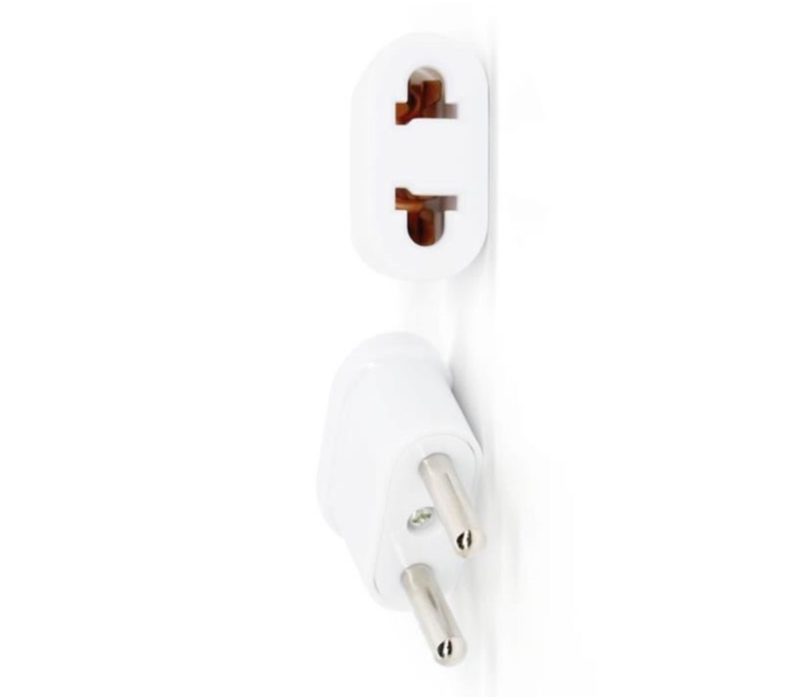
The first thing most visitors do in a Tunisian hotel room, before the curtains or the view, is crouch beside the bedside table with a phone charger in one hand and squint at the wall. What they find is a round, recessed socket with two holes and a small metal pin sticking out of it, which is either instantly familiar or faintly alarming depending on where they flew in from. For a French or Belgian traveler it is home. For a Briton it is the moment they remember the adapter is still in a drawer in Leeds. For an American it is that, plus a flicker of worry about whether the hairdryer is about to catch fire.
Here is everything the socket is trying to tell you, plus the part no adapter guide mentions: what to do when the power goes off, which, in a Tunisian summer, it now reliably does.
The short answer
Tunisia runs on 230 volts at 50 hertz and uses the French-style two-pin sockets known as Type E, with older Type C sockets still common in cheaper hotels and private homes. Any plug that works in France works here. Travelers from the UK, Ireland, the United States, Canada, Australia and most of Asia need a simple plug adapter, and nothing more for phones, laptops and cameras, which are all built for 230 volts. The only things that need thought are high-wattage heat appliances from 110-volt countries, and even those are easier to leave at home than to convert.
The sockets, explained
Type E is the socket you will meet in every hotel built or refurbished since the 1990s: two round holes 19 millimetres apart, with an earth pin protruding from the socket itself that slots into a hole in the face of the plug. Type C is its ungrounded ancestor, the plain two-hole socket, and it survives in older guesthouses, medina dars, cafés and most private flats. Both take the same two-pin plug; the difference is only whether the earth connects.
That matters for one group in particular. The German-style Schuko plug, Type F, which is what most of Europe outside France and Britain uses, comes in two versions. The modern hybrid, moulded with both side clips and a hole for the French earth pin, fits a Tunisian Type E socket perfectly, and it is what almost every appliance sold in Europe in the last twenty years carries. An older, pure Schuko plug without that hole will not go in, because the earth pin is in the way. If your device is more than two decades old or came from a German flea market, check the face of the plug before you fly.
Flat-pinned plugs from the Americas and Japan, the three-pin rectangular plugs of Britain and Ireland, and the angled flat pins of Australia and New Zealand all need an adapter, and only an adapter. Buy the small, country-specific kind rather than the universal brick; it costs a few pounds or dollars, fits into recessed sockets that the universal ones often cannot reach, and weighs nothing. Bring two. One will spend the trip behind the bedside table and the other will live in your day bag.
Voltage: the hairdryer question
Almost everything you will plug in, including phone and laptop chargers, camera batteries, electric toothbrushes, e-readers and shavers, is dual-voltage, marked somewhere on the brick with “INPUT 100–240V”. Those devices need nothing but the adapter. The exceptions are appliances that make heat: hairdryers, straighteners, curling tongs and travel kettles from the United States, Canada or Japan, where mains power is 100 to 120 volts. Plugged into Tunisian 230 volts without a converter, a single-voltage hairdryer will run briefly, very hot, and then die, sometimes with a smell that gets the hotel’s attention.
A voltage converter for a 1,500-watt hairdryer is heavy and unreliable, and the sensible alternatives are to buy a dual-voltage travel dryer, or to use the one in the room. Hotels from three stars up supply a hairdryer as standard, usually screwed to the bathroom wall; straighteners are not supplied, so pack a dual-voltage pair if you need one. Everyone from Europe, Britain, Australia and most of Africa and Asia is already on 220–240 volts and can ignore this section entirely.
In the room
The newest resort hotels along the coast and the better Tunis business hotels have started fitting USB sockets by the bed, which spares you the adapter dance for phones. Do not count on it; most rooms still offer one or two Type E sockets, often in inconvenient places, and sharing them between a phone, a camera and a laptop is the small nightly negotiation of travel here. A compact multi-plug with two or three outlets and USB ports, bought at home, turns one awkward socket into enough for everyone. The packing list has the rest of the hardware.
If you arrive without an adapter, you are not stuck. Electronics shops in any town, the hypermarkets, and the small souvenir shops inside resort hotels all sell cheap two-pin adapters for British and American plugs; expect to pay a few dinars, more in the hotel shop. Mobile-phone shops, which are everywhere, sell USB chargers with Tunisian plugs for the same money, and a replacement cable if yours has died.
When the power goes off
This is the part the adapter guides skip, and the part a visitor is most likely to remember. Tunisia generates nearly all its electricity from natural gas, most of it imported from Algeria, through a utility, STEG, that is deeply in debt and running close to its ceiling. In July 2026 national demand hit a record 6,000 megawatts against available capacity of around 4,400, and the state turned to rolling load-shedding across every region of the country to avoid a repeat of the nationwide blackout of September 2023. The cuts began as afternoon interruptions and, by late August, were arriving in two daily windows, early afternoon and late evening, lasting up to two hours. We covered the blackout summer as it happened and explained why August is built into the problem. Outside summer, the grid is stable and a cut is a rare, short-lived nuisance.
Most tourists noticed less than you would expect. The large resort hotels and the serious Tunis hotels have diesel generators that kick in within seconds, and the main casualty was a flicker of the lights and a pause in the lift. The experience is different in a medina guesthouse, a rented apartment or a small hotel in the interior, where a cut means no air-conditioning, no Wi-Fi, no lift, and, because the building’s water pump has stopped too, sometimes no water pressure. Ask when you book whether there is a generator. The hotels guide explains what the star ratings actually buy you.
A few habits make a summer cut painless. Charge everything whenever the power is on rather than overnight, because the overnight window is now one of the cut windows. Carry a power bank with at least 10,000 mAh, which covers a phone for two days; buy one at home, since those sold at Tunisian market stalls tend to be optimistic about their capacity. Keep mobile data as a backup for Wi-Fi: the prepaid SIM guide explains the options, and the mobile networks, which have their own backup power, usually stay up through a cut. If you work from a laptop, unplug it when the lights go out and plug it back in only once the power has steadied, because the return surge is harder on electronics than the cut itself; a small travel surge-protector is cheap insurance for anyone on a longer stay, and the digital nomad guide has more on working through it.
Off the grid by choice
In the far south, the question reverses. Desert camps at Ksar Ghilane and in the dunes beyond Douz run on solar panels and generators that are switched off at a fixed hour, and you should expect to charge a phone at the reception tent during the evening and not at all overnight. Arrive with everything full. The same applies to overnight stays in the troglodyte houses of Matmata and the ksour of Tataouine, where electricity is present but the sockets are few, ancient and shared; the desert guide has the practicalities for each kind of stay.
The one-paragraph version
Pack a French-style two-pin adapter, two if you can, and a small multi-plug with USB ports. Leave the single-voltage hairdryer at home. Charge things when the lights are on, carry a power bank in summer, and ask about the generator before you book anywhere smaller than a resort. Then stop thinking about it: Tunisia’s sockets are among the least of its surprises, and the country has far better things to hold your attention than the wall behind the bed.
From the Carthage Magazine Bookshelf
Once the charger is sorted, the trip itself is the easy part — and these three are what we’d load onto a full battery before takeoff.
- All About Tunisia — the definitive English-language traveler’s guide. 572 pages, 27 chapters, all nine regions, every UNESCO inscription, five thematic trails — and the practical answers (visa, currency, transport, etiquette) most travelers wish they’d had on the plane. $24.99 · PDF & EPUB.
- Speak Like a Local — 200+ Tunisian Arabic phrases with native audio recorded in Tunis. The phrases for the taxi, the souk, the café, and the dinner table. $14.99 · PDF, EPUB, MP3.
- The Authentic Tunisian Cookbook — sixty traditional recipes from the heart of North Africa. For when you get home and find yourself missing the food. $9.99 · PDF & EPUB.
All three available as a bundle for $39.99 — guide, language, and food, delivered together.
