
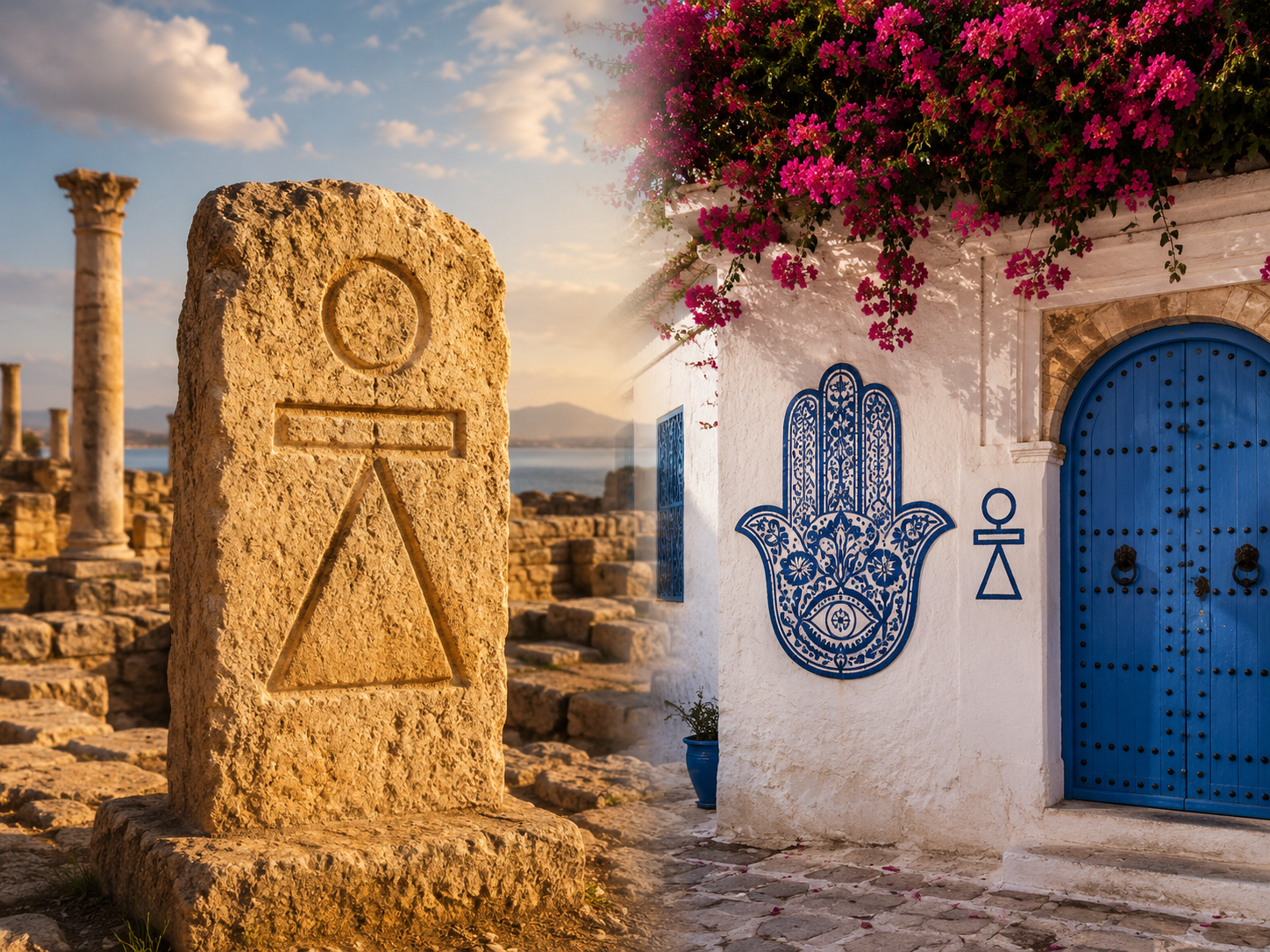
Quick Answer — Rome burned Carthage in 146 BCE, but it never managed to burn the habits. A surprising number of things Tunisians do today — a bridal rite, a children’s rain song, a word for untended farmland, the hand on the door, the bread oven in the courtyard, the courtyard itself — descend in a recognizable line from the Punic world of Tanit and Baal Hammon. Most Tunisians perform them without knowing their age. Here are the survivals, what the archaeology and folklore actually support, and where to see the originals.
Watch a Tunisian bride at the jelwa. She stands raised above the room, veiled, a candle burning at either side, and lifts her open palms while she turns — slowly, ceremonially, the guests ululating around her. Nobody in the room is thinking about the fifth century BCE. But stand afterwards in the Punic galleries of the Bardo, in front of the stelae lifted from the sanctuary of Carthage, and there she is: the same figure, arms raised, palms open — the posture of Tanit, the great goddess of Carthage, carved by hands that turned to dust more than two thousand years ago.
Tunisia is a country famous for its layers — Amazigh, Punic, Roman, Arab, Ottoman, French — and we usually describe the layers as if they were geological: each one sealed under the next. The truth is stranger. The oldest layer never stopped moving. It survives not in ruins but in gestures, words, ovens, and floor plans — practiced daily by people who would be astonished to learn what they are quoting. This is a field guide to living Carthage.
The Jelwa: A Bride in the Posture of a Goddess
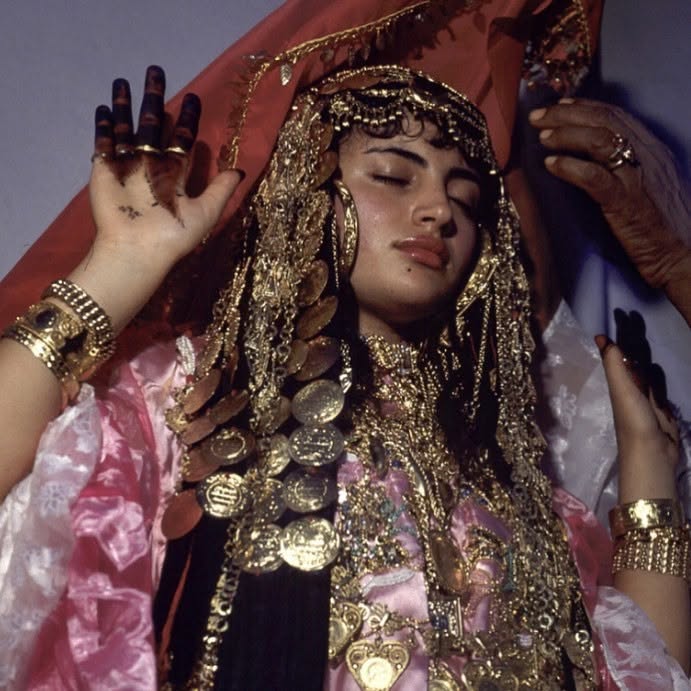
The jelwa is the display of the bride — the moment, in the long arc of a Tunisian wedding, when she is presented in ceremonial dress, often veiled, often turning slowly on a platform with her hands raised and open, candles carried around her. It survives across the country and across North Africa, absorbed comfortably into Muslim weddings for fourteen centuries.
The reading many Tunisian folklorists give it is older. In Carthage, marriage sought the blessing of the city’s great goddess — Tanit, heir of the Levantine Astarte — and the raised-palm, arms-lifted posture at the heart of the jelwa mirrors, with uncanny precision, the goddess’s canonical pose on thousands of votive stelae: the open hands that ask for blessing and fertility. On this account, the jelwa began as exactly that — a bride’s request to Tanit to bless the marriage — and kept the choreography long after it lost the theology. Honesty requires the caveat: this is attribution, not excavation; no inscription spells it out. But the resemblance is not subtle, and it belongs to a wedding cycle — the ceremonial hammam, the henna night — that is pre-Islamic from end to end.
The Amazigh communities of the south preserve an even more explicit echo: a documented bridal rite in which the bride alternately veils and reveals her face with her open hands — a gesture villagers themselves describe as the pose of Tanit, performed to promise fertility. Two traditions, one choreography, one goddess.
Omek Tangou: The Rain Doll That Is a Goddess
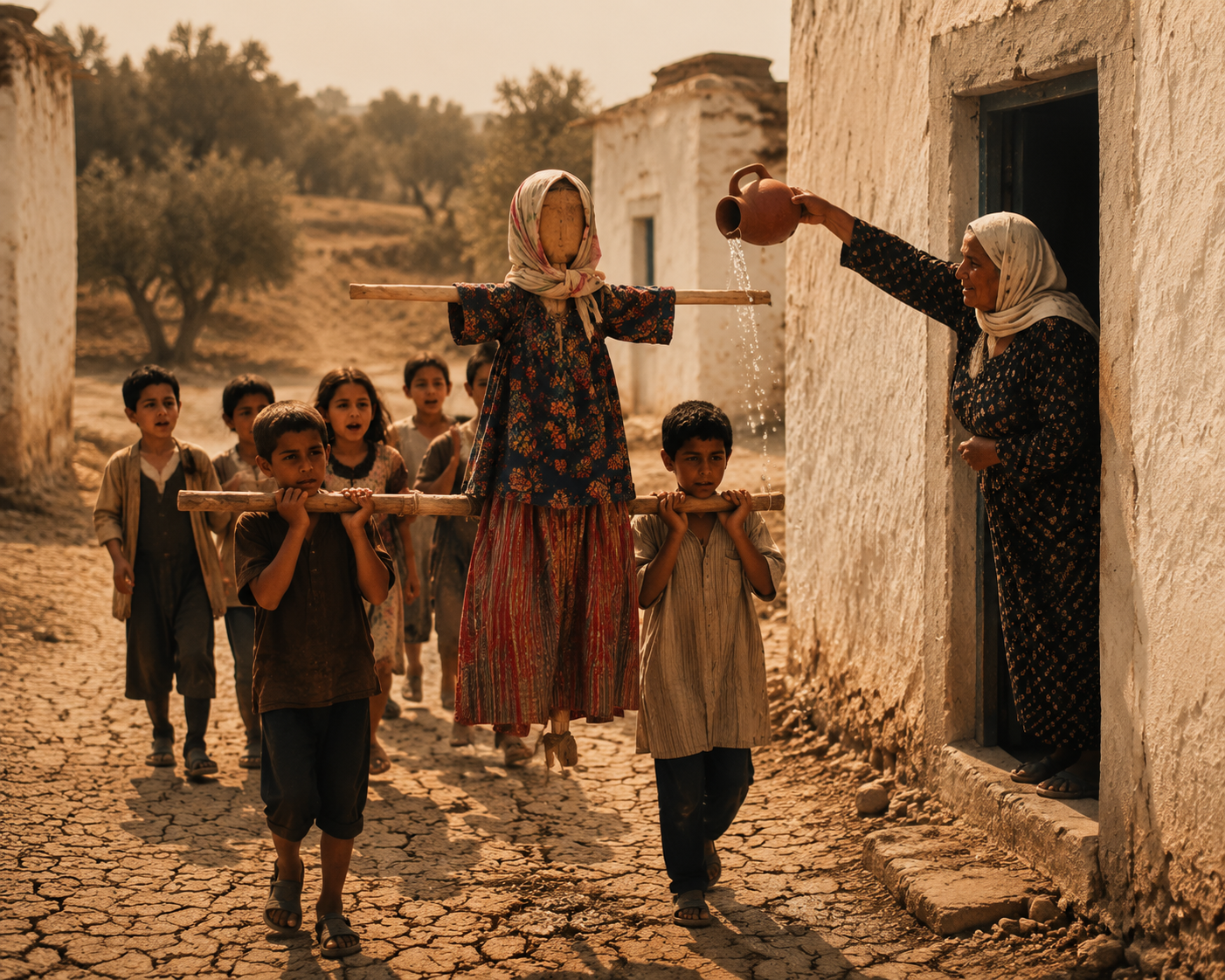
Here the lineage is not folk speculation. It is documented. Within living memory, when drought gripped a Tunisian village, the children would dress a wooden cross or a carved female head in women’s clothes and carry her from door to door, singing: Omek Tangou ya nsa, tolbet rabbi aal shta — “O women, Omek Tangou has asked God for rain.” At each threshold, a housewife poured water over the effigy. Then everyone shared a meal, and everyone waited for the sky.
Omek Tangou — “Mother Tangou” — is Tanit. The name barely changed. She was, among her many offices, the goddess of the rains that filled the wadis, consort of Baal Hammon, the weather-lord of Carthage; and for more than two millennia after her temples fell, Tunisian and Algerian villages went on carrying her through the streets when the rain failed, the invocation politely re-addressed to God while the goddess kept her procession. The rite is nearly extinct now — television and irrigation finished what the Romans and fourteen centuries of Islam never quite did — but Tunisians over a certain age remember singing it, with no idea they were performing the oldest continuously attested ritual in the country.
Ba3li: A Bronze Age God in Everyday Derja
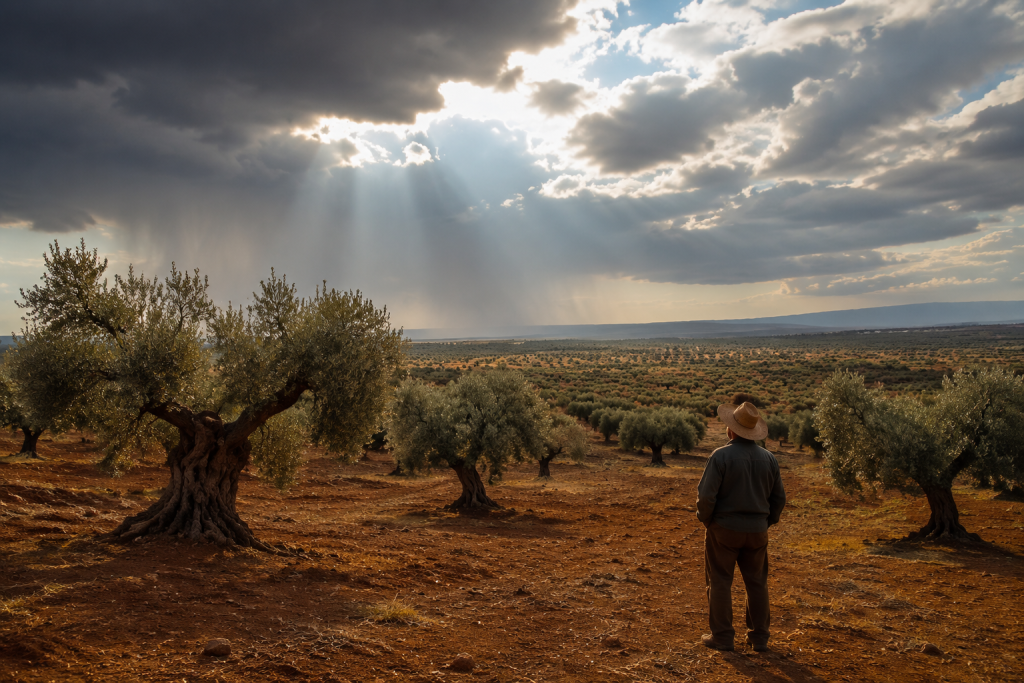
Ask a Tunisian farmer about an olive grove that gets no irrigation and he’ll shrug: ba3li — watered by nothing but the sky. The word has drifted, in city speech, toward anything left untended, to chance, to fate: it grew bel-ba3li, on its own, nobody’s doing.
The word is a god. Baal — “Lord” — was the great Northwest Semitic sky and storm deity, and in Carthage his face was Baal Hammon, king of the pantheon, master of weather and the fertility of the fields. Land watered only by rain was, in the most literal sense, land left to Baal. The idiom is at least as old as it sounds: the identical usage is attested in Hebrew, Phoenician’s sister language, as far back as the Mishnah in the second century CE — and the divine name itself is well over three thousand years old. Every time a Tunisian says something happened ba3li, a Bronze Age god collects a small, unnoticed tribute. The dialect carries other such fossils — Derja is a braid of Arabic, Amazigh, French, Italian, and a few stubborn threads of Punic — but none so widespread, or so divine, as this one.
The Khomsa on the Door
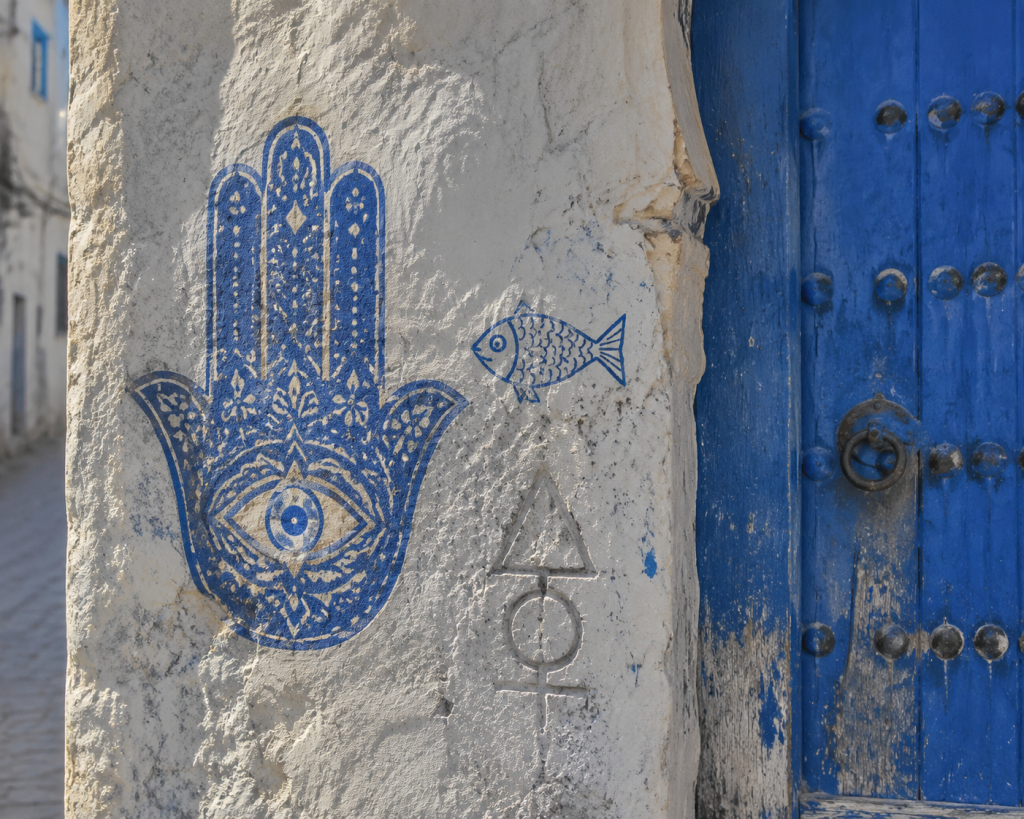
The open right hand — painted blue on doors, hung over cradles, worked into silver the length of the country — is Tunisia’s universal shield against the evil eye, and we’ve told its long story in our guide to the khomsa. What belongs in this article is the ancestry: some Tunisian scholars argue, with reasonable confidence, that the Hand of Fatima is the direct descendant of the sign of Tanit — the raised arms, the protective open palm, redrawn for a new religion with the job description unchanged.
Carthaginians incised her sign on tombstones and house walls to ask protection; Tunisians sketch the khomsa on doorways for precisely the same reason, inside a whole grammar of protective habits — the mashallah after a compliment, the fish drawn against envy, the fear of the admiring glance — whose deepest layers are Punic and Amazigh, not Arab. The fish deserves its own line: painted at weddings and on fishing boats, it is a fertility-and-protection symbol that predates Islam by many centuries and swims straight out of the Punic Mediterranean.
The Goddess in Clay and Ink
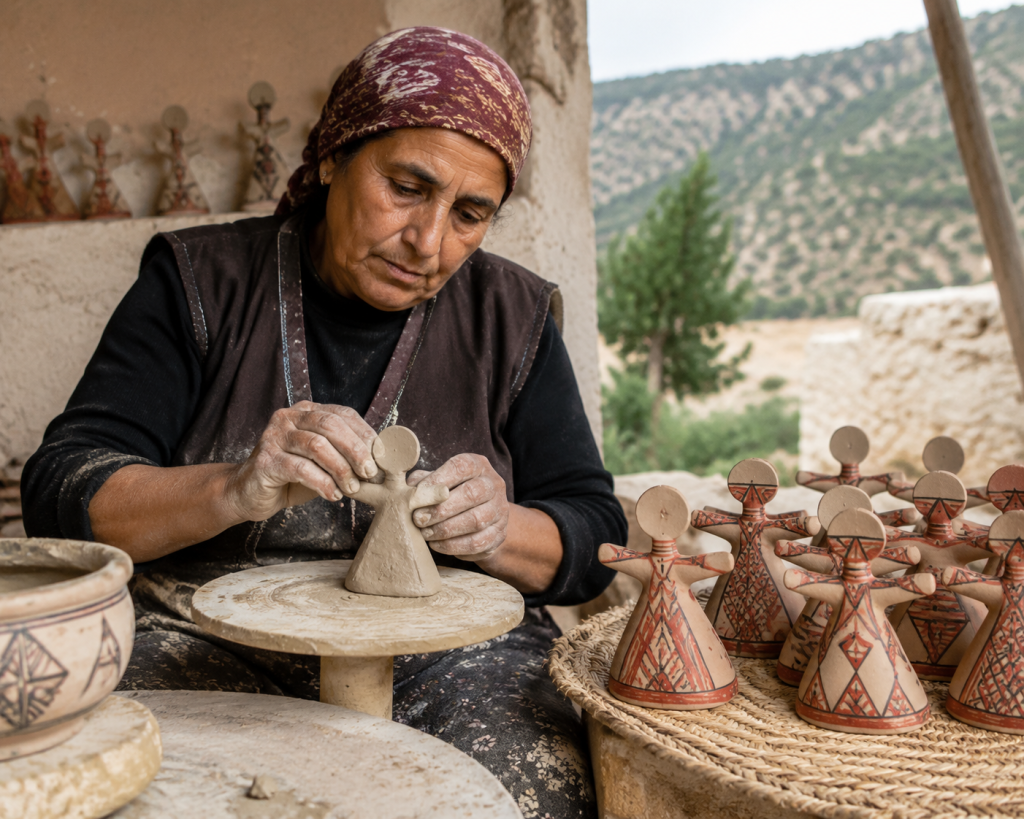
Two crafts carry Tanit forward more literally than any ritual — one thriving, one dying.
The thriving one is in the Mogod hills of the northwest, where the women potters of Sejnane still pinch and shape small clay figurines by techniques passed from mother to daughter for longer than anyone can count. Look at the figures: a disc head, a triangular body, arms outstretched. It is the sign of Tanit, reproduced with the fidelity of muscle memory, by women who call the figures simply dolls. When UNESCO inscribed the Sejnane pottery tradition on its intangible heritage list in 2018, it was listing — in part, and without quite saying so — a goddess who has been in continuous production for well over two thousand years. Our profile of Tanit tells her fuller story.
The dying craft is the tattoo. Within living memory, Amazigh women across rural Tunisia wore facial and hand tattoos — the ticṛaḍ — applied at the great thresholds of a woman’s life. The most telling of them is the siyala, the vertical line on the chin given to a girl at her first menstruation: a mark of Tanit, the fertility goddess, drawn on the body at the exact moment the body became capable of what the goddess governed. Around it ran the rest of the old lexicon — the fish for abundance, the diamond and the eye against envy — the same repertoire that fills the kilims of Kairouan and the pottery of the south. The tradition stopped being transmitted within a single generation, judged un-Islamic by the same centuries that had somehow never minded it before; today only the oldest women in the villages still carry the marks, and some have had them removed. When they are gone, the last skin that Tanit was written on goes with them — which is precisely why young Tunisian artists have begun tattooing her sign again, this time by choice.
Tabouna: Bread From a Carthaginian Oven
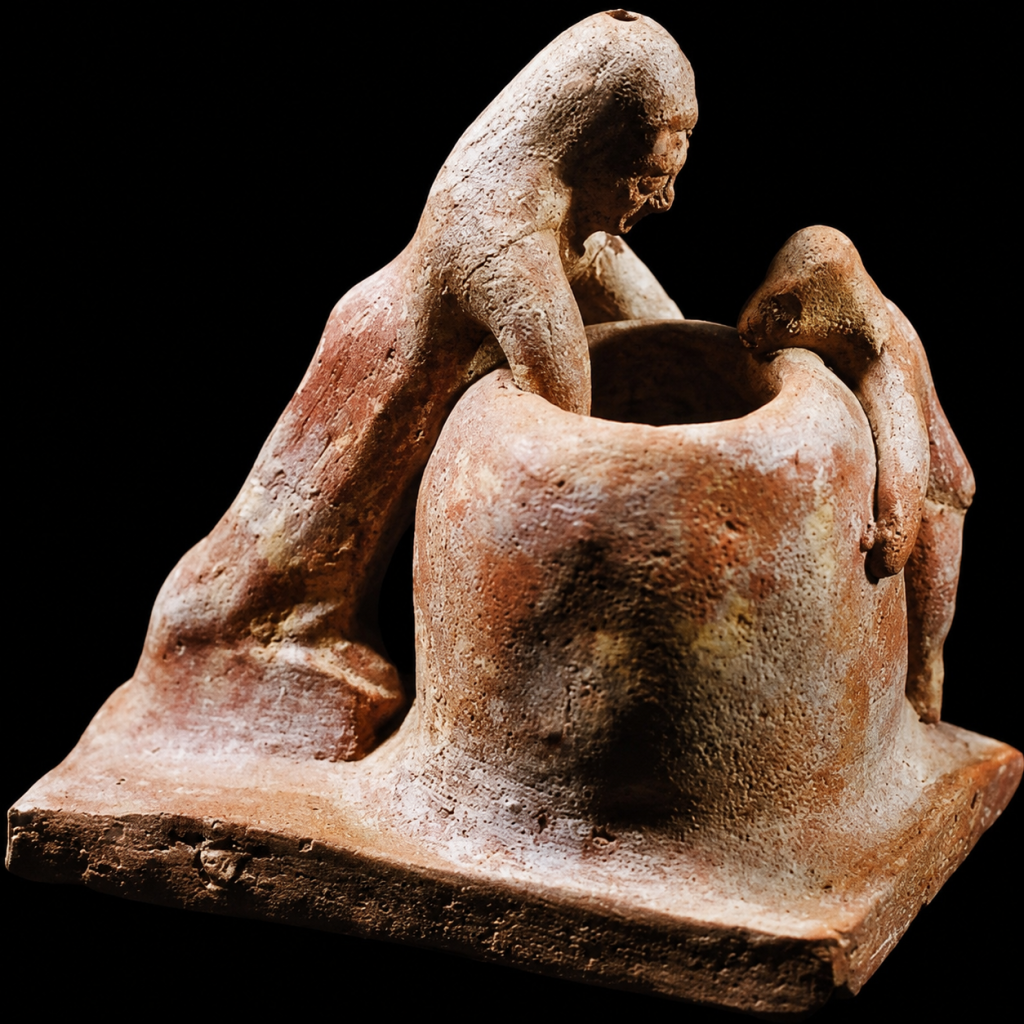
The tabouna — the waist-high domed clay oven, heated with olive-wood and dried pulp from the oil presses, the flattened dough slapped by hand onto its scorching inner wall — is still how bread is made in courtyards and villages across Tunisia, and the round loaf it produces carries the oven’s name. The technique is ancient beyond argument. Domestic ovens turn up in the excavated Punic houses of Kerkouane on Cap Bon, and the word itself shares a Semitic root with the tabun ovens of the Levant — the Phoenician homeland — where the same bread is baked the same way to this day.
Whether the oven sailed west with the settlers of Carthage or was already here with the Amazigh and merely took a Semitic name, the honest conclusion is the same: a woman bending over a tabouna at dusk is doing something older than Rome, in a country whose staples — the olive oil, the preserved fish, the cumin-caraway-coriander spice triad — carry Punic fingerprints of their own. Even the pomegranate splitting open in the autumn markets was the sacred fruit of Baal — the Romans, tasting it here during the Punic Wars, simply called it the malum punicum: the apple of Carthage.
Dar Arbi: The Floor Plan That Refused to Die
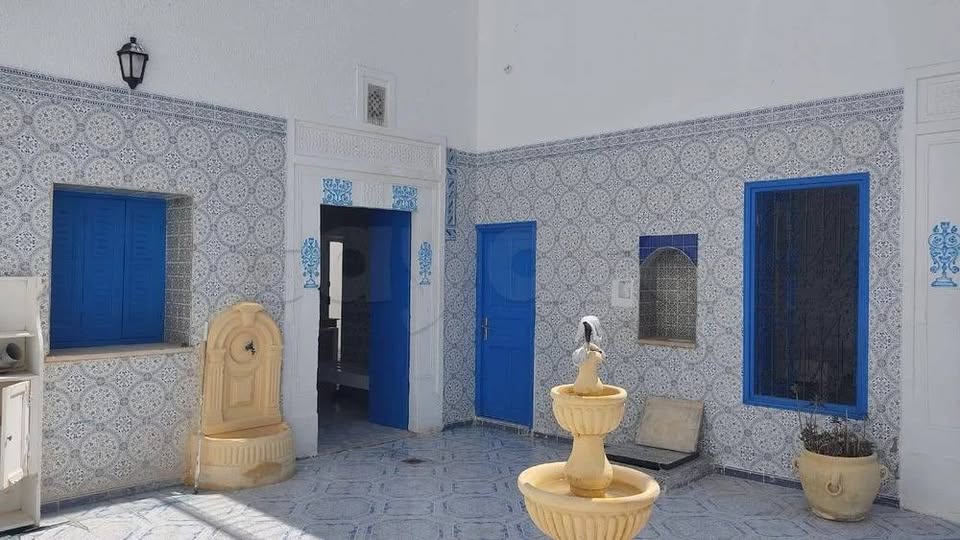
Walk into a traditional dar arbi in the medina of Tunis — blank wall to the street, a bent entrance passage (the skifa) that blocks the view inside, and then the sudden bright square of the wast ed-dar, the open courtyard with the rooms of the household arranged around it. Now walk the streets of Kerkouane, the small Punic town on Cap Bon that was abandoned in the third century BCE and never rebuilt — the “Punic Pompeii,” UNESCO-listed since 1985. The houses there follow the same grammar: blind facades, angled entrance corridors guarding the family’s privacy, rooms opening onto a central court, even en-suite bathrooms finished in waterproof pink plaster.
The dar arbi is not a copy of a Punic house; it is the same Mediterranean-North African idea of a house, transmitted through Roman atria and Arab-Islamic courtyards without ever breaking the chain — one strand in the longer braid of Tunisian architecture. Twenty-three centuries separate the two floor plans. A visitor can walk both in the same afternoon and struggle to say what fundamentally changed.
Awessou: The Month the Sea God Walks the Beach
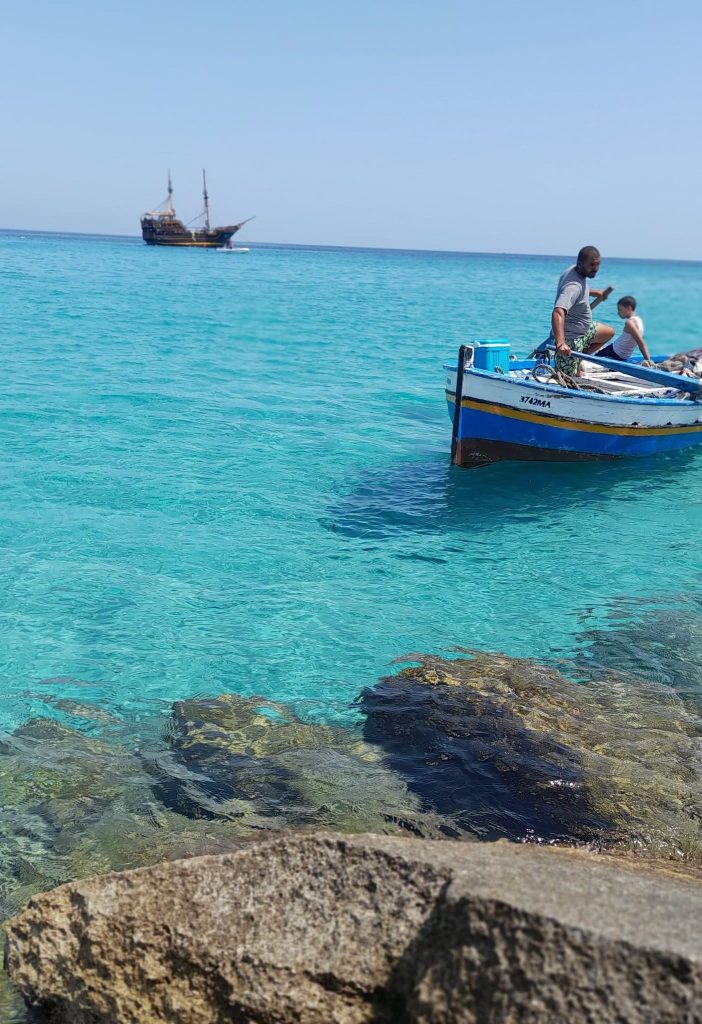
One more survival deserves its place here, with an honest asterisk: it is Roman-era pagan rather than provably Punic — though on this coast the two are hard to pry apart. In the old Berber calendar still used by Tunisian farmers, Awessou names the furnace weeks from late July to mid-August, and along the Sahel it names something more: the season when, in the folk telling, the god of the sea leaves the water to walk among the bathers, guarding and blessing them.
For generations, coastal families have taken ritual dawn baths in these weeks — the sea of Awessou is held to heal the skin and the joints — a custom folklorists trace to the Neptunalia, the Roman midsummer feast of the sea god, celebrated in this very province, and possibly further back still; one etymology derives Awessou itself from Oceanus. The modern Carnival of Awussu in Sousse, with its chariot-borne sea god parading past Boujaafar beach every 24th of July, is a twentieth-century creation dressed in that older memory — invented tradition wrapped around a genuine one. The parade is new. The belief that this sea, in this month, blesses the people who enter it — that is the old religion of the coast, still taken one dawn swim at a time.
The Survivals Hiding in Plain Sight
Once you start looking, Carthage is everywhere. The name of the country itself may be a survival — some scholars connect Tunis to Tanit, patron goddesses being a common source of ancient city names, though the etymology is contested. The sign of Tanit — triangle, bar, disc — is stencilled on café walls and jewellery across the country, and the grand prize of the Carthage Film Festival is a Tanit d’or cast in her shape. Tunisian parents have begun naming daughters Tanit and Elyssa outright, part of the quiet Carthaginian revival running through Tunisian names. And looming over the Gulf of Tunis stands Jebel Boukornine, the twin-horned mountain sacred to Baal Hammon, where Tunisians still climb and picnic on the heights their ancestors reserved for the king of the gods.
None of this is nostalgia. It is continuity — the thing Tunisia does better than almost anywhere, absorbing every conqueror and quietly keeping what worked, a layering we’ve traced in the story of the Punic civilization and in the country’s long habit of holding many faiths at once. Rome salted the earth of Carthage, or so the legend says. It should have salted the weddings, the rain songs, the dialect, the ovens, the pottery, and the floor plans. Those, it turns out, were the empire that could not be destroyed — and to stand where they began, you only need an afternoon among the ruins of Carthage, with this list in your pocket and your eyes newly opened.
From the Carthage Magazine Bookshelf
If the oldest layer of Tunisia is the one that hooked you, these three go deeper — into the country, the dialect that still carries Baal’s name, and the food with Punic fingerprints.
- All About Tunisia — the definitive English-language traveler’s guide. 572 pages, 27 chapters, all nine regions, every UNESCO inscription, five thematic trails — and the practical answers (visa, currency, transport, etiquette) most travelers wish they’d had on the plane. $24.99 · PDF & EPUB.
- Speak Like a Local — 200+ Tunisian Arabic phrases with native audio recorded in Tunis. The phrases for the taxi, the souk, the café, and the dinner table. $14.99 · PDF, EPUB, MP3.
- The Authentic Tunisian Cookbook — sixty traditional recipes from the heart of North Africa. For when you get home and find yourself missing the food. $9.99 · PDF & EPUB.
All three available as a bundle for $39.99 — guide, language, and food, delivered together.
