
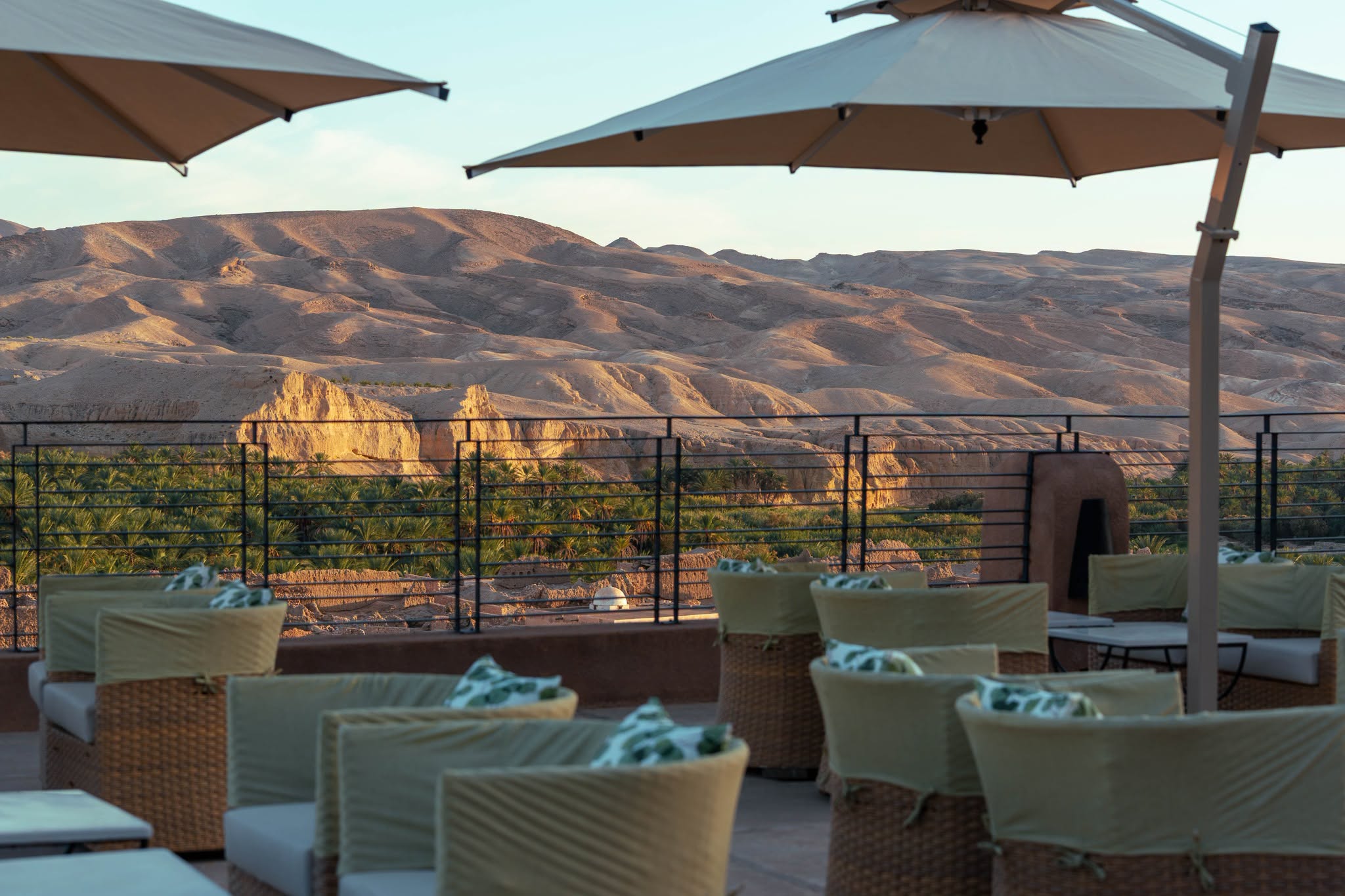
The road into Tozeur announces itself the way few roads anywhere do. For an hour there has been nothing but stone-coloured emptiness — the flat, glaring plain of the Jerid, the white shimmer of salt on the horizon — and then, all at once, a wall of green: hundreds of thousands of date palms standing shoulder to shoulder, fed by springs that have been running since before anyone thought to write the fact down. This is the palmeraie of Tozeur, one of the great oases of the Sahara’s northern edge, and the town that grew beside it has been trading on that miracle for well over two thousand years — first as Thusuros, a stop on the Roman caravan route, then as the medieval capital of the date trade, and now as the base camp for almost everything worth doing in Tunisia’s cinematic southwest.
Most visitors treat Tozeur as a launchpad — for the mountain oases, the salt lake, the Star Wars sets slowly drowning in the dunes, and the longer desert routes mapped in our Tunisian Sahara field guide. They are not wrong to. But the town itself rewards the traveller who gives it a full day rather than a rushed evening, and this guide covers both: the Tozeur under the palms, and the day trips that radiate out of it.
Quick Answer: Tozeur is the capital of the Jerid, Tunisia’s oasis region, about 430 kilometres southwest of Tunis at the edge of the Chott el Jerid salt lake. Getting there: a one-hour flight from Tunis with Tunisair Express, a five-to-six-hour drive, or the Tozeur–Tunis train, which resumed service in 2025 after an eight-year gap. Give it two or three nights: one day for the palmeraie and the brick medina, one for the mountain oases of Chebika, Tamerza, and Mides, and one for the desert — Ong Jmal, the Mos Espa set, and the crossing of the great salt lake. Visit between October and April; summer here is genuinely punishing.
The Palmeraie: A Forest Where No Forest Should Be
Start where Tozeur starts — with the water. The palmeraie covers more than a thousand hectares and holds hundreds of thousands of palms, layered in the classic three-storey architecture of the Saharan oasis: date palms above, fruit trees — pomegranate, fig, banana, apricot — in their shade, and vegetables in the shade of those. The whole system runs on a network of channels whose water-sharing rules were codified in the thirteenth century by Ibn Chabbat, a Tozeur-born mathematician whose scheme divided the springs’ flow among the growers with such fairness and precision that versions of it governed the oasis for seven hundred years.
Walk or cycle the lanes through the groves in the early morning, when the light comes through the fronds in blades and the only sounds are birdsong and running water; the horse-drawn calèches that wait near the Belvedere offer the lazier classic version. Either way, the palmeraie is the point of Tozeur — everything else in town exists because of it.
Ouled el-Hadef: The Brick Medina
Tozeur’s old quarter, Ouled el-Hadef, is unlike any other medina in Tunisia. Built in the fourteenth century by the town’s date-wealthy merchant families, its walls are made of small, pale yellow bricks fired from local clay and laid in raised geometric patterns — diamonds, zigzags, protruding relief motifs that echo the designs of Berber carpets and throw crisp shadows in the low desert light. The effect is of a town knitted rather than built.
The quarter is small, residential, and lived-in; give it an unhurried hour, getting mildly lost on purpose. Nearby, the Dar Cherait museum recreates the interiors of a wealthy Jerid household, and the Eden Palm estate on the edge of the palmeraie tells the story of the region’s real currency: the date.
Deglet Nour: The Finger of Light
Tozeur and the Jerid produce Tunisia’s most celebrated export after olive oil — Deglet Nour dates, the translucent, honey-coloured variety whose name means “finger of light,” because a ripe one held up to the sun glows from within. The harvest runs from late October into December, when the groves fill with climbers and the market in town overflows with dates still on the branch.
If you are here in season, buy them that way — a regime of Deglet Nour on the stem is the single best souvenir the south sells, and it costs a fraction of what the same box commands in a Paris épicerie. Out of season, the covered market still sells last harvest’s crop, along with date syrup, date paste, and the local pastry logic that follows from having the world’s best dates on your doorstep.
The Mountain Oases: Chebika, Tamerza, and Mides
The classic Tozeur day trip runs northwest toward the Algerian border, where the last folds of the Atlas Mountains meet the desert and spring water has carved three improbable oases into the rock. Chebika, the first, is a palm-filled gorge with a waterfall at its head and the ruins of the old village — abandoned after catastrophic floods in 1969 — on the slope above; the short hike up the canyon is the best forty-five minutes of walking in the region.
Tamerza, the largest, has its own cascades and a dramatic abandoned old town strung along a ridge. Mides, the furthest, guards the most spectacular sight of the three: a serpentine canyon, sheer-walled and deep, that curls around the village like a moat — film buffs will recognise it from The English Patient. The three are strung along one road and done together in a half or full day by hired 4×4 or driver; every guesthouse in Tozeur arranges the trip. Go early, both for the light and to walk Chebika before the tour groups arrive.
The Desert: Ong Jmal, Mos Espa, and the Salt Lake
The other great day out points west and south, into the dune country that convinced George Lucas he had found his alien planet. Ong Jmal — “the camel’s neck,” a wind-carved rock formation above the Chott el Gharsa — and the nearby Mos Espa film set are usually combined in a single 4×4 run from town, often timed to end with sunset over the dunes; our field guide to Star Wars in Tunisia covers every site in detail, including the honest news that the desert is slowly reclaiming the set.
South of town stretches Chott el Jerid, the largest salt lake in the Sahara — a blinding white plain, veined with rose and green mineral pools, that the causeway road crosses on the way to Douz. Driving it feels like traversing the surface of another planet, which is of course exactly how the movies used it. Travellers with more time and deeper desert ambitions — dune camps, camel caravans, nights under the full Saharan sky — should read our guides to the Tunisian Sahara and camel trekking and desert tours, for which Tozeur and Douz are the twin gateways.
Nefta: The Basket of Springs
Twenty-five kilometres west, on the road to the Algerian frontier, sits Nefta — Tozeur’s smaller, holier sibling. Its centrepiece is the Corbeille, a natural amphitheatre of a hollow filled with palms and once fed by more than a hundred and fifty springs, ringed by the domed shrines that made Nefta one of the great centres of Sufism in North Africa.
The springs have weakened in recent decades and the Corbeille is greener in memory than in fact, but the view from its rim at golden hour, with the domes and minarets against the palms, remains one of the Jerid’s defining images. It pairs naturally with the Ong Jmal desert run.
Making It Work
Getting there: Tunisair Express flies Tunis–Tozeur in about an hour; the drive takes five to six via Gafsa; and the overnight train from Tunis, back in service since 2025, restores the slow, romantic option. Louages connect Tozeur with Gafsa, Douz, and Kebili for onward travel. When to go: October through April, full stop — summer temperatures routinely pass 45°C, and the best time to visit Tunisia guide has the month-by-month detail.
November is the sweet spot: harvest in the palmeraie, the Oasis Festival in town, and the Sahara Festival at Douz following close behind in December. Where to stay: the character choices are the dars — restored brick houses in and around the old quarter — while the hotel zone along the palmeraie’s edge handles the resort end. How long: two nights minimum, three if you want the desert and the mountain oases without rushing either. And where next: east to Matmata’s underground houses and the ksour of Tataouine, completing the great southern loop.
Tozeur is the rare place that is both a destination and a doorway. Stay long enough to see the light come through the palms in the morning and the brickwork catch fire in the evening, and you’ll understand why the caravans stopped here for two thousand years — and why, once you’ve crossed half a country of desert to reach the green, you won’t be in a hurry to leave it either.
From the Carthage Magazine Bookshelf
If the oasis road is calling — Tozeur, the Jerid, and the desert beyond — these three ebooks were built for the journey:
- All About Tunisia — the definitive English-language traveler’s guide. 572 pages, 27 chapters, all nine regions, every UNESCO inscription, five thematic trails — and the practical answers (visa, currency, transport, etiquette) most travelers wish they’d had on the plane. $24.99 · PDF & EPUB
- Speak Like a Local — 200+ Tunisian Arabic phrases with native audio recorded in Tunis. The phrases for the taxi, the souk, the café, and the dinner table. $14.99 · PDF, EPUB, MP3
- The Authentic Tunisian Cookbook — sixty traditional recipes from the heart of North Africa. For when you get home and find yourself missing the food. $9.99 · PDF & EPUB
All three available as a bundle for $39.99 — guide, language, and food, delivered together.
